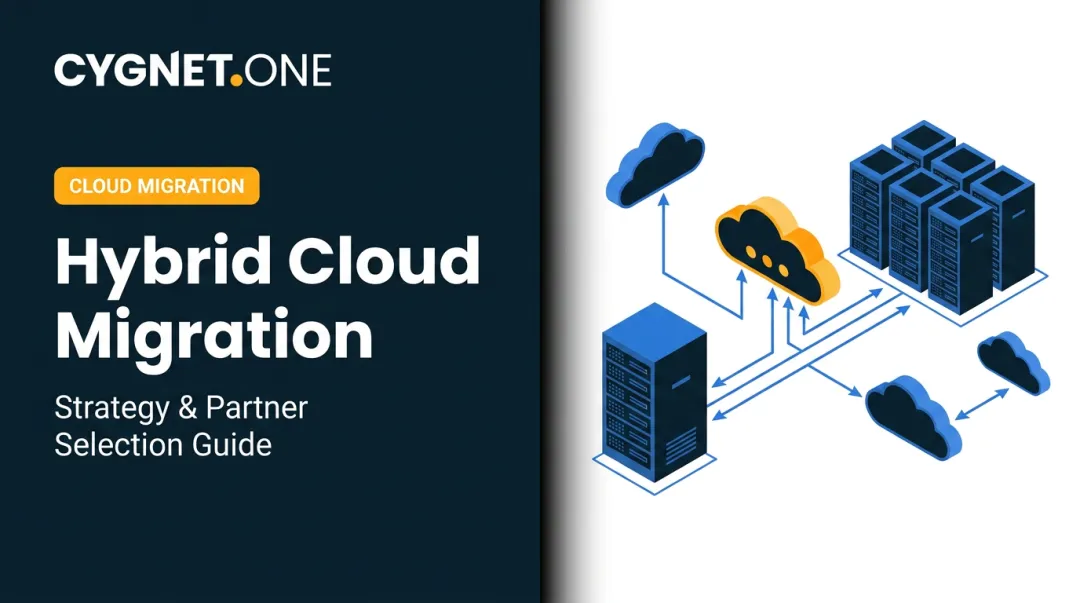
AWS hybrid cloud is an operating model that connects on-premises or colocation infrastructure with AWS, so workloads, data, and applications sit wherever they best meet business, technical, security, and regulatory needs. It's not a stopgap before "real" cloud adoption. It's a deliberate architecture choice.
This article focuses on practical use cases, the AWS services behind them, and the governance decisions that make hybrid deployments work. Hybrid cloud is broader than a VMware migration, and we'll treat it that way.
Key Takeaways
- Hybrid cloud lets enterprises combine existing infrastructure with AWS services without a disruptive big-bang move
- Disaster recovery, phased modernisation, analytics, seasonal bursting, and regulated workloads are the strongest entry points
- Secure connectivity and consistent identity controls determine whether hybrid architectures stay manageable
- HDFC Bank's cloud modernisation with Cygnet.One cut recovery time by 75% and long-term storage costs by 50%
- Governance gaps, not technology gaps, cause most hybrid cloud failures
What Does AWS Hybrid Cloud Mean, and When Should You Use It?
Hybrid cloud, multicloud, and traditional on-premises infrastructure get used interchangeably far too often, and that causes confusion at the planning stage.
- On-premises infrastructure means everything runs in owned or leased data centres, with no cloud integration at all
- Multicloud means running workloads across two or more public cloud providers, often without deep integration between them
- Hybrid cloud means on-premises systems and AWS are connected with real data flow, identity integration, and shared operational processes
- Full public cloud means workloads run entirely on AWS, with no on-premises dependency
Owning both an on-premises data centre and an AWS account doesn't make you hybrid. Integration is what qualifies it.
Deciding What Stays, What Moves, What Splits
The decision usually comes down to a handful of factors:
- Data sensitivity: regulatory records that must stay in India under sector rules
- Latency: applications needing sub-millisecond response at a plant or branch
- Application dependencies: tightly coupled ERP modules that resist being split apart
- Scalability and resilience: workloads with unpredictable spikes or strict uptime targets
- Licensing: existing enterprise agreements tied to specific hardware or hypervisors
- Modernisation effort and total cost of ownership: whether refactoring is worth the engineering hours
Common patterns include on-premises applications calling AWS databases or analytics services, AWS-hosted front ends connected back to local systems of record, and on-premises production supported by AWS-based backup or disaster recovery.

Shared Responsibility Doesn't Disappear in Hybrid Setups
Moving part of a workload to AWS doesn't transfer away your responsibility for identity, configuration, data protection, or compliance. AWS secures the underlying infrastructure; your team still owns data classification, IAM configuration, and application-level security, whether a system sits on AWS or in your own data centre.
Quick checklist: is hybrid cloud the right fit?
- Do you have at least one workload that cannot move to AWS immediately, for regulatory or technical reasons?
- Do you need AWS-native services (analytics, AI, elastic compute) alongside that workload?
- Can you commit to dedicated connectivity and consistent identity management across environments?
If you answered yes to all three, hybrid is probably the right architecture, not just a transitional phase.
AWS Hybrid Cloud Use Cases for Indian Enterprises
Cloud-Based Disaster Recovery and Business Continuity
Hybrid DR keeps production on-premises while AWS holds a replicated recovery environment, ready to fail over. AWS Elastic Disaster Recovery replicates source-server data continuously into a staging subnet, and recovery instances can launch within minutes of a declared disaster, without the cost of running duplicate infrastructure full-time.
Getting this right requires more than replication:
- Define recovery time and recovery point objectives per application, not just at the organisation level
- Map application dependencies, since databases, authentication, and middleware all need to recover together
- Test failover regularly, not just during audits
- Confirm DNS and traffic redirection actually work under failure conditions
- Validate that connectivity and identity services themselves are recoverable, not single points of failure
Cygnet.One's banking clients have seen this pay off directly. HDFC Bank's AWS-based cloud modernisation cut recovery time by 75% and reduced long-term storage costs by 50%, while giving IT teams centralised visibility across cloud workloads instead of fragmented, site-by-site monitoring.
Gradual Migration and Application Modernisation
Few enterprises move everything at once, and few should. AWS's current migration framework recognises seven strategies: rehost, replatform, refactor, repurchase, retain, retire, and relocate, each suited to different application profiles.

A typical phased path looks like this:
- Start with backup or secondary environments on AWS, limiting risk while teams build familiarity
- Rehost suitable servers using AWS Transform MGN (previously AWS Application Migration Service), which continuously replicates source servers for cutover
- Replatform databases, such as moving SQL Server workloads to Amazon Aurora or PostgreSQL, without rewriting application code
- Refactor selected components once there's a clear case for AWS-native services
Dependency discovery matters enormously here. ERP, banking, and insurance systems are interconnected in ways that aren't obvious until migration waves are planned, which is why Cygnet.One's migration engagements start with structured readiness assessments before touching production systems.
Data Analytics and AI Without Moving Every System of Record
Operational data can stay in the on-premises database while governed copies move to AWS for analytics, machine learning, or generative AI workloads. This pattern avoids the risk and cost of moving entire systems of record.
Key design decisions include:
- Data classification before anything leaves the on-premises environment
- Masking or tokenisation for sensitive fields, since AWS Glue's PII detection can redact or hash identified entities during ETL
- Ingestion frequency: batch analytics tolerates delay; fraud detection or pricing engines don't
- Lineage and access controls so auditors can trace exactly where a dataset travelled
Cygnet.One's analytics work for a consumer goods manufacturer consolidated historical records and real-time feeds into Amazon Redshift, replacing siloed spreadsheets with a single governed source of truth, complete with documented ownership and version control for audit purposes.
Seasonal Demand, Batch Processing, and Capacity Bursting
Baseline workloads can stay on-premises while AWS absorbs predictable spikes: financial close, tax-period demand, exam season, or festival campaigns. Doing so avoids over-provisioning hardware that sits idle eleven months a year.
Before treating bursting as a given, check:
- Workload portability: does the application architecture even support running split across environments?
- Licensing constraints tied to existing on-premises agreements
- Data-transfer costs and network throughput, which can erode the savings if not modelled upfront
- Performance testing under realistic peak conditions, not synthetic load
Research institutions using the AWS Plugin for Slurm have reported jobs launching in cloud resources within two to three minutes of a burst trigger, which illustrates the mechanism, though actual timing depends on your own workload and queue conditions.
Low-Latency, Edge, and Plant-Level Processing
Factories, branches, and retail locations often need local processing for latency or intermittent connectivity reasons, with AWS handling central management and analytics.
| Option | What it does | India availability |
|---|---|---|
| AWS Regions | Full regional AWS infrastructure | Mumbai and Hyderabad |
| AWS Outposts | AWS infrastructure on your premises | Mumbai listed; Hyderabad not currently listed |
| AWS Local Zones | AWS infrastructure closer to end users | Delhi and Kolkata operational |
| AWS Wavelength | Edge zones at carrier locations | No India location currently listed |
These are distinct deployment models, not interchangeable labels. Always verify current service documentation before committing to a specific site, since availability changes faster than most internal planning documents.
Sensitive Financial, Tax, and Compliance Workloads
Hybrid placement lets enterprises separate systems of record carrying sensitive financial or regulatory data from cloud-based integration, reporting, and analytics layers.
Consider a tax or finance transformation platform like Cygnet.One's TaxAssurance, built for enterprise tax governance and compliance automation. In a hybrid architecture, a platform of this kind would typically keep core transactional records within controlled environments while workflow, reconciliation, and reporting components integrate with AWS for scale. Before any such deployment, the controls that need independent validation include:
- Data residency and access-logging requirements specific to the sector
- Encryption key ownership and management across both environments
- Audit trail completeness for regulator review
This is an illustrative workload category, not a claim about a specific AWS deployment; any production design needs its own validation against current requirements.
How to Design and Operate an AWS Hybrid Cloud Environment
A conceptual hybrid architecture typically includes on-premises infrastructure, AWS accounts and VPCs, private subnets, identity integration, data services, monitoring, and clearly approved pathways between environments. This is a starting framework, not a production-ready blueprint. Every enterprise's version looks different once security and compliance requirements are layered in.
Connectivity That Doesn't Become the Bottleneck
Two main options dominate hybrid connectivity:
- Site-to-Site VPN: dual tunnels across different AZs; up to 1.25 Gbps standard, or 5 Gbps with Large Bandwidth Tunnels via Transit Gateway or Cloud WAN
- AWS Direct Connect: dedicated ports from 1 Gbps to 400 Gbps, plus hosted connections at smaller increments when a full port is unnecessary

Resilient designs use separate connections, separate terminating devices, and more than one physical location, so a single fibre cut doesn't take down connectivity entirely. Routing, DNS forwarding, firewall policy, and network segmentation all need to be tested under failure conditions, not just assumed to work.
Data Movement, Identity, and Observability
Data integration between environments relies on APIs, messaging, scheduled file transfer, and database replication tools such as AWS DataSync and AWS Database Migration Service. Each pattern needs clear answers on consistency, conflict handling, encryption, and retention. An unencrypted nightly sync job is a common and avoidable audit finding.
For identity, centralising through AWS IAM Identity Center connected to your existing Active Directory avoids maintaining separate credential sets across environments. Pair this with least-privilege IAM roles, privileged access controls, secrets management, and a consistent joiner-mover-leaver process so offboarded staff don't retain access on one side of the hybrid boundary.
Observability needs to span both environments too:
- Unified logs and metrics, using tools like the CloudWatch agent on on-premises servers
- Configuration records and security findings in one place, not two separate dashboards
- Clear alert ownership so incidents don't get lost between on-premises and cloud teams
A Phased Path, Not a Single Cutover
- Assess workloads and classify data by sensitivity and dependency
- Establish a landing zone using AWS Control Tower for multi-account governance
- Connect environments via VPN or Direct Connect, with redundancy built in from day one
- Run a pilot on a low-risk workload before touching production systems
- Test failure scenarios, including connectivity loss and identity provider outages
- Migrate or integrate in waves, prioritising by dependency complexity
- Continuously optimise cost, performance, and security posture
Industry, Security, and Governance Considerations
Indian regulated sectors carry distinct requirements that directly shape hybrid placement decisions.
- BFSI: The RBI's IT governance directions, effective from April 2024, require commercial banks and specified NBFCs to document cloud policies addressing sovereignty, recoverability, and storage location
- Payment systems: RBI's data localisation directive requires payment data to be stored in India, with foreign processing copies deleted and confirmed within one business day
- Insurance: IRDAI's 2025 regulations require records of Indian policies and claims to sit in data centres located and maintained within India
- Cross-sector: CERT-In directions require covered entities to report specified incidents within six hours and retain ICT logs for a rolling 180 days within Indian jurisdiction
Security controls need to span both environments consistently, not just the AWS side:
- Encryption in transit and at rest, with centralised key management
- Network segmentation and documented vulnerability management
- Backup isolation, so a compromised production environment can't corrupt its own recovery copies
- Endpoint protection and audit logging across every system touching regulated data
Hybrid governance fails in predictable ways: inconsistent policies between environments, untracked data copies, unclear ownership when something breaks, configuration drift, and unexpected data-transfer bills.

A governance framework should explicitly define:
- Workload placement rules and approved services
- Account structures and change management
- Incident response paths
- Evidence collection auditors will ask for
Cygnet.One's governance, risk, and compliance practice works with banking, insurance, and healthcare clients where boards and regulators expect structured accountability over IT controls, not only the technical layer underneath.
AWS Services and Adoption Strategies to Evaluate
Rather than a product list, map services to what you're actually trying to solve:
| Need | Relevant AWS service |
|---|---|
| Server rehosting | AWS Transform MGN (formerly Application Migration Service) |
| Database movement | AWS Database Migration Service |
| File or object transfer | AWS DataSync |
| Hybrid storage access | AWS Storage Gateway |
| Dedicated connectivity | AWS Direct Connect or Site-to-Site VPN |
| Centralised backup | AWS Backup |
Always verify current service capabilities and regional availability before committing. Feature coverage isn't uniform across regions. AWS Backup, for instance, is available in both Mumbai and Hyderabad, but VMware-specific backup gateway features are only confirmed for Mumbai at present.
On adoption strategy, different applications in the same organisation legitimately need different paths:
- Retain systems with no business case for change right now
- Rehost stable applications that just need new infrastructure
- Replatform databases for managed-service benefits without a rewrite
- Refactor components that genuinely benefit from cloud-native architecture
- Repurchase or retire anything a SaaS alternative already does better
Measure outcomes that matter to the business: recovery performance, application latency, migration wave progress, security findings, and total cost, not just "migration complete" as a binary milestone.
For enterprises modernising tax, finance, or e-invoicing processes specifically, the harder challenge is usually integration with existing regulated data flows, not AWS capability itself. Cygnet.One, an AWS Advanced Tier Partner, works across cloud migration, FinOps cost governance, and SAP ERP transformation for exactly this kind of layered engagement, where compliance requirements and infrastructure decisions can't be treated separately.
Frequently Asked Questions
What AWS migration services are available to migrate VMware VMs to AWS?
AWS Transform MGN (formerly Application Migration Service) handles server-level replication and cutover, while AWS Transform for VMware adds discovery, dependency mapping, and migration-wave planning. Verify current service status before planning, since naming and capabilities have changed recently.
Can I run VMware on AWS?
Yes, through options like Amazon EVS, which combines AWS infrastructure with VMware Cloud Foundation, separate from migrating VMware VMs natively to Amazon EC2. The right choice depends on workload compatibility, existing licensing, and how much modernisation you actually want to do.
What are the main benefits of using AWS hybrid cloud?
Hybrid cloud enables phased modernisation, AWS-based disaster recovery, elastic capacity for seasonal demand, and flexible data placement, while giving you access to AWS-native analytics and AI services without forcing every system to move at once.
How do I connect my on-premises environment to AWS?
Most enterprises use Site-to-Site VPN for quicker setup or AWS Direct Connect for dedicated, higher-bandwidth connectivity. Either option needs redundant links, tested routing and DNS, firewall segmentation, and performance testing before production traffic relies on it.
How should organisations decide which data stays on-premises?
Start with data classification against regulatory requirements, then factor in latency needs, application dependencies, and operational resilience. Weigh this against the cost and risk of keeping data synchronised across two environments indefinitely.