Introduction
Customer service teams are caught between two realities. On one side, 82% of service professionals say customer expectations are higher than ever — people want instant, personalized, 24/7 support. On the other, agents spend only 46% of their time actually talking to customers, the rest swallowed by administrative work, system-switching, and manual processes.
The cost of falling short is steep. PwC's 2025 Customer Experience Survey found that 52% of consumers stopped buying from a brand after a single bad experience. At that scale, service quality is directly tied to revenue.
Agentic AI addresses this gap by reasoning through problems, connecting to live systems, and resolving issues end-to-end — without waiting for human direction at each step. That's a meaningful shift from earlier automation approaches.
This guide covers what agentic AI is, how it operates inside a real customer service environment, where it delivers the highest impact, and what enterprises need to plan for before deploying it.
Key Takeaways
- Agentic AI reasons through problems and takes multi-step actions — it operates on a fundamentally different architecture than a standard chatbot
- Core use cases span self-service resolution, intelligent routing, proactive outreach, and live agent assist
- McKinsey data shows gen AI in customer care can deliver productivity value equal to 30–45% of current function costs
- Clean data integration, compliance guardrails, and change management are non-negotiable prerequisites for deployment
- Mature deployments shift AI to handle high-volume queries while humans focus on complex, relationship-driven interactions
What Is Agentic AI for Customer Service?
Agentic AI is a system that can perceive context, reason toward a goal, execute sequential actions using integrated tools, and adapt based on outcomes — all with minimal human intervention. IBM defines an AI agent as a system capable of autonomously performing tasks by designing its own workflow and using available tools.
That puts it in a different category from standard chatbots and narrow AI models — which is worth unpacking directly.
Agentic AI vs. Traditional Chatbots
The distinction is straightforward: chatbots follow rules and handle one specific task, while AI agents can plan and act within guardrails — a framing Salesforce uses to separate the two.
To make this concrete: a customer submits a return request.
- Traditional chatbot: Presents a scripted menu, collects an order number, and asks the customer to call support or wait for an email
- Agentic AI: Looks up the order in the live OMS, checks return eligibility against policy, initiates the return, triggers a shipping label, and sends a confirmation — all in the same conversation
The chatbot responds. The agent resolves.
Agentic AI vs. Generative AI
These two are often conflated. The difference is action vs. creation:
- Generative AI creates content — drafts responses, summarizes tickets, writes FAQs
- Agentic AI takes action — initiates a refund, routes a case, checks live order status
They're complementary. Most agentic systems use a large language model as their reasoning engine, with generative capabilities handling communication while the agent executes the workflow.
Understanding where generative AI ends and agentic AI begins helps clarify how both arrived at their current form — which the timeline below maps out.
The Evolution: From IVR to Agentic AI
| Era | Technology | Capability |
|---|---|---|
| 1990s | IVR / call routing | Press 1 for billing, press 2 for support |
| 2000s | Rule-based chatbots | Scripted FAQ responses |
| 2010s | NLP virtual assistants | Natural language understanding, still reactive |
| 2022–23 | Generative AI chatbots | Conversational, context-aware responses |
| 2024+ | Agentic AI systems | Autonomous reasoning, multi-step action, system integration |

Agentic AI isn't an incremental upgrade to the chatbot. It's a fundamentally different operating model: the AI has a goal (resolve the issue), uses tools (CRM, order management, knowledge base), holds memory across the conversation, and iterates until resolution or escalation. That perceive → reason → act → learn loop is what enables resolution at scale — without a human in the loop for every step.
How Agentic AI Works in a Customer Service Context
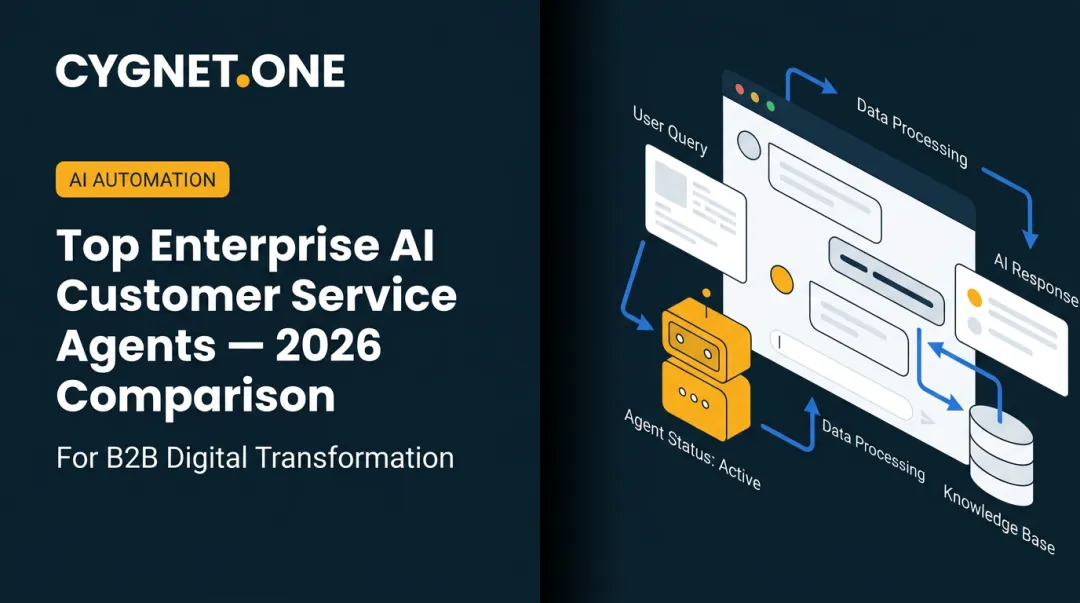
Understanding how agentic AI actually functions helps clarify why it behaves so differently from a standard chatbot. The core stack consists of a large language model as the reasoning engine, connected to tools (APIs linked to CRM, ticketing systems, databases), memory (conversation history and customer profile), and guardrails (compliance rules, escalation triggers). The agent plans its actions step by step rather than responding to a single prompt.
Multi-Agent Orchestration
Most enterprise deployments don't run on one monolithic AI. Salesforce describes a multi-agent architecture where a primary agent acts as the intelligent entry point — analyzing intent and routing work to specialised agents working behind the scenes.
In practice, that might look like:
- Agent 1: Classifies intent and pulls customer profile
- Agent 2: Fetches order data from OMS
- Agent 3: Processes the refund in the billing system
- Agent 4: Sends confirmation and closes the ticket
Each agent handles a discrete task. The customer experiences one unified interaction.
Omnichannel Context Continuity
A persistent frustration in customer service: customers repeat their entire story every time they switch channels. Agentic AI eliminates this by retaining full conversation context across chat, email, phone, and social. If someone starts on live chat and calls in five minutes later, the agent already knows the full history — issue type, prior steps taken, and customer sentiment.
This matters at scale. Salesforce reports that 26% of service reps often lack necessary context about a customer's situation — a gap agentic AI closes through a persistent memory layer that maintains a unified customer profile across every channel and session.
Human-in-the-Loop: When AI Escalates
Agentic AI is built to recognize the boundaries of autonomous resolution. It continuously evaluates escalation signals and routes to a human agent when needed, including:
- High negative sentiment or emotional distress
- Complex issues outside trained resolution paths
- Regulatory or compliance-sensitive situations
- High-value customers requiring relationship-led handling
When it escalates, it doesn't hand off a blank slate — it provides the human agent with a complete context summary, relevant knowledge articles, and recommended next steps.
The Fisher & Paykel deployment with Salesforce Agentforce is one of the clearest documented examples: call handle time fell from 12 minutes to under 6 minutes after implementation, with the AI reasoning across 10,000+ knowledge articles to support both autonomous resolution and human handoffs.
Key Use Cases of Agentic AI in Customer Service
Agentic AI isn't a single-purpose tool. Its applications span self-service, backend automation, and human augmentation across BFSI, FMCG, retail, BPO, and healthcare.
Autonomous Self-Service Resolution
AI agents handle end-to-end self-service by connecting directly to live enterprise systems. Common autonomous tasks include:
- Answering account and balance queries
- Processing returns and order status checks
- Resetting passwords and access credentials
- Scheduling appointments and service calls
Endress+Hauser's Salesforce Agentforce deployment is the clearest published example: the company manages 95,000+ support cases annually, searching across 32,000+ knowledge articles. Agentforce is projected to handle 50% of those cases — roughly 47,500 per year — autonomously, with an expected 30% productivity increase and 212% three-year ROI.

Intelligent Case Routing and Escalation
Standard keyword-based routing sends cases to available agents. Agentic AI routes based on issue type, customer sentiment, urgency, agent skills, and live availability simultaneously.
For BFSI clients handling loan queries, claims, or compliance-sensitive interactions, the difference is measurable. The right case reaching the right agent — with full context already loaded — compresses resolution time and reduces downstream error rates.
Proactive Customer Outreach
Most customer service is reactive: the customer has a problem, contacts support, waits. Agentic AI flips this. It monitors systems in real time and reaches out before the customer needs to.
McKinsey's 2025 contact centre research cites one energy company that cut billing call volume by approximately 20% and reduced customer authentication time by up to 60 seconds using an AI voice assistant for proactive outreach. A bank can flag a suspicious transaction and guide a customer through resolution before they notice the charge.
Agent Assist and Real-Time Co-Pilot
Not every interaction should be autonomous. For complex or high-value conversations, agentic AI works alongside human agents with real-time support:
- Surfaces relevant knowledge articles on demand
- Suggests next-best actions based on conversation context
- Flags compliance risks before they escalate
- Drafts responses for agent review
McKinsey's verified data on gen AI in customer care shows 14% more issues resolved per hour and 9% less time handling individual issues at organizations that deployed AI assistance at scale.
Sentiment Analysis and Personalized Engagement
AI agents analyze tone and sentiment throughout a conversation. When distress signals appear, the system can trigger empathetic response templates, alert supervisors, or initiate retention offers before the customer considers leaving.
Combined with personalization — customer history, preferences, and behavioral patterns — every interaction becomes more relevant. This is where agentic AI starts contributing to revenue, not just cost reduction.
Business Benefits of Agentic AI for Customer Service Teams
The numbers from verified enterprise deployments are consistent:
| Metric | Finding | Source |
|---|---|---|
| Service cost & resolution time | Average 20% reduction expected | Salesforce |
| AI case resolution | 30% of cases resolved by AI in 2025; projected 50% by 2027 | Salesforce |
| Productivity value | 30–45% of current customer-care function costs | McKinsey, 2023 |
| Cost per call | 50% reduction driven by AI agents | McKinsey, 2025 |
| Workforce efficiency | 30% efficiency gains over 2–3 years; 40–50% fewer agents handling 20–30% more volume | McKinsey, 2025 |
| Agent satisfaction proxy | Attrition and manager-escalation requests fell 25% | McKinsey, 2023 |

The data reflects two structural shifts that go beyond cost savings:
- Workforce reallocation: Routing repetitive queries to AI frees human agents for complex problem-solving and high-empathy conversations — roles that reduce burnout and build more sustainable teams.
- Elastic scalability: Traditional models require headcount to absorb demand spikes. Agentic AI handles surges without adding staff, operating multilingual and around the clock without queue degradation.
Implementation Challenges and How to Address Them
Data and Systems Integration
Customer service environments are fragmented. Contact centre agents switch between an average of nine applications per interaction (CX Foundation), and Salesforce's own data shows 26% of reps regularly lack full customer context.
Agentic AI is only as effective as the data it can access. Before deploying agents at scale:
- Audit data quality across all source systems
- Unify fragmented CRM, ERP, ticketing, and order management data
- Prioritise clean, well-documented API integrations
- Map which systems the AI needs to both read and write to
Compliance, Security, and Governance
In regulated industries — BFSI, insurance, healthcare — autonomous AI must operate within clearly defined guardrails. The NIST AI Risk Management Framework offers a practical starting structure: govern, map, measure, manage.
Regional compliance adds another layer. Organizations in India must account for the Digital Personal Data Protection Act, 2023 (DPDP). UAE deployments fall under Federal Decree-Law No. 45 of 2021, and Saudi operations must align with SAMA's data protection requirements.
Key governance requirements for agentic customer service deployments:
- Define which actions AI can take autonomously vs. which require human approval
- Log all agent decisions for audit and regulatory review
- Build escalation triggers for regulated interactions
- Implement real-time monitoring of agent outputs
Change Management and Workforce Transition
A significant portion of contact centre knowledge lives in informal channels — passed on through peer coaching, manager guidance, and institutional habit. Capturing this before AI deployment is essential.
Practical steps:
- Transcribe and structure existing call and chat data to surface undocumented resolution patterns
- Define new roles — AI supervisor, quality reviewer, complex-issue specialist — before deployment, not after
- Upskill agents to work alongside AI, focusing on judgment-heavy tasks where human context matters most
- Build feedback loops so agents can flag AI errors and improve model performance over time
For regulated industries, implementation partners with deep enterprise integration experience make a measurable difference. Cygnet.One's Agent as a Service deploys AI agents that connect with SAP, Salesforce, and Oracle environments — with policy-based constraints, human handoff triggers, and full activity logging built in from the start.
Frequently Asked Questions
What is an agentic AI tool for customer service?
An agentic AI tool is a system that autonomously understands customer intent, reasons through multi-step solutions, and takes action (such as processing a refund or routing a query) across integrated enterprise systems. Unlike basic chatbots, it operates without constant human direction and improves its approach based on each resolved interaction.
Can you use AI for customer service?
Yes. AI is widely deployed in customer service, from basic chatbots to advanced agentic systems. Modern agentic AI goes well beyond answering FAQs: it autonomously resolves complex, multi-step requests across channels while connecting to live CRM, ticketing, and order management systems in real time.
How is agentic AI different from a traditional chatbot?
Chatbots follow scripted decision trees and are limited to pre-set responses. Agentic AI reasons dynamically, accesses live systems, and completes multi-step tasks within a single interaction, without human intervention: checking order status, initiating a return, and sending a confirmation all in one pass.
What industries benefit most from agentic AI in customer service?
BFSI, retail, healthcare, telecommunications, and BPO see the highest impact. For financial services specifically, agentic AI handles loan status queries, fraud alerts, claims processing, and compliance-sensitive escalations at scale — all with full audit trails for regulatory review.
What are the key challenges of implementing agentic AI in customer service?
Three implementation challenges stand out:
- Data fragmentation: Poor data quality and disconnected platforms limit the AI's ability to act across systems
- Compliance governance: Regulated sectors require security controls, audit trails, and policy guardrails
- Change management: Human agents need retraining and repositioning into higher-value, AI-augmented roles
How does agentic AI handle escalation to human agents?
Agentic AI monitors sentiment, issue complexity, and regulatory flags in real time and transfers the interaction to the most appropriate human agent when needed — along with a full context summary and recommended next steps, enabling faster resolution without the customer repeating their issue.