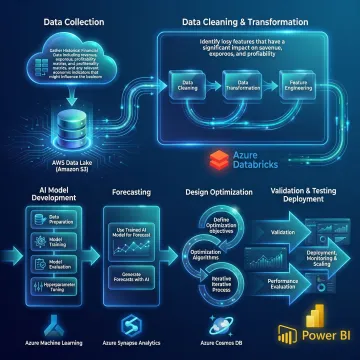
What is a modern data warehouse architecture for enterprise?
A modern enterprise data warehouse architecture is a cloud-native, scalable system designed to centralize data from multiple sources — ERP, CRM, operational databases — into a unified, governed repository. Unlike legacy on-premise warehouses, modern architectures support real-time ingestion, lakehouse patterns, AI/ML integration, and elastic scaling, enabling enterprises to derive faster, more reliable business intelligence across all functions.
How does Cygnet.One approach data warehouse migration from legacy systems?
We follow a structured migration methodology that begins with a full assessment of your existing data landscape — schemas, query patterns, data quality, and compliance requirements. We then design the target architecture, engineer migration pipelines, validate data integrity at each stage, and execute cutover with minimal business disruption. Migrations typically include transitions from on-premise SQL to cloud databases like Aurora or PostgreSQL, or from traditional warehouses to lakehouse platforms.
What cloud platforms does Cygnet.One support for enterprise data warehouse deployments?
Cygnet.One is an AWS Advanced Tier Partner and primarily delivers data warehouse solutions on AWS using services like Amazon Redshift, Aurora, S3-based lakehouse architectures, and SageMaker for ML integration. We also support multi-cloud and hybrid environments depending on the enterprise's existing investments and compliance requirements across regions including India, UAE, UK, and Europe.
How long does it take to build or migrate an enterprise data warehouse?
Timelines vary depending on data volume, source system complexity, and target architecture. A focused migration from a single legacy warehouse to a cloud-native platform typically takes 8–16 weeks. Larger programs involving multiple source systems, complex transformation logic, and AI layer integration may run 4–9 months. We provide detailed project plans with milestones after completing the initial discovery and architecture design phase.
How does Cygnet.One ensure data governance and compliance in warehouse architecture?
Data governance is built into every layer of our architecture design — from access controls and role-based permissions to data lineage tracking, audit logging, and retention policies. As a SOC 2 Type II compliant organization, we apply rigorous controls aligned with standards like ISO 27001. For regulated industries such as BFSI and healthcare, we incorporate sector-specific compliance requirements directly into the warehouse design and operational monitoring framework.
Can AI and machine learning models be integrated directly into the data warehouse?
Yes. Cygnet.One integrates predictive ML models and AI analytics layers directly within the warehouse environment using platforms like Amazon SageMaker and Bedrock. This allows enterprises to operationalize AI — running credit scoring, demand forecasting, or patient risk models — directly on live warehouse data rather than exporting to separate environments, reducing latency and maintaining a single source of truth.
What industries does Cygnet.One serve for enterprise data warehouse projects?
Cygnet.One serves enterprises across BFSI (banking, NBFCs, insurance), manufacturing, retail and FMCG, healthcare, IT services, education, and government sectors. Our data warehouse work spans use cases from financial risk analytics and invoice processing intelligence to supply chain optimization and operational efficiency dashboards — with clients across India, UAE, UK, Saudi Arabia, Malaysia, Belgium, and Europe.
What measurable outcomes can we expect from a modern data warehouse implementation?
Cygnet.One's enterprise data implementations have delivered over 95% reduction in report processing time, 90% faster operational process cycles, and significantly improved data reliability for downstream analytics and AI workloads. Enterprises typically see improvements in dashboard responsiveness, reduction in manual data reconciliation effort, and faster time-to-insight for business decision-makers — with results measurable within the first post-launch quarter.