Introduction
Enterprise system integration projects rank among the most complex and high-stakes IT decisions organizations face today. A wrong partner choice can trigger costly delays, create persistent data silos, or expose your organization to serious compliance failures. With large IT projects running 45% over budget on average and delivering 56% less value than predicted, the financial and operational consequences of a poor choice are real and lasting.
The challenge intensifies when dozens of vendors claim expertise across every platform and industry. Enterprises need a structured evaluation framework that rigorously assesses technical depth, compliance credentials, and long-term support capabilities — not just polished sales presentations.
The right partner handles sensitive financial, transactional, and customer data across your entire technology ecosystem. They become a core part of how your business runs, which makes the selection decision far more consequential than a typical vendor contract.
Key Takeaways
- Enterprise system integration connects ERP, CRM, tax platforms, and other business systems to enable seamless data flow and process automation
- Partner selection should prioritize regulatory compliance, proven integration architecture expertise, and robust post-go-live support—not just technical capability
- Evaluate partners on completed integrations, uptime metrics, and verifiable client references—track record outweighs company size
- Security certifications (SOC 1/2, ISO 27001) and regulatory accreditations (PEPPOL, government e-invoicing approvals) are required for regulated, cross-border integrations
- A structured six-factor evaluation framework helps shortlist partners against your operational and compliance requirements
What is Enterprise System Integration?
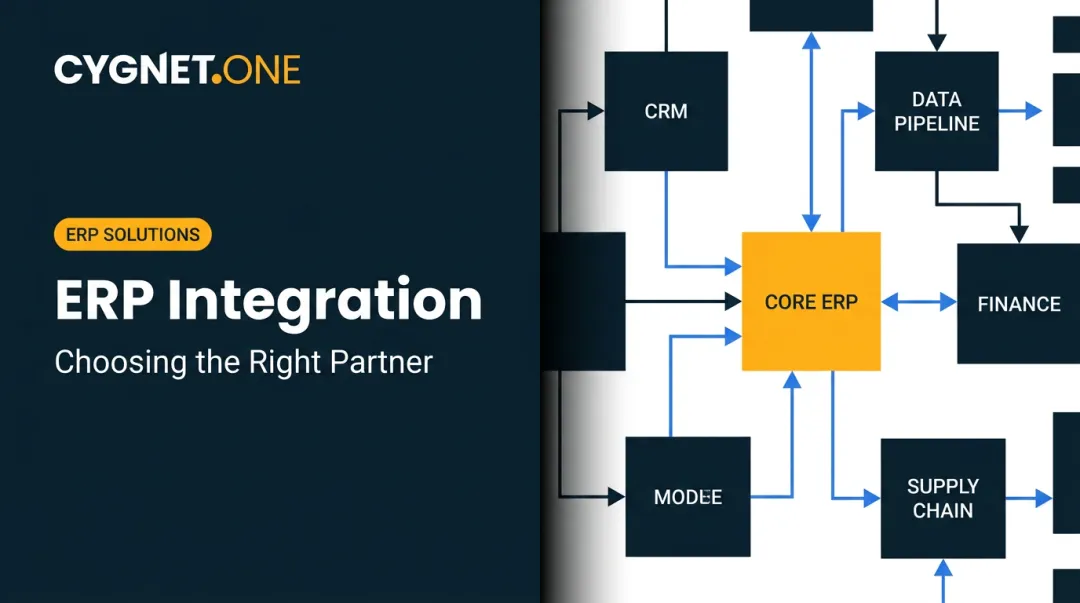
Enterprise system integration connects multiple software applications, platforms, and data sources so they function as a unified, interoperable ecosystem.
Rather than operating as isolated islands, integrated systems enable real-time data exchange, eliminate manual handoffs, and create a single source of truth across your technology stack.
Integration needs vary dramatically based on business size, industry, and geography. A multinational manufacturer's integration requirements differ fundamentally from a regional financial services firm's needs, which is why one-size-fits-all partners rarely deliver optimal results.
Common Integration Approaches
The integration landscape offers several architectural approaches, each with distinct advantages:
- Point-to-point integration creates direct connections between systems, simple to implement initially but brittle and unmanageable as system count grows
- Enterprise Service Bus (ESB) provides centralized middleware that routes messages between systems, offering better control but requiring significant infrastructure investment
- iPaaS (Integration Platform as a Service) delivers cloud-native integration capabilities with pre-built connectors, ideal for organizations embracing cloud transformation
- API-led connectivity treats APIs as reusable products organized into layers, enabling modular reuse and self-service access across business units

A capable integration partner should recommend the right approach for your specific systems and scale, not default to their preferred tool. This matters especially for enterprises with compliance obligations — tax reporting, e-invoicing, financial disclosures — where the integration architecture must also handle regulatory data flows alongside internal system connectivity.
Why Choosing the Right Integration Partner Matters
The operational stakes of integration partner selection are substantial. The average enterprise manages 897 applications, yet only 29% are integrated, creating data silos that cost organizations an average of $12.9 million annually due to poor data quality. A poorly executed integration compounds these costs through data inconsistencies, process breakdowns, and compliance gaps that prove difficult and expensive to remediate after go-live.
Beyond cost, the nature of integration work means your partner becomes embedded in your enterprise's operational backbone. They access sensitive financial, transactional, and customer data flowing across systems. Trust, security posture, and compliance maturity are therefore as critical to the selection decision as technical capability.
A wrong choice carries compounding consequences that outlast the initial project failure:
- Productivity losses as teams work around broken integrations or revert to manual processes
- Regulatory penalties from non-compliant data flows in tax, financial reporting, or data privacy
- Rework costs from re-integrating with a new partner, including system downtime and business disruption
- Delayed digital transformation initiatives stalled by foundational integration failures
Key Factors to Consider When Choosing an Enterprise System Integration Partner
These five factors move evaluation past vendor brochures and into the dimensions that directly determine integration success, operational continuity, and long-term ROI.
Domain Expertise and Industry Alignment
A partner with deep expertise in your specific industry—BFSI, FMCG, manufacturing, healthcare—brings pre-built knowledge of common data models, workflow patterns, and regulatory requirements. This domain context reduces scoping time and integration risk.
Industry-aligned partners understand sector-specific challenges without lengthy explanation. They recognize that a pharmaceutical manufacturer's batch traceability requirements differ from a bank's transaction reconciliation needs. This expertise translates to faster implementations and fewer costly surprises during deployment.
Evaluation approach:
- Request 3-5 client references within your exact industry vertical
- Ask for case studies demonstrating integration types similar to your requirements
- Probe for specific regulatory knowledge relevant to your sector
- Watch for red flags: partners lacking domain context often propose misaligned SLA expectations or demonstrate unfamiliarity with mandatory compliance obligations
Technical Depth and Integration Architecture
A credible integration partner should be an architect, not just a tool implementer. They must demonstrate the ability to design the right integration pattern—ESB, iPaaS, API-led, or hybrid—for your specific landscape, including complex hybrid cloud and on-premises environments.
Technical depth reveals itself through how a partner handles these core challenges: data transformation logic, error handling and recovery, API lifecycle management, versioning strategies, and performance optimization under load.
Critical questions to ask during evaluation:
- What integration patterns do you support, and how do you determine the right approach for each client?
- How do you handle data transformation between systems with different data models?
- What is your error management and recovery strategy when integrations fail?
- How do you approach API versioning and lifecycle management when upstream systems release updates?
- Can you demonstrate your approach to hybrid cloud/on-premises integration architecture?
Partners who provide vague or generic answers to these questions likely lack the technical depth required for enterprise-grade integrations.
Regulatory Compliance and Security Credentials
For enterprises operating across multiple geographies or in regulated industries, compliance credentials are non-negotiable. A partner holding recognized accreditations signals that their processes and infrastructure meet independently verified standards—not just marketing claims.
The regulatory landscape for enterprise data has intensified dramatically. The EU's VAT in the Digital Age (ViDA) mandate requires near-real-time reporting for cross-border trade. Saudi Arabia's ZATCA Phase 2 mandates direct API integration with government platforms. Malaysia's MyInvois programme implements continuous transaction controls. These are legal requirements, and non-compliance carries significant financial penalties.
Essential credentials to verify:
- Security certifications: SOC 2 Type III or SOC 2 Type II reports, ISO 27001 certification
- E-invoicing accreditations: PEPPOL certification for European and international trade
- Government approvals: Recognition from tax authorities in your operating jurisdictions (HMRC in UK, FTA in UAE, ZATCA in Saudi Arabia, MDEC in Malaysia)
- Data privacy compliance: GDPR adherence for European operations, relevant data protection framework compliance

Cygnet.One exemplifies what a compliance-first integration partner's credential profile should look like. The company holds SOC 2 Type II compliance, PEPPOL certification, and recognition from tax authorities in India (IRP/GSP), UK (HMRC), UAE (FTA), Malaysia (MDEC), Belgium (BOSA), and Saudi Arabia (ZATCA)—demonstrating the breadth of accreditation required for enterprises with cross-border data and tax obligations.
Proven Track Record and Integration Scale
Evaluate a partner's track record through concrete delivery metrics, not just client logos on their website. The most reliable indicators of partner capability include:
- Completed integrations in production environments (not just pilots or proofs of concept)
- Uptime guarantees backed by contractual SLA commitments
- Transaction volumes processed monthly, demonstrating platform scalability
- Time-to-go-live benchmarks for integrations similar to yours
Request case studies specific to your integration type—ERP-to-tax-platform, CRM-to-ERP, multi-system data reconciliation—and scrutinize whether the partner has handled integration at comparable transaction volumes and complexity.
Red flags to watch for:
- Inability to provide recent, contactable client references
- Case studies that lack specific metrics or outcomes
- References only from small implementations when you need enterprise scale
- Vague claims about "hundreds of clients" without verifiable details
Cygnet.One demonstrates the level of specificity enterprises should expect: 250+ successful ERP integrations delivered, 55 million transactions processed monthly via their platform, and 412 million+ e-invoices generated to date. These concrete metrics enable meaningful comparison across potential partners.
Post-Integration Support, SLAs, and Scalability
Enterprise integrations are never one-time projects. They require ongoing monitoring, updates for API changes, patches for security vulnerabilities, and scale adjustments as transaction volumes grow. Without a robust post-go-live support model, even a well-executed integration will degrade over time.
Critical SLA components to evaluate:
- Uptime guarantees: Industry standard is 99.9% or higher for production integrations
- Response time tiers: Clearly defined response windows based on incident severity (typically under 1 hour for critical P1 incidents)
- Support availability: 24x7x365 coverage for business-critical integrations
- Escalation paths: Clear procedures for escalating unresolved issues to senior technical resources
- Maintenance windows: Scheduled maintenance policies that minimize business disruption

Partners with dedicated support teams, proven infrastructure scalability, and transparent SLA commitments are better positioned to sustain long-term integration health. Integration outages cost over $100,000 for 54% of incidents, making reliable support infrastructure a critical evaluation criterion.
Cygnet.One's 99% infrastructure uptime and 24x7 expert support demonstrate the operational maturity required for enterprise-grade integration partnerships.
How Cygnet.One Can Help
Cygnet.One brings 25 years of experience as an enterprise integration partner, with 250+ successful ERP integrations and proven infrastructure processing 55 million transactions monthly. The company serves enterprises across BFSI, FMCG, IT services, and government sectors in 35 countries.
Key differentiators position Cygnet.One for enterprises with complex compliance and integration needs:
- PEPPOL-certified access point for standardized cross-border e-invoicing
- SOC 2 Type II compliant infrastructure with audited security controls
- Government-recognized platform with IRP and GSP approval in India, HMRC recognition in UK, FTA recognition in UAE, MDEC accreditation in Malaysia, BOSA registration in Belgium, and ZATCA recognition in Saudi Arabia
- Multi-geography compliance coverage addressing both technical integration and regulatory dimensions
Those compliance credentials back a delivery record built on measurable outcomes:
- 250+ ERP integrations across SAP, Oracle, Microsoft Dynamics, Tally, and custom platforms
- 99% infrastructure uptime with contractual SLA backing
- 24x7 expert support with dedicated account management
- 60% reduction in invoice processing time achieved for clients
- Scalable platform handling 412 million+ e-invoices generated to date
- Processes 15–19% of India's total e-invoice volumes
Conclusion
Choosing an enterprise system integration partner is a strategic decision that will shape your organisation's operational efficiency, compliance posture, and data integrity for years—not a simple procurement exercise. The wrong choice creates technical debt, compliance exposure, and operational friction that compounds over time.
Apply the evaluation framework as a structured scoring process, not just a checklist. At minimum, assess each candidate against these five dimensions:
- Domain expertise: Does their experience align with your industry and use cases?
- Technical architecture: Can they handle your current stack and scale with you?
- Regulatory compliance: Do they hold the credentials relevant to your operating markets?
- Proven track record: Can they provide specific metrics from comparable engagements?
- Post-go-live support: What does their support model look like after handover?
The partner that scores strongest across all five — not just in the sales conversation — is the one most likely to deliver lasting value.
Get this decision right, and your integration layer becomes a competitive asset. Get it wrong, and you inherit your partner's limitations as your own.
Frequently Asked Questions
What is a system integration partner and what do they do?
A system integration partner is a specialized technology firm that designs, builds, and manages connections between an enterprise's disparate software systems. They automate data flow between platforms like ERP, CRM, tax engines, and payment systems — eliminating manual handoffs and creating a coherent technology ecosystem.
What are the main types of enterprise system integration?
There are four primary integration approaches:
- Point-to-point: Direct connections between two systems
- ESB (Enterprise Service Bus): Centralized middleware routing
- iPaaS: Cloud-native integration platform as a service
- API-led connectivity: APIs treated as reusable, managed products
The right approach depends on your system landscape, data volume, and scalability requirements.
What are popular enterprise application integration (EAI) tools?
Commonly used EAI platforms include MuleSoft Anypoint, Dell Boomi, IBM App Connect, SAP Integration Suite, Microsoft Azure Integration Services, Workato, Oracle Integration Cloud, and SnapLogic. Tool selection should be driven by compatibility with your existing systems and the partner's demonstrated expertise with those specific platforms.
How do I evaluate the technical expertise of a system integration partner?
Assess technical depth by examining:
- Integration architectures they've designed and delivered
- Certifications on ERP and middleware platforms
- Documented approach to error handling and data transformation
- Volume of live integrations currently under their management
Request detailed technical discussions, not just marketing presentations.
What compliance credentials should an enterprise system integration partner hold?
For regulated industries and cross-border operations, look for SOC 1/2 Type II and ISO 27001 certifications, government-recognized e-invoicing accreditations (PEPPOL, ZATCA, HMRC, FTA), and data privacy framework adherence. These credentials matter most when integration spans multiple jurisdictions with distinct regulatory requirements.