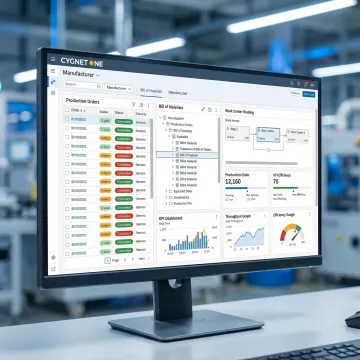
What is SAP in manufacturing engineering?
SAP in manufacturing engineering refers to the suite of SAP modules — primarily within S/4HANA — that digitize and integrate engineering master data, production planning, shop floor execution, and quality management. It enables manufacturers to manage Bills of Materials, routings, work centers, and production orders in a single real-time system, replacing fragmented legacy processes and spreadsheets with a unified operational backbone.
What is the difference between SAP PEO and PP?
SAP PP (Production Planning) is the traditional ECC module for managing production orders, MRP, and capacity planning. SAP PEO (Production Engineering & Operations) is the S/4HANA evolution that extends PP with an integrated manufacturing engineering layer — unifying engineering master data management, work instructions, shop floor control, and real-time analytics in a single role-based environment built on the HANA in-memory platform.
Which module in SAP is used for managing production and operations?
In SAP S/4HANA, production and operations are managed primarily through the Manufacturing — Production Engineering & Operations (PEO) module, supported by PP/DS (Production Planning & Detailed Scheduling) for advanced scheduling. PEO consolidates engineering master data, production order management, shop floor execution, and quality integration within S/4HANA's unified data model for real-time operational visibility.
What is the role of a production engineer in manufacturing?
A production engineer is responsible for designing, implementing, and optimizing manufacturing processes — including defining Bills of Materials, work center routings, and work instructions. In an SAP S/4HANA environment, production engineers use PEO tools to maintain engineering master data, release production orders, monitor shop floor execution, and analyze yield and efficiency data to drive continuous improvement.
What are the types of manufacturing in SAP?
SAP S/4HANA supports several manufacturing types: Discrete Manufacturing (individual units with defined routings), Process Manufacturing (batch-based production using recipes, common in chemicals and food), Repetitive Manufacturing (high-volume continuous production), and Engineer-to-Order (project-based custom production). S/4HANA PEO is designed to support all of these within a unified platform, including mixed-mode environments across multiple plants.
How long does an SAP S/4HANA PEO implementation typically take?
Implementation timelines vary based on scope, number of plants, and integration complexity. A focused single-plant PEO implementation typically takes 4–6 months. Multi-plant, multi-country rollouts with MES integrations and data migration from ECC can range from 9–18 months. Cygnet.One conducts an upfront scoping assessment to provide a realistic timeline and phased delivery roadmap before any commitment.
Can SAP S/4HANA PEO integrate with existing MES and IoT systems?
Yes. SAP S/4HANA PEO is designed for integration with Manufacturing Execution Systems (MES) and IoT platforms via standard SAP APIs, IDocs, and the SAP Integration Suite. This enables real-time production confirmations, machine data capture, and quality event recording directly from the shop floor. Cygnet.One has completed 250+ ERP integrations and can design a connectivity architecture that fits your existing operational technology landscape.
What happens to our existing SAP PP data when migrating to S/4HANA PEO?
Migrating from SAP ECC PP to S/4HANA PEO involves converting master data objects — including BOMs, routings, work centers, and production versions — to S/4HANA's unified data model. Cygnet.One's migration methodology includes data profiling, cleansing, test migration cycles, and reconciliation validation to ensure data integrity is maintained through the transition, with no loss of historical production and costing data.