How is cloud computing used in financial services?
Cloud computing is used in financial services for core banking modernization, risk analytics, customer data platforms, and disaster recovery. Financial institutions also leverage the cloud for AI/ML-powered credit scoring and fraud detection, data platform migration to cloud-native architectures, and maintaining compliance with regulatory standards like SOC 2, ISO 27001, RBI guidelines, FCA rules, and SAMA requirements—all while ensuring data security and continuous availability.
Can financial institutions use cloud computing?
Yes, financial institutions can and increasingly do use cloud computing. Modern cloud platforms offer the security controls, data residency options, and compliance certifications required by banking regulators. Financial institutions leverage the cloud for core banking modernization, risk analytics, customer data platforms, and disaster recovery—while maintaining compliance with standards like SOC 2, ISO 27001, and jurisdiction-specific mandates such as RBI guidelines, FCA rules, or SAMA requirements.
What compliance standards does Cygnet.One support for cloud deployments in financial services?
Cygnet.One is SOC 2 Type II certified and is recognized by regulatory bodies including HMRC (UK), FTA (UAE), ZATCA (Saudi Arabia), GSTN (India), and BOSA (Belgium). Their GRC practice designs cloud environments aligned with ISO 27001, SOC 2, and sector-specific financial regulations—ensuring your cloud infrastructure is audit-ready across every jurisdiction you operate in.
What cloud consulting services does Cygnet.One offer for financial services organizations?
Cygnet.One offers six core cloud consulting services for financial organizations: Cloud Strategy & Architecture, Cloud Engineering & Migration, Disaster Recovery & Backup, Governance Risk & Compliance (GRC), Data Platform Modernization, and AI/ML & Predictive Analytics. These services are purpose-built for the compliance, security, and scalability demands of banks, NBFCs, and insurers operating across global markets.
How long does a typical cloud migration take for a financial services organization?
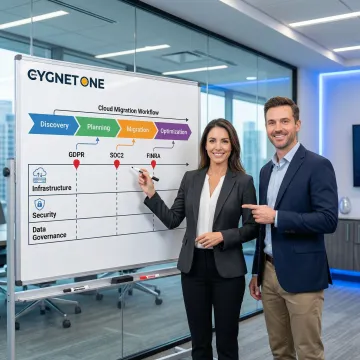
Migration timelines vary based on workload complexity, data volume, and compliance requirements. A readiness assessment and strategy phase typically takes 4–8 weeks. Phased migrations of core financial workloads generally span 3–9 months. Cygnet.One's structured ORBIT migration framework minimizes disruption by sequencing migrations carefully—prioritizing business continuity and 99% uptime throughout the process.
What is the ORBIT migration framework and how does it benefit financial institutions?
The ORBIT migration framework is Cygnet.One's structured approach to moving on-premise financial workloads to the cloud. It executes phased migrations—rehosting, replatforming, or refactoring applications—with measurable outcomes, minimal disruption, and FinOps-led cost governance. For financial institutions, this means 99% uptime is maintained throughout the transition, and business continuity is preserved at every stage of the migration.
Can Cygnet.One help with disaster recovery planning for banking and NBFC environments?
Yes. Cygnet.One's disaster recovery practice delivers solutions that reduce recovery time by up to 75% and achieve sub-minute recovery point objectives—ensuring that banks, NBFCs, and insurers can recover rapidly from outages, data loss, or system failures. They design, test, and manage DR environments that align with regulatory requirements for business continuity in financial services.
Does Cygnet.One offer ongoing support after cloud deployment for financial organizations?
Yes. Cygnet.One's managed IT and infrastructure services provide 24/7 monitoring, proactive patching, performance tuning, compliance oversight, and application support after your cloud environment goes live. Financial institutions benefit from continuous availability management, regular security assessments, and FinOps reviews that keep infrastructure costs controlled and compliance posture current as regulations evolve.