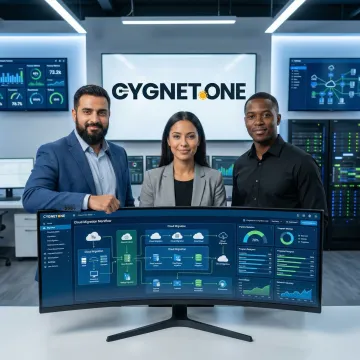
What cloud migration approach does Cygnet.One use for manufacturing companies?
Cygnet.One uses its structured ORBIT migration framework, which begins with a cloud readiness assessment of existing manufacturing workloads—ERP, MES, databases—then executes migration in controlled phases using rehost, replatform, or re-architect strategies. This phased approach ensures measurable progress while keeping production operations uninterrupted throughout the migration lifecycle.
Which cloud platforms does Cygnet.One support for manufacturing migrations?
Cygnet.One is an AWS Advanced Tier Partner and specializes in AWS-native services including Amazon Aurora, SageMaker, and Bedrock. Their cloud engineering practice also supports multi-cloud environments. For manufacturing companies, AWS workloads are optimized through Well-Architected reviews and FinOps-led cost governance to maximize performance and reduce infrastructure spend.
How does Cygnet.One minimize production downtime during cloud migration?
Cygnet.One's ORBIT framework executes migration in phased, controlled stages—prioritizing lower-risk workloads first and maintaining parallel operations where needed. Every phase includes data validation, integration testing, and performance benchmarking before go-live, ensuring critical manufacturing systems such as ERP and production management platforms remain stable throughout the transition.
Can Cygnet.One migrate legacy ERP and on-premise manufacturing databases to the cloud?
Yes. Cygnet.One specializes in migrating legacy on-premise databases—including SQL servers—to modern cloud-native platforms like Amazon Aurora and PostgreSQL, as well as transitioning traditional data warehouses to lakehouse architectures. They have completed 250+ successful ERP integrations, giving them deep expertise in the complex data dependencies common in manufacturing environments.
What happens after migration is complete—does Cygnet.One offer ongoing support?
After migration, Cygnet.One provides 24/7 managed infrastructure services including monitoring, patching, performance tuning, and security management. Their FinOps-led cost governance continuously optimizes cloud spend, while disaster recovery solutions maintain sub-minute recovery point objectives—ensuring manufacturing operations remain resilient, compliant, and cost-efficient on an ongoing basis.
How does cloud migration improve data analytics for manufacturers?
Cloud migration unlocks scalable data infrastructure that enables manufacturers to deploy predictive analytics and AI/ML models—such as those built on Amazon SageMaker—for predictive maintenance, operational efficiency tracking, and demand forecasting. Cygnet.One also builds centralized data pipelines and warehouses that unify siloed ERP, CRM, and production data for faster, more accurate decision-making.
What security and compliance standards does Cygnet.One adhere to during cloud migration?
Cygnet.One holds SOC 2 Type II compliance and designs cloud architectures aligned with regulatory and governance requirements from the outset. Their cybersecurity capabilities include endpoint protection, identity and access management, and threat detection. For manufacturing companies operating across multiple geographies, their GRC practice supports ISO 27001 and SOC 2 alignment throughout the migration and post-migration phases.
How is cloud migration pricing structured for manufacturing projects?
Cygnet.One's cloud migration pricing is scoped based on the scale, complexity, and specific requirements of each manufacturing engagement—including the number of workloads, data volumes, chosen cloud platform, and level of managed services required post-migration. This tailored approach ensures manufacturers pay for the precise outcomes they need rather than a fixed one-size-fits-all package.