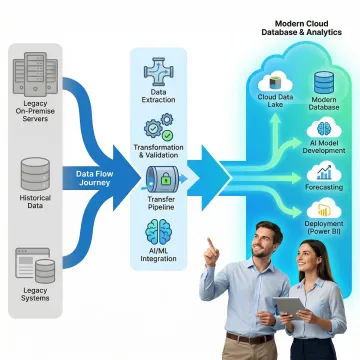
What is cloud database migration?
Cloud database migration is the process of transferring your existing databases—along with their schemas, data, stored procedures, and configurations—from on-premise servers or legacy systems to a cloud-hosted database platform. This involves assessing compatibility, designing target architecture, executing data transfer, validating integrity, and optimizing the cloud environment post-migration for performance and cost efficiency.
What is a database migration service?
A database migration service is a managed offering where a technology partner handles the end-to-end process of moving your databases to a new environment—typically from on-premise to cloud. It includes readiness assessment, migration planning, data transfer, schema conversion, quality validation, and post-migration support, ensuring minimal downtime and zero data loss throughout the transition.
What are cloud migration services?
Cloud migration services encompass the full spectrum of activities required to move an organization's IT workloads—including databases, applications, and infrastructure—from on-premise or legacy environments to cloud platforms like AWS, Azure, or Google Cloud. Services range from initial cloud readiness assessments and architecture design to execution, optimization, and ongoing managed support post-migration.
How long does a cloud database migration typically take?
Migration timelines depend on database size, complexity, number of integrations, and compliance requirements. A straightforward database rehost may take 4–8 weeks, while a full data platform modernization involving schema conversion, pipeline re-engineering, and phased cutover can span 3–6 months. Cygnet.One conducts a discovery assessment upfront to provide a realistic, project-specific timeline.
Will there be downtime during the database migration?
Cygnet.One's migration approach is designed to minimize or eliminate downtime using phased migration waves, parallel environment running, and live data synchronization before cutover. For business-critical databases in banking, healthcare, or e-commerce, we implement strategies that allow you to cut over during off-peak windows with recovery time objectives measured in minutes, not hours.
How is data integrity ensured during migration?
Data integrity is validated at every stage of the migration using automated QA testing frameworks, row-count reconciliation, checksum verification, and regression testing. Cygnet.One's quality engineering practice runs parallel validation checks between source and target environments before any cutover is authorized, ensuring that no records are lost, altered, or duplicated during the migration process.
Which cloud databases and platforms does Cygnet.One support for migration?
Cygnet.One supports migration to a range of cloud-native database platforms, including Amazon Aurora, Amazon RDS, PostgreSQL, Amazon Redshift, and other AWS-managed database services. As an AWS Advanced Tier Partner, our primary specialization is on AWS-native targets. We also support transitions to modern lakehouse architectures for enterprises moving beyond traditional data warehousing.
What support is available after the migration is complete?
Post-migration, Cygnet.One provides 24/7 managed infrastructure support including performance monitoring, query optimization, patching, FinOps-led cost governance, and disaster recovery management. Our managed services team maintains 99% uptime SLAs and ensures your cloud database environment is stable, secure, and continuously optimized as your data volumes and workloads evolve.