








































What’s new

Global e-Invoicing

e-Invoicing compliance Timeline

Know More →

Global e-Invoicing

UAE e-Invoicing: The Complete Guide to Compliance and Future Readiness

Read More →

Cygnet Vendor Postbox

Types of Vendor Verification and When to Use Them

Read More →

Cygnet Vendor Postbox

Safeguard Your Business with Vendor Validation before Onboarding

Read More →

Cygnet BridgeFlow

Modernizing Dealer/Distributor & Customer Onboarding with BridgeFlow

Read More →

Cygnet BridgeFlow

Accelerate Vendor Onboarding with BridgeFlow

Read More →

Cygnet Bills

GST Filing 360°: GST, E-Invoicing, E-Way Bills & Annual Returns Made Simple

Read More →

Cygnet Bills

Why Manual Tax Determination Fails for High-Volume, Multi-Country Transactions

Read More →

Cygnet IRP

GST Filing 360°: GST, E-Invoicing, E-Way Bills & Annual Returns Made Simple

Read More →

Cygnet IRP

Key Features of an Invoice Management System Every Business Should Know

Read More →

Cygnature

Automating the Shipping Bill & Bill of Entry Invoice Operations for a Leading Construction Company

Read More →

Cygnature

From Manual to Massive: How Enterprises Are Automating Invoice Signing at Scale

Know More →

What’s new

Data Analytics & AI

AI-Powered Voice Assistant for Smarter Search Experiences

Explore More →

Data Analytics & AI

Cygnet.One’s GenAI Ideation Workshop

Know More →

Digital Engineering

Our Journey to CMMI Level 5 Appraisal for Development and Service Model

Read More →

Digital Engineering

Extend your team with vetted talent for cloud, data, and product work

Explore More →

Quality Engineering

Enterprise Application Testing Services: What to Expect

Read More →

Quality Engineering

Future-Proof Your Enterprise with AI-First Quality Engineering

Read More →

Cloud Engineering

Cloud Modernization Enabled HDFC to Cut Storage Costs & Recovery Time

Know More →

Cloud Engineering

Cloud-Native Scalability & Release Agility for a Leading AMC

Know More →

Managed IT Services

AWS workload optimization & cost management for sustainable growth

Know More →

Managed IT Services

Cloud Cost Optimization Strategies for 2026: Best Practices to Follow

Read More →

Amazon Web Services

Cygnet.One’s GenAI Ideation Workshop

Explore More →

Amazon Web Services

Practical Approaches to Migration with AWS: A Cygnet.One Guide

Know More →

Cygnet TaxAssurance

Tax Governance Frameworks for Enterprises

Read More →

Cygnet TaxAssurance

Cygnet Launches TaxAssurance: A Step Towards Certainty in Tax Management

Read More →

Cygnet TaxAssurance

10 Generative AI Use Cases Driving Enterprise Value

Read More →

Cygnet TaxAssurance

Navigating the Generative AI Landscape

Read More →

Cygnet TaxAssurance

Truly Rise with SAP: The Business Integrators Guide

Read More →

Cygnet TaxAssurance

Mastering SAP S/4HANA Migration: Essential Pre-Migration Strategies and Preparation

Read More →

Qatar e-Invoicing Solution for Future Compliance Readiness

Prepare for Qatar’s emerging e-Invoicing mandate with an enterprise-ready solution designed for clearance and reporting models, ERP integration, structured invoice validation, secure exchange, and audit-ready compliance.

Qatar e-Invoicing Timeline

Qatar is progressing toward the implementation of its e-Invoicing framework following the approval of the draft law and executive regulations. The GTA also conducted an e-Invoicing pilot program with a select group of large companies from February to June 2026, providing participating businesses with tools and resources to test invoice generation, validation, digital signing, QR code creation, and integration with the central platform. While the final legislation, technical specifications, implementation timeline, and taxpayer phasing are still awaited, businesses should use this preparation window to assess ERP readiness, invoice data quality, integration capabilities, and compliance processes

May 2026

Qatar Cabinet approves the draft e-Invoicing law and executive regulations.

Next Phase

Publication of the final law and executive regulations.

Technical Release

Release of XML schemas, APIs, validation rules, and implementation specifications.

Phased Rollout

Expected phased implementation based on taxpayer categories.

Go-Live

e-Invoicing framework becomes operational following official implementation.

Qatar e-Invoicing at a Glance

Understand the key elements organizations should prepare for as Qatar moves toward mandatory electronic invoicing.

Applicability

Expected to apply to businesses that fall within the scope defined under Qatar’s final e-Invoicing legislation, with implementation anticipated to follow a phased approach.

Timeline

Draft legislation has been approved, while implementation timelines and taxpayer phases are awaited.

Operating Model

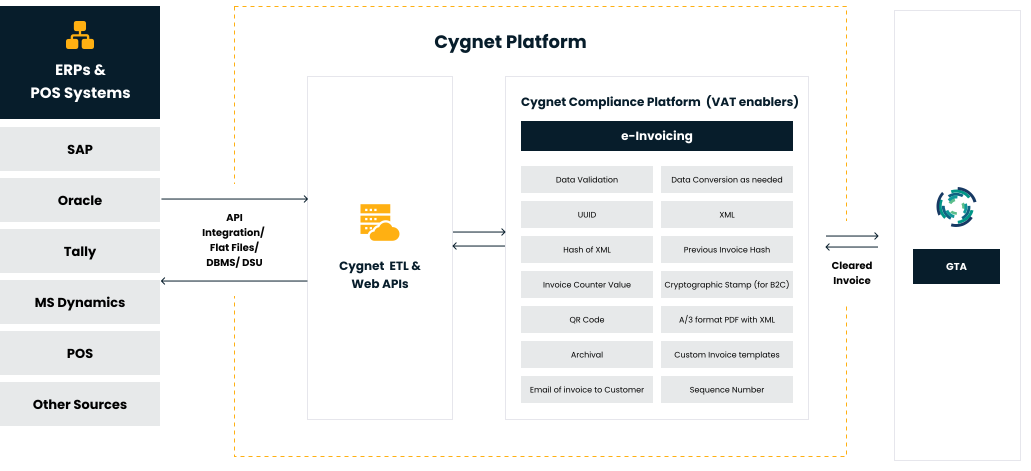
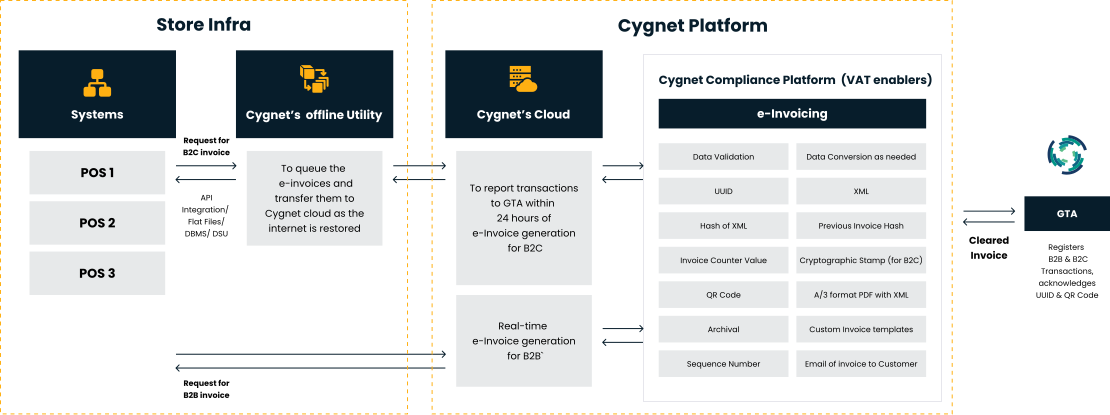
Expected hybrid approach with Clearance for B2B and B2G transactions, and Reporting for B2C transactions.

Invoice Data Readiness

Businesses should prepare ERP and invoicing processes for structured invoice generation, validation, QR codes, digital signatures, and mandatory invoice data.

Business Readiness

Evaluate ERP integration, master data quality, invoice workflows, governance, and audit controls before implementation.

Why e-Invoicing Matters in Qatar 

Qatar's e-Invoicing initiative is set to transform invoice processing by improving tax transparency, accelerating digital finance operations, and standardizing electronic invoice exchange across businesses. As organizations move away from paper-based and manual invoicing, structured electronic invoices will improve operational efficiency, invoice accuracy, and compliance readiness. 

National e-Invoicing Framework

Qatar is building a national e-Invoicing framework under the General Tax Authority (GTA).  

Standardized Invoice Validation

Standardized Invoice Validation

Prepare Early, Implement Smoothly

Businesses that prepare their systems and processes early can reduce implementation complexity.

Accuracy, Automation & Transparency

Structured invoice exchange helps improve invoice accuracy, automation, transparency, and audit readiness.  

Driving Tax Digitalization

The initiative supports Qatar’s broader digital transformation and future tax modernization objectives.  

Key Challenges Businesses Face

  • Structured Invoice Readiness– Prepare ERP and billing systems to generate, validate, and manage structured invoice data.
  • ERP & Business Integration– Connect SAP, Oracle, Microsoft Dynamics, NetSuite, Tally, billing applications, POS systems, and custom business applications.
  • Master Data Readiness– Ensure customer, supplier, tax, and product master data is complete, accurate, and standardized.
  • e-Invoicing Operational Readiness– Prepare for both real-time invoice clearance and post-issuance reporting requirements.
  • Validation & Exception Management– Build processes to manage invoice validations, acknowledgements, rejected invoices, corrections, retries, and operational exceptions.
  • Audit & Archival– Maintain secure invoice records, validation history, acknowledgements, and complete audit trails.
  • Regulatory Readiness– Develop a flexible implementation approach that can adapt quickly when GTA releases final specifications.

Preparing for Qatar e-Invoicing extends beyond generating electronic invoices. Businesses need to align ERP systems, finance processes, tax logic, invoice data, and governance to build a scalable compliance framework. 

Key Challenges Jordan Businesses Face

Understanding Qatar's e-Invoicing Models

Based on the draft framework, Qatar is expected to support two transaction models depending on the invoice type.

Clearance Model

Standard invoices are expected to follow a clearance model, where invoices are validated by the GTA before they can be exchanged between suppliers and buyers.

clearance modal 

Reporting Model

Simplified invoices are expected to follow a reporting model, allowing invoices to be issued first and reported to the GTA after issuance within the prescribed reporting timeline.

reporting modal

Cygnet.One Qatar e-Invoicing Solution

Cygnet.One helps organizations prepare for Qatar's evolving e-Invoicing requirements through structured invoice validation, ERP integration, secure invoice exchange, centralized monitoring, and audit-ready compliance.

Why Businesses Choose Cygnet.One

GCC Experience

Extensive experience supporting digital tax and e-Invoicing initiatives across the GCC. 

Enterprise Integration 

Connect seamlessly with leading ERP, finance, procurement, billing, and POS platforms. 

One Platform for Global Compliance 

Support multiple countries and evolving electronic invoicing mandates from one enterprise platform. 

Secure by Design 

Enterprise-grade security, governance, audit controls, and document traceability. 

Scalable Architecture 

Designed for high transaction volumes across multiple entities, countries, and business units. 

Accelerated Implementation 

Accelerate implementation using proven methodologies, reusable integration frameworks, and experienced delivery teams. 

Who Needs to Prepare?

Qatar’s e-invoicing system will likely affect all VAT-registered businesses in a phased manner. Entities in the following categories should begin assessment and implementation:

Must enable invoice digitization and integration

Need to build awareness and readiness among corporate clients

Should prepare for standardized e-invoice validation

Likely inclusion in future B2C e-invoicing phase

Our Accreditations

With tax authorities across the globe

Trust metrics

Organizations worldwide rely on our enterprise-grade e-Invoicing solution. 

14+ global accreditations 

1 scalable platform 

25+ years of expertise 

5 billion+ documents generated 

250+ ERP integrations  

1000+ enterprise clients 

FAQs

Qatar has taken the first formal legislative step toward e-Invoicing. On 6 May 2026, the Council of Ministers approved a draft law on electronic invoicing and its executive regulations, prepared by the Ministry of Finance in coordination with the General Tax Authority (GTA).

No. The Cabinet approval relates to a draft law and does not by itself make e-Invoicing mandatory for businesses. Further legislative and regulatory steps are required before businesses become subject to an enforceable e-Invoicing obligation.

Qatar has not yet announced an official mandatory implementation date. Businesses should therefore avoid relying on speculative 2027 or other implementation dates until the GTA, Ministry of Finance or another authorised government body formally publishes the rollout timetable.

Not yet. The GTA has not officially published a final invoice schema, structured format, API specification, clearance or reporting architecture, service-provider model, or detailed technical implementation requirements. These are expected to become clearer through subsequent legislation and GTA guidance.

The final taxpayer scope has not yet been officially published. Details such as turnover thresholds, B2B, B2G or B2C applicability, exemptions and phased implementation are expected to be defined through the final legislation, executive regulations or subsequent GTA guidance.

According to the official Cabinet announcement, the framework is intended to regulate the issuance of electronic invoices and notices, improve transparency, support digital transformation and create reliable databases for regulatory and oversight purposes.

Businesses can start by identifying invoice-generating systems, assessing the completeness and consistency of invoice data, documenting B2B, B2G, B2C and cross-border transaction scenarios, reviewing ERP integration capabilities and establishing ownership across Finance, Tax and IT. Final technical development should be aligned with the specifications once they are formally released by the relevant Qatari authorities.

Prepare Your Business for Qatar e-Invoicing

Start preparing today by evaluating your ERP landscape, invoice data, integrations, and compliance processes. Early readiness can help simplify implementation and minimize operational disruption business as Qatar’s e-Invoicing framework evolves.

background image