

































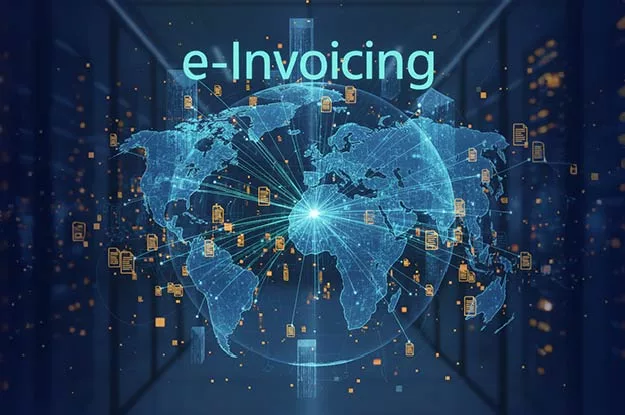
e-Invoicing is no longer limited to a handful of country-specific initiatives. Across Europe, the Middle East, Asia, Africa, and Latin America, businesses are navigating a growing mix of structured invoice exchange, clearance, continuous transaction controls (CTCs), and digital reporting requirements.
Tax authorities worldwide are not waiting for businesses to catch up. Mandates are live, deadlines are moving, and the cost of building country-by-country is compounding fast.
For multinational organisations, a scalable e-Invoicing compliance platform can provide the foundation for managing regulatory change, system integration, and invoice processes across multiple jurisdictions.
The World Is Going Digital
e-Invoicing adoption has accelerated across multiple regions as governments modernise tax administration and digital reporting. Regulatory models differ by country, but the broader direction is clear: structured invoice data and digitally connected compliance processes are becoming increasingly important.
For a business operating in one jurisdiction, e-Invoicing may involve a single regulatory and technical framework. For multinational organisations, complexity increases as finance and IT teams must manage different invoice formats, validation models, reporting processes, and implementation timelines.
What Is a Global e-Invoicing Compliance Platform?
A global e-Invoicing compliance platform acts as an integration and compliance layer between internal systems—such as ERP, billing, and accounting platforms, and country-specific e-Invoicing or tax-reporting environments.
The platform can transform invoice data, apply jurisdiction-specific rules, support applicable integrations, and manage invoice processing across multiple markets from a more consistent architecture.
Instead of building separate compliance integrations for every jurisdiction, businesses can use a central platform to standardise ERP connectivity while applying country-specific compliance and integration logic.
Think of the platform as a translation and orchestration layer: the ERP provides invoice data, while the compliance platform maps that data to the formats, rules, and processes required in each supported jurisdiction.
One ERP system cannot natively speak the tax language of 50 countries.
How a Global Platform Actually Works
The architecture is simpler than it sounds. Here is the flow for a business operating across, say, Saudi Arabia, Germany, and Kenya.
[Your ERP / billing system]
Generates invoice data in your format
            │
           ▼  Raw invoice data

[Global compliance platform]
Transforms format · applies digital signatures
routes to correct authority · handles errors
                         │
    ┌───────┼───────┐
    ▼       ▼       ▼                  ▼
UBL XML  ZUGFeRD  XML / API

[ZATCA]       [BMF portal]      [KRA eTIMS]
Saudi Arabia    Germany           Kenya
    │               │               │
   ▼               ▼               ▼
Cleared        Validated       CUIN issued
            │
            ▼  Validated invoices returned

[Buyers receive valid invoices]
Compliant across all markets[
Why Global e-Invoicing Has Become So Complex
e-Invoicing models vary significantly across jurisdictions. Some countries use clearance or continuous transaction control models, while others focus on structured invoice exchange, digital reporting, or a combination of these approaches. Certain jurisdictions also apply specific signing, validation, or security requirements.
There is a mix-and-match scenario of requirements that no ERP system is designed to accommodate.
| Country | Model type | Validation timing | Format | Key requirement |
| India | IRP clearance | Near real-time | JSON | IRN + QR code |
| Saudi Arabia | Clearance (ZATCA) | Real-time | UBL XML | API + cryptographic stamp |
| Egypt | Clearance-like | Real-time | JSON | Digital signature + status |
| Germany | Structured exchange | Post-issuance | EN 16931 XML / ZUGFeRD | XRechnung / ZUGFeRD |
| Malaysia | Clearance (MyInvois) | Real-time | UBL XML / JSON | QR code + unique ref no. |
| Zambia | CTC (Smart Invoice) | Real-time | JSON | VSRP / fiscal device |
This diversity is not just a technical challenge; it is an operational one. Your finance team, your IT team, and your ERP vendor all feel it differently, but they all feel it.
Core Capabilities Every Platform Must Have
Global e-Invoicing platforms vary significantly in country coverage, integration depth, regulatory update processes, and exception management. When evaluating a platform, businesses should assess five core capability areas.
First, there is a step of data transformation when invoice data is transformed into formats specific for each country (such as XML, JSON, etc.). The next one is API connectivity to ensure an updated connection with tax authorities. Next, a validation engine will help you avoid errors by checking invoices. After submitting your invoices, the status monitoring feature provides information regarding your invoices’ approval or rejection. Finally, compliant archiving will archive your documents.
5 Core Levels briefly
- API Connectivity: Support integrations with applicable tax-authority, government, and exchange systems
- Validation Engine: Apply data and business-rule checks before submission or exchange
- Status Monitoring: Track invoice responses, validation outcomes, and processing status
- Compliant Archiving: Support record storage according to applicable country requirements
Centralised vs Decentralised: The Decision That Defines Your Compliance Future
Decentralised Approach: Integration on Local Levels in Each Country
The decentralised approach means dealing with compliance separately in each country through either an internal solution or a local partner. This strategy may seem quicker and more straightforward at first, particularly for companies operating in just one or two countries.
Yet, scaling is quite difficult here because every expansion involves more integration and vendors to work with along with additional cost. Compliance updates will be dealt with separately too and systems won’t work together effectively as time goes by. Data may become fragmented among platforms which adds to complexity.
Centralised Approach: One Platform, Multiple Countries
A centralised approach uses a common platform and integration architecture to manage e-Invoicing across multiple jurisdictions. The organisation can standardise core ERP connectivity, data mapping, monitoring, and governance while applying country-specific compliance logic.
This approach can reduce duplicated integration effort and improve visibility across markets. However, internal finance, tax, and IT teams still remain responsible for governance, business decisions, and organisation-specific processes.
How Real-Time Compliance Is Reshaping Finance Operations
The Impact of Real-Time Compliance on Finance Processes
- Change from period-based to real-time processes
Month-end and post-period reconciliations will not work. Documents have to be checked when they are created. - Accounts Receivable (AR) transformation
Batches of documents will not work either. Everything has to be processed instantaneously. - Accounts Payable (AP) transformation
Documents must be checked and accepted only if they carry official government seals. Otherwise, documents might be unacceptable. - Transformation in the tax team
Changes from period end verification procedures to continuous verification. - IT is becoming more responsible
Constant updating because of constantly evolving APIs and document formats. - Finance culture change
From a world where finance deals mainly with document management (paper, PDF) to one focused on data management (structured data). - The invoice definition redefinition
Not any longer just a document but a data entity to comply with certain requirements.
Choosing the Right Platform: What to Actually Look For
Selecting a global e-Invoicing platform is a strategic technology and compliance decision. The chosen platform should be able to support regulatory change, system complexity, and the organisation’s geographic growth plans.
| Criteria | What to look for | Red flag |
| Country coverage | Supports your current and planned markets natively | New countries need separate contracts or build |
| Regulatory updates | Platform absorbs updates automatically; no manual patching | You’re responsible for monitoring changes yourself |
| ERP compatibility | Pre-built connectors for SAP, Oracle, Dynamics, etc. | API-only with no ERP-specific accelerators |
| Error handling | Built-in workflows for rejections, cancellations, resubmission | All exception management handled manually |
| Security and data residency | SOC 2 / ISO 27001 certified; region-specific hosting where required | Vague data residency policies for regulated markets |
Besides the table above, there are more subtle but just as critical indicators to consider. Beyond feature comparisons, businesses should examine a provider’s implementation and regulatory-change track record. Ask how the provider supported its most recent country launches, how regulatory updates are communicated, and how implementation timelines are managed.
Customer references are also valuable. Where possible, speak with organisations operating in similar industries, jurisdictions, and transaction-volume environments.
Implementation Strategy: The Phased Approach That Works
A phased implementation approach can help multinational organisations manage complexity and prioritise markets with near-term regulatory or operational requirements. Rather than deploying across every jurisdiction simultaneously, businesses can build and refine a repeatable implementation model.
- The first phase is entirely devoted to assessment: Phase one focuses on assessment. Map the countries in scope, current and upcoming requirements, ERP and billing systems, invoice data, and existing integrations. Prioritise markets according to compliance timelines, business impact, system complexity, and implementation readiness.
- The second phase involves ERP integration and API configuration: Phase two covers data and integration readiness. Map invoice fields, assess master-data quality, configure country-specific rules, and design the required integration and authentication processes. Data-quality issues should be identified before end-to-end testing begins.
- Finally, phase three is testing: Phase three focuses on testing. Validate standard invoices, credit and debit adjustments, cancellations, rejection scenarios, resubmissions, system downtime, and other transaction flows relevant to the business. Use available test or sandbox environments where supported.
- Phase four involves going live: Phase four covers go-live and stabilisation. Establish enhanced monitoring, defined escalation paths, and clear ownership for invoice exceptions during the initial production period.
The Future: The Next Phase of International e-Invoicing
The direction of digital tax administration continues to favour structured data, electronic invoice exchange, and more connected reporting processes. Regulatory models will continue to differ, but businesses operating internationally should expect invoice data and system integration to play a larger role in compliance.
In the European Union, the VAT in the Digital Age (ViDA) package was adopted in March 2025 and is being phased in through 2035. The reforms include digital reporting changes for cross-border transactions based on e-Invoicing.
For multinational organisations, this reinforces the need for scalable data, integration, and compliance architectures that can adapt as country requirements evolve.
Conclusion
For multinational organisations, global e-Invoicing is increasingly becoming a core part of finance and tax technology architecture. Managing each jurisdiction through isolated integrations can increase complexity as regulatory and technical requirements evolve.
A scalable compliance platform can help standardise invoice data, integration, validation, monitoring, and governance across markets while supporting country-specific requirements.
The strategic decision is not simply how to meet the next mandate. It is how to build an e-Invoicing architecture that can support the organisation’s current compliance obligations and future geographic growth.
FAQs
Businesses that are operating in different countries will encounter multiple e-invoicing regulations and submission deadlines. This type of system helps simplify everything since it allows for low-cost solutions and risk-free processes within each country.
A typical e-invoicing system acts as a mediator between the ERP of the firm and local tax authorities. This system automatically converts, validates, submits, tracks, and archives the invoice data based on country-specific regulations.
For a good platform, you will find the following components: data transformation tools, API integration capabilities, validation engine, invoice monitoring, and storage.
With the centralized approach, only one system will work for the whole organization in every country. A decentralized strategy involves having separate platforms for each country.
In most cases, ERP systems lack the ability to cope with the needs of e-invoices in different countries due to their rigidity in terms of formatting and integration with various APIs. Therefore, a dedicated platform has to be selected separately for these purposes.
The company should make sure that the provider offers global coverage, regular updates regarding changes in legislation, integration with the ERP system, scalability, real-time monitoring capabilities, and good customer support.
The future belongs to global e-invoicing that enables real-time data exchange among different participants according to the global standard and legislative regulation of tax procedures. The introduction of EU ViDA confirms the above point.