




























In Spain, e-invoicing is the electronic issuance, exchange, and reporting of structured invoice information between business parties, as per government-defined standards.
The Crea y Crece Law is leading to a shift to a mandatory B2B e-invoicing system in Spain, managed by the Agencia Tributaria (AEAT). Spain is on the final mile of one of the most important e-invoicing transformations in Europe.
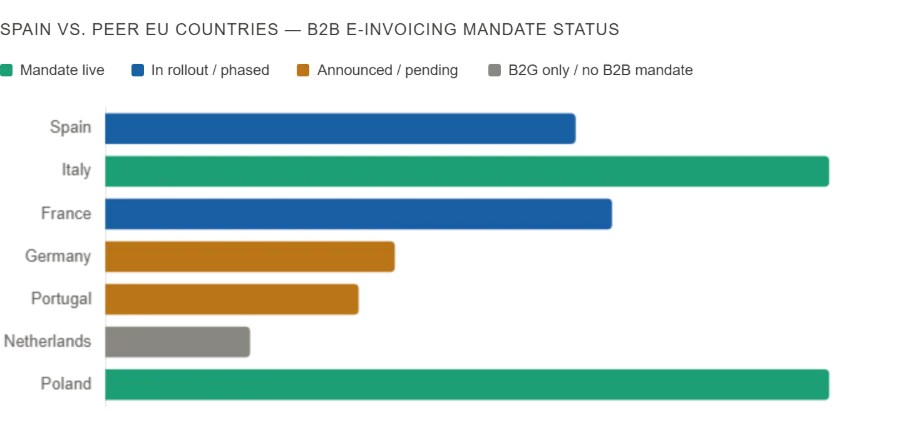
The country is now mandating all business-to-business (B2B) transactions to use structured e-invoicing, after over ten years of obligatory e-invoicing of transactions in the public sector making Spain one of the few EU member states to mandate structured e-invoicing throughout the economy.
The Timeline of Regulations
| Year | Milestone | Key Details |
| 2015 | B2G Mandate Enforced | Mandatory electronic invoicing applies to relevant public-sector suppliers through the applicable public-sector framework |
| Sept 2022 | Crea y Crece Law Passed | Law 18/2022 establishes mandatory e-Invoicing between businesses and professionals |
| March 31, 2026 | Royal Decree 238/2026 published | The Royal Decree develops the mandatory B2B e-Invoicing system and platform framework |
| October 1, 2027 | First implementation phase | Businesses and professionals with annual turnover above EUR 8 million enter the mandatory framework |
| October 1, 2028 | Wider implementation | Remaining businesses and professionals enter the mandatory framework |
Spain’s B2B e-Invoicing framework is now moving from regulatory development into implementation. Businesses should assess their applicable timeline and prepare invoice data, systems, and exchange processes before their compliance date.
The System Operations: Two Tracks, One Standard
Spain’s mandatory B2B e-Invoicing framework supports invoice exchange through private electronic invoicing platforms and the public electronic invoicing solution. The system is designed to enable interoperability between invoice-exchange platforms and ensure that businesses can issue, transmit, and receive electronic invoices within the mandatory framework.
Businesses using private platforms should ensure that their ERP, billing, or accounting systems can generate supported structured invoice data and exchange invoice and status information through the selected platform.
The public electronic invoicing solution provides another route within the mandatory framework. Businesses should assess the appropriate exchange model based on their existing systems, invoice volumes, and integration requirements.
For finance teams, preparation should include both accounts payable and accounts receivable processes because the Spanish framework includes invoice-status information in addition to electronic invoice exchange.
Types of Invoice Formats: What is Accepted and What is Not
One of the operationally specific aspects of the mandate of Spain is the format requirements. The accepted and rejected forms are presented in the table above, however, there are two points that should be pointed out.
To start with, the Facturae 3.2.x qualified with a qualified XAdES electronic signature is the native structured format in Spain as well as the only format that can be used in B2G transactions. In the case of B2B, UBL 2.1 and CII are also allowed – this is important to businesses that already have PEPPOL-based infrastructure deployed in other EU markets, as they can potentially extend existing integrations to meet Spanish B2B requirements.
Second, PDF invoices are not compliant – even digitally signed or sent over email. This is among the most common myths among businesses that are planning to be ready in the mandate. A PDF is a graphic image of an invoice; it is not a structured information. It cannot be automatically processed by an ERP unless manually re-entered. Since the mandate will be in effect as of the go-live date, PDF-only invoicing to Spanish B2B counterparts will not be in compliance with the legal mandate.
The Buyer Acknowledgement Obligation: Spain’s Distinctive Feature
One of the requirements of the mandate of Spain is what makes it unlike nearly all the other countries that have a mandate: buyers are required to actively acknowledge all the e-invoices they are receiving. This is not optional, and it is not confined to accepting invoices, buyers have to inform rejection with a given reason where invoices are not accepted.
| Status | Meaning | Time limit |
| Accepted | Invoice received and validated; buyer intends to pay | Within 4 business days of receipt |
| Rejected | Invoice refused; reason must be stated | Within 4 business days of receipt |
| In dispute | Payment terms under commercial dispute | As per commercial agreement |
| Paid | Payment confirmed | At point of payment |
This poses a two-sided compliance burden. AP teams need to develop recognition processes in their invoice processing beyond receiving and posting invoices, but by actively responding via the platform. Companies that receive thousands of supplier invoices monthly must automate this response; the manual response at scale is not an option.
In the case of AR teams, the recognition is also beneficial: it establishes written evidence that the buyer has received and accepted the invoice, which will give the legal status of the legal dispute in case of late payment under the commercial law in Spain.
Accredited Platform Requirement
One of the major features of the e-invoicing model of Spain is the invoicing platforms that are accredited by the government. Companies cannot just email structured XML invoices and expect them to be compliant.
These platforms serve as a regulated exchange layer. They:
- Validate invoice format
- Apply or verify electronic signatures
- Timestamp transactions
- Send route invoices to recipient
- Store documents of the required four-year audit period.
The accreditation system is controlled by the Ministry of Economic Affairs and Digital Transformation (MAETD), which keeps the official list of approved platforms.
Considerations when choosing a platform
The selection of the appropriate platform is essential to compliance and efficiency of operation. Businesses should evaluate:
- Accreditation status: Establish that the platform is registered on the official MAETD register.
- Trading partner connectivity: Make sure that it is compatible with commonly used platforms of your suppliers and buyers.
- Workflow support: Possibility to handle invoice acknowledgements (sent, received, accepted, rejected)
- ERP integration: The API-first platforms are better integrated with other systems such as SAP, Oracle and Microsoft Dynamics 365.
- B2G capability: Public-sector invoicing support (where necessary) through FACe.
Future Outlook: What’s Next for Spain
The e-invoicing system in Spain is set to develop in connection with the larger EU digital reporting projects.
What to expect
- Stricter reporting requirements
- Greater automation of VAT controls
- Increased EU interoperability
- Congruity with real-time reporting models.
Forward view: Spain is heading to full-digital tax control, not e-invoicing.
Conclusion
The B2B e-invoicing requirement in Spain is a progressive step towards organised and transparent and traceable invoicing. In contrast to the easier models of exchange, Spain makes businesses control the transmission of invoices and reporting. This adds complexity to compliance- but also efficiency and automation.
E-invoicing in Spain does not simply involve the sending of invoices, it is about managing the whole invoice lifecycle in a digital compliant ecosystem.
FAQs
Yes. The mandatory of Spain is that invoices must be traded in government-approved systems, whether mutually agreed or not. Emailing of structured invoices through email or non-accelerated systems will not be compliant. The platform guarantees validation, routing and audit traceability.
It is still possible to share PDFs to be read by humans or refer to them internally. They are however not legally binding in and of themselves. The official, compliant invoice is the structured invoice (e.g. Facturae) sent via an official platform.
Your ERP needs to handle structured invoice format, integrate with a certified platform and retrieve the invoice status. This, in most instances, involves integration improvements or middleware and not the replacement of the current ERP system as a whole.
Spain needs a monitoring of invoice life cycle events like acceptance, rejection and payment status. This introduces a visibility but necessitates AP and AR updates as well. Teams must actively track and react to change of invoice status.
In the initial stages, there might be a little flexibility, but it will need the two parties to implement e-invoicing to comply fully. Companies ought to actively bring on board major suppliers and customers to prevent the hiccups in case enforcement is made.
Not necessarily. B2B e-invoicing and B2G invoicing are supported by numerous accredited platforms through FACe. The adoption of a single solution should help in minimizing the complexity and help in streamlining compliance in various types of transactions.
Spain integrates invoice exchange and mandatory reporting and lifecycle tracking, but PEPPOL is based more on standardised exchange. This makes the model of Spain more complete and operationally challenging.
Late preparedness may cause integration delays, invoices that are non-compliant and delays in payment. Rushing, increased costs and disruption of operations in businesses may occur as deadlines loom.