








ETA-Compliant e-Invoicing Solution in Egypt
Digitize invoicing in Egypt with a secure, scalable e-Invoicing solution fully aligned with the Egyptian Tax Authority’s (ETA) e-Invoicing mandate.

e-Invoicing compliance Timeline

UAE e-Invoicing: The Complete Guide to Compliance and Future Readiness

Types of Vendor Verification and When to Use Them

Safeguard Your Business with Vendor Validation before Onboarding

Modernizing Dealer/Distributor & Customer Onboarding with BridgeFlow

Accelerate Vendor Onboarding with BridgeFlow

GST Filing 360°: GST, E-Invoicing, E-Way Bills & Annual Returns Made Simple

Why Manual Tax Determination Fails for High-Volume, Multi-Country Transactions
GST Filing 360°: GST, E-Invoicing, E-Way Bills & Annual Returns Made Simple

Key Features of an Invoice Management System Every Business Should Know

Automating the Shipping Bill & Bill of Entry Invoice Operations for a Leading Construction Company

From Manual to Massive: How Enterprises Are Automating Invoice Signing at Scale

AI-Powered Voice Assistant for Smarter Search Experiences

Cygnet.One’s GenAI Ideation Workshop

Our Journey to CMMI Level 5 Appraisal for Development and Service Model

Extend your team with vetted talent for cloud, data, and product work

Enterprise Application Testing Services: What to Expect

Future-Proof Your Enterprise with AI-First Quality Engineering

Cloud Modernization Enabled HDFC to Cut Storage Costs & Recovery Time

Cloud-Native Scalability & Release Agility for a Leading AMC

AWS workload optimization & cost management for sustainable growth

Cloud Cost Optimization Strategies for 2026: Best Practices to Follow
Cygnet.One’s GenAI Ideation Workshop

Practical Approaches to Migration with AWS: A Cygnet.One Guide
Tax Governance Frameworks for Enterprises
Cygnet Launches TaxAssurance: A Step Towards Certainty in Tax Management

10 Generative AI Use Cases Driving Enterprise Value

Navigating the Generative AI Landscape

Truly Rise with SAP: The Business Integrators Guide

Mastering SAP S/4HANA Migration: Essential Pre-Migration Strategies and Preparation

| Who / Applicability | Timeline / When | Model | Transaction Type | Additional Notes |
|---|---|---|---|---|
| Legal Framework Established | March 2020 | Pre-Clearance (CTC) – Legal Basis | — | Ministerial Decree No. 188/2020 established the mandatory e-Invoicing framework, with the Egyptian Tax Authority (ETA) designated as the implementing authority. |
| 134 Large Taxpayers (Phase 1) | November 2020 | ETA Clearance Model – Pre-Clearance CTC |
B2B
|
Mandatory e-Invoicing rollout began with 134 large companies selected under ETA Resolution No. 386/2020. |
| Additional 347 Large Taxpayers (Phase 2) | February 2021 | ETA Clearance Model – Pre-Clearance CTC |
B2B
|
The mandate expanded to an additional 347 companies under ETA Resolution No. 518/2020. |
| Remaining Large Taxpayer Center Companies (Phase 3) | May 2021 | ETA Clearance Model – Pre-Clearance CTC |
B2B
|
All remaining companies in the Large Taxpayer Center were required to join the e-Invoicing system. |
| Public Sector / Government Entities (Phase 4) | July 2021 | ETA Clearance Model – Pre-Clearance CTC |
B2G
|
e-Invoicing became mandatory for all B2G transactions. Non-compliant businesses were prohibited from dealing with public sector entities. |
| All VAT-Registered Businesses | January 2022 | ETA Clearance Model – CTC |
B2B
|
Paper invoices were no longer accepted for VAT deduction from this date. |
| B2C e-Receipt System – Pilot | April 2022 | ETA e-Receipt System – Real-Time Reporting |
B2C
|
ETA launched the B2C e-Receipt pilot, with phased onboarding of retailers beginning in July 2022 and continuing through January 2023. |
| All VAT-Registered Businesses | January 2023 | ETA Clearance Model – Real-Time Submission |
B2B
|
Same-day invoice submission became mandatory, replacing the phased submission window used during 2022. |
| All VAT-Registered Businesses | April 2023 | ETA Clearance Model – Fully Enforced |
B2B
|
Full B2B mandate achieved. All VAT-registered businesses were required to issue e-Invoices, with paper invoices invalid for tax purposes from July 2023. |
| B2C e-Receipt System – Sixth Wave | 15 January 2025 | ETA e-Receipt System – Stage 2 |
B2C
|
ERP/POS integration with the ETA platform became mandatory for in-scope businesses as B2C e-Receipt adoption continued. |
| Small Businesses (EGP 250,000–500,000 Turnover) | 31 March 2026 | ETA Clearance Model / e-Receipt System |
B2B
B2C |
VAT registration threshold reduced to EGP 250,000. Newly in-scope businesses must register for e-Invoicing by 31 March 2026 or face penalties. |
| All Applicable Businesses (Ongoing Enforcement) | Ongoing | Real-Time Pre-Clearance CTC |
B2B
B2C B2G |
Continuous compliance includes mandatory invoice archiving, real-time reporting, and penalties for non-issuance, late submission, or archiving failures. |
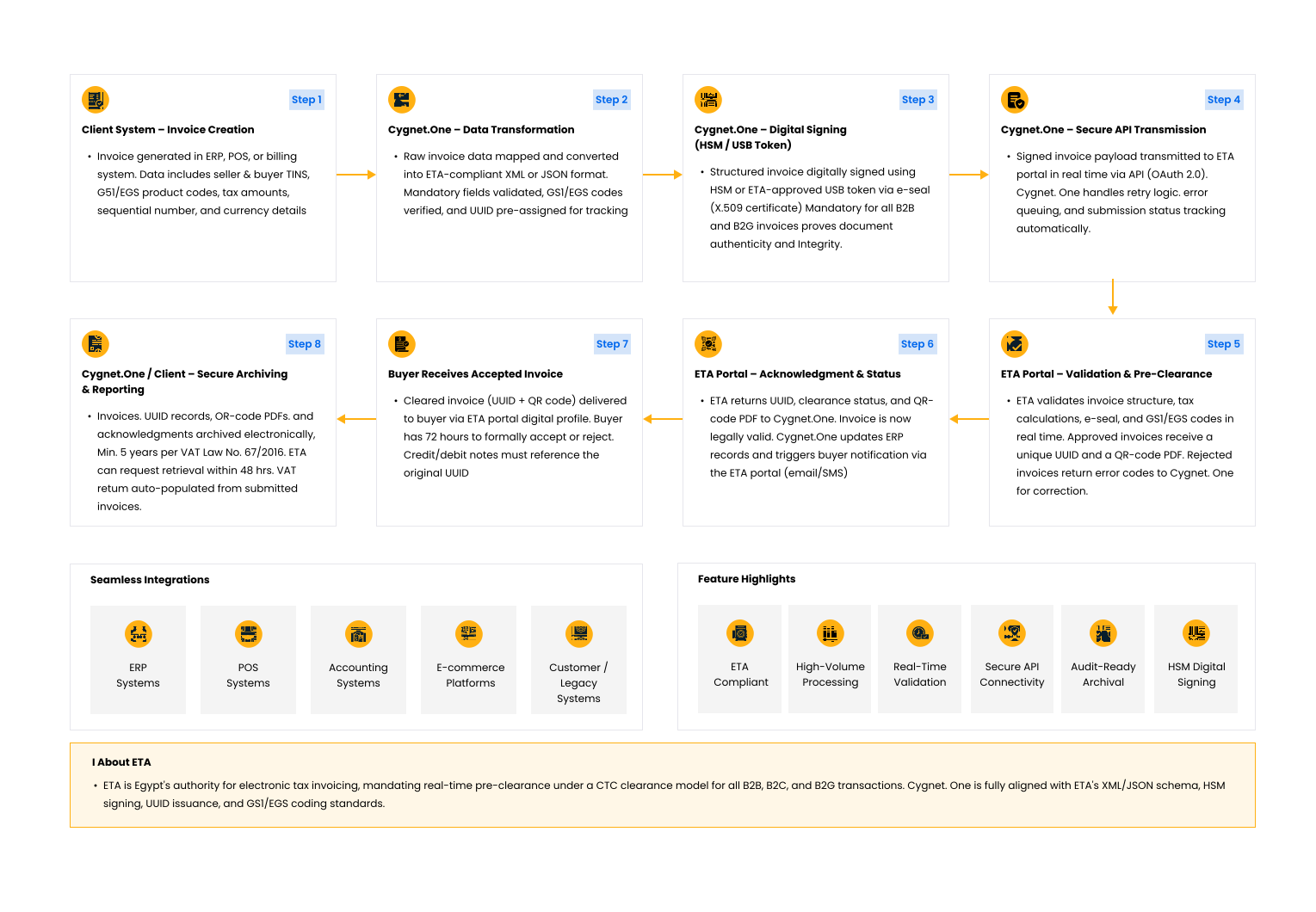
Cygnet.One connects your ERP and billing systems with the Egyptian Tax Authority’s e-Invoicing portal to enable seamless validation, real-time submission, and end-to-end compliance through a secure, scalable architecture.
Generate ETA-ready invoice data from your ERP or billing system
XML/JSON format, UUID, and electronic signature checks
Send invoices to ETA for real-time pre-clearance validation
Receive ETA clearance and buyer acknowledgment updates
Retain invoices and audit records securely for 7-year compliance







Learn how global businesses can overcome e-Invoicing implementation challenges, including multi-country compliance, data accuracy, and change management.

Learn how enterprises integrate VAT compliance with ERP systems amid ViDA and MTD mandates. Explore challenges, best practices, and automation…

Understand the global e-invoicing roadmap for 2025–2027, key mandates, regional timelines, and how enterprises should prepare for real-time compliance.
A UUID (Unique Universal Identifier) is a unique reference number assigned by ETA to every successfully validated invoice. UUID is what links credit notes and debit notes back to the original invoice, which is a key compliance detail for enterprise clients. It serves as the official identifier for the invoice.
Businesses mandated by the Egyptian Tax Authority must comply with e-Invoicing requirements. The rollout has been implemented in phases, covering large taxpayers first and progressively expanding to additional taxpayer groups and sectors.
The e-Invoicing system primarily covers B2B transactions, while the e-Receipt system is designed for B2C transactions. Depending on their business model, organizations may need to comply with one or both frameworks.
Large organizations often operate multiple tax registrations and digital certificates. Centralized certificate management is critical to avoid expired certificates, signing failures, and invoice submission disruptions.
Credit and debit notes must reference the original ETA-cleared invoice and follow specific document relationship rules. Proper linkage is essential for maintaining compliance and audit readiness.