

































Why change Challenges this solution is built to solve
Risk teams need a fast way to decide which businesses deserve deeper assessment. Full data collection can be slow, while visible deterioration in GST filing behavior may already indicate operating or financial stress.
Slow lead pre-qualification
Teams invest effort in applications before a basic business-compliance screen is available.
Early distress is easy to miss
Changes in filing behavior may emerge before traditional financial information is refreshed.
Portfolio monitoring is manual
Thousands of borrower GSTINs cannot be checked consistently through spreadsheets.
Vendor and customer exposure
Corporates need a simple signal to prioritize counterparty due diligence and credit controls.
How it works From raw data to a governed business decision
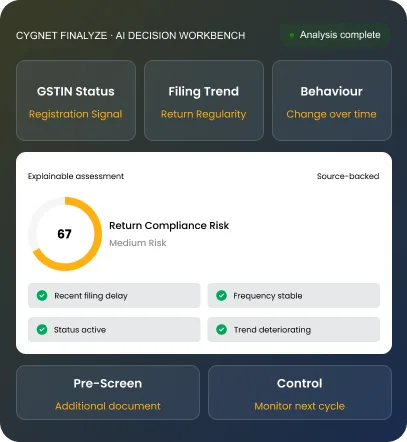
The GRC Score converts publicly available GST return-filing behavior into a consistent score, trend and explainable early-warning signal.
Submit a GSTIN individually or through a portfolio file or API.

Read available registration and return-filing information without a consent journey.

Evaluate regularity, recency, changes and patterns across filing periods.

Generate a compliance score, risk band and the drivers behind the outcome.

Refresh scores and alert teams when a counterparty’s behavior materially deteriorates.

AI-first architecture Intelligence that understands, evaluates and acts
AI is used where it creates measurable value: structuring data, identifying context, detecting risk, explaining findings and routing exceptions, while keeping people and policy in control.
Layer 01 Public Signal Layer
Uses publicly available GST registration and return-filing information for rapid screening.
- Non-consent input
- GSTIN-based
- Portfolio scale
Layer 02 Behavior Scoring Layer
Evaluates filing regularity, recency and change patterns through a consistent scoring model.
- Trend features
- Risk band
- Reason codes
Layer 03 Early-Warning Action Layer
Prioritizes deeper due diligence, monitoring or counterparty controls based on score movement.
- Alerts
- Watchlists
- Workflow routing
Business impact Designed for BFSI, NBFCs and corporates
Use one intelligence foundation across lending, risk monitoring and counterparty assessment, with the workflow and controls required by each segment.
Banks, Rating Agencies & Financial Institutions
Apply the same intelligence foundation to the decisions and workflows that matter most to
this segment.
Priority use cases
- Pre-screen MSME and business-loan applications
- Add a periodic early-warning signal to portfolios
- Identify accounts that need deeper review
- Improve branch-level screening consistency
What changes for teams
- Fewer manual preparation steps
- Consistent evidence and risk logic
- Exception-led analyst review
- Structured integration into existing systems
NBFCs & Specialized Lenders
Apply the same intelligence foundation to the decisions and workflows that matter most to
this segment.
Priority use cases
- Reduce cost per application in high-volume funnels
- Use API scoring in digital onboarding
- Create score-based routing and document requests
- Monitor thin-file borrowers between reviews
What changes for teams
- Fewer manual preparation steps
- Consistent evidence and risk logic
- Exception-led analyst review
- Structured integration into existing systems
Corporates & Large Enterprises
Apply the same intelligence foundation to the decisions and workflows that matter most to
this segment.
Priority use cases
- Screen vendors and customers by GST behavior
- Prioritize credit-limit and onboarding checks
- Add context to ITC and counterparty risk
- Monitor key channel partners and distributors
What changes for teams
- Fewer manual preparation steps
- Consistent evidence and risk logic
- Exception-led analyst review
- Structured integration into existing systems
Why Cygnet Finalyze Move beyond disconnected data tools
The differentiator is not AI as a label. It is verified data, specialized document intelligence, explainable risk logic and integration into the decisions your teams already make.

- Manual GST portal checks
- Binary active/inactive interpretation
- No trend or score movement
- Periodic spreadsheet-based reviews
- Same due diligence effort for every entity
- Standardized score and risk band
- Behavioral trends and explainable drivers
- Portfolio-scale refresh and alerts
- Risk-based routing into deeper assessment
- API integration into onboarding and monitoring
Governed AI Enterprise control around every AI-assisted output
Support faster decisions without turning models into a black box. Review, override, trace and integrate outputs within your own governance model.
Transparent Drivers
Present the filing behaviors behind the score rather than an unexplained number.
Configurable Risk Bands
Align score cut-offs and actions with product or counterparty policy.
Portfolio Audit Trail
Record score history, changes, alerts and user actions.
Role-Based Access
Control views and actions by portfolio, branch, entity or function.
Decision Support, Not Sole Decision
Use GRC as an early signal alongside broader due diligence and credit evidence.
Secure Batch & API Use
Run individual, portfolio and integrated scoring workflows.
- Lead management
- LOS / LMS
- Vendor onboarding
- Customer credit systems
- Portfolio monitoring
- Tax risk workflows
- Batch upload
- REST APIs
Frequently asked questions Questions credit, risk and technology teams ask
It is a score and risk signal built from publicly available GST registration and return-filing behavior to support business pre-screening and monitoring.
The score is designed around publicly available GST signals and therefore can support non-consent-based pre-screening. Deeper GST BI analysis uses authorized or consent-based data.
It is an early-warning and risk-prioritization indicator, not a standalone prediction or final credit decision. It should be used with broader credit evidence and policy controls.
Yes. Scores can be refreshed periodically to identify deterioration and route accounts for review.
Yes. Corporates can use it as one input for vendor due diligence, customer credit review, channel-partner monitoring and tax-risk prioritization.
Yes. GSTIN input, scores, risk bands, reason codes and alerts can be embedded into onboarding, lending and monitoring systems.