







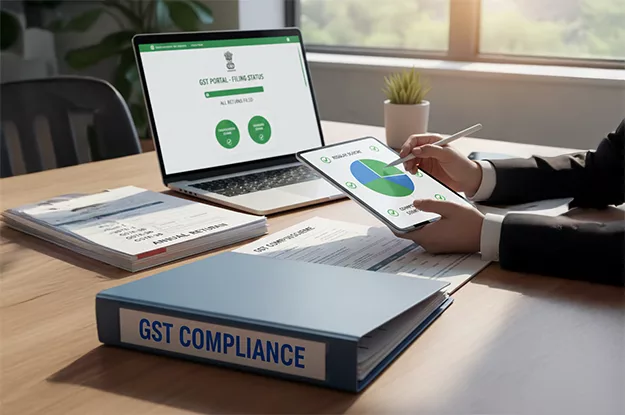


























Incorrect invoice classification in GST purchase registers remains a persistent compliance challenge, often leading to mismatched tax credits, reconciliation issues, and audit risks. Despite digital GST systems, errors in HSN codes, tax rates, and vendor tagging continue due to manual processes and high transaction volumes.
Artificial Intelligence is now emerging as a potential solution by automating classification, learning from past data patterns, and reducing human error. This blog explores whether AI can finally address this long-standing GST compliance problem at scale.
The Hidden Cost of a Wrong Tax Code
When your company receives an invoice, it must first classify it as either CGST or IGST; the crew that enters the data manually into your accounts payable department cannot afford to classify invoices incorrectly or miss maximize ITC claims. The risks increase with the number of invoices processed; many mid-market companies process thousands of invoices each month and rely on their Accounts Payable staff to manually classify each invoice as CGST or IGST and whether it will qualify for an input tax credit or be blocked. As the volume of invoices increases, so do the risks associated with incorrectly classifying those invoices problems that may lead to incorrect GST return submissions and, ultimately, monetary penalties. In addition, GSTR-2A mismatches and demand notices may be looming in the future
In this blog, we will discuss the impact of incorrectly classifying invoices compared to appropriate classification and how traditional (manual) invoice processing and classification systems do not properly address this growing problem. We will also review how artificial intelligence (AI), particularly as it relates to machine learning (ML) and OCR technologies (Optical Character Recognition), can help you to resolve these issues associated with the classification of invoices for your GST purchases.
A GST Purchase Register: What Is It and Where Does It Fail?
A GST Purchase Register records each purchase made by an entity within a specified period. Before the data in the GST Purchase Register can be uploaded to filing The data must match GSTR-2B. This is the auto-generated summary of available input tax credit (ITC).
Invoice classification is a crucial step in this process, which entails accurately labeling each invoice with:
| Classification field | What it means | Impact if wrong |
| HSN / SAC code | Harmonized code for the good or service | Incorrect GST rate applied |
| Tax type | IGST (interstate) vs CGST + SGST (intrastate) | Mismatch between GSTR-1 and GSTR-2B |
| ITC eligibility | Eligible, partially eligible, or blocked (Section 17(5)) | Tax reversals and penalties |
| Ledger mapping | Capital purchase vs expense | Distorted financials, wrong ITC |
The Four Most Common Classification Error
- Incorrect HSN/SAC Code Key Features of GST This will result in an incorrect GST rate applied to the transaction. This may also cause incorrect claims for ITC and put you at risk for additional scrutiny.
- CGST / IGST Mismatch Recording an intra-state transaction as an inter-state or vice versa will cause a mismatch between GSTR-1 and GSTR-2B.
- Blocked ITC Claimed Claiming ITC on ineligible items such as certain vehicles, food or memberships can result in reversing your tax credit and incurring penalties.
- Incorrect Ledger Mapping Posting capital purchase to expense or the reverse will distort the financial records and create incorrect ITC calculations.
Why Rule-Based Systems Struggle
Most ERP and accounting systems rely on rule-based logic Vendor X goes to Ledger Y with GST code Z. This worked when GST launched in 2017. Three forces have eroded its effectiveness since:
| Challenge | What happens |
| Scale | Thousands of invoices per month; rules are applied blindly with no error detection. |
| Complexity | GST rates and rules have changed significantly since 2017; outdated rules cause misclassifications. |
| Variety | “Consulting fees”, “advisory charges”, “management services” all mean the same thing — simple rules can’t map them to the right SAC code. |
Rule-based systems don’t fail loudly. They continue applying outdated or wrong rules month after month — errors accumulate quietly until an audit or demand notice makes them visible. By then, penalties and interest have already compounded.
How AI Tackles Invoice Classification
This section explains the AI pipeline to the stages through which an invoice moves before it becomes a correctly classified entry in the GST purchase register.
Step 1: Extracting Information via OCR
Invoice paperwork can come as PDFs, scans, and pictures. OCR will be used to read the data on the invoices. The OCR will pull out the key invoice data information including Vendor Name, Invoice Number, GSTIN, Total tax amount, HSN/SAC code, description of each line item, and extract the data to convert all invoice paperwork into a structured data format.
Step 2: Classifying Invoice Description Through NLP
Invoice descriptions such as “Consulting Fee”, “Professional Services”, and Advisory Charges” will be analyzed against known classifications through Natural Language Processing. When there is a variation in the wording of the description, the system will still be able to match or relate to the same type of service and assign it to the correct HSN/SAC classification.
Step 3: Determining Place of Supply Invoicing
To determine the Place of Supply for each invoice, the following will be analyzed: the supplier’s GSTIN, the buyer’s GSTIN and the interstate/intrastate (India) place of supply rules. After the analysis is complete, the system will be able to assign the appropriate tax treatment as either CGST + SGST or IGST.
Step 4: Filling Out Input Tax Credit Criteria
The system will analyze whether the Input Tax Credit qualifies as 100% Allowed, Partially Allowed or direct compliance risk. The system will automatically identify restricted items in this category which typically include vehicles, food & beverages, and club memberships.
Step 5: Detecting Anomalies
The system will scan invoices to look for abnormal activity such as abnormal GST in terms of claimed Tax, Wrong Tax Classification or Wrong HSN, and duplicated invoices. These items will be flagged for a manual review.
Key insight: Unlike rule-based systems, AI learns historical data and identifies patterns. This allows it to accurately classify new invoices, even when vendor names, descriptions, or formats vary.
What AI Delivers to Finance Teams
AI-powered invoice classification helps finance and accounting teams improve efficiency and accuracy.
- Higher accuracy: Around 95% accuracy in HSN/SAC classification vs. 70–80% manually
- Faster reconciliation: Automatic GSTR-2B matching in minutes instead of days
- Lower compliance risk: Flags blocked ITC before GST filing
- Better ITC claims: Identifies eligible credits that might be missed
- Audit-ready records: Logs every decision with confidence scores
- Scalable: Handles hundreds or thousands of invoices efficiently
Overall, AI improves GST compliance, accuracy, and productivity for finance teams.
Real-World Applications
Automatic Vendor Invoice Classification
A manufacturing company receives invoices from 300+ vendors each month, often using different descriptions for similar goods.
Before AI:
Accounts teams manually classify invoices, leading to inconsistent tagging (e.g., steel angles classified differently.
After AI:
An AI/NLP model standardizes descriptions, maps them to the correct HSN code (e.g., 7216), applies the correct GST rate, and flags errors like outdated tax rates.
Other Uses
Tax Rate Detection: Identifies incorrect GST rates.
ITC Checks: Flags invoices with blocked or ineligible ITC.
Challenges You Should Know About
Using Artificial Intelligence is very useful. It is not easy to set up. There are some things you should think about:
The use of AI is very helpful but can take time to set up. Here are some considerations to make when using AI:
- Preparing the Model for Use- For AI to work, you will need to give it 6 to 12 months of invoice paperwork so it can learn about how your business operates properly set up.
- Connecting to Other Computer Systems – Depending on the software program you utilize to run your business (i.e., SAP, Oracle, Tally…etc.), you may need a special code or extra software to connect to the AI.
- Verifying Data Is Correct – If old data is incorrect or inconsistent, it will impact the models’ accuracy and may require cleaning up the data to ensure it is accurate.
- Cost of Setting Up AI- The monthly fee for AI tools to use in mid-size companies will range from ₹2,000 to ₹15,000 per month, with larger companies potentially paying even more.
- Updating the AI Model to Comply with Laws – The AI model must be updated to comply with any changes in tax rules/tax rates.
- With these challenges, companies consider that AI has sufficient benefits compared to the sacrifice of resources. The efficiencies gained from using AI in the long term will offset the investment in AI.
Where GST AI is Heading
The issue of incorrectly categorizing purchases made using an invoice is not new; it has existed since the implementation of GST in India. The new development is that we now have access to AI-powered tax technology which allows us to solve the problem reliably and efficiently on a large scale, for an affordable price for many mid-sized businesses.
Rule based systems were built for a simpler time where vendor lists were limited, invoice forms were standardized, and GST regulations were stable. However, the conditions that defined the previous tax landscape do not exist today and there is extensive complexity in today’s business environment; therefore, AI’s purpose is to manage complexity, by learning from prior data, by adjusting to changes and by improving with each invoice processed.
For GST classification accuracy is not just about complying with regulations; it impacts your cash flow, your entitlement to Input Tax Credits (ITC’s) and the credibility of your organization with tax authorities. Businesses that view GST classification as a strategic issue rather than an administrative activity will be the ones that prosper as the enforcement of GST increases in severity.
The transition to AI systems will likely be a lengthy process and will require preparing the model by cleansing the historical data and integrating it with your existing Enterprise Resource Planning (ERP) software. One thing is clear; because of GST, manual classification is a liability while AI is the answer going forward.
The classification problem is solvable, and the time is now:
- Utilize your previous data. Compile invoices for 6–12 months prior and eliminate any errors in the data since this is the training base for the AI model to learn invoice patterns and GST classifications.
- Test the AI via a pilot program using a single vendor category. This should be the vendor category with the largest volume of invoices or the most errors in classification. This will allow you to validate the system and adjust prior to full deployment.
- Always maintain human intervention in the process. The AI can point out classifications or possible issues, but your finance or accounts payable personnel must make the final determination, especially for more complicated situations.
- Finally, create a plan for changing the rules of GST. The AI models should be retrained on a regular basis since tax rates and ITC eligibility will change based on reporting and reconciliation of your company’s GST compliance schedule.
GST compliance in India is only going to get more complex and more scrutinized. The businesses that invest in AI powered invoice classification today are not just solving today’s problem; they are building the compliance infrastructure that will carry them through whatever comes next.
Every month you delay is another month of avoidable errors, missed ITC, and compliance risk. Technology is ready. The question is whether your business is.
Frequently Asked Questions
Invoice classification is the process of assigning correct details like HSN/SAC code, tax type (CGST/IGST), ITC eligibility, GSR 3B Table mapping, and ledger mapping to each purchase invoice.
It can lead to wrong GST returns, loss of input tax credit (ITC), GSTR-2B mismatches, and potential penalties or demand notices from tax authorities.
Common errors include wrong HSN/SAC codes, CGST vs IGST mismatch, claiming blocked ITC, and incorrect ledger mapping.
They struggle due to high invoice volumes, changing GST rules, and variations in invoice descriptions, leading to frequent and unnoticed errors.
AI uses OCR to extract data and machine learning to understand patterns, classify invoices correctly, detect anomalies, and adapt to new data over time.
Yes, AI can automatically match purchase data with GSTR-2B, flag mismatches, and ensure accurate reporting before filing GSTR-3B.
Challenges include the need for historical data, system integration with ERP, data cleaning, ongoing model updates, and initial setup costs.
No, AI assists by automating routine tasks and highlighting risks, but human experts are still needed for final decisions and complex cases.