









Japan e-Invoicing Solution for Qualified Invoice System (QIS) Compliance
Simplify compliance with Japan’s Qualified Invoice System using a fully automated, ERP-integrated e-Invoicing solution designed for accuracy, interoperability, and scalability.

e-Invoicing compliance Timeline

UAE e-Invoicing: The Complete Guide to Compliance and Future Readiness

Types of Vendor Verification and When to Use Them

Safeguard Your Business with Vendor Validation before Onboarding

Modernizing Dealer/Distributor & Customer Onboarding with BridgeFlow

Accelerate Vendor Onboarding with BridgeFlow
GST Filing 360°: GST, E-Invoicing, E-Way Bills & Annual Returns Made Simple

Why Manual Tax Determination Fails for High-Volume, Multi-Country Transactions
GST Filing 360°: GST, E-Invoicing, E-Way Bills & Annual Returns Made Simple

Key Features of an Invoice Management System Every Business Should Know

Automating the Shipping Bill & Bill of Entry Invoice Operations for a Leading Construction Company

From Manual to Massive: How Enterprises Are Automating Invoice Signing at Scale

AI-Powered Interviewing Helped an Education Group Reduce Hiring Time Significantly

AI-Powered Voice Assistant for Smarter Search Experiences

Cygnet.One’s GenAI Ideation Workshop

Our Journey to CMMI Level 5 Appraisal for Development and Service Model

Extend your team with vetted talent for cloud, data, and product work

Enterprise Application Testing Services: What to Expect

Future-Proof Your Enterprise with AI-First Quality Engineering

Cloud Modernization Enabled HDFC to Cut Storage Costs & Recovery Time

Cloud-Native Scalability & Release Agility for a Leading AMC

AWS workload optimization & cost management for sustainable growth

Cloud Cost Optimization Strategies for 2026: Best Practices to Follow
Cygnet.One’s GenAI Ideation Workshop

Practical Approaches to Migration with AWS: A Cygnet.One Guide
Tax Governance Frameworks for Enterprises
Cygnet Launches TaxAssurance: A Step Towards Certainty in Tax Management

| Who / Turnover / Applicability |
Timeline / When | Model | Transaction Type | Format of e-Invoice | Additional Notes |
|---|---|---|---|---|---|
| All Businesses (Consumption Tax Reform Phase) | 1 October 2019 | Transitional Invoice Retention System |
B2B
B2C |
Paper / Electronic Invoices | Introduction of standard (10%) and reduced (8%) Consumption Tax rates. Transitional invoice rules applied until the Qualified Invoice System (QIS) took effect. |
| Standardization Bodies / Ecosystem | July 2020 | Peppol-Based Interoperability (Voluntary) |
B2B
B2G |
Peppol BIS Billing 3.0 | EIPA was established to promote standardized e-Invoicing and Peppol adoption. Japan’s Digital Agency became the country’s Peppol Authority in September 2021. |
| Businesses Using Peppol (Voluntary) | 28 October 2022 Onwards | Peppol Network Enablement |
B2B
B2G |
JP PINT v1.0 (Peppol BIS Billing 3.0) | Peppol Access Points became available with the release of JP PINT v1.0, enabling structured invoice exchange independent of QIS compliance. |
| Registered Qualified Invoice Issuers | 1 October 2023 | Qualified Invoice System (QIS) |
B2B
|
Paper or Electronic Qualified Invoice | QIS launched under the National Tax Agency (NTA). Only registered Qualified Invoice Issuers can issue invoices that allow buyers to claim input tax credits. JP PINT and Peppol remain optional. |
| Businesses Purchasing from Non-Registered Suppliers | 1 Oct 2023 – 30 Sep 2026 | QIS Transitional Input Tax Credit |
B2B
|
N/A | Transitional relief allows 80% input tax credit until 30 September 2026, reducing to 50% until 30 September 2029, and ending thereafter. |
| All Businesses Conducting Electronic Transactions | 1 January 2024 | Electronic Books Preservation Act (EBPA) |
B2B
B2C |
Electronic Transaction Records | Businesses must retain electronic transaction records digitally. This requirement is separate from QIS and is administered by the NTA. |
| Businesses Using Peppol / JP PINT | 1 June 2024 Onwards | Peppol-Aligned Interoperability (Voluntary) |
B2B
B2G |
JP PINT v1.0.2 | The Digital Agency updated JP PINT to align with Peppol PINT BIS Billing v1.0.2, enhancing interoperability and supporting additional invoice scenarios. |
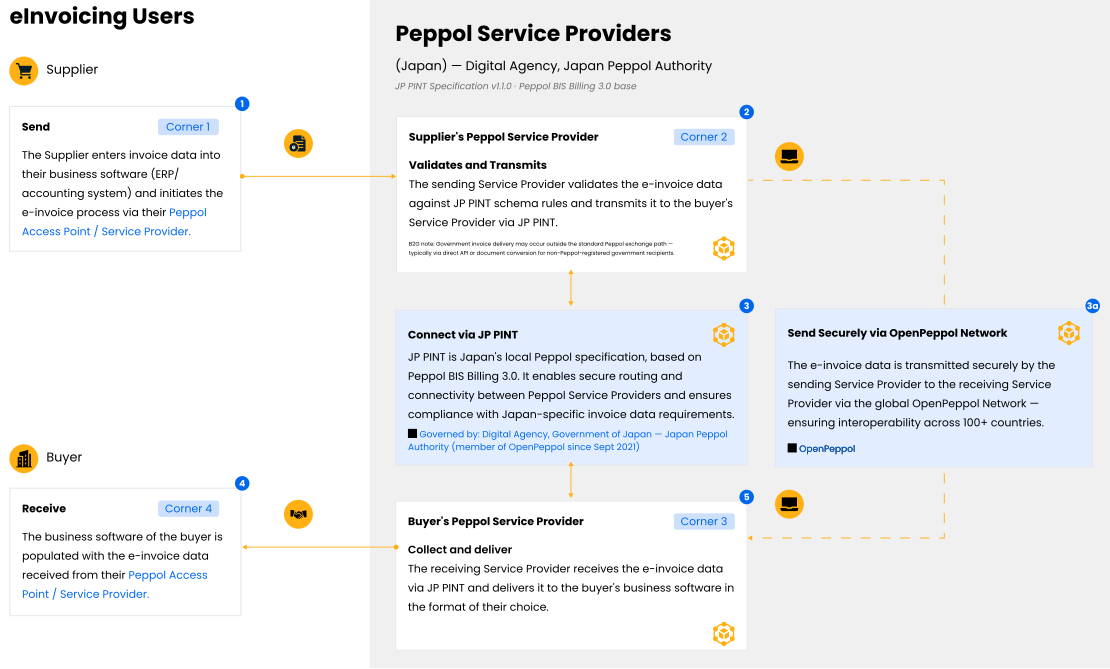
Cygnet.One connects your ERP and billing systems with Qualified Invoice System requirements and PEPPOL networks to enable seamless validation, exchange, and compliance.
Create JP PINT-compliant invoices directly from ERP or billing systems
Validate invoice data against Qualified Invoice System and Peppol requirements
Exchange invoices securely through certified Peppol Access Points
Secure archival with complete audit trail and e-Storage Law compliance








How an MSME enabled invoice generation after government mandate

A leading IT services giant saved ERP switching cost automating e-Invoicing and digital signing with us.

Ensure compliance for ZATCA’s latest e-invoicing mandate in Saudi Arabia, effective January 2023.
It is a tax system introduced by the National Tax Agency requiring businesses to issue qualified invoices.
These invoices are necessary for buyers to claim input tax credits.
Businesses that wish to issue qualified invoices enabling customers to claim input tax credits must register as Qualified Invoice Issuers with the National Tax Agency and comply with QIS requirements.
Yes. Advanced platforms can collect supplier tax information, validate registration numbers, identify missing data, and automate compliance checks during onboarding. This helps organizations reduce supplier-related tax risks and improve data quality.
Many enterprises operate across multiple jurisdictions. A global compliance platform can support Japan’s Qualified Invoice requirements alongside mandates in France, Poland, Saudi Arabia, Singapore, Malaysia, and other regions through a unified architecture.
Manual correction processes can create compliance and reconciliation issues. Automated workflows help manage invoice amendments, maintain audit history, and ensure corrections are properly reflected in ERP, tax, and reporting systems.