







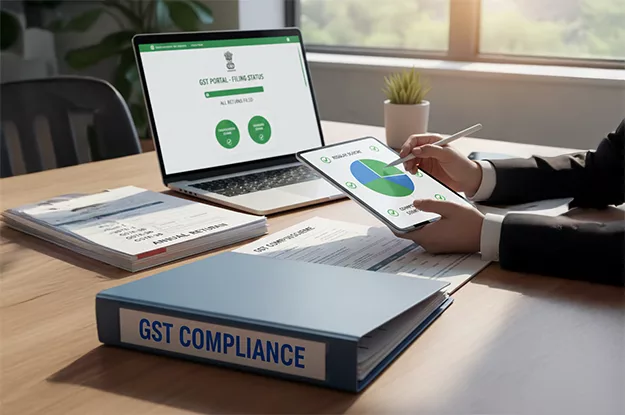



























Purchase invoice classification involves going through invoices and categorizing them in accordance with GST norms and rates. While even in the current GST-enabled digital environment, many finance departments still employ manual approaches for classifying invoices.
This blog will investigate the reasons behind this practice, especially when there are several sophisticated solutions available today. The article will discuss the difficulties involved in the manual classification approach and will also explain what impact manual classifications have on financial organizations. Lastly, this article will provide insights into how business entities can move towards adopting automated invoicing.
In short, improving invoice classification is key to reducing errors, protecting ITC, and driving efficient GST compliance.
Myth vs Reality
Myth: GST automation means finance teams no longer handle invoices manually.
Reality: Automation handles the movement of invoice data. The classification of that data, what it is, if it is eligible for ITC, what GST rate applies, etc. is still overwhelmingly a manual, human decision in most organizations.
Myth: E-invoicing has solved the problem of manual data entry.
Reality: E-invoicing normalizes invoices from large registered suppliers. There are thousands of vendors who are exempt, non-compliant, or simply send a PDF or a WhatsApp message. This “last mile” is still manual for most AP teams.
Present GST invoice processing scenario
This is what GST invoice processing in India looks like in reality:
- Invoice Received: by email, courier, vendor portal, WhatsApp, ERP system, etc. Format, whatever vendor chose to send today.
- Read and Extract: Vendor’s GSTIN, Invoice No., Date, Items, HSN/SAC Code, Tax Breakup, Place of Supply manually in whatever format received.
- Judgment Call: Capital/Revenue? Blocked under Section 17(5)? Taxable/Exempt Supply? Eligibility for GSTR-2B Match? here’s the part that’s still not automated.
- Validate GST: Is Vendor’s GSTIN valid? Is the HSN/SAC Code, correct? Did supplier file their GSTR-1 this month? Check online.
- 3-Way Match: match invoice against Purchase Order and Goods Receipt Note and check if there is a discrepancy?
- Enter into ERP: enter correctly against correct GL Code, Cost Center Code, Tax Code, and ITC Eligibility and pray ERP accepts data.
- File: hold for end-of-month GSTR-2B match, discover three of today’s invoices not in GSTR-2B as supplier has not yet filed.
Repeat this 200 times a day. This is what GST Invoice Processing looks like in India for a mid-size enterprise. Every step from 2 to 5 is manual. Every step can go wrong. Every wrong step can mean an ITC loss or a GST notice.
The Real Culprits
Manual classification persists not because finance teams don’t want automation; they do. It persists because of four structural problems that existing tools have not fully solved:
Messy vendor data: Halfyour vendors send invoices in non-standard formats. Scans, handwritten documents, PDFs without selectable text. OCR tools help, but they produce structured output from unstructured input, and that output still needs human validation before it enters a compliance workflow.
Changing GST rules: the GST Council has met 55 times since 2017. Over 1,900 rate notifications have been issued. HSN/SAC classifications change. Section 17(5) exceptions evolve. No static rule engine keeps pace with this. Someone must track it and apply the latest interpretation.
Broken integrations: most ERP systems were not built for real-time GST classification. The gap between your invoicing system, your ERP, and the GSTN portal is routinely filled by a human doing a manual export-import. The data flows, but it does not flow clean.
Exceptions everywhere: about 20-30% of any enterprise invoice are edge cases: mixed-use expenses, composite supplies, works contracts with partial ITC, foreign vendor invoices, invoices with wrong GST details that need resolution. These exceptions are where the real compliance risk lives, and they require human judgment, not just pattern matching.
The Cost Nobody Talks About
It is not only inefficient but also has a real, quantifiable financial as well as human cost that is not reflected as a line item on the P&L statement:
3-5x more costly on a per-invoice basis compared to an automated process (Consensus from various studies on AP Automation)
60-70% of ITC-related errors in Indian businesses result from the classification of invoices
45-90 days taken to resolve an issue with the mismatch in the GSTR-2B statement due to the classification of invoices
18% interest charged on the ITC claimed but not properly classified from the date the claim was made, not from the date the issue was discovered
But then there is the cost that is never reflected on the financial statement at all: the cost of the cumulative burnout of the accounting team as they spend 60% of their work time on data entry instead of analysis. The month-end is a sprint. Quarter-end is a crisis. The best people on the team start wondering whether they spent the last four years in the financial department to manually typing in the codes on the spreadsheet.
Why Finance Teams Still Rely on It
If this process is so costly, why haven’t all Finance teams automated this process so far? There are three reasons why manual processes persist:
Trust issues with automation: When a classification error causes a wrong ITC claim, the Finance Officer signs off on the return, not the software. There are many CFOs and Finance Heads who are not willing to offload this responsibility for a ITC claim decision to a system they cannot interrogate or explain to a DGGI Officer.
Fear of getting it wrong: Classification in GST involves interpreting rules, which are constantly changing. An automated system, designed on last year’s rules, may get this year’s rules wrong, especially in complex invoices where there is a lot at stake in terms of ITCs.
Legacy systems holding them back: Upgrading an ERP, implementing a new GST Compliance tool, training the team, and migrating historical data is a 6–12-month project with a significant cost associated with it. There are many Finance teams who are holding off on automating this process while they plan, budget, delay, re-plan, and finally put off this project to the next financial year.
The Way Forward: Not full Automation. Smarter Automation
The answer to manual invoice classification is not a binary switch from human to machine. The businesses getting this right are building a layered approach:
| Layer | What It Does | Technology |
| Capture | Extract structured data from any invoice format be it PDF, scan, image, email, portal | OCR + AI-based invoice data extraction |
| Classify | Assign HSN/SAC codes, determine taxability, flag blocked ITC categories automatically | AI/ML GST rule engine with live notification updates |
| Validate | Human review of flagged exceptions, edge cases, and high-value invoices only | Exception-based workflow in AP/ERP system |
| Reconcile | Auto-match classified invoices against GSTR-2B; flag mismatches in real time | GST compliance platform with IMS integration |
| Audit | Maintain a documented classification decision trail for every invoice | ERP + GST platform integration with timestamped logs |
The key enablers that help this hybrid model work:
- Data standardization: force your vendor base to comply with e-invoicing; create templates for non-e-invoicing vendors to minimize unstructured data input
- AI-based classification: use tools that learn from your invoice history and updates from GST notifications, not those built in 2021
- ERP-GST integration: stop the export-import cycle between your AP system and GST compliance solution; data should not be carried, it should flow
- IMS review discipline: own the actions on your IMS system; never use the concept of deemed acceptance for invoices flagged for classification risk
- Continuous compliance monitoring: use real-time GSTR-2B reconciliation instead of month-end chaos; detect errors in the same month they happen
Conclusion
Manual purchase invoice classification is not the result of ignorance. It is the rational response to a complex problem with unstructured input, changing rules, high-stakes decision-making, and ERP systems that were never designed to handle classification.
But rationality is not the same as optimism. The cost of manual classification is building quietly every month, measured in terms of classification errors, time, ITC leakage, and audit risk. And as GST Reconciliation infrastructure improves (IMS, tightened GSTR-2B linkage, AI-based scrutiny at the department level), the cost of an incorrectly classified invoice is not diminishing; it is growing.
The companies that will gain are those that move beyond the question “Should we automate purchase invoice classification?” to “Which aspects of purchase invoice classification can we automate today, and what do we need to make the rest work?”
FAQs
The process by which the team members in the finance department read the invoices received from the vendors, determine the right code to be used, determine the GST rate applicability, determine the ITC applicability, and then enter the data into the ERP system is known as the process of manual purchase invoice classification in GST.
The reason is that the GST system is digitized, but the process of understanding the invoices is still manual. The process of digitizing the invoices is present, but the process of understanding the invoices is still manual.
The best way to automate classification of invoices for GST is to use a combination of data extraction through OCR, an AI-based GST classification tool, ERP integration, and human review for exceptions. The idea is to automate 75-80% of the task and leave the rest to humans.
E-Invoicing is the standardization of invoice data generation and reporting to the IRP portal during the time of invoice issue. Invoice classification is the classification process done on the buyer’s end to determine the way to claim the ITC on the received invoice. E-Invoicing is the data capture process and does not involve classification.
The steps which can be taken to reduce errors in GST invoice processing are implementing OCR-based invoice capture to eliminate data entry errors, using GST classification with live rule updates, implementing the eligibility criteria as per Section 17(5), using AP systems with GSTR-2B reconciliation tools, and moving the human interface away from data entry.