
































What’s new

Global e-Invoicing

e-Invoicing compliance Timeline

Know More →

Global e-Invoicing

UAE e-Invoicing: The Complete Guide to Compliance and Future Readiness

Read More →

Cygnet Vendor Postbox

Types of Vendor Verification and When to Use Them

Read More →

Cygnet Vendor Postbox

Safeguard Your Business with Vendor Validation before Onboarding

Read More →

Cygnet BridgeFlow

Modernizing Dealer/Distributor & Customer Onboarding with BridgeFlow

Read More →

Cygnet BridgeFlow

Accelerate Vendor Onboarding with BridgeFlow

Read More →

Cygnet Bills

GST Filing 360°: GST, E-Invoicing, E-Way Bills & Annual Returns Made Simple

Read More →

Cygnet Bills

Why Manual Tax Determination Fails for High-Volume, Multi-Country Transactions

Read More →

Cygnet IRP

GST Filing 360°: GST, E-Invoicing, E-Way Bills & Annual Returns Made Simple

Read More →

Cygnet IRP

Key Features of an Invoice Management System Every Business Should Know

Read More →

Cygnature

Automating the Shipping Bill & Bill of Entry Invoice Operations for a Leading Construction Company

Read More →

Cygnature

From Manual to Massive: How Enterprises Are Automating Invoice Signing at Scale

Know More →

What’s new

Data Analytics & AI

AI-Powered Voice Assistant for Smarter Search Experiences

Explore More →

Data Analytics & AI

Cygnet.One’s GenAI Ideation Workshop

Know More →

Digital Engineering

Our Journey to CMMI Level 5 Appraisal for Development and Service Model

Read More →

Digital Engineering

Extend your team with vetted talent for cloud, data, and product work

Explore More →

Quality Engineering

Enterprise Application Testing Services: What to Expect

Read More →

Quality Engineering

Future-Proof Your Enterprise with AI-First Quality Engineering

Read More →

Cloud Engineering

Cloud Modernization Enabled HDFC to Cut Storage Costs & Recovery Time

Know More →

Cloud Engineering

Cloud-Native Scalability & Release Agility for a Leading AMC

Know More →

Managed IT Services

AWS workload optimization & cost management for sustainable growth

Know More →

Managed IT Services

Cloud Cost Optimization Strategies for 2026: Best Practices to Follow

Read More →

Amazon Web Services

Cygnet.One’s GenAI Ideation Workshop

Explore More →

Amazon Web Services

Practical Approaches to Migration with AWS: A Cygnet.One Guide

Know More →

Cygnet TaxAssurance

Tax Governance Frameworks for Enterprises

Read More →

Cygnet TaxAssurance

Cygnet Launches TaxAssurance: A Step Towards Certainty in Tax Management

Read More →

Cygnet TaxAssurance

10 Generative AI Use Cases Driving Enterprise Value

Read More →

Cygnet TaxAssurance

Navigating the Generative AI Landscape

Read More →

Cygnet TaxAssurance

Truly Rise with SAP: The Business Integrators Guide

Read More →

Cygnet TaxAssurance

Mastering SAP S/4HANA Migration: Essential Pre-Migration Strategies and Preparation

Read More →

Oman e-Invoicing Solution for Fawtara Compliance and Secure Invoice Exchange 

Prepare for Oman’s Fawtara e-Invoicing mandate with a PEPPOL-ready platform for ERP integration, PINT-OM validation, secure invoice exchange, acknowledgement tracking, and audit-ready compliance
A Phased Fawtara Rollout

Oman’s Fawtara e-Invoicing rollout is being implemented in phases, beginning with large VAT-registered businesses and gradually expanding across the wider taxpayer ecosystem. Businesses should use this preparation window to assess ERP readiness, invoice data quality, PEPPOL connectivity, VAT processes, and compliance workflows.

2026 | Pilot & Preparation

Pilot activities, testing and enterprise implementation preparation ahead of mandatory e-Invoicing.

1 April 2027 | Mandatory Phase 1

Mandatory e-Invoicing for taxable persons whose annual supplies exceed OMR 5 million.

1 October 2027 | Mandatory Phase 2

Mandatory e-Invoicing for taxable persons whose annual supplies do not exceed OMR 5 million.

Oman e-Invoicing at a Glance

Understand the key elements enterprises should prepare for as Oman moves through the phased implementation of Fawtara e-Invoicing.

Applicability

Mandatory e-Invoicing begins on 1 April 2027 for taxable persons with annual supplies exceeding OMR 5 million, followed by taxable persons with annual supplies of OMR 5 million or less from 1 October 2027.

Timeline

Two mandatory implementation dates now apply: 1 April 2027 and 1 October 2027, based on the value of annual supplies.

Operating Model

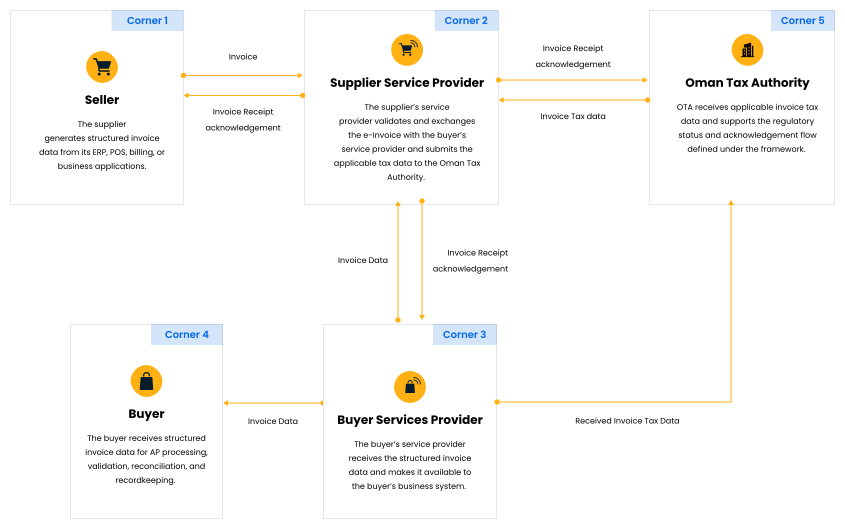
Oman follows a PEPPOL-based 5-corner model connecting suppliers, buyers, service providers, and the Oman Tax Authority.

Structured Invoice Readiness

Businesses need to prepare ERP and invoicing systems for structured invoice data, validation requirements, and applicable PINT-OM specifications and business rules.

Business Readiness

ERP integration, master data, VAT treatment, invoice scenarios, exception handling, business continuity, and audit controls should be assessed before implementation.

Why e-Invoicing Matters in Oman

Oman is moving toward a structured digital tax ecosystem under the Oman Tax Authority’s Fawtara initiative. As businesses move beyond traditional paper, PDF, and manual invoice processes, structured electronic invoicing will support standardized data exchange, stronger tax transparency, improved automation, and greater transaction-level visibility.

Digital Tax Shift

Oman is advancing tax digitization through the Oman Tax Authority’s Fawtara e-Invoicing initiative.

Mandatory Rollout

e-Invoicing becomes mandatory from 1 April 2027, with further expansion from 1 October 2027 based on annual supplies.

PEPPOL Framework

The 5-corner PEPPOL model enables secure, standardized invoice exchange across businesses, service providers, and OTA.

Operational Efficiency

Structured e-Invoicing can reduce manual errors, improve processing accuracy, and enhance automation.

Enhanced Transparency

Standardized invoice data strengthens transaction-level transparency, auditability, and compliance oversight.

Digital Tax Future

The mandate supports Oman’s broader agenda for tax modernization and a digitally connected economy.

Key Challenges Businesses Face 

  • Structured Format Readiness – Preparing ERP and invoicing systems to generate, map, validate, and exchange structured invoice data against applicable Oman requirements.
  • ERP & System Integration – Connecting ERP, POS, billing, finance, and other source systems with the selected service provider without disrupting existing business workflows.
  • Mandate & Deadline Readiness – Aligning implementation plans with the applicable 1 April or 1 October 2027 deadline while preparing systems, data and compliance workflows for Fawtara.
  • Invoice Data Accuracy – Ensuring invoice data accuracy to meet validation rules and reduce future rejection risk.
  • Vendor & Buyer Alignment – Aligning internal teams, vendors, buyers, and service providers with the new compliance workflow.
  • Exception & Audit Controls – Building controls for acknowledgements, validation failures, retries, corrections, outages, disaster recovery, archival, and exception ownership.
  • VAT & Transaction Scenario Readiness – Testing standard-rated, zero-rated, exempt, reverse-charge, advance-payment, correction, and other applicable transaction scenarios before go-live.
  • Business Continuity & Data Recovery – Preparing for system outages, technical failures and data loss with appropriate recovery, monitoring and continuity controls.

For enterprises evaluating e-Invoicing solutions in Oman, readiness goes far beyond changing the invoice format. It can impact ERP data, VAT logic, customer and supplier master data, structured invoice mapping, exception handling, AP/AR workflows, business continuity, archival, and audit readiness.

Key Challenges Jordan Businesses Face

How Oman’s PEPPOL-Based 5-Corner Model Works 

Oman’s e-Invoicing framework follows a PEPPOL-based 5-corner model that connects suppliers and buyers through service providers while enabling applicable invoice tax data to flow to the Oman Tax Authority. The model supports structured, standardized, and interoperable invoice exchange across the ecosystem. 

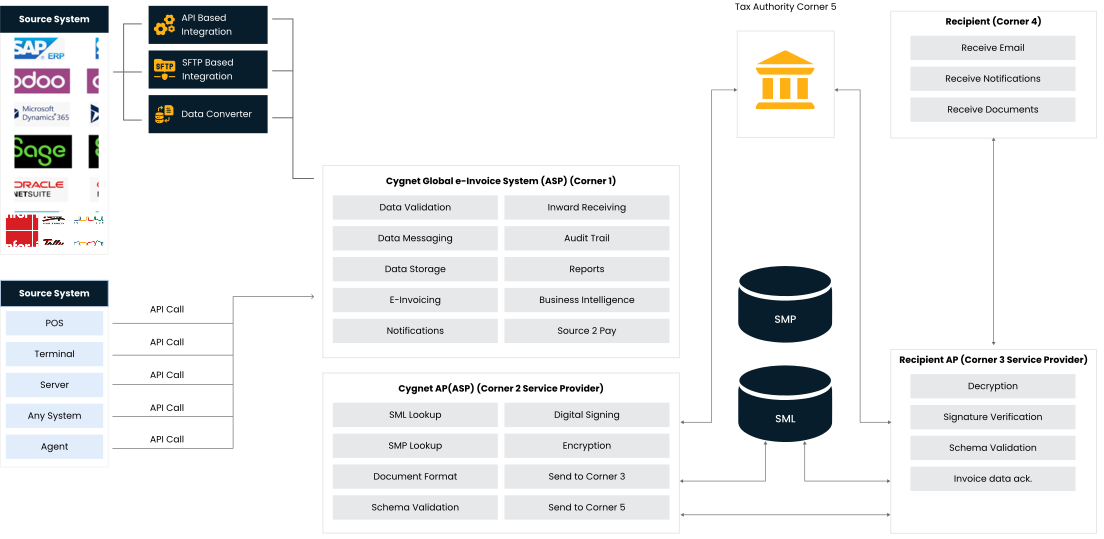
Oman e-Invoicing Architecture: From ERP to PEPPOL Exchange

See how invoice data can move from ERP, POS, billing, and source systems through transformation, validation, PEPPOL-based exchange, OTA reporting, acknowledgement tracking, and archival. 

Cygnet.One Oman e-Invoicing Solution at a Glance 

Cygnet.One helps enterprises prepare for Oman e-Invoicing with a scalable solution designed for structured invoice validation, ERP integration, PEPPOL exchange, acknowledgement tracking, and audit-ready archival.

Cygnet.One brings invoice validation, PEPPOL exchange, ERP connectivity, acknowledgement tracking, and archival into one operating layer for Oman e-invoicing readiness.

One platform for VAT + e-Invoicing

Validate invoice data against applicable tax and business rules

Align VAT treatment, tax codes, exemptions, and zero-rated transactions

Manage credit note, debit note, advance payment, import, and reverse charge scenarios

Reconcile invoices with GL, tax reports, and accounting records

Track acknowledgements, corrections, retries, and exceptions

Maintain audit-ready trails for every transaction

VAT Readiness Alongside Oman e-Invoicing

e-Invoicing directly connects invoice data with VAT treatment, transaction classification, reconciliation, and audit readiness. Finance and tax teams should prepare VAT compliance and invoice-exchange processes together rather than treating them as separate workstreams.

This unified approach helps reduce manual errors, improve VAT accuracy, close reconciliation gaps, and give finance and tax teams better control over compliance.

Trust metrics

Organizations worldwide rely on our enterprise-grade e-Invoicing solution. 

14+ global accreditations 

1 scalable platform 

25+ years of expertise 

5 billion+ documents generated 

250+ ERP integrations  

1000+ enterprise clients 

Start Your Oman E-Invoicing Journey with Confidence

Get a practical assessment of your ERP readiness, invoice data quality, VAT treatment, PEPPOL exchange requirements, archival controls, and go-live roadmap.

background image

FAQs

Fawtara is Oman’s electronic invoicing programme introduced by the Oman Tax Authority (OTA). It enables invoices to be issued, exchanged, validated and reported electronically in a structured digital format instead of relying on paper or PDF invoices. A PDF invoice by itself is not considered an e-invoice under the Fawtara framework.

OTA has announced a phased implementation:

  • Phase 1: 100 large VAT-registered companies, beginning August 2026
  • Phase 2: All large VAT-registered companies, beginning February 2027
  • Phase 3: Remaining VAT-registered taxpayers, beginning August 2027
  • Phase 4: Government institutions and entities, with the implementation year for the February start still to be announced

Businesses can also use OTA’s rollout-checking facility to verify their applicable rollout period using their VAT identification number.

Oman uses a 5-Corner Model. The supplier sends the invoice through its service provider, which exchanges the validated invoice with the buyer’s service provider. The buyer receives the invoice while specified tax data is also transmitted to OTA. This model is designed to support secure and interoperable invoice exchange between businesses.

Businesses participating in Fawtara are expected to work with a service provider that meets OTA’s accreditation requirements. OTA requires taxpayers to complete integration with their respective service provider on or before their applicable go-live date.

Not necessarily. OTA states that existing ERP systems may be retained depending on the arrangement between the taxpayer and its accredited service provider. Businesses should, however, assess whether their ERP, accounting and billing systems can capture the required data and integrate with the Fawtara ecosystem.

Businesses should identify their applicable rollout phase, assess invoice data quality, map invoice fields across ERP and billing systems, evaluate integration requirements, select an appropriate service provider and plan sufficient time for testing and onboarding. OTA has stated that taxpayers are expected to complete service-provider integration before their respective go-live dates.