What’s new

Global e-Invoicing

e-Invoicing compliance Timeline

Know More →

Global e-Invoicing

UAE e-Invoicing: The Complete Guide to Compliance and Future Readiness

Read More →

Cygnet Vendor Postbox

Types of Vendor Verification and When to Use Them

Read More →

Cygnet Vendor Postbox

Safeguard Your Business with Vendor Validation before Onboarding

Read More →

Cygnet BridgeFlow

Modernizing Dealer/Distributor & Customer Onboarding with BridgeFlow

Read More →

Cygnet BridgeFlow

Accelerate Vendor Onboarding with BridgeFlow

Read More →

Cygnet Bills

GST Filing 360°: GST, E-Invoicing, E-Way Bills & Annual Returns Made Simple

Read More →

Cygnet Bills

Why Manual Tax Determination Fails for High-Volume, Multi-Country Transactions

Read More →

Cygnet IRP

GST Filing 360°: GST, E-Invoicing, E-Way Bills & Annual Returns Made Simple

Read More →

Cygnet IRP

Key Features of an Invoice Management System Every Business Should Know

Read More →

Cygnature

Automating the Shipping Bill & Bill of Entry Invoice Operations for a Leading Construction Company

Read More →

Cygnature

From Manual to Massive: How Enterprises Are Automating Invoice Signing at Scale

Know More →

What’s new

Data Analytics & AI

AI-Powered Voice Assistant for Smarter Search Experiences

Explore More →

Data Analytics & AI

Cygnet.One’s GenAI Ideation Workshop

Know More →

Digital Engineering

Our Journey to CMMI Level 5 Appraisal for Development and Service Model

Read More →

Digital Engineering

Extend your team with vetted talent for cloud, data, and product work

Explore More →

Quality Engineering

Enterprise Application Testing Services: What to Expect

Read More →

Quality Engineering

Future-Proof Your Enterprise with AI-First Quality Engineering

Read More →

Cloud Engineering

Cloud Modernization Enabled HDFC to Cut Storage Costs & Recovery Time

Know More →

Cloud Engineering

Cloud-Native Scalability & Release Agility for a Leading AMC

Know More →

Managed IT Services

AWS workload optimization & cost management for sustainable growth

Know More →

Managed IT Services

Cloud Cost Optimization Strategies for 2026: Best Practices to Follow

Read More →

Amazon Web Services

Cygnet.One’s GenAI Ideation Workshop

Explore More →

Amazon Web Services

Practical Approaches to Migration with AWS: A Cygnet.One Guide

Know More →

Cygnet TaxAssurance

Tax Governance Frameworks for Enterprises

Read More →

Cygnet TaxAssurance

Cygnet Launches TaxAssurance: A Step Towards Certainty in Tax Management

Read More →

e-Invoicing Software in France for PA/PDP and Chorus Pro Readiness

Prepare for France’s mandatory e-Invoicing and e-Reporting reforms with a PEPPOL-accredited solution designed for PDP connectivity, Factur-X compliance, ERP integration, and multi-country tax compliance.

PDP-In ProgressPEPPOL-Enabled ERP-Compatible AI-Driven 100% Compliance

Why e-Invoicing Matters in France

France’s e-Invoicing and e-Reporting reforms are reshaping how businesses exchange invoice data and meet VAT compliance obligations. Organizations must prepare their systems, processes, and reporting frameworks to support structured invoicing, PDP connectivity, and ongoing compliance with the new requirements.

einvoicing for United Arab Emirates

Key Challenges Businesses Face

  • Navigating France’s evolving e-Invoicing, e-Reporting, and PDP requirements
  • Ensuring ERP and finance systems are ready for structured invoice exchange
  • Identifying and correcting invoice, VAT, and master data quality issues
  • Transitioning from PDF-based invoicing to compliant formats such as Factur-X, UBL, and CII
  • Managing supplier and customer onboarding across the new invoicing ecosystem
  • Aligning finance, tax, procurement, and IT teams around compliance initiatives
  • Maintaining end-to-end visibility, auditability, and reporting accuracy across invoice lifecycles
Key Challenges businesses Face

Everything you need to know about France e-Invoicing

Who / Applicability Timeline / When Model Transaction Type Format of E-Invoice Additional Notes
B2G (all suppliers to public sector) Live since 1 January 2020 Direct via Chorus Pro (not PA-to-PA routed)
B2G
Factur-X, UBL, CII (via Chorus Pro) Predates the B2B reform; buyer is the platform itself, so no PA intermediary is needed on the receiving side.
Large Companies Issue & Receive: 1 September 2026 PA-based exchange (Y-model via PPF)*
Domestic B2B
Factur-X, UBL, CII Must issue and receive from this date; e-reporting obligations (for their B2C/cross-border flows) apply in parallel.
Mid-size Companies (ETI) Issue & Receive: 1 September 2026 PA-based exchange (Y-model via PPF)*
Domestic B2B
Factur-X, UBL, CII Same as Large; e-reporting obligations apply in parallel.
All businesses (incl. PME & Micro) – Receive 1 September 2026 PA-based exchange
Domestic B2B
Factur-X, UBL, CII Receiving obligation applies to every VAT-registered business regardless of size, from this date.
PME (SME) & Micro-Enterprises – Issue 1 September 2027 PA-based exchange (Y-model via PPF)*
Domestic B2B
Factur-X, UBL, CII Issuance starts from this date; e-reporting obligations apply in parallel. Note: PME and Micro are two distinct size categories (different thresholds) that happen to share this Phase-2 date.
Non-established taxable persons (foreign entities with French VAT obligations) 1 September 2027 E-reporting only — no PA-based invoice issuance
Cross-border B2B / international
Structured reporting data Deferred to align with Phase 2 under the Sept 2025 simplification package; report data rather than issue full e-invoices.
All businesses – E-reporting Phased: Large/ETI from 1 Sept 2026; PME/Micro from 1 Sept 2027 PA-based reporting to PPF → DGFiP
B2C
B2B international/cross-border
Structured (aggregated) reporting data Transaction data for non-e-invoiced flows must be transmitted to the tax administration; payment/collection data is also subject to e-reporting.
Large Companies 1 September 2026 PDP-based exchange
Domestic B2B
Factur-X, UBL, CII Must be able to receive and issue e-Invoices; e-reporting obligations also apply.
Mid-size Companies (ETI) 1 September 2026 PDP-based exchange
Domestic B2B
Factur-X, UBL, CII Must be able to receive and issue e-Invoices; e-reporting obligations also apply.
SMEs & Micro Enterprises – Receive 1 September 2026 PDP-based exchange
Domestic B2B
Factur-X, UBL, CII All businesses must be able to receive e-Invoices from this date.
SMEs & Micro Enterprises – Issue 1 September 2027 PDP-based exchange
Domestic B2B
Factur-X, UBL, CII Issuance obligation starts from this date; e-reporting obligations also apply.
All Businesses – E-reporting Phased from 1 September 2026 PDP-based reporting
B2C
B2B International / cross-border
Structured reporting data Transaction data for non-e-invoiced transactions must be transmitted to the tax administration; payment data is also subject to e-reporting requirements.

e-Invoices are sent and received through certified Partner Dematerialization Platforms (PDPs).

Understand What France’s E-Invoicing Mandate Means for Your Business

Key Features of Our France e-Invoicing Software

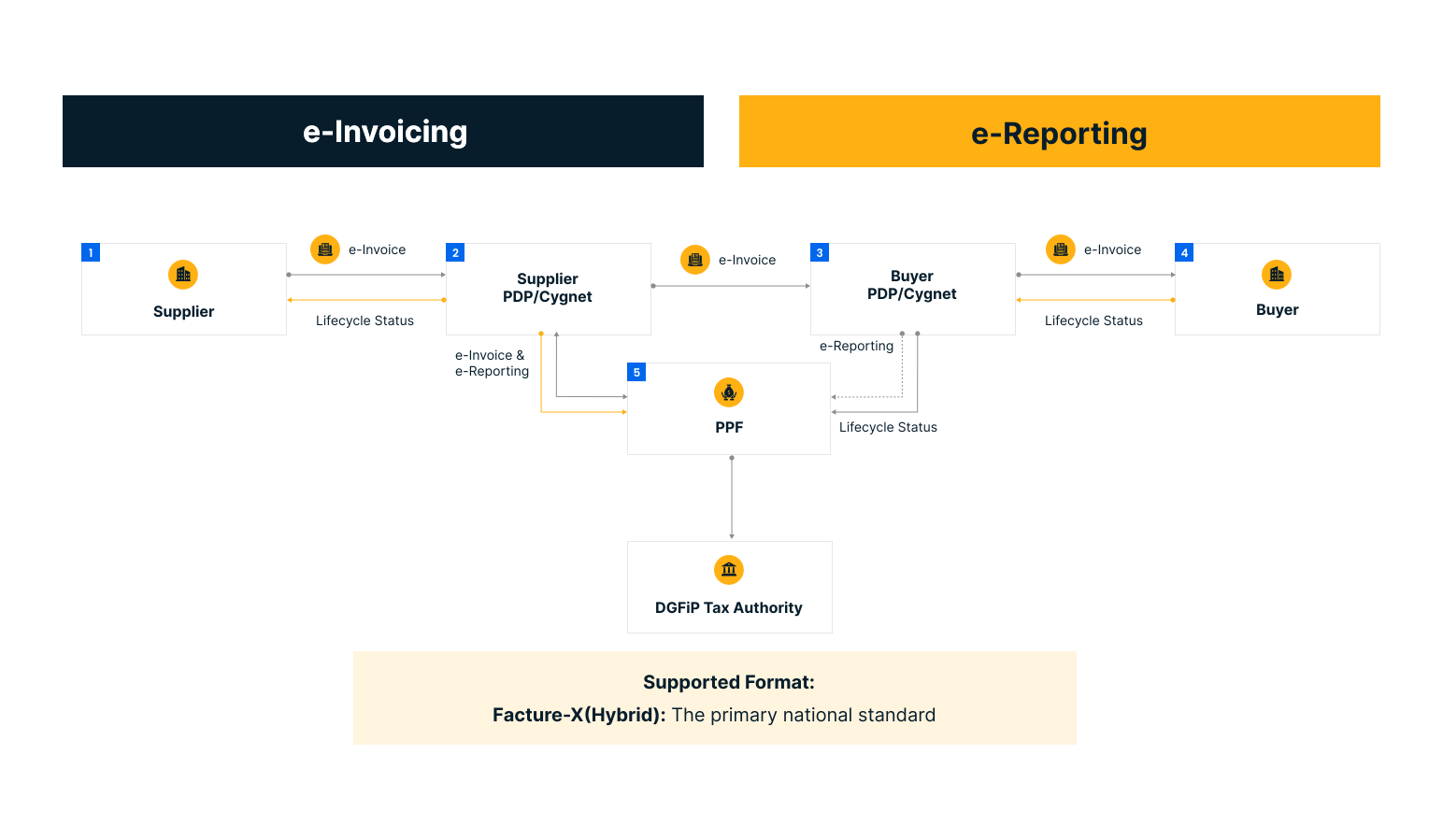
France e-Invoicing Flow

Streamline invoice exchange, e-Reporting, and compliance management through one connected platform.

France e-Invoicing flow

How It Works

1

Invoice Generation

Generate structured e-invoices from ERP or business systems in compliant formats such as UBL, CII or Factur-X.

2

Validation & Compliance Checks

Validate invoice data, mandatory fields, tax information, and required structured invoice formats.

3

PDP Exchange & e-Reporting

Send e-invoices through an authorised PDP for secure exchange with the buyer’s platform and transmission of required data to the French tax administration.

4

Storage & Audit Readiness

Securely archive electronic invoices with complete transaction records, audit trails, and statutory retention support.

Cygnet.One’s e-invoicing software in France automates the end-to-end e-Invoicing lifecycle with ERP integration, real-time validation, secure PDP exchange, e-Reporting support, and audit-ready archival.

Value Created by Cygnet.One

Organizations worldwide rely on our enterprise-grade e-Invoicing solution.

15+ global accreditations 

1 scalable platform 

26+ years of expertise 

5 billion+ documents generated 

250+ ERP integrations  

1000+ enterprise clients 

Our Accreditations

With tax authorities across the globe

Insights from our experts

FAQs

Yes. France is implementing mandatory e-Invoicing and e-reporting for B2B transactions in phases. From September 2026, all businesses must be able to receive e-Invoices, while large and mid-sized companies will be required to begin issuing e-Invoices and e-reporting. The rollout will continue in stages, with full implementation for all businesses expected by September 2027.

A PDP (Plateforme de Dématérialisation Partenaire) is a government-certified private platform that enables businesses to **issue and receive e-Invoices, perform e-reporting to the French tax authority, and comply with France’s e-Invoicing regulations**. PDPs act as intermediaries between businesses and the French tax administration, helping ensure secure and compliant exchange of invoice and reporting data.

Chorus Pro is the French government’s official invoicing platform, primarily used for **B2G (Business-to-Government) transactions. It has been mandatory for invoicing public sector entities since 2020 and, under France’s new e-Invoicing framework, will continue to play an important role alongside **PDPs and the central platform

All businesses established in France and registered for VAT are required to comply with the e-Invoicing mandate, including **large enterprises, mid-sized companies, SMEs, and micro-enterprises**. The mandate applies primarily to **domestic B2B transactions**, while **B2C and cross-border transactions are subject to additional e-reporting requirements** under the French framework.

In France, e-Invoicing covers domestic B2B transactions and requires structured invoices to be exchanged electronically. e-Reporting covers mainly B2C and cross-border transactions by sending relevant transaction and VAT data to the French tax authority.

France supports several e-Invoice formats, including **Factur-X, UBL 2.0/2.1, CII, Peppol BIS 3.0, EDIFACT**, and compliant PDF formats. **UBL, CII, and Factur-X** are the three mandatory core formats that accredited e-Invoicing platforms must support.

No – e-invoicing applies only to domestic B2B transactions in France.

Cygnet.One supports e-Invoicing France compliance through ERP integration, invoice transformation, data validation, PDP connectivity, e-Reporting, reconciliation, audit logs, and secure archival.

Get Ready for France’s E-Invoicing & E-Reporting Mandate