What’s new

Global e-Invoicing

e-Invoicing compliance Timeline

Know More →

Global e-Invoicing

UAE e-Invoicing: The Complete Guide to Compliance and Future Readiness

Read More →

Cygnet Vendor Postbox

Types of Vendor Verification and When to Use Them

Read More →

Cygnet Vendor Postbox

Safeguard Your Business with Vendor Validation before Onboarding

Read More →

Cygnet BridgeFlow

Modernizing Dealer/Distributor & Customer Onboarding with BridgeFlow

Read More →

Cygnet BridgeFlow

Accelerate Vendor Onboarding with BridgeFlow

Read More →

Cygnet Bills

GST Filing 360°: GST, E-Invoicing, E-Way Bills & Annual Returns Made Simple

Read More →

Cygnet Bills

Why Manual Tax Determination Fails for High-Volume, Multi-Country Transactions

Read More →

Cygnet IRP

GST Filing 360°: GST, E-Invoicing, E-Way Bills & Annual Returns Made Simple

Read More →

Cygnet IRP

Key Features of an Invoice Management System Every Business Should Know

Read More →

Cygnature

Automating the Shipping Bill & Bill of Entry Invoice Operations for a Leading Construction Company

Read More →

Cygnature

From Manual to Massive: How Enterprises Are Automating Invoice Signing at Scale

Know More →

What’s new

Data Analytics & AI

AI-Powered Voice Assistant for Smarter Search Experiences

Explore More →

Data Analytics & AI

Cygnet.One’s GenAI Ideation Workshop

Know More →

Digital Engineering

Our Journey to CMMI Level 5 Appraisal for Development and Service Model

Read More →

Digital Engineering

Extend your team with vetted talent for cloud, data, and product work

Explore More →

Quality Engineering

Enterprise Application Testing Services: What to Expect

Read More →

Quality Engineering

Future-Proof Your Enterprise with AI-First Quality Engineering

Read More →

Cloud Engineering

Cloud Modernization Enabled HDFC to Cut Storage Costs & Recovery Time

Know More →

Cloud Engineering

Cloud-Native Scalability & Release Agility for a Leading AMC

Know More →

Managed IT Services

AWS workload optimization & cost management for sustainable growth

Know More →

Managed IT Services

Cloud Cost Optimization Strategies for 2026: Best Practices to Follow

Read More →

Amazon Web Services

Cygnet.One’s GenAI Ideation Workshop

Explore More →

Amazon Web Services

Practical Approaches to Migration with AWS: A Cygnet.One Guide

Know More →

Cygnet TaxAssurance

Tax Governance Frameworks for Enterprises

Read More →

Cygnet TaxAssurance

Cygnet Launches TaxAssurance: A Step Towards Certainty in Tax Management

Read More →

Germany e-Invoicing Solution for XRechnung, ZUGFeRD and EN 16931 Compliance

Prepare your finance, tax, AP, AR and ERP teams for Germany’s phased B2B e-Invoicing mandate with structured invoice generation, receipt readiness, validation workflows, ERP integration and audit-ready archival.
Germany's e-Invoicing Transformation is Here

Germany is undergoing one of the biggest tax digitization initiatives in Europe. As part of its broader VAT modernization strategy and future Continuous Transaction Controls (CTC) framework, Germany is introducing mandatory structured e-Invoicing for domestic B2B transactions.

Unlike traditional PDF invoices, Germany requires businesses to adopt machine-readable structured invoice formats that comply with European standards.

Organizations operating in Germany must prepare their ERP systems, invoice processes, supplier networks, and compliance controls to avoid disruptions.

Image

Why Germany e-Invoicing Matters

  • Increase VAT transparency and reduce tax fraud
  • Standardize invoice exchange across businesses
  • Improve automation and processing efficiency
  • Prepare businesses for future digital reporting obligations
  • Align Germany with broader European Union digital tax initiatives
Image

Common Challenges Businesses Face

  • Multiple Invoice Standards: Businesses must support formats such as: XRechnung, ZUGFeRD, and EN 16931 compliant EDI.

    Managing multiple formats across customers and suppliers can become complex.

  • ERP Integration Complexity: Organizations often operate multiple ERP systems across regions, making invoice generation and validation difficult.

  • Supplier and Customer Readiness: Businesses must ensure both sending and receiving capabilities are established across their ecosystem.
  • Compliance Monitoring: Germany’s phased rollout requires businesses to continuously monitor changing obligations and deadlines.
  • Archival and Audit Requirements: Invoices must be stored securely while maintaining authenticity, integrity, and accessibility.
  • Cross-Border Operational Complexity: Multinational organizations need a scalable solution that supports Germany alongside other global e-Invoicing mandates.
Image

Everything You Need to Know About Germany e-Invoicing

Germany e-Invoicing is being introduced in phases, starting with mandatory receipt readiness from 2025 and moving toward mandatory structured invoice issuance from 2027 and 2028.

Who / Turnover /
Applicability
Timeline / When Model Transaction Type Additional Notes
All Companies (Any Turnover) 1 January 2025 Structured EN 16931 e-Invoicing
B2B
Businesses must be able to receive structured e-Invoices in EN 16931 formats (XRechnung, ZUGFeRD ≥ 2.0.1, CII, UBL, or Peppol BIS). Suppliers may still send PDF or paper invoices if the recipient agrees.
Large Taxpayers (≥ €800,000 Annual Turnover) 1 January 2027 Structured EN 16931 e-Invoicing
B2B
Mandatory issuance of structured e-Invoices. Direct system-to-system exchange is permitted where compliant and mutually agreed. Certain EDI formats remain acceptable if compliant with recognized standards.
SMEs (≤ €800,000 Annual Turnover) Until 31 December 2027 Transition Period
B2B
SMEs may continue issuing PDF or paper invoices during the transition period. Structured e-Invoicing becomes mandatory from 1 January 2028.
All Companies (Final Phase) 1 January 2028 Structured EN 16931 e-Invoicing
B2B
Mandatory issuance of structured e-Invoices for all domestic B2B transactions. Paper and PDF invoices will no longer be permitted.
Suppliers to Public Sector Already Mandatory (Since 2020/2021) B2G e-Invoicing (ZRE / OZG-RE / Peppol)
B2G
Mandatory B2G e-Invoicing using ZRE/OZG-RE portals or Peppol. Supported formats include XRechnung, Peppol BIS, and ZUGFeRD. Channels vary across German federal states (Länder).
All Companies (Future Reporting) ~2030 EU ViDA-Aligned Transactional Reporting
B2B
B2G
Germany plans to introduce a national electronic transaction reporting system aligned with the EU VAT in the Digital Age (ViDA) initiative.

Germany e-Invoicing, Simplified

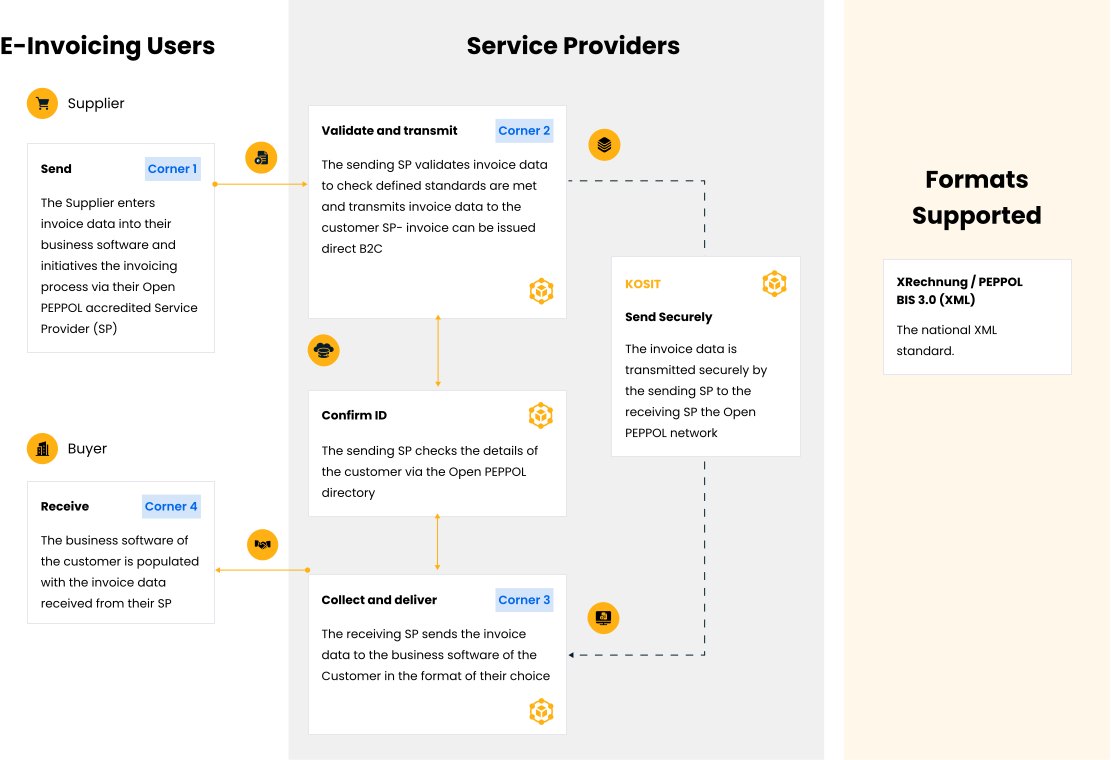
e-Invoicing in Germany - The Flow

Compliance + Experience = Trust

Organizations worldwide rely on our enterprise-grade e-Invoicing solution. 

14+ global accreditations 

1 scalable platform 

25+ years of expertise 

5 billion+ documents generated 

250+ ERP integrations  

1000+ enterprise clients 

Our Accreditations

Cygnet.One maintains regulatory compliance and certifications across multiple jurisdictions, ensuring enterprises can adopt a trusted digital invoicing solution for global operations.

Resources

Blog

Germany E-Invoicing Mandate Explained (2025–2028): Timeline, Formats & VAT Impact 

Germany e-invoicing becomes mandatory for B2B transactions from 2025 to 2028. Understand timelines, XRechnung, ZUGFeRD formats, VAT impact, and readiness…

Read More Explore Full Story
Blog

Overcoming e-Invoicing Implementation Challenges for Global Businesses

Learn how global businesses can overcome e-Invoicing implementation challenges, including multi-country compliance, data accuracy, and change management.

Read More Explore Full Story
Blog

Global e-Invoicing Roadmap 2025–2027: What Enterprises Must Prepare For 

Understand the global e-invoicing roadmap for 2025–2027, key mandates, regional timelines, and how enterprises should prepare for real-time compliance.

Read More Explore Full Story