



































The finance function is being subjected to greater demands to move beyond mere transaction processing. These include demands for speed, precision, adherence to rules, and timely insights amid rising transaction volumes and complex regulations. This situation calls for automation of the financial process.
End-to-end automation of the AP and AR processes is quickly becoming the bedrock of today’s finance function. The end-to-end process incorporates all aspects of the invoice management process from the purchase of goods to payments to issuing invoices to collecting cash.
This is not merely an issue of efficiency but a means of converting the finance department into a strategic, real-time, and insights-oriented function.
The Hidden Cost of Manual Finance Operations
Finance executives recognize the inefficiencies of their AP and AR systems, but what they may be unaware of is the cost that inefficiency incurs, not just in concept, but in real dollars that are walking out the door daily.
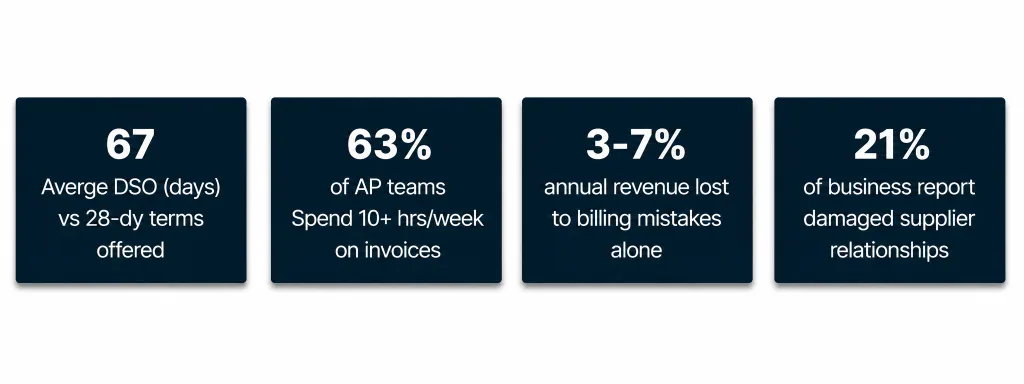
It’s not a matter of whether these inefficiencies are present, because they are and they have a tangible cost. It’s when you will reach the point where it becomes too costly not to fix them.
What End-to-End Automation Actually Means
The term “AP and AR automation” is used in an elastic manner. Some use it to refer to the digital process of invoice approval. Others see it as a way of digitizing the input process by scanning invoices rather than manually entering them into the system. That’s not full automation but only automation of one process among others: out of ten.
| ACCOUNTS PAYABLE (Procure to Pay) | ACCOUNTS RECEIVABLE (Invoice to Cash) |
| Purchase order created | Contract terms read, invoice generated |
| Invoice captured | Invoice delivered instantly on shipment |
| 3-waymatching (PO/GRN/invoice) | Payment tracked, AI predicts delays |
| Approval routing by business rules | Automated dunning, risk-prioritised |
| Payment executed (with discount logic) | AI cash application, matches payment |
| Reconciled to ERP automatically | Cash posted to ERP, Books closed |
Partial automation deals with simple tasks while leaving complex processes for manual handling. Complete automation involves running the whole process from start to finish. Humans will check for any exceptions, but they won’t do anything else. After the invoice is approved, payment will be processed behind the scenes without printing checks or keying numbers. Since the system will always follow company guidelines, it becomes easier to spot any exceptions.
The AP Side: What Automation Actually Changes
Accounts payable encompasses procurement, operations, IT, and suppliers, which is precisely why the automation of AP processes will never be solely an IT project. Each stage along the procure to pay process has always been a challenge. This is what will change when you automate each step.
Invoice Capture
The point where things begin, and one of the least appreciated benefits. For organizations that are still dealing with paper invoices, artificial intelligence (AI)-based optical character recognition (OCR) captures invoice information without the need for any manual input. If an organization deals with electronic invoices, and this practice is becoming increasingly common as mandates such as India’s Goods & Services Tax (GST), Poland’s KSeF, and Saudi Arabia’s ZATCA Phase 2 are being implemented across the world, invoice data is provided in structured format without any capture.
The three-way match
verifying that the invoice matches the purchase order and goods receipt note – and this is where most AP groups waste their time. This process happens instantly with automated matching. If there is an exception where there is a discrepancy in the figures, or a field is missing, it will go to someone. Otherwise, it goes straight through. Many legacy solutions have fixed database models, manual uploads of files, and run in batches; nothing works like that in AP automation today. Not anymore, EY.
Approval routing
It is done according to business rules (invoice amount, vendor category, cost centre) rather than the person who happened to come into the office and see the email. Approval happens instantly with an audit trail, no hassles involved.
The payment execution phase
It involves strategic decisions around cash management. An automation platform provides you with instant insight into your AP transactions and highlights early payment opportunities to secure the discount from suppliers. Your payment run is no longer dependent on when someone thinks to initiate it.
The AR Side: Getting Paid Faster Without Chasing More
In terms of revenue collection, the situation is similar but even more critical because AR inefficiency directly impacts cash flow, while in a competitive environment, it could be detrimental to client relations if billing was irregular or collections were seen as pushy.
A closed deal in an automated setting means that automation will interpret the agreement, create accurate invoices, send them to the clients, monitor the process of payment and reconcile cash flow without any human intervention. That is where the bar is set. And most companies do not get close to that. This is how each part of the process works ideally. Marosa
The creation and dispatch of the invoices
It must take place right after the goods were delivered. Any delay until someone on the billing staff does this creates extra time in your DSO for free. Automation takes away the delay. Automating reminders, providing clients with ways to make digital payments and monitoring client activity are key elements here.
Time spent on collections and dunning
AR processes tend to be time consuming in many organizations because accounts are manually identified and selected for chasing, while reminder follow-up emails may lack uniformity in tone and frequency. Automated dunning, on the other hand, schedules reminders, prioritizes them based on a risk score assigned, and escalates them to a person only after the sequence of automated steps has failed.
Cash application
These processes are another activity where human labor is often extensive, particularly as payments received contain limited remittance data, necessitating cross-referencing multiple sources of information to match them. Automated cash application through AI technology uses confidence scoring for automated exception handling and immediate posting to an ERP system. All companies employing AI in AR have managed to improve their Days Sales Outstanding metric, with 75% experiencing a decrease of six or more days.
The DSO Problem: Why This Is a Cash Story, Not an Admin Story
The most critical statistic when automating AR is Days Sales Outstanding; the number of days on average between sending out an invoice and getting paid. It’s something that most finance departments keep tabs on. However, very few finance departments have a strategic approach to lowering it. Automation becomes that strategy.
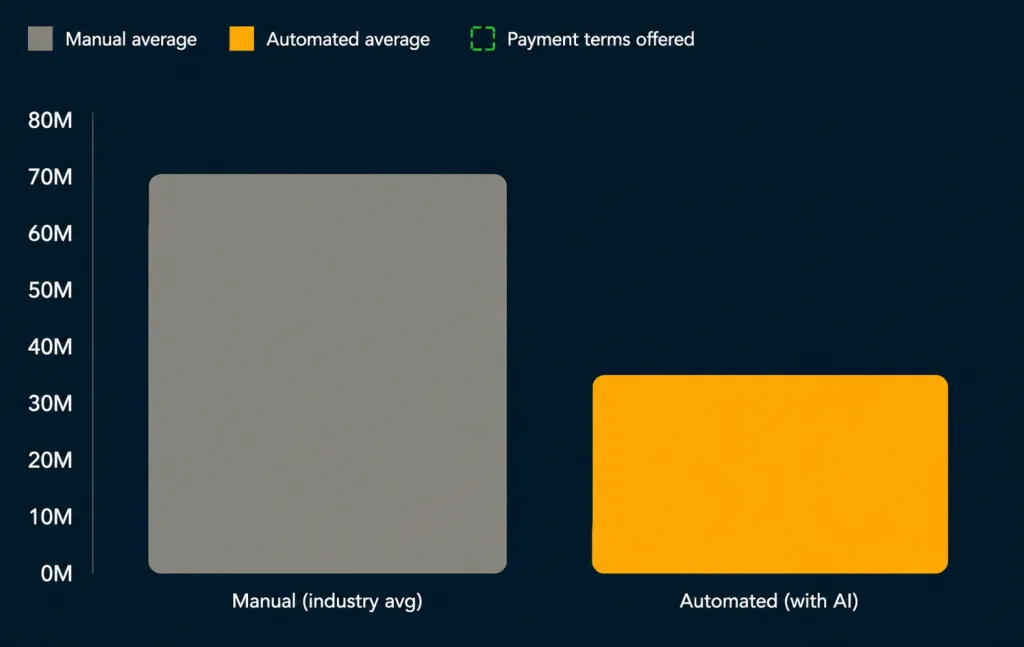
Businesses implementing end-to-end AR automation have received DSO from an industry average of 67 days down to 33-40 days – a reduction of over 30 days in collected cash cycle time
By automating their AR processes, companies were able to bring down DSO from 67 days on average to 33-40 days. Finance departments also reported a 50% decline in the number of accounts older than 90 days. It’s not just a slight improvement but a complete shift in cash flow.
Where AP and AR Connect: The Cash Intelligence Layer
Normally, AP and AR are managed separately by different teams, software, and processes. The result is that there is a lack of visibility.
The integration of the AP and AR automation system addresses this issue by consolidating all activities into a single platform.
- Cash visibility: Having information on both inbound and outbound payments simultaneously will make it easier to make more accurate cash decisions on a weekly basis.
- Cash management: If there is an instance where a customer payment is overdue, while an invoice is due to be settled to a supplier, then you will be able to plan better.
- Dynamic discounting: If you need to take advantage of discount offers from your suppliers, or encourage your customers to pay early, then you have that option available.
- Automatic accounting: Invoice and payment matching will happen automatically, rather than manually each month-end.
- Accurate cash forecasting: Informed by actual transactions, rather than projections, cash forecasts will be more accurate.
In layman’s terms, integration allows finance teams to have a complete real-time view of their cash flows.
The Metrics That Tell You If It Is Working
Automation without measurement is activity without accountability. These are the numbers to track from day one.
| METRIC | FUNCTION | MANUAL BENCHMARK | AUTOMATED TARGET | SIGNAL |
| Day sales outstanding (DSO) | AP | Industry avg: 67 days | 33-40 days | No. 1 metric |
| Invoice processing cost | AP | $5-$15 per invoice | $1-$3 per invoice | Cost ROI |
| Straight-through processing rate | AP | Below 30% | Above 80% | Efficiency |
| Cash application hit rate | AR | Below 60% | 90% + automated | Quality |
| 90-day aged accounts | AR | High and growing | 50% reduction | Risk Flag |
If you have a straight-through processing rate below 50%, this indicates that the easier invoices are being taken care of by automation, while the difficult invoices remain with your employees to be dealt with, suggesting that there is an issue with your match rules, master data, or ERP connection. If you have a cash application hit rate below 70%, this suggests that the data quality from the customers is at fault.
Conclusion: AP and AR as Strategic Assets
Automation is now not only about saving time but becoming a powerful instrument to transform your finance function. Using the end-to-end AP & AR automation process gives you an opportunity to reduce expenses, make your invoicing faster, and see your finances in more detail. In this case, you’ll be able to go from boring tasks to decision-making which will be more helpful for your business.
But there is also one more aspect that should be highlighted, Being a first mover here brings some serious benefits. With faster collections, improved working capital, and less dependency on borrowed money, you will be able to invest in growing your business. The question is not whether to automate. It is whether to do it now and gain the advantage, or later and spend the next few years catching up.
FAQs
Companies benefit from reduced manual work in AP processes, increased accuracy via automatic matching, faster approval processes, and better cash management thanks to early detection of discounts and proper scheduling of payments.
Automation of invoice generation, prompt delivery, and reminders/follow-ups can assist in improving cash flows since they enable faster payment processing due to prompt invoice delivery.
Three-way matching is the verification process of an invoice, purchase order, and the receipt of products against an invoice prior to payment. Automation makes this instant and alerts of any discrepancies to avoid overpayment or other inaccuracies without any manual work.
Automation decreases the time involved in creating, delivering and following up with invoices and results in quicker payments from clients due to timely invoice delivery resulting in lower DSO.
Artificial intelligence increases efficiency in automation due to the following factors: intelligent capture through OCR, smart invoice/payment matching, and predictive analysis. AI plays a role in cash application automation through automatic invoicing and payment matching according to the confidence level.
Difficulties associated with automation of the processes inside the company may consist of system fragmentation, data inconsistency, lack of change management, and complex ERP integration.