
































Generative AI is speeding up operations by stepping in where workflows stall, such as the reports, the drafts, and the responses that eat up time before the real work even begins
At its core, generative AI use cases are the specific workflows where AI produces outputs your team can act on, such as content, code, customer responses, data summaries, and more. Unlike traditional automation that follows fixed rules, generative AI generates new outputs by learning from large datasets, which means it adapts to context rather than just executing a script.
According to McKinsey’s 2025 State of AI survey, 71% of organizations now regularly use generative AI in at least one business function, up from 65% just a year earlier, reflecting a quick shift from experimentation to operational use.
In this blog, we break down 10 high-impact generative AI use cases across industries, explore how GenAI fits into automation workflows, and outline what enterprises actually gain when deployment is done right.
What are Generative AI Use Cases?
Generative AI use cases refer to real-world applications where AI models produce content, code, decisions, or data outputs based on inputs or triggers. Unlike traditional automation that follows fixed rules, generative AI generates new outputs using patterns learned from large datasets.
These use cases span every major business function, from marketing and software development to healthcare, finance, and customer support.
At their core, generative AI use cases are valuable when they replace a repetitive, structured output task that previously required significant human time. The output can be text, code, an image, a summary, or a structured dataset, depending on the model and the workflow it is embedded in.
Common examples include:
- Content and copy generation (blogs, emails, ad copy)
- AI-powered chatbots and virtual assistants
- Code generation and technical documentation
- Clinical and legal document automation
- Financial reporting and data summarization
Core Categories of Generative AI Use Cases
Generative AI applications cluster into a small number of operational categories. Understanding them before diving into specific use cases helps frame where AI delivers real impact versus where it tends to be overpromised.
The core categories are:
- Content generation and marketing automation
- Conversational AI and virtual assistants
- Software development and code generation
- Creative design and media production
- Data generation and simulation
These categories form the foundation of most enterprise GenAI implementations and frequently overlap within automation workflows. A customer service implementation, for instance, may combine conversational AI with content generation to produce personalized responses.
The category boundaries are useful for planning, but real-world deployments typically cross them.
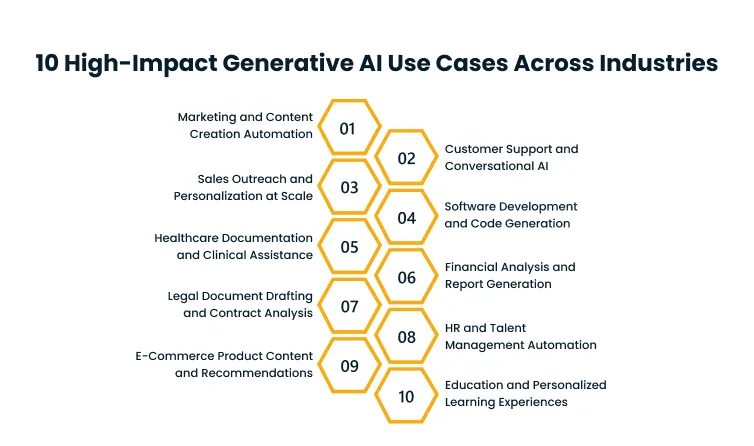
10 High-Impact Generative AI Use Cases Across Industries
Across industries, some generative AI use cases stand out for their consistency and scale of impact. The ten below represent workflows where AI replaces significant manual effort and delivers measurable results, each built around a clear, repeatable output type.
1. Marketing and Content Creation Automation
Marketing teams are under constant pressure to produce more content, faster, without sacrificing quality. Generative AI makes that possible by handling first drafts of blogs, ad copy, email sequences, and social content at a speed no human team can match.
The real gain is that teams can now test five variations of a campaign asset at the same cost as producing one. That changes how you approach creative decisions.
Key applications:
- Blog drafting and SEO content generation
- Personalized email sequences by user behavior
- Ad copy variations for A/B testing
- Product descriptions at catalog scale
- Social media content across platforms
AI-generated content still needs editorial oversight. Treat it as a strong first draft instead of a finished product, and you will get the most out of it.
2. Customer Support and Conversational AI
AI-powered support assistants now handle tier-1 queries, ticket classification, and FAQ resolution without requiring a human in the loop for every interaction.
According to the 2024 Gartner Customer Service Survey, 85% of customer service leaders planned to pilot conversational GenAI in 2025, signaling a clear industry shift from experimentation to implementation.
Unlike rule-based chatbots, modern conversational AI understands context, adapts to varied phrasing, and escalates to human agents when needed.
The measurable gains:
- Faster first response through AI-handled triage
- 24/7 availability with no staffing overhead
- Human agents freed for complex, high-value cases
The ceiling here is knowledge base quality. The better structured and more up-to-date your content is, the better your AI support outcomes will be.
3. Sales Outreach and Personalization at Scale
Writing personalized outreach for every prospect at a pipeline scale is not a realistic approach. Generative AI changes this by taking structured prospect data (role, industry, behavior signals) and producing personalized emails and follow-ups that need light editing, not full drafts.
Applications in sales:
- Personalized cold outreach from account research
- Follow-up sequences tailored to behavior signals
- Proposal drafts based on stated requirements
- Meeting prep summaries from CRM data
Teams that layer AI outreach on top of clean, segmented data consistently see better response rates. Without quality data feeding the AI, personalization becomes noise.
4. Software Development and Code Generation
Developer capacity is finite. More requirements, tighter timelines, and the same engineering headcount create a gap that AI-assisted coding tools are positioned to close.
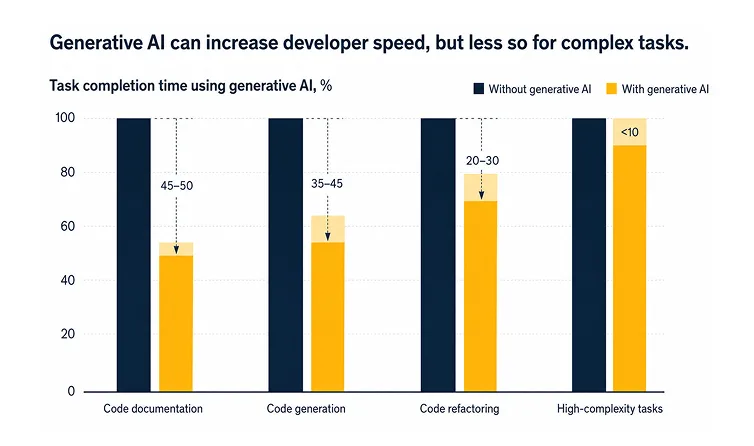
According to the 2024 McKinsey Developer Productivity Study, developers complete documentation in half the time and write new code twice as quickly when using generative AI tools.
Where the gains show up:
- Boilerplate and scaffolding generation
- Unit test writing for existing functions
- API documentation from code
- In-IDE code completions and refactor suggestions
- Converting requirements to working code drafts
AI copilots free up developer capacity for architecture-level decisions. For teams looking to build scalable AI workflows alongside their core product, managed AI services remove the infrastructure overhead entirely.
5. Healthcare Documentation and Clinical Assistance
Healthcare professionals spend disproportionate time on documentation that could be automated. Clinical notes, patient summaries, and referral letters are necessary, but they cut into patient-facing hours.
According to the 2025 McKinsey Healthcare GenAI Study, 85% of healthcare leaders had explored or adopted GenAI as of Q4 2024, with 64% reporting positive ROI from implemented use cases.
AI documentation tools transcribe consultations and generate structured EHR notes for clinician review. The outcome:
- Less time per patient spent on documentation
- More detailed notes from the full consultation capture
- More patients seen per shift without extending hours
Governance requirements are non-negotiable in healthcare. Clinician sign-off is mandatory for any AI-generated clinical output before it enters the record.
6. Financial Analysis and Report Generation
Finance teams produce the same structured content every period: reports, commentaries, and investor updates that follow consistent logic even when the numbers change. Generative AI automates this generation from structured data sources.
Connect AI to your ERP or data warehouse, define the output template, and the system generates the written report on trigger. Human review validates before distribution.
Key use cases:
- Monthly and quarterly report generation
- Variance commentary from comparative data
- Investor update drafts from financial performance data
- Regulatory filing support
- Forecast narrative from planning model outputs
For finance teams using AI in business intelligence more broadly, generative AI slots naturally into the reporting and narrative layer on top of your existing analytics.
7. Legal Document Drafting and Contract Analysis
Legal teams handle high volumes of contracts, NDAs, and compliance documents, many of which follow standard structures. Generative AI handles first drafts and contract analysis faster than manual review allows.
In the drafting direction, AI generates initial versions from defined templates and deals with parameters. Legal reviews and adjusts rather than starting from scratch, and the time saved in the drafting phase is significant.
In the analysis direction, AI reads contracts, flags non-standard clauses, identifies missing provisions, and summarizes key obligations. This is particularly valuable during due diligence at high volume.
Key applications:
- Standard contract drafting (NDAs, MSAs, vendor agreements)
- Clause extraction and risk flagging
- Cross-portfolio contract comparison
- Compliance checks within document sets
- Legal summarization for non-legal stakeholders
AI handles the repetitive work, while the legal judgment stays with your team.
8. HR and Talent Management Automation
Talent acquisition is operationally intensive regardless of company size. Generative AI handles a significant share of the workload without affecting the candidate experience.
Key applications:
- Job description generation by role, level, and department
- Resume screening and ranking against defined criteria
- Candidate communication templates by application stage
- Interview questions aligned to role requirements
- Onboarding documentation and training materials
Beyond acquisition, AI supports talent development through learning plan generation, performance review drafting, and policy updates at scale.
Governance matters here. AI screening must evaluate on role-relevant criteria only, and bias audits are essential before you scale. The efficiency gains are real, but the framework has to come first.
9. E-Commerce Product Content and Recommendations
Catalog scale is a content production problem for e-commerce teams. Thousands of SKUs need unique, SEO-optimized descriptions, and updating them manually is not sustainable. Generative AI produces content from structured product attributes in volume.
Applications beyond static descriptions:
- Bulk product description generation from attribute data
- SEO-optimized content by category and search intent
- Personalized descriptions based on browsing behavior
- Email recommendations based on purchase history
- Review summaries for product pages
Personalized product narratives by user segment improve conversion without requiring a larger content team. The prerequisite is clean, structured product data. Without it, AI-generated content will inherit the same gaps your catalog already has.
10. Education and Personalized Learning Experiences
Personalized instruction at an institutional scale has always required a trade-off between reach and quality. Generative AI removes that constraint by generating individualized content, assessments, and learning paths for each learner simultaneously.
Applications in education and enterprise L&D:
- Study material generation based on learning progress
- Quiz and assessment creation by curriculum objective
- Adaptive learning path recommendations
- Writing feedback and improvement suggestions
- Subject explanation at different complexity levels
For enterprise learning teams, AI generates role-specific training, compliance updates, and skill-gap assessments faster than traditional instructional design allows.
Measure outcomes, not just engagement. AI content that improves click-through without improving comprehension has not solved the underlying problem.
Each of these use cases becomes more powerful when it is not deployed in isolation. The real leverage comes from connecting generative AI to the workflows and data systems already driving your operations.
How Generative AI Fits into Automation Workflows
Individual use cases are a starting point, but where generative AI truly scales is when you embed it in automation workflows, where AI-generated outputs feed into downstream actions automatically. Let’s take a look at some examples below.
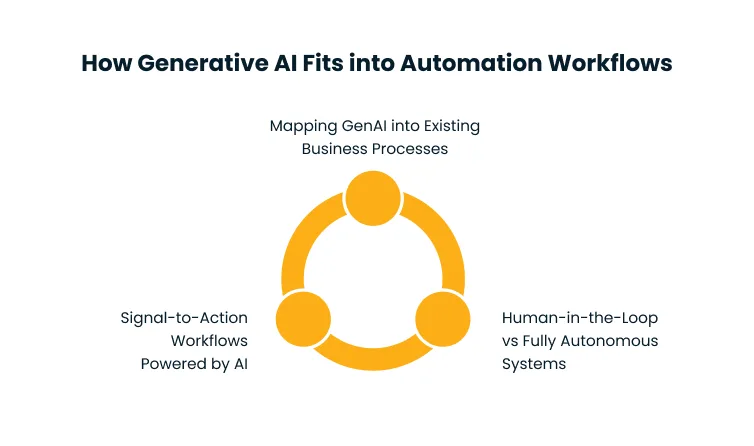
Mapping GenAI into Existing Business Processes
The starting point is not picking a model. It is identifying which existing workflows involve repetitive, structured output generation and where that output currently creates a bottleneck.
A simple diagnostic:
1. Identify high-volume output tasks (reports, emails, documents, summaries)
2. Assess whether the input data is structured enough to feed an AI consistently
3. Map where human judgment must stay in the loop
4. Define what a successful output looks like before the system goes live
For most organizations, content-heavy workflows like marketing, HR, and support offer the fastest returns. The input-output pattern is clear, and errors are manageable with a review step. Finance and legal workflows typically need more governance infrastructure before AI can be embedded without risk.
Understanding AI in data management before scaling use cases across the organization helps avoid integration friction down the line.
Signal-to-Action Workflows Powered by AI
Generative AI creates its highest leverage when embedded in a signal-to-action workflow. A data event triggers the AI to generate output, which automatically drives a downstream action.
How it works:
- Signal: A data event occurs (user behavior, transaction, query, alert)
- Processing: AI generates a contextually relevant output (email, report, response, recommendation)
- Action: The output triggers a downstream step (send, publish, escalate, route)
In practice:
- Customer abandons a cart; AI generates a personalized recovery email, sent automatically
- Support ticket created; AI classifies intent and drafts a response; agent reviews and sends
- Financial data updated; AI generates variance commentary; report routes to stakeholders
The key design principle is human oversight at appropriate points. Fully autonomous workflows work well for low-risk, reversible outputs. But for high-stakes outputs, a review step before delivery is mandatory.
Human-in-the-Loop vs Fully Autonomous Systems
Not every AI output should go directly to its destination. Where you place human oversight depends on three factors.
The first is output risk. A wrong product description is recoverable, but a wrong clinical note or contract term is not. Higher-stakes outputs need human review before action.
The second is reversibility. If an error can be corrected after delivery without lasting consequences, more automation is defensible. But if it creates a permanent record or obligation, review the output first.
The third is established confidence. As you accumulate evidence that a system consistently meets your quality bar, you can reduce oversight. That confidence is earned through monitored operation, not assumed from day one.
Strong AI governance practices make these decisions systematic rather than reactive, giving your teams a consistent framework for expanding or tightening oversight as evidence builds.
A phased approach works best. Start with full human review, track quality metrics, and reduce oversight only where the AI is demonstrably reliable.
When these workflow patterns are in place, the benefits compound across the organization. Here is what you can realistically expect.
Benefits of Generative AI Use Cases for Enterprises
Getting generative AI deployment right pays off in ways that go beyond a single workflow improvement. Here is what organizations consistently see when use cases are properly selected and deployed.
- Operational efficiency. Repetitive, high-volume tasks move faster and at greater scale. Your team redirects freed capacity to higher-value work.
- Faster time-to-value. Content, code, and documentation that took days now takes hours. Faster outputs mean faster decisions.
- Scalable personalization. Marketing messages, learning paths, and product recommendations can be individualized at scale without proportional headcount increases.
- Cost optimization. Fewer human hours on low-complexity tasks means lower cost per output across content, support, and documentation functions.
- Improved productivity. When AI handles repetitive generation, your team focuses on work that requires judgment, creativity, and relationships.
- Innovation capacity. Faster prototyping and fewer production bottlenecks create room to experiment and bring ideas to market.
Teams that pair generative AI with AI-driven analytics and data insights see the benefits compound faster, as AI-generated outputs are grounded in live operational data rather than static reporting.
The benefits are real, but they depend on picking the right use cases and building the right implementation foundation. ROI follows precision, not ambition.
Conclusion
Here is the reality most organizations discover after their first few GenAI pilots: the technology is not the hard part. Knowing which workflows are ready for AI today and building a structured path to production is.
If you are still in the discovery phase, start narrow. Pick one workflow, define the input and expected output, set a review step, and measure the result. That proof of concept is the foundation for everything that follows.
If you are ready to move faster, Cygnet.One brings both the implementation depth and domain experience to get you from use case identification to production deployment. From mapping your workflows to building and scaling your AI systems across healthcare, finance, software, and enterprise operations, the process is structured, not open-ended.
Book a demo with Cygnet.One today and build a generative AI deployment plan that is grounded in your data, your workflows, and your business goals.
FAQs
Common use cases include content generation for marketing and documentation, AI-powered chatbots for customer support, code generation for software development, personalized sales outreach, and clinical documentation automation in healthcare. These use cases share a common trait: they involve high-volume, structured output that previously required significant human time to produce consistently.
Generative AI automates tasks by taking structured data inputs or event triggers and generating contextually relevant outputs such as reports, emails, responses, or code. It integrates into existing automation workflows as a generation layer, where it produces output that either goes directly to an end state or passes through a human review step before delivery.
Healthcare, finance, software development, legal services, retail and e-commerce, and marketing organizations have seen the most consistent returns. These industries share characteristics that make GenAI deployments effective: high documentation volume, repetitive structured outputs, and measurable quality benchmarks against which AI-generated content can be evaluated.
Yes. Small businesses can access generative AI through hosted platforms and managed services without building AI infrastructure themselves. The most accessible entry points are content generation tools, AI writing assistants, and customer support chatbots, all of which reduce the operational burden on small teams without requiring significant upfront investment.
Key risks include inaccurate or hallucinated outputs, data privacy exposure when proprietary data is used to prompt AI systems, regulatory compliance gaps in high-stakes industries, and over-reliance on AI output without adequate human review. Most of these risks are manageable with proper governance frameworks, review protocols, and AI system monitoring in place.
Start by identifying two or three existing workflows that involve repetitive, structured output generation. Assess whether the input data for those workflows is clean and consistent enough to feed an AI system. Define what a successful output looks like and how it will be reviewed before use. Run a focused pilot on one workflow before scaling to others.
Author


Abhishek Nandan
AVP, Marketing
Abhishek Nandan is the AVP of Services Marketing at Cygnet.One, where he drives global marketing strategy and execution. With nearly a decade of experience across growth hacking, digital, and performance marketing, he has built high-impact teams, delivered measurable pipeline growth, and strengthened partner ecosystems. Abhishek is known for his data-driven approach, deep expertise in marketing automation, and passion for mentoring the next generation of marketers.