




































RTR is changing the landscape of corporate tax compliance. Companies have been forced to abandon traditional practices where they had to submit consolidated data on monthly or quarterly bases to start reporting transactional information on a real-time basis or near real-time basis to the tax authorities.
There are many reasons behind this phenomenon. Governments are seeking greater transparency, tax evasion reduction, and timely access to information. It makes RTR an important element of the digital transformation process of taxation.
In addition, there are certain challenges related to this process. Companies are facing the necessity of a comprehensive transformation of their internal processes, technology, and data management practices.
What Is Real-Time Tax Reporting and Why Is It Happening Now?
- Change from periodic to continuous tax reporting: Before, firms used to report tax information on a monthly or quarterly basis after completing the transactions. RTR has replaced this practice with continuous transaction-based reporting.
- Embedding compliance within operations: Tax reporting is no longer treated as an independent process; instead, it is now embedded in the firm’s operations, such as invoicing.
- The cause is the reduction of the tax gap: The authorities seek to get rid of the tax gap caused by mistakes, fraud, and delays in submission.
- Driven by technologies: E-invoicing, automation, and analytics have been the engines of transition to real-time compliance.
RTR is a fundamental departure from conventional approaches. In contrast to reporting summarized figures at a later stage, RTR involves sharing and verifying transactional information immediately. This will enable tax administrations to observe all actions continually, thus minimizing room for any manipulation. It also makes life difficult for firms since it demands robust technology, reliable data, and automation.
How RTR Differs from Traditional Tax Reporting
It is crucial to comprehend the difference between the two models, as the difference is far greater than what meets the eye.
Under the traditional periodic reporting, there was a cycle where transactions were made, recorded in the ERP system, reconciled at the end of the period and submitted as a part of a return prepared according to a schedule defined by the tax authority. There was always time for verification and correction.
In case of real-time tax reporting, everything changes in the most important way imaginable. The transaction is reported almost instantly. The system of data validation is automatic. Any errors result in immediate rejection. Correction is possible only under formal procedure. And the tax authority has your information before you file it.
| TRADITIONAL PERIODIC REPORTING | REAL-TIME TAX REPORTING (RTR) |
| Transactions recorded, then reported on a fixed schedule Monthly, quarterly or annually | Transaction data reported at or near the moment of occurrence Seconds to minutes after issuance |
| Time to review and correct before submission Errors caught during reconciliation | Validation is automatic and immediate Rejection is instant – no grace window |
| Tax authority receives summarised data Detail only seen during audit | Tax authority has granular transaction data in real time before returns are filed |
| Amended returns accepted for corrections Retroactive adjustments possible | Corrections require formal credit or debit notes No informal resends or overwrites |
| Tax function operates downstream of operations Reporting is a post process | Tax compliance embedded in operational processes Part of the transaction, not after it |
After you submit something, any corrections become impossible There must be no mistakes. Accuracy, validity, completeness, and availability of data are essential.
Three models for real-time tax reporting
Not all RTM regulations are the same. It is important to know the technical model used in the target jurisdiction. Different models have different demands on your system.
Model of clearance (CTC)
Under the clearance model, the invoice can only be considered legal once it has been uploaded to the government platform. Examples include ZATCA in Saudi Arabia, KSeF in Poland, e-Factura in Romania, and SDI in Italy. In this model, the tax administration will first see the invoice before the buyer does. When the platform is unavailable, there are special rules for offline use with strict upload deadlines.
Post-Audit Model (Peppol-enabled)
Under the post-audit or decentralized model, invoices are transferred between businesses via trusted intermediaries, while the tax administration gets the copy at the same time or just after. Singapore’s InvoiceNow 5-Corners solution and Belgium’s Peppol adoption adopt this approach. The only exception is that the invoice may be received by the purchaser before getting verified by the authority, although the latter will get the data instantly.
Digital Reporting Requirements (DRR)
Some countries (mostly during their transition phase) mandate the periodic transfer of structured transaction level data files instead of invoice clearance. SAF-T (Standard Audit File for Tax) regulations in Poland, Portugal, Norway, and Lithuania exemplify such cases, as well as the EU’s ViDA Digital Reporting Regulation that comes into force gradually from 2028. Lithuanian, Romanian, and Hungarian states, among others, have developed solutions that use real-time transactions to pre-populate the VAT return and detect inconsistencies in taxpayers’ records.
Why RTR Compliance Requires Addressing Data Challenges First and Tax Challenges Second
Although many companies think of RTR as being more of a tax issue, what they are really facing is a data and technology issue first and a tax issue second**. Under the previous model of periodic reporting, any inaccuracies could be smoothed over by aggregations, reconciliations, and review. This is no longer possible under RTR, as every single transaction is validated in real time.
- Data fragmentation: Invoices are frequently processed on different platforms, resulting in discrepancies that are then picked up under the new RTR system.
- Unverified master data: Out-of-date and inaccurate tax IDs, addresses, and entities are rejected by the government’s validation process.
- Inconsistent tax codes: Manual coding results in improper classification, which causes the whole invoice to fail.
- Calculation discrepancies: The slightest differences between the calculations on different platforms are viewed as serious issues.
What RTR reveals are shortcomings that previously did not matter. Organizations need to ensure that their processes deliver consistency, accuracy, and connectivity to be compliant.
The Organisational Impact: Who RTR Compliance Belongs To
One of the most persistent mistakes in RTR implementation is treating it as a single team’s responsibility. Successful implementation emphasises the need for alignment between tax, finance, and IT teams. In practice, each function owns a different part of the problem.
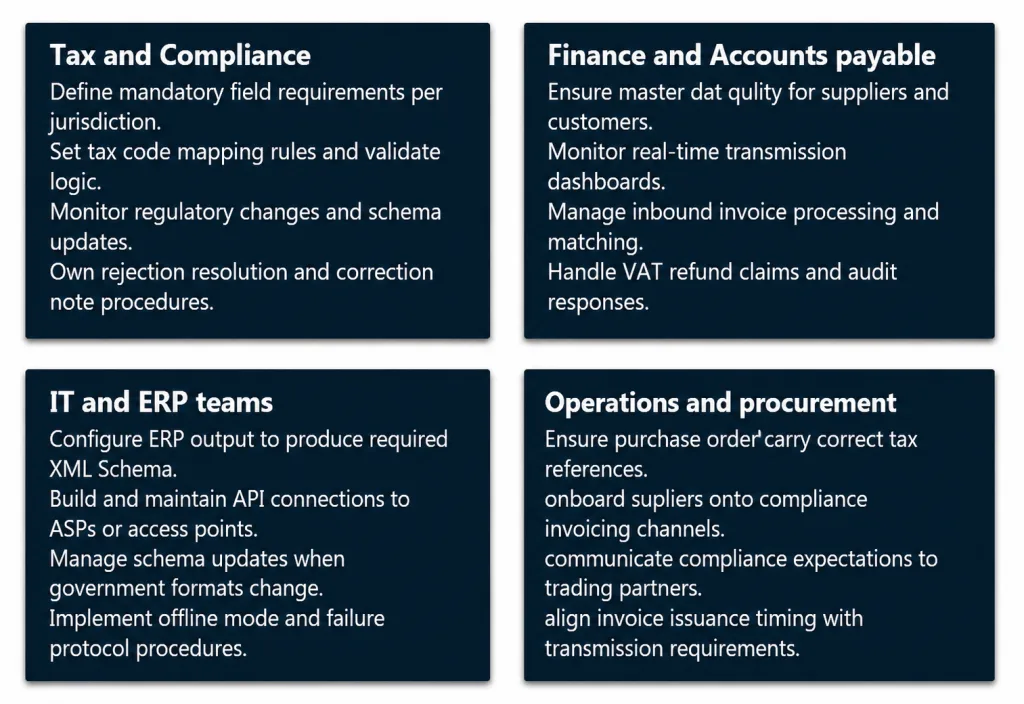
The taxation process is not merely an accounting issue anymore; it is moving into becoming part of the digital backbone of the company. In other words, external entities (governmental systems) are now a part of your transactional structure. If you have tax within your transaction, compliance will always be at play wherever there is a transaction.
How to Build an RTR-Ready Compliance Infrastructure
Step 1: Evaluate Your Exposure Per Jurisdiction
List down all the jurisdictions from which you receive or send invoices. Determine the applicable model and mandate timelines based on your organization’s size.
Step 2: Conduct Data Quality Check First
Check your master data like tax ID numbers, addresses, and tax codes. Address any issues such as rounding problems because RTR systems will reject inaccurate information automatically.
Step 3: Choose an Expandable Multi-Country Software Solution
Choose the software capable of handling various formats and adapting to changing regulations. The solution must connect to local intermediaries. You should avoid point solutions that won’t be able to scale internationally.
Step 4: Integrate at the Transaction Level
Ensure that you integrate at the transactional level during invoice creation in the ERP. This method is more effective than the batch processing one.
Step 5: Implement Continuous Monitoring and Upgrade Procedures
Apply continuous monitoring and automatic regulation updates
Conclusion
The concept of Real-Time Tax Reporting is not a transient compliance effort but is a permanent way of doing business. As authorities adopt a continual and transactional approach to monitoring tax activities, it becomes increasingly difficult for companies to use fragmented methods based on local country requirements.
For organizations to be successful with RTR, they need to adopt it as an operational model. That is, they should integrate their tax rules into daily transactional activities, ensuring that they have high-quality and validated data and flexible systems capable of adapting to changes in regulatory requirements.
Organizations that adopt such an approach will achieve much more than just complying with regulations; they will be able to take advantage of enhanced data quality, better reconciliations, improved audit preparedness, and streamlined cash flows.
FAQs
Periodic reports rely on periodic and aggregate data, leaving room for correction, reconciliation, and error handling. RTR, in turn, implies immediate report creation and verification for each individual transaction. Incorrect data will be rejected immediately, requiring a high level of accuracy at the source.
The introduction of RTR helps governments address their challenges such as reduction of tax evasion, closing of tax gaps, and obtaining real-time financial information. Moreover, RTR also enables governments to implement wider digital transformation strategies, shifting from audits to analysis.
RTR implementation may include clearance model, post-audit (decentralized) model, and digital reporting requirements. Each model differs in the moment of verification and exchange of invoice data between a taxpayer and tax authorities.
RTR reveals inconsistencies of data, which used to remain unnoticed in periodic reporting. Lack of an integrated data management platform, use of incorrect codes for taxes and other errors result in automatic rejection of invoices.
Enterprises require ERP solutions that provide capabilities for structured data, connectivity, and validation. Solutions that can scale and adjust to changes in regulatory compliance are also required.
RTR requires real-time validation, quick approvals, and continuous monitoring. Enterprises must switch from batch processing to automated processes, which help them solve issues on-the-go and comply with RTR requirements.
Some of the data-related issues that may arise for organizations include fragmentation of information, outdated master data, incompatible tax codes, and errors in calculations.
It is mandatory for businesses to undertake an analysis of their global footprint, evaluate data management capabilities, adopt a scalable solution, and analyse data at the transactional level.