






























Poland takes a huge leap in the direction of tax digitalization by introducing mandatory e-invoicing through the KSeF system. As other European countries start moving toward real-time reporting and structured invoicing, Poland is setting itself up as one of the leaders in compliance-driven innovations.
The implementation of these changes is being performed by the National Revenue Administration, which is introducing the use of the Krajowy System e-Faktur (KSeF): an online platform designed for issuing, receiving, and archiving invoices.
For companies, the implementation of such a system implies not only changing the way their invoices look. Rather, it means transitioning from traditional transaction reporting to transactional control, real-time validation, and monitoring.
What Is KSeF and Why Does It Exist?
KSeF (Krajowy System e-Faktur) stands for Poland’s centralized e-invoicing solution, through which all invoices will be issued, validated, and archived using the government system.
As opposed to sending invoices directly to their clients, businesses will be required to do the following:
- Create invoices using a standardized structure
- Send invoices to KSeF
- Get invoices validated and given a unique identifier
- Consider the document officially valid
It is called a clearance system since a tax body acts as an intermediary in the invoice issuing procedure.
The crucial word is centralised. In contrast to the Peppol network that is used by Singapore in its InvoiceNow system, where the transactions take place directly between companies using authorised intermediaries, KSeF is a clearance system. All invoices go through the system controlled by the Ministry of Finance, are approved, time-stamped and provided with their own unique KSeF reference number, which makes an invoice validly issued.
It is the Continuous Transaction Control (CTC) model system design implemented in Europe and the Middle East, where tax authorities are not required to wait for regular submissions for reviewing invoices. The tax authorities have access to this data immediately after its approval. This is what Poland, Italy, France, Romania, and other countries in Europe have chosen as the basis for their VAT systems.
KSeF vs Traditional E-invoicing
| Aspect | Traditional Model (PDF / Email) | KSeF Clearance Model |
| Step 1 | Seller sends PDF to Buyer | Seller submits invoice to KSeF (Gov. platform) |
| Step 2 | Buyer receives PDF | KSeF validates and assigns ID |
| Step 3 | Tax authority sees it months later | Buyer retrieves invoice from KSeF |
| Govt Visibility | Delayed – months after transaction | Real-time government visibility |
| Invoice Validity | Valid on sending | Invoice valid only after KSeF ID is assigned |
From Invoice Creation to Approval: How the KSeF Flow Works
KSeF is not just a digital upgrade: it’s the government sitting at your invoicing table.
| Step | Title | Details |
| 01 | Create | FA(3) XML created in ERP |
| 02 | Authenticate | KSeF certificate / seal applied |
| 03 | Submit | XML sent to KSeF via API |
| 04 | KSeF Validates | Schema validated + KSeF ID assigned |
| 05 | Invoice Issued | KSeF ID = legal proof of invoice |
| 06 | Buyer Retrieves | Buyer retrieves invoice from KSeF platform |
Understanding the actual flow helps teams prepare the right way. Here is what happens at each stage:
Step 1 – Create: Invoice created in your ERP or accounting software or in the ministry’s free e-mikrofirma application as an FA(3) XML file, each entry must adhere strictly to the required schema – no improvising.
Step 2 – Authentication: System identifies itself to KSeF with the use of the KSeF certificate, qualified electronic seal or Trusted Profile. Tokens act as system login details, allowing accounting or sales applications to authenticate themselves without repeated login and talk directly to KSeF.
Step 3 – Submission: XML document is transmitted through API to the KSeF system (manual submission for small quantities through the taxpayer’s web portal).
Step 4 – Validation: Once the document reaches the KSeF system, it goes through several stages of validation: XML technical validation, data business validation, duplication detection and finally storage and assignment of the KSeF number.
Step 5 – Legal Issue: Documents that survive this whole process become legally recognized as being issued, registered and timestamped. Rejected invoices are considered as never being issued.
There’s even a contingency plan in case of failure, a.k.a. offline24. In such situation, you can issue your invoices, but you’ll have to submit them to KSeF the next day.
Understanding the FA(3) Structured Invoice Format
The FA(3) schema is the technical heart of KSeF. Getting it wrong means getting rejected. Here is what it is:
- FA(3) is an invoice format that relies on XML (data structure specified by the Polish Ministry of Finance). It comprises more than 300 attributes, some mandatory, while others conditional depending on the type of transactions. The XML file should comply with the official XSD document specified by the Ministry of Finance. Invoice Navigator
- Starting from 1 February 2026, all e-invoices sent using KSeF will have to comply with the FA(3) specification: original, correction, and settlement invoices regardless of the period when transactions took place. Poland Accounting
- The invoice data are divided into four major blocks: Header (technical metadata), Entity 1 & 2 (details about the supplier and the buyer, including NIP tax number), FA (invoice itself comprising items and their amounts, VAT rates etc.) and the new Attachment block containing supplementary information.
- NIP is 10-character Polish tax identifier. KSeF validates the number as to its format and checksum (mod-11 algorithm). The NIP of the seller is a required field; the invoice cannot be sent without it. The NIP of the buyer determines inclusion of the invoice in the KSeF account. Invoice Navigator
FA(3) was launched starting from 1 February 2026 replacing the previous FA(2) version. FA(2) is not compatible with FA(3).
Rollout Strategy: What Businesses Should Know About Implementation Phases
On February 1, 2026, Poland’s Ministry of Finance launched the first mandatory phase of B2B electronic invoicing through KSeF, affecting approximately 4,200 large taxpayers. The rollout then expands in clear stages.
| Date | Phase | Scope | Key Details |
| 1 Feb 2026 | Phase 1: Live | Large taxpayers | Businesses with 2024 gross sales exceeding PLN 200 million (~4,200 companies). All businesses must also be able to receive KSeF invoices from this date regardless of size. |
| 1 Apr 2026 | Phase 2: Live | All other VAT-registered businesses | All SMEs, sole proprietors, and mid-size businesses. Broadest phase: brings millions of businesses into scope. |
| 1 Aug 2026 | Payment refs | KSeF number in bank transfers | Every bank payment must reference the KSeF ID of the invoice being paid. Payment systems need to be updated before this date. |
| 1 Jan 2027 | Penalties begin | Micro-entrepreneurs + full enforcement | Businesses with monthly sales under PLN 10,000 join the mandate. Penalties for non-compliance take effect: up to 100% of VAT on non-compliant invoices. |
Practical Roadmap: Preparing Your Business for KSeF
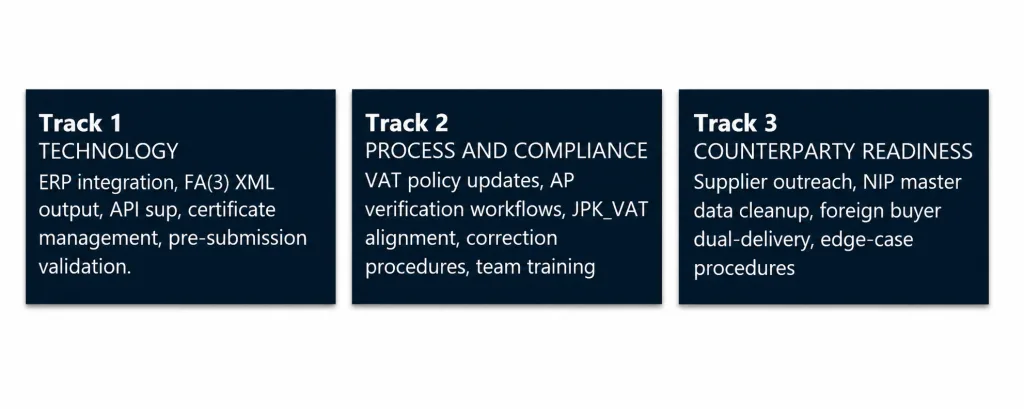
In the case of the KSeF implementation, there are three streams that must be considered simultaneously technologies, processes, and counterparty. None of them can be considered secondarily. If a company is ready with the technologies side of the implementation but did not train their accounting staff, it will fail regardless. If it has updated its processes, but forgot about its suppliers’ readiness, it will fail due to invoices not coming.
How KSeF Changes Day-to-Day Finance Operations
KSeF is not just an IT project. It rewires the daily workflow of finance, accounting, and procurement teams. Here is what changes:
- Accounts Receivable: No more sending invoices to your clients; you’ll submit them to KSeF, and they’ll pick them up there. You need to monitor the status of your KSeF submissions, not deliveries.
- Accounts Payable: Any companies that receive their purchase invoices using KSeF should be aware that KSeF might also contain incorrect purchase invoices, either accidentally or due to fraud. It is thus vital to create processes for verifying and approving purchase invoices.
- Payments: As of August 2026, every bank transfer must include a reference number for the invoice that you pay. Treasury and payments staffs need to adjust their bank transfer templates and runs accordingly.
- VAT Reconciliation: The data in the KSeF invoices must match the data that your business reports in JPK_VAT documents. Discrepancies between them would become immediately obvious to tax authorities. VAT departments should ensure that their reporting systems use the same data sources as the KSeF system.
- Archiving: All KSeF invoices that you submit remain in the possession of the tax authorities for at least ten years, which surpasses the statute of limitations on VAT in Poland. You don’t have to archive KSeF invoices separately, as the centralized system is the authoritative one.
Adapting to a Real-Time, Government-Led Invoicing Future
KSeF marks a completely new era in the Polish business environment. For the first time ever, all transactions conducted by VAT-registered entities will be subject to government inspection before being officially recognized. The Ministry of Finance is no longer just an auditing authority, it becomes a direct player in the invoicing chain.
There are three important things to keep in mind:
- KSeF is already in force. Phase 1 businesses are already participating in the obligatory program. Phase 2 included practically all market players from April 2026. Your company does business with Poland, and if you have not started yet, today is your day.
- There will be no more penalty-free period after 31 December 2026. Invoicing via KSeF is no longer optional and non-compliance can lead to huge fines on the invoice issued. The period of non-penalty was not a reason to procrastinate on the contrary.
- It is more than a ticket in the IT shop; finance departments, accounting firms, ERP providers, and legal experts must come together on this. Companies who will have the easiest time implementing KSeF will be those who approached it from an organisational perspective rather than a technical one.
Poland might be a pioneer in rolling out the clearance system for electronic invoices in full force in all companies, but it certainly will not be the last country to do so. Other EU member states can learn from what happens in Poland, and the ViDA project from the European Commission will strive to achieve real-time reporting obligations within the EU by 2030.
Stay ahead of the 2026 mandate with a secure, KSeF-integrated e-invoicing solution in poland
Conclusion
The Polish electronic invoicing system KSeF clearly shows the transition of Poland from reporting to the model of real-time control and centralized verification. With each invoice going through the state platform, Poland creates an environment of proactive compliance rather than retrospective checks and audits. This is a completely new concept for any business when it comes to its invoices.
From creating FA(3) XML invoice to handling the validation process and performing corrections, each step in the workflow is crucial and needs to be done perfectly. Errors and mistakes in this case cannot be easily fixed, and therefore accurate data and efficient systems are crucial at each stage.
However, the benefits from KSeF in the long term should not be overlooked. There are fewer reports needed, greater visibility of audits, and more standardized processes. Any company that is ready to meet the challenge now will reap the benefits.
FAQs
Yes, in Poland, there is a possibility of issuing invoices outside the system during any kind of system malfunction using the “offline24” system. In such a scenario, the invoice needs to be communicated to the KSeF system on the very next working day. In case the invoice is not shared, the validity of the invoice will become an issue.
In order to gain access, businesses will have to authenticate themselves using qualified electronic signatures, electronic seals, and trusted profiles. In case of automation, API tokens will come into play so that ERP systems can connect with the KSeF systems directly without manual intervention at every point.
ERP systems will continue to function independently for creating and processing invoices while KSeF will become the source of truth for validating these invoices. Therefore, it is important to maintain consistency between both sources.
Yes, from February 2026 onwards, all invoices that use the KSeF system will need to conform to the FA(3) standard. Older versions like FA(2) will no longer be allowed, and it is necessary for all business organizations to ensure they upgrade their systems according to the new standards.
KSeF will increase the connection between invoicing and payments, and businesses will need to put in the reference number of the KSeF invoice while making payments. Therefore, it is necessary to make changes to the payment process as well.