



































Jordan is moving quickly toward a tax environment that is based on digital technology, with electronic invoicing at the heart of this change. As countries across the globe begin to implement real-time reporting and compliance, Jordan has also decided to step up its game and follow the same best practices across the world.
The e-Invoicing project, managed by the Income and Sales Tax Department (ISTD), strives to achieve consistency, greater visibility, and compliance through e-invoices.
For those organizations operating out of Jordan, it is important to understand that this is an attempt to make their accounting processes more transparent and compliant.
Key Snapshot (Estimated values)
| Value | Description |
| 16% | Standard General Sales Tax (GST) rate on most B2B, B2C and B2G transactions requiring e-invoicing |
| Dec 2022 | JoFotara national e-invoicing system officially launched by ISTD as a voluntary platform |
| 1 Apr 2025 | Phase 2 mandatory enforcement under Amended Billing Regulation No. 2 of 2025: applies to all VAT-registered taxpayers |
| Real-time | Centralised clearance / CTC model: every invoice must be validated by JoFotara before it is legally issued (no 72-hour window) |
| JOD 75K | Annual turnover threshold that defined Phase 1 in-scope businesses (deadline closed 31 May 2024) |
| JOD 500 | Maximum administrative fine per non-compliance violation; non-compliant invoices also lose VAT input deductibility |
| 4 years | Standard digital invoice & record retention period under Jordan’s Income & Sales Tax Law |
| JOD 10K | Buyer-identification threshold: invoices below this value may omit buyer details (still archived for audit) |
What Is Jordan e-Invoicing?
e-Fattura or the e-Invoicing program of Jordan, also referred to as the ISTD E-Invoicing System, requires that firms who are registered for VAT must create, transmit, and store their invoices online through an authorized platform. It needs to be noted here that unlike the usual PDF invoices that are transmitted via emails, e-invoices need to be in a machine-readable format (UBL XML/Equivalent).
The goal of the system is to minimize instances of tax evasion, increase VAT collection efficiency, and modernize Jordan according to international norms for electronic trading. All companies in Amman, Zarqa, Irbid, and other commercial hubs will be covered under the jurisdiction of the system.
The ISTD e-Invoicing Rollout Timeline
Jordan introduced its National Electronic Invoicing System as part of the country’s wider digital tax transformation. The Income and Sales Tax Department (ISTD) has progressively expanded registration and participation in the system and provides procedures for joining and linking business invoicing systems with the national platform.
Businesses should assess their current obligations against applicable Jordanian invoicing regulations and current ISTD guidance. ERP, accounting, billing, and point-of-sale systems should be reviewed early to determine applicable system-linking and invoice-data requirements.
Jordan’s phased approach is intentional. Starting from big corporations, which constitute a major percentage of all VAT revenues in terms of value, ensures that during early stages, the implementation of ISTD has the greatest fiscal impact. Companies approaching the requirements for the second or third phase of ISTD should not consider impending deadlines distant occurrences. Integration of ERP-enabled e-Invoice solutions usually takes 3-6 months’ time period; hence early preparation would be advisable.
Key Components of the Jordan e-Invoicing Framework
Mandate is based on four pillars that together enable a real-time, government-integrated compliance model.
1. Structured invoice format requires all invoices to be issued in UBL 2.1 XML, a machine-readable schema validated at the ISTD portal level. Structured machine-readable invoice formats are expected to become the primary compliance format under Jordan’s evolving framework.
2. Centralized reporting means that invoice data is submitted directly to the ISTD at the time of issuance rather than at period end, giving tax authorities an ongoing real-time view of commercial transactions across the economy.
3. Real-time data exchange requires B2B invoices to be sent to the ISTD portal as part of the invoicing workflow itself, necessitating API-connected systems with reliable error handling rather than batch or manual uploads.
4. System integration brings everything together: ERP and billing systems must be configured or connected via certified middleware for compliant XML generation and digital signature application and automatic transmission of invoices; without integration, other three pillars cannot work at scale.
Who needs to comply?
The mandate applies to all VAT-registered taxpayers making B2B, B2G, and B2C sales in Jordan. The scope is defined mainly by annual revenue; however, it has been progressively reduced by the ISTD over the phases.
| Business category | General consideration |
| Businesses required to use the National Electronic Invoicing System | Should register and issue invoices according to applicable ISTD requirements |
| Businesses using ERP or accounting systems | Should assess system-linking and integration requirements |
| Businesses with multiple branches or entities | Should align invoice data and processes across applicable operations |
| Businesses issuing high invoice volumes | Should assess automation, monitoring, and exception-management capabilities |
| Businesses with complex tax or transaction profiles | Should confirm applicable invoicing requirements against current ISTD guidance |
Businesses situated near a threshold boundary should take initiative and assess their scope position rather than waiting for formal notification from the ISTD. Free zone entities and businesses with mixed domestic and export revenues should get specific guidance from the ISTD on applicability.
The e-Invoicing Process: Step by Step
Knowing how an invoice moves through its life helps finance and IT departments map out who does what in each department easily. Below is the five-step flow that represents the usual journey of B2B e-invoicing under the ISTD setup.
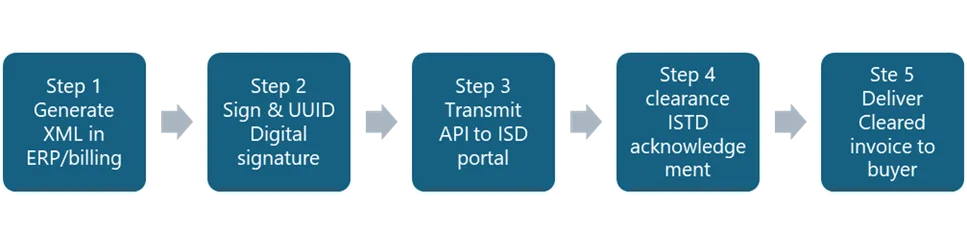
Jordan’s National Electronic Invoicing System enables invoice data to be generated through the national platform or transferred electronically from connected business systems. Businesses using ERP, accounting, billing, or point-of-sale systems should configure the applicable integration and invoice-data processes according to ISTD requirements.
Finance and IT teams should focus on accurate invoice data, reliable system connectivity, invoice-process monitoring, and effective management of errors and corrections.
Technical Requirements: What Your System Must Support
Jordan’s e-Invoicing mandate is built on internationally recognised standards, but the ISTD has defined specific implementation requirements that go beyond generic XML invoicing.
Any solution that is compliant, whether it be developed internally or provided by a partner fintech firm that is certified, needs to fulfil all the following conditions.
Structured invoice data: Businesses should generate invoice information according to the data and invoice requirements defined for Jordan’s National Electronic Invoicing System.
System integration: Businesses using ERP, accounting, billing, or point-of-sale systems should assess the applicable ISTD linking and integration procedures.
Invoice identification and verification: Systems should support the invoice identification, verification, and other data requirements applicable under the national e-Invoicing framework.
Invoice transmission and processing: Integrated systems should reliably transfer invoice data and provide appropriate monitoring and error-management processes.
Record management: Invoice and supporting tax records should be retained and made accessible according to applicable Jordanian tax and invoicing requirements.
Jordan in the MENA e-Invoicing Landscape
Jordan’s mandate places it within a rapidly digitizing regional tax ecosystem. Understanding the difference makes it easier for multinational corporations to plan an overarching compliance strategy rather than implementing piecemeal approaches for individual countries.
Regional Strategy Insight: unified e-invoicing solution that would support multiple countries’ regulations, thereby minimizing the overall compliance costs while providing an opportunity for streamlined audit trails for Amman, Riyadh, Cairo, and Dubai entities.
| Country | Authority | Mandate Start | Model | Format |
| Jordan ★ | ISTD | 2024 (Phase 1) | Clearance | UBL XML |
| Saudi Arabia | ZATCA | 2021 | Clearance + Reporting | UBL XML / FATOORA |
| Egypt | ETA | 2020 | Clearance | JSON / XML |
| UAE | FTA | 2026 (expected) | Reporting | Peppol UBL |
| Turkey | GIB | 2012 | Clearance | UBL-TR XML |
Choosing the Right e-Invoicing Partner
The complexity of Jordan’s technical specifications makes an experienced e-invoicing solution provider with deep MENA regulatory expertise a strategic advantage over building in-house. While considering vendors, think about these selection criteria:
- ISTD-certified or ISTD-aligned platform with active API integration and sandbox testing environment
- Out-of-the-box integration options with SAP, Oracle, Microsoft Dynamics and other enterprise ERPs
- Multi-country MENA coverage for scalable regional compliance from a single platform
- Dedicated compliance monitoring, regulatory update alerts and managed services model
Trusted digital transformation partners serving enterprises across Jordan GCC and broader MENA markets offer end-to-end e-invoicing compliance services – from initial gap assessment through to go live support and ongoing regulatory maintenance. Explore how proven fintech compliance platforms have helped businesses navigate mandatory e-invoicing transitions across the region.
Jordan in the Global e-Invoicing Landscape
Jordan’s National Electronic Invoicing System forms part of the wider shift toward digital invoice and tax processes across the MENA region. However, e-Invoicing requirements differ across Jordan, Saudi Arabia, Egypt, the UAE, and other jurisdictions in terms of scope, technical architecture, invoice formats, and tax-authority processes.
For multinational businesses, common capabilities such as ERP integration, invoice-data mapping, system connectivity, monitoring, and exception management may be reused across jurisdictions while country-specific compliance requirements are managed separately.
Conclusion
For businesses operating in Jordan, the immediate priority is to understand applicable ISTD requirements and ensure that invoice data, systems, and internal processes support compliant electronic invoicing.
Finance and IT teams should assess system integration, invoice-data quality, process monitoring, and correction workflows. Businesses operating across multiple MENA markets should also consider how Jordan fits into a scalable e-Invoicing architecture without treating regional mandates as technically identical.
A structured approach to system readiness can help organisations manage Jordan’s e-Invoicing requirements while building stronger foundations for evolving digital tax obligations.
Comply with Jordan’s National E-Invoicing System Using a Secure, Scalable Jordan e-invoicing Solution from Cygnet.One
FAQs
Businesses in Jordan can keep using their systems but these systems must work with the governments e-invoicing system. The businesses need to send the invoice information to the Income and Sales Tax Department in the format. This way the businesses can follow the rules. Still do things their own way.
You cannot change an invoice once it is issued. If you need to make a change you have to use a credit or debit note that is linked to the invoice. This way everything is clear and easy to see. It helps with keeping track of all the money.
The e-invoicing system in Jordan also includes transactions between businesses and individual customers. Businesses may need to report sales information or issue electronic invoices for these transactions. This way all taxable transactions are included in the system.
The requirement of the electronic copies stored safely and are readily accessible will suffice. You might not need to keep copies yourself but should ensure that it is easy for you to access your records when you must do so.
In Jordan, the standard practice is usually that invoice data is provided on time. This allows eliminating any delay issues. It ensures that the tax authority has the latest information available.
If a business has branches all of them have to follow the e-invoicing system. The business needs to have a way of reporting and doing things and make sure everything is the same across all locations.
The automation of the process is essential in case of large transaction volumes since it is vital to provide an automatic handling of them. A solution should enable sending out lots of invoices at once while being scalable.
Automation in Jordan e-invoicing helps with checking, reporting and keeping track of everything in real time. It reduces mistakes. Makes sure everything is done correctly. For businesses that are growing automation is necessary to handle all the transactions. Jordan e-invoicing and automation go together to make things easier for businesses, in Jordan.