









Oman e-Invoicing Solution for OTA and PEPPOL Compliance
Prepare for Oman’s Fawtara e-Invoicing mandate with a PEPPOL-ready solution built for ERP integration, structured invoice validation, secure exchange, and audit-ready compliance.

e-Invoicing compliance Timeline

UAE e-Invoicing: The Complete Guide to Compliance and Future Readiness

Types of Vendor Verification and When to Use Them

Safeguard Your Business with Vendor Validation before Onboarding

Modernizing Dealer/Distributor & Customer Onboarding with BridgeFlow

Accelerate Vendor Onboarding with BridgeFlow

GST Filing 360°: GST, E-Invoicing, E-Way Bills & Annual Returns Made Simple

Why Manual Tax Determination Fails for High-Volume, Multi-Country Transactions
GST Filing 360°: GST, E-Invoicing, E-Way Bills & Annual Returns Made Simple

Key Features of an Invoice Management System Every Business Should Know

Automating the Shipping Bill & Bill of Entry Invoice Operations for a Leading Construction Company

From Manual to Massive: How Enterprises Are Automating Invoice Signing at Scale

AI-Powered Interviewing Helped an Education Group Reduce Hiring Time Significantly

AI-Powered Voice Assistant for Smarter Search Experiences

Cygnet.One’s GenAI Ideation Workshop

Our Journey to CMMI Level 5 Appraisal for Development and Service Model

Extend your team with vetted talent for cloud, data, and product work

Enterprise Application Testing Services: What to Expect

Future-Proof Your Enterprise with AI-First Quality Engineering

Cloud Modernization Enabled HDFC to Cut Storage Costs & Recovery Time

Cloud-Native Scalability & Release Agility for a Leading AMC

AWS workload optimization & cost management for sustainable growth

Cloud Cost Optimization Strategies for 2026: Best Practices to Follow
Cygnet.One’s GenAI Ideation Workshop

Practical Approaches to Migration with AWS: A Cygnet.One Guide
Tax Governance Frameworks for Enterprises
Cygnet Launches TaxAssurance: A Step Towards Certainty in Tax Management
Oman is moving toward a structured digital tax ecosystem under the Oman Tax Authority’s Fawtara initiative. The mandate is expected to bring standardized invoice exchange, stronger tax transparency, and improved automation across business transactions.

For enterprises, Oman e-Invoicing will not be limited to invoice format changes. It will impact ERP data, VAT treatment, invoice validation, buyer and supplier master data, exception handling, archival, and audit readiness.

| Who / Turnover / Applicability |
Timeline / When | Model | Transaction Type | Format of E-Invoice | Additional Notes |
|---|---|---|---|---|---|
| Early Adopters / Voluntary Registrants | December 2022 | Clearance Model – CTC (Voluntary Registration) |
B2B
B2C B2G |
UBL 2.1 XML, Encrypted JSON, QR Code | Official launch of JoFotara by ISTD in collaboration with MDEE; voluntary registration opened to all businesses. |
| Selected Large Taxpayers & Pilot Groups | January 2023 | Clearance Model – CTC (Phase 1 Mandatory) |
B2B
B2C B2G |
UBL 2.1 XML, Encrypted JSON, QR Code | Mandatory registration begins for selected large taxpayers, companies, and professionals within the first rollout phase. |
| All In-Scope Taxpayers | February 2023 Onwards | Clearance Model – CTC (Integration & Testing) |
B2B
B2C B2G |
UBL 2.1 XML, Encrypted JSON, QR Code | Businesses integrate ERP, POS, and billing systems with JoFotara APIs and submit test invoices for validation. |
| All Taxpayers (Universal Registration Deadline) | 31 May 2024 | Clearance Model – CTC (Mandatory Registration) |
B2B
B2C B2G |
UBL 2.1 XML, Encrypted JSON, QR Code | All taxpayers were required to register with JoFotara by this date; failure to register may result in ISTD enforcement penalties. |
| All Remaining Taxpayers | October 2024 | Clearance Model – CTC (Enforcement Preparation) |
B2B
B2C B2G |
UBL 2.1 XML, Encrypted JSON, QR Code | ISTD issues final compliance notices and reminders to complete system setup and API integration before full enforcement. |
| All Taxpayers (No Sector or Size Exemption) | 1 April 2025 | Clearance Model – CTC (Full Mandatory Clearance) |
B2B
B2C B2G |
UBL 2.1 XML, Encrypted JSON, QR Code | Full enforcement under Amended Billing and Control Regulation No. 2 of 2025. All invoices must be issued through JoFotara or an integrated system. Non-compliant invoices are invalid for VAT deduction. Grace period extended until 31 May 2025. |
| SMEs & Remaining Sectors | 2026 and Beyond | Clearance Model – CTC (Continued Expansion) |
B2B
B2C B2G |
UBL 2.1 XML, Encrypted JSON, QR Code | Ongoing phased onboarding of SMEs and remaining sectors based on ISTD guidance. Businesses should monitor sector-specific implementation timelines. |
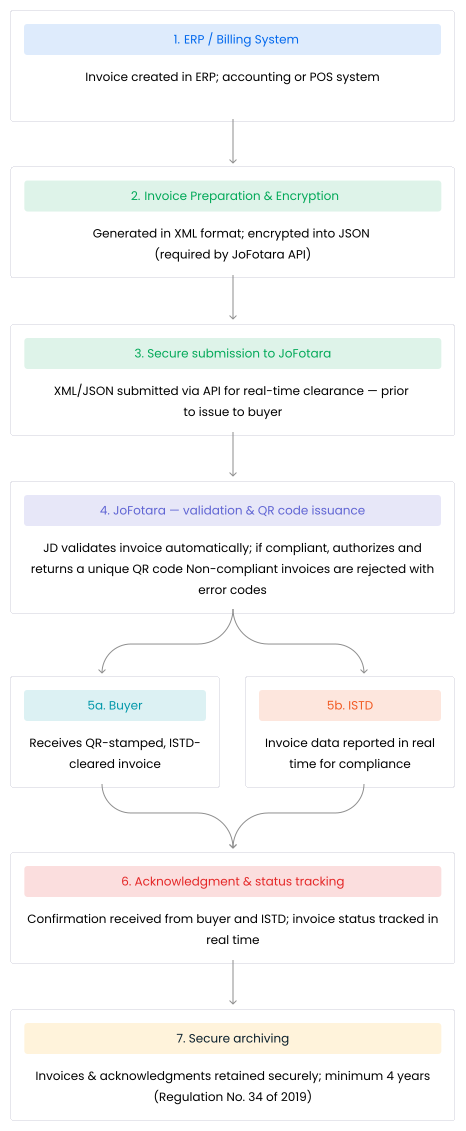
Cygnet.One connects your ERP and billing systems with JoFotora system with ISTD requirements to enable seamless validation, transmission, and compliance for B2B e-Invoicing in Jordan
Generate invoice data directly from your ERP, accounting, or billing application in structured JSON/XML format with mandatory fields and QR code.
Automatically validate invoice data against Jordan’s ISTD and JoFotara compliance requirements.
Transmit the validated invoice securely to the required stakeholders and the JoFotara regulatory platform.
Receive confirmation, validation status, and acknowledgment from both the buyer and the tax authority.
Securely store invoices and related acknowledgments for regulatory retention and audit compliance.








Cygnet Digital helped a leading multi-brand retail & manufacturing company to simplify, improve and support the complexity in documentation, and…
Learn how global businesses can overcome e-Invoicing implementation challenges, including multi-country compliance, data accuracy, and change management.

AI in e-invoicing addresses complex situations & offers predictive capabilities & benefits that enhance e-invoicing. Know more on the benefits…
Oman e-Invoicing is the electronic creation, validation, exchange, and reporting of invoice data under the Oman Tax Authority’s Fawtara initiative. It is designed to support structured invoice exchange, tax transparency, and digital compliance.
Fawtara is Oman’s national e-Invoicing initiative led by the Oman Tax Authority. It aims to modernize invoice reporting and enable standardized electronic invoice exchange.
Yes. Oman is expected to follow a PEPPOL-based 5-corner model for invoice exchange between suppliers, buyers, service providers, and OTA.
The 5-corner model connects the supplier, supplier service provider, buyer service provider, buyer, and Oman Tax Authority. It enables structured invoice exchange and tax data reporting through the e-invoicing ecosystem.
The rollout is expected to begin with selected 150 large VAT-registered businesses and expand to all large VAT-registered companies, remaining VAT-registered taxpayers, and government entities in later phases.
Yes. Cygnet.One supports integration with SAP, Oracle, Microsoft Dynamics, NetSuite, Tally, POS, billing systems, and custom ERPs through APIs, SFTP, database connectors, middleware, and file-based models.
An electronic invoicing system helps businesses create structured invoice data, validate mandatory fields, reduce errors, track acknowledgements, manage exceptions, and maintain audit-ready records.
An issued e-Invoice should not be directly cancelled or manually edited. Corrections should be handled through linked credit notes or debit notes, subject to final OTA rules and transaction-specific guidance.
Your ERP should support structured invoice data extraction, field mapping, tax validations, buyer and supplier master data, invoice status tracking, acknowledgement handling, correction flows, and integration with the e-invoicing solution.
Businesses should begin with a readiness assessment covering invoice sources, ERP readiness, master data quality, transaction scenarios, integration methods, validation controls, archival requirements, and cross-functional ownership.