


































Why Manual ITC Eligibility Review Creates GST Credit Risk
Large enterprises do not lose ITC confidence because teams lack data. They lose it because every invoice requires a decision: Can this credit be claimed? Should it be reversed? Is it blocked? Is the vendor risk acceptable? Is the supporting evidence strong enough? Cygnet.One makes these decisions AI-assisted, explainable, reviewable, and filing ready.
Missed eligible credits
Under-claimed ITC increases cash outflow and affects working capital.
Incorrect availment
Over-claimed or wrongly classified credits can trigger reversals, interest, penalties, and notices.
Manual Table 4 mapping
Manual GSTR-3B Table 4 classification creates filing-time rework.
Weak audit trail
Teams struggle to defend why ITC was claimed, reversed, blocked, reclaimed, or parked for review.
How Cygnet's AI-Led ITC Eligibility Validation Works
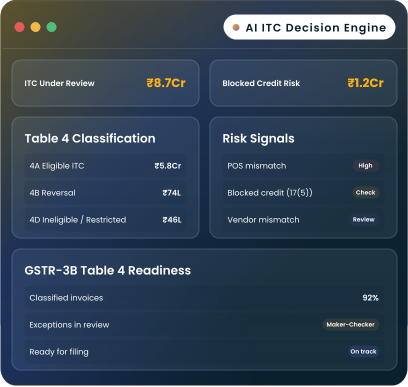
The platform reviews every invoice and line item, applies GST logic, classifies ITC eligibility, identifies blocked or risky credits, maps amount to GSTR-3B Table 4, and routes exceptions to the right reviewer with structured reasoning.
Invoice Ingestion

Data ingested through ERP, API’s, PDF’s, & Excel upload.
AI Eligibility Check

Evaluate invoice and line-item context against ITC rules, blocked-credit indicators, RCM, and POS.
Risk Signal Detection

Flag Section 17(5), POS mismatch, vendor mismatch, time-barred credits, duplicate, and incomplete data cases.
Table 4 Mapping

Map eligible, reversed, reclaimed, ineligible, RCM, import, ISD, and review-required credits into GSTR-3B buckets.
GSTR-3B Readiness

Create a defensible, invoice-level ITC position before return finalization.
AI ITC Decision Layer for Invoice-Level GST Credit Classification
Cygnet.One turns each document into structured, verifiable compliance data, helping teams move from reactive checking to proactive tax and finance governance.
Context Understanding Layer
AI reads invoice descriptions, line items, HSN/SAC, vendor profile, expense category, GSTIN, POS, tax values, ERP fields, GSTR-2B and reconciliation signals.

Eligibility Reasoning Layer
The engine evaluates whether ITC is eligible, blocked, risky, reversal-required, reclaim-ready or review-required, using configured GST logic and enterprise tax policy.

Governed Action Layer
AI recommends GSTR-3B Table 4 treatment, assigns confidence, highlights reason codes, routes exceptions and stores reviewer approvals or overrides for audit defense.
Two Ways to Run AI-Based ITC Classification
METHOD 1Document-first analysis
When invoices come as PDFs, scans, emails, or uploads. The AI engine reads the invoice copy through intelligent document processing, extracts header and line-item fields, understands the transaction context, and then determines ITC eligibility and GSTR-3B treatment.
METHOD 2 Data-first analysis
When invoice data is already available in ERP, via API, or as an Excel upload. The AI engine works on structured invoice and reconciliation data to classify GST treatment and GSTR-3B reporting on a scale.
Sample E-Invoice and AI Decision Intelligence
Invoice Type
Vendor service invoice with GST charged and PO reference available.
Risk Signals
Vendor mismatch, possible restricted category, pending payment validation.
Reviewer Action
Validate nature of service, supplier filing status, payment ageing and business-use evidence.
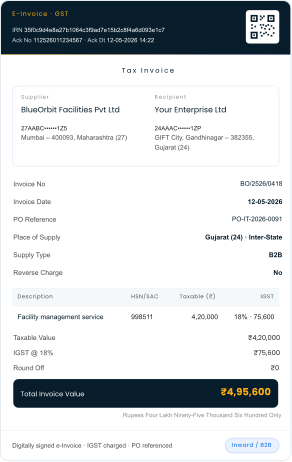
AI Finding
Vendor service invoice with GST charged and PO reference available.
Table 4 Recommendation
Keep under review-required action until supporting evidence is confirmed. Proposed mapping: 4B(2) / internal review queue.
Audit Trail
AI reason code, source data, confidence score, reviewer action and override notes captured.
Why Cygnet Goes Beyond ITC Reconciliation and OCR Automation

Traditional ITC Process
- Manual invoice review
- Matching-first approach
- Spreadsheet-based Table 4 working
- Limited blocked-credit intelligence
- Weak decision trail
- Filing-time firefighting
AI-Native Cygnet.One Approach
- Invoice and line-item AI reasoning
- Confidence-scored exception prioritization
- Autonomous Table 4 recommendation layer
- Blocked credit, POS, 180-day and time-bar checks
- Explainable AI decision trail
- Return readiness before filing deadline
Governed AI for GST Credit Decisions
Human-in-the-loop Review
Tax teams approve high-risk, high-value, low-confidence and policy-sensitive ITC decisions.
Explainable AI reasoning
Every AI recommendation includes reason, signal, source data, confidence, and review status.
Audit Trail by Invoice
Capture decision history, reviewer action, override reason, approval, and final classification.
Role-based Access
Control access by GSTIN, entity, business unit, user role, function, or approval level.
Maker-checker Controls
Enforce review and approval workflows before high-risk ITC positions move into GSTR-3B.
ERP and GST Integration
Connect invoice, purchase register, vendor, payment, reconciliation, and return-preparation data.
AI-Led ITC Validation for Every Stakeholder
CFO
Protect cash flow by reducing under-claimed credits, avoid exposure from incorrect availment, and get better visibility into credit risk before GSTR-3B finalization.

Heads of Tax
Standardize ITC decisions across GSTINs, classify credits correctly into Table 4, and maintain defensible reasoning for every claim, reversal, reclaim, and blocked-credit decision.

Finance Controllers
Improve month-end controls with cleaner ITC working, documented approvals, exception status, and audit-ready invoice-level decision trails.

AP and Shared Services
Reduce back-and-forth between AP and tax teams by routing only exception invoices with clear next actions, vendor signals, and missing-data requirements.

ERP and IT Teams
Add intelligence above existing ERP and GST data flows without redesigning the entire finance stack. Feed cleaner, classified ITC data into return-preparation workflows.

Book an AI-Powered ITC Validation Software Demo
Start with a focused review of your invoice flow, ITC eligibility logic, Table 4 working, blocked-credit risk, vendor mismatch exposure, reversal and reclaim tracking, and audit-trail maturity.
Walk through invoice ingestion, AI eligibility decisioning, Table 4 mapping, exception review, and audit trail.
Frequently asked questions
AI-led ITC eligibility validation uses invoice, vendor, tax, payment, reconciliation, and GST return data to determine whether input tax credit should be claimed, blocked, reversed, reclaimed, or sent for tax-team review.
AI can classify invoice-level ITC amounts into the relevant GSTR-3B Table 4 buckets such as eligible ITC, reversals, reclaims, ineligible credits, RCM, imports, and review-required categories before filing.
No. The AI layer supports review by identifying risk, suggesting classification, and explaining recommendations. Final decisioning, overrides, approvals, and filing control remain with tax and finance teams.
Yes. The platform can flag possible blocked or restricted credit scenarios for tax-team review based on expense type, invoice context, vendor data, POS, Section 17(5) indicators, and business rules.
Cygnet.One acts as an intelligence layer that connects invoice, purchase register, vendor, payment, reconciliation, ERP, GST and return-preparation data for controlled ITC review.