








BIR-Compliant Philippines e-Invoicing Solution
Built to support BIR e-Invoicing Philippines’ requirements for JSON invoice generation, JWS digital signing, and near real-time invoice transmission.

e-Invoicing compliance Timeline

UAE e-Invoicing: The Complete Guide to Compliance and Future Readiness

Types of Vendor Verification and When to Use Them

Safeguard Your Business with Vendor Validation before Onboarding

Modernizing Dealer/Distributor & Customer Onboarding with BridgeFlow

Accelerate Vendor Onboarding with BridgeFlow
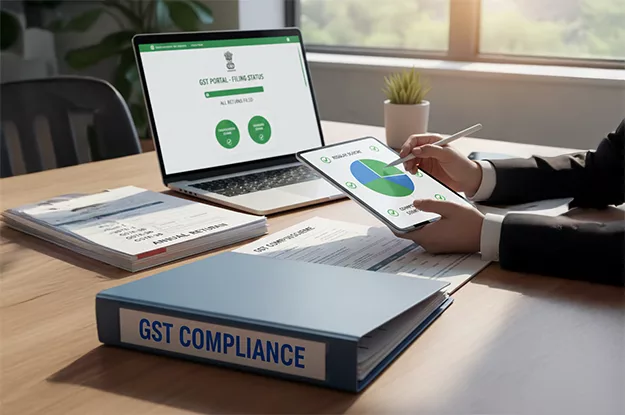
GST Filing 360°: GST, E-Invoicing, E-Way Bills & Annual Returns Made Simple

Why Manual Tax Determination Fails for High-Volume, Multi-Country Transactions
GST Filing 360°: GST, E-Invoicing, E-Way Bills & Annual Returns Made Simple

Key Features of an Invoice Management System Every Business Should Know

Automating the Shipping Bill & Bill of Entry Invoice Operations for a Leading Construction Company

From Manual to Massive: How Enterprises Are Automating Invoice Signing at Scale

AI-Powered Interviewing Helped an Education Group Reduce Hiring Time Significantly

AI-Powered Voice Assistant for Smarter Search Experiences

Cygnet.One’s GenAI Ideation Workshop

Our Journey to CMMI Level 5 Appraisal for Development and Service Model

Extend your team with vetted talent for cloud, data, and product work

Enterprise Application Testing Services: What to Expect

Future-Proof Your Enterprise with AI-First Quality Engineering

Cloud Modernization Enabled HDFC to Cut Storage Costs & Recovery Time

Cloud-Native Scalability & Release Agility for a Leading AMC

AWS workload optimization & cost management for sustainable growth

Cloud Cost Optimization Strategies for 2026: Best Practices to Follow
Cygnet.One’s GenAI Ideation Workshop

Practical Approaches to Migration with AWS: A Cygnet.One Guide
Tax Governance Frameworks for Enterprises
Cygnet Launches TaxAssurance: A Step Towards Certainty in Tax Management

| Stage / Regulation | Timeline / When | Model | Transaction Type | Format of E-Invoice | Additional Notes |
|---|---|---|---|---|---|
| TRAIN Law (RA 10963), Section 237-A | December 2017 (Effective January 2018) | Legislative Framework |
B2B
B2C B2G |
— | Required the BIR to establish the Electronic Invoicing/Receipting and Sales Reporting System (EIS). Later amended by the CREATE MORE Act (RA 12066). |
| EIS Pilot (RR 8-2022 & RR 9-2022) | 1 July 2022 | Near Real-Time Reporting (EIS) |
B2B
B2C B2G |
Structured JSON | Pilot launched for selected exporters, e-commerce businesses, and Large Taxpayer Service (LTS) entities. Invoice issued first, then sales data transmitted to BIR. |
| EIS Pilot Suspension | November 2023 – February 2025 | Pilot Suspended | — | — | BIR paused active EIS transmissions due to system maintenance and implementation challenges. |
| EOPT Act (RA 11976) & RR 7-2024 | 2024 | Document Classification |
B2B
B2C |
Sales Invoice / Official Receipt | Sales Invoice became the primary tax document, while Official Receipt became supplementary for reporting purposes. |
| RR 11-2025 (CREATE MORE Act) | Effective 14 March 2025 | Structured Reporting (EIS) |
B2B
B2C B2G |
Structured JSON (XML Supported for Issuance) | Expanded mandatory scope to large taxpayers, e-commerce businesses, and businesses using compliant invoicing software. Sales data must be transmitted within three calendar days. |
| RR 26-2025 (Deadline Extension) | 31 December 2026 | Reporting (EIS) |
B2B
B2C B2G |
Structured JSON | Compliance deadline extended to 31 December 2026. Exporters and incentive enterprises remain under a future implementation wave. |
| Cross-Border e-Invoicing (JAO No. 001-2025) | Phased Rollout from Early 2027 | Customs e-Invoicing (CEI) |
Cross-Border
|
Structured Electronic Invoice | Foreign exporters must register and submit customs invoices through the government CEI portal. Separate from the domestic EIS. |
| Wave 1 – Full Mandatory Enforcement | 1 January 2027 | Reporting (EIS) |
B2B
B2C B2G |
Structured JSON with JWS Signature | Mandatory electronic invoicing for in-scope taxpayers. Non-compliant invoices become invalid for VAT claims and are subject to statutory penalties. |
| Wave 2 – Exporters & Incentive Enterprises | TBD | EIS + ESRS |
B2B
B2C B2G |
Structured JSON | Exporters, PEZA/BOI incentive enterprises, and certain POS-based retailers will be onboarded under a future BIR regulation. |
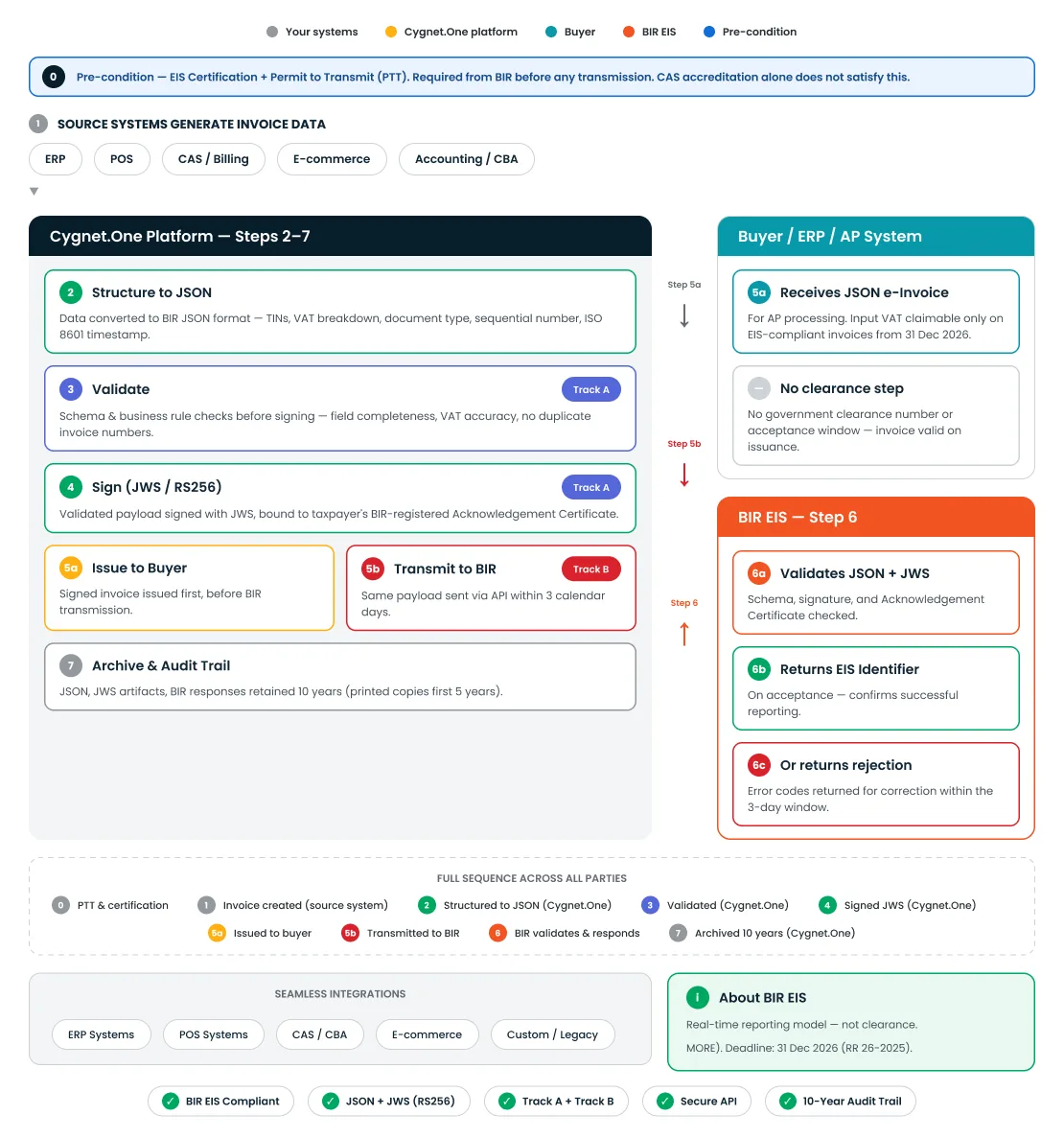
Cygnet.One connects your ERP, POS, and billing systems to the BIR EIS generating structured JSON invoices, applying JWS signatures, and transmitting sales data in near real time through a secure, scalable architecture.
Generate invoice data directly from your ERP, POS, accounting, or billing application.
Convert invoice data into structured JSON and validate it against BIR EIS requirements and mandatory tax fields.
Apply a JWS digital signature and issue the compliant invoice to the buyer.
Transmit signed invoice data securely to the BIR EIS and receive acknowledgment and status updates.
Archive invoices, digital signatures, and acknowledgments securely to meet statutory retention and audit requirements.
Cygnet.One streamlines the complete Philippines EIS invoice lifecycle—from invoice creation and JSON validation to digital signing, secure BIR transmission, and long-term archival—ensuring regulatory compliance and operational efficiency.







Cygnet Digital helped a leading multi-brand retail & manufacturing company to simplify, improve and support the complexity in documentation, and…
Learn how global businesses can overcome e-Invoicing implementation challenges, including multi-country compliance, data accuracy, and change management.

AI in e-invoicing addresses complex situations & offers predictive capabilities & benefits that enhance e-invoicing. Know more on the benefits…
The EIS is the Bureau of Internal Revenue’s platform for receiving electronic invoice and sales data. Mandated under the TRAIN Law (RA 10963, Section 237-A) and rolled out from 1 July 2022 under RR 8-2022, it requires covered taxpayers to issue structured electronic (JSON) invoices and transmit sales data to the BIR in near real time.
No. The Philippine EIS is a reporting/transmission model. The taxpayer generates the JSON invoice, signs it with a JSON Web Signature (JWS), issues it to the buyer, and transmits the sales data to the BIR. There is no government-issued clearance number or QR code that the invoice must obtain before it is valid, and it does not use a PEPPOL four-corner network.
RR 11-2025 also extended the mandate to taxpayers using Computerized Accounting Systems (CAS), Computerized Books of Accounts (CBA) with electronic invoicing, or any other invoicing software capable of generating and transmitting structured data regardless of revenue size. If your business runs any ERP, accounting, or billing software, you should verify whether this triggers your obligation under RR 11-2025.
No. The EIS requires a structured electronic invoice in JSON format. Emailing or printing a PDF does not meet the requirement, the data must be structured, signed with a JWS, and transmitted to the BIR.
Under the Ease of Paying Taxes Act (RA 11976) and RR 7-2024, the Sales Invoice became the primary document for the sale of both goods and services, and the Official Receipt was repositioned as a supplementary document. This affects which document type your system issues and transmits.
Non-compliance can trigger administrative penalties under the National Internal Revenue Code, and non-compliant invoices can be challenged putting input VAT claims and deductibility at risk and increasing audit and assessment exposure. (Confirm specific penalty amounts against current BIR issuances.)
Cygnet.One connects to SAP, Oracle NetSuite, Microsoft Dynamics, and local/custom accounting (CAS) systems, along with POS and e-commerce platforms. It maps your data into the EIS JSON format, applies JWS signing, validates against EIS rules, and transmits to the BIR with audit-ready archival.