



































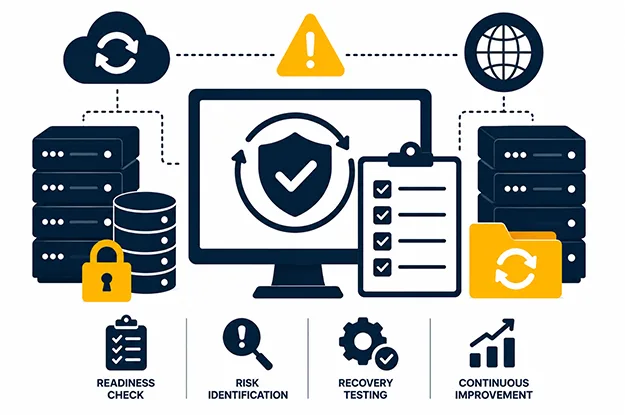
A recovery plan earns credibility only when the business can restore the right service, with the right data, in the right order, under conditions that resemble a real disruption.
That distinction matters more than many DR documents admit. Veeam’s 2026 Data Trust and Resilience Report found that 90% of surveyed organizations were confident they could recover from a cyber incident within their recovery time objectives, yet only 28% of ransomware-affected organizations fully recovered all affected data. Confidence and demonstrated recovery are clearly different measures.
A disaster recovery readiness assessment closes that gap, especially when enterprises need to reduce IT downtime by validating recovery before a real disruption occurs. It tests whether recovery assumptions still match the environment that exists today. It checks dependencies, restores backup data, measures recovery behavior, exposes timing gaps, and records evidence that leaders can act on.
That is the practical meaning of DR readiness: recovery capability that has been demonstrated, measured, and understood before an outage forces the issue.
DR Readiness vs. DR Documentation: What Is the Difference?
A disaster recovery document can be complete and still be operationally weak.
Plans usually describe applications, owners, recovery priorities, backup policies, contacts, and procedures, but understanding how managed IT services work shows why recovery ownership, testing, and escalation matter beyond documentation. Those records matter. NIST contingency planning guidance treats system priorities, recovery requirements, and coordinated planning as core elements of preparedness. Yet documentation proves that a process has been written down. It does not prove the process will work against the current architecture.
DR readiness asks harder questions:
- Can the team restore the application without access to the primary identity service?
- Are certificates, secrets, DNS records, firewall rules, and third-party connections included in the recovery path?
- Does the backup contain usable application data, rather than merely a completed backup job?
- Can the team reach the recovery environment if normal administrative access is unavailable?
- Does the restored service actually support the business transaction it was meant to recover?
The difference is evidence. A useful way to think about a business continuity assessment is that it examines how critical operations continue across people, facilities, communications, suppliers, and technology. Disaster recovery concentrates more closely on restoring technology services and data. The two should meet at the point where a recovered system becomes usable by the business.
For enterprise disaster recovery planning, the written plan should be treated as an operating hypothesis. Testing decides whether that hypothesis survives contact with the real environment.
What Should a Disaster Recovery Readiness Assessment Validate?
A strong disaster recovery readiness assessment follows the recovery path instead of auditing isolated controls. The path usually runs through six areas: dependencies, backup integrity, recovery execution, timing, people, and evidence.
1. Map the Application Dependency Chain Before Testing Recovery
Applications rarely recover alone. A customer portal may depend on an identity provider, API gateway, database, message queue, object store, DNS service, key management service, external payment connection, monitoring platform, and several network controls. A runbook that starts with “restore the application server” can miss half the recovery path.
Google Cloud’s recovery guidance explicitly recommends including the full application stack, critical infrastructure services, and external dependencies in recovery testing. AWS guidance similarly stresses coordinated recovery across components and data dependencies.
Dependency mapping should answer four questions for each critical service:
| Recovery question | Evidence to capture |
| What must be available first? | Upstream systems, identity, network, secrets, DNS |
| What does the service depend on outside IT? | Vendors, SaaS platforms, data feeds, certificates |
| Who owns each dependency? | Named technical and business owner |
| What happens if the dependency is unavailable? | Workaround, alternate path, or accepted outage |
A practical DR gap analysis often finds that the primary application is protected while a smaller dependency has no recovery procedure, which is one of the top IT challenges enterprises face when dependency ownership is unclear. That smaller dependency can become the real outage boundary.
2. Validate Backups by Restoring Them
Backup success is an operational signal. Restore success is recovery evidence.
CISA recommends regularly testing backup availability and integrity in a disaster recovery scenario. AWS also recommends periodic recovery of data to verify backup integrity and recovery processes.
Backup validation should therefore go beyond job status and retention settings. It should confirm that the selected recovery point can be restored, mounted or opened, checked for integrity, connected to the application, and used to complete an expected business action.

For ransomware scenarios, clean recovery deserves separate attention. The recovery team needs a method for deciding whether restored data and systems are trustworthy before reconnecting them to production. A backup that exists but cannot be trusted creates another decision problem during an already pressured incident.
One useful metric here is recovery evidence age: how long it has been since the current service architecture was successfully restored from protected data. A recent backup does not make old recovery evidence fresh.
3. Test Recovery as a Sequence, not a Collection of Tasks
Good recovery readiness testing examines the order in which recovery has to happen.
A tabletop exercise can expose ownership and decision gaps. A component restore can prove that backup data is usable. An application recovery can test dependencies. A controlled failover can test routing, access, observability, and user validation. Each exercise produces a different kind of evidence.
| Test type | What it should prove |
| Tabletop exercise | Roles, decisions, escalation paths, communications |
| Backup restore | Data can be recovered and checked |
| Application recovery | Service dependencies can be rebuilt in sequence |
| Controlled failover | Traffic, identity, access, monitoring, and operations work in the recovery environment |
| Business verification | Users can complete the critical transaction after recovery |
Microsoft’s current cloud security guidance recommends end-to-end disaster recovery scenarios, including tabletop exercises, failover drills, business continuity validation, and structured backup recovery tests.
A clean rehearsal is the wrong objective for recovery readiness testing. A failed test can be valuable if it exposes a hidden assumption early enough to fix it.
RTO RPO Validation: Are the Targets Real or Merely Recorded?
Recovery time objective and recovery point objective are often treated as policy fields. They should be treated as testable business commitments.
Microsoft defines RTO around how long essential access, data, and functionality can remain unavailable, while RPO concerns the amount of data loss the business can tolerate. Its guidance also stresses testing restores to verify integrity and understand actual restoration time.
Effective RTO RPO validation compares the target with observed recovery behavior.
For RTO, decide exactly when the clock starts. Is it the moment the disruption begins, the moment monitoring detects it, or the moment a disaster is declared? Then decide what stops the clock. A server being online is usually insufficient. The service should be usable for the business process that depends on it.
For RPO, verify the actual recovered data point. Replication frequency, snapshot schedules, and backup policies describe expected protection. The restored dataset shows what the business can truly recover.
This is where DR readiness often becomes uncomfortable. A technically successful recovery can still miss the business target because detection, approval, dependency recovery, data checks, or user validation consumed time that the original estimate ignored.
A disciplined comparison records those delays instead of smoothing them out of the final report.
Which Recovery Gaps Should Enterprises Fix First?
The most serious recovery gaps are often ordinary. An administrator account exists only in the primary directory. A recovery runbook points to a document stored inside the affected environment. A certificate renewal changed a service endpoint after the last exercise. A vendor connection requires an allowlist that was never added to the recovery network. A database restores correctly, but the reporting service expects a different hostname.
These issues share one trait: the recovery design assumed continuity in a component that the incident may remove.
A DR gap analysis should therefore classify findings by recovery impact. Ease of remediation belongs in a separate field. A missing contact number and a missing identity recovery path should not carry equal weight.
For each gap, record:
- The failed or unproven recovery assumption
- The service and business process affected
- The evidence from the test
- The accountable owner
- The corrective action
- The condition that must be retested
This turns DR readiness from a periodic review into a controlled improvement cycle.
How to Build a Disaster Recovery Readiness Assessment Scoring Model
A readiness score should summarize evidence without hiding weak points.
The simplest model is to assess six domains: dependencies, backup recoverability, recovery execution, RTO/RPO performance, operational ownership, and business verification. Rate each domain using evidence states such as Unverified, Documented, Partially Tested, Validated, and Repeatable. The label should describe what the latest exercise actually proved.
| Domain | Evidence required for a strong rating |
| Dependency readiness | Current dependency map with tested recovery order |
| Backup recoverability | Successful restore plus integrity and usability checks |
| Recovery execution | Runbooks executed successfully by the responsible team |
| Recovery objectives | Measured results meet approved business targets |
| Operational ownership | Clear authority, escalation, access, and communications |
| Business verification | Critical user activity works after recovery |
An overall status is useful, but it should not overrule a critical failure. If backup recoverability or identity recovery is unverified, the service should remain at risk even when other domains are well tested.
This gate prevents false comfort from a polished summary rating.
A second control makes the model more useful: attach an evidence date to every domain. DR readiness can decay after architecture changes, new integrations, access-control changes, major application releases, or infrastructure moves. A high score based on an obsolete environment should be downgraded until the affected recovery path is tested again.
That approach makes a disaster recovery readiness assessment more useful for technical teams and easier for leadership to read. The score shows condition. The evidence shows why.
What Should a Recovery Readiness Report Show Leadership?
Senior leaders need a concise view of which business services can be recovered, which remain unproven, and what blocks the required state. Detailed test steps can stay in the technical record.
A useful report should show:
- Critical services assessed
- Current readiness rating and evidence date
- Recovery objective status
- Unresolved dependency or backup risks
- Business impact of each material gap
- Owner and retest requirement
This is where a business continuity assessment and technical DR testing should connect. The technology team may report that an application was restored. The business owner should confirm that the process supported by that application can resume.
For enterprise disaster recovery planning, that verification is the point where technical recovery becomes business recovery.
Recovery Readiness Is a Measured Capability
The strongest recovery programs are built around proof. AWS, Microsoft, Google Cloud, and CISA all emphasize regular recovery testing, backup validation, and measurable recovery objectives because recovery assumptions age quickly as systems and dependencies change.
A disaster recovery readiness assessment gives enterprises a structured way to test those assumptions before an incident does it for them. It identifies what depends on what, proves whether protected data can be used, measures real recovery performance, and makes unresolved risk visible.
The most useful question is simple: when was this exact service last recovered successfully using the people, access, dependencies, data, and procedures available today? If the answer is unclear, DR readiness remains an assumption.
Author


Yogita Jain
Content Lead
Yogita Jain leads with storytelling and Insightful content that connects with the audiences. She’s the voice behind the brand’s digital presence, translating complex tech like cloud modernization and enterprise AI into narratives that spark interest and drive action. With a diverse of experience across IT and digital transformation, Yogita blends strategic thinking with editorial craft, shaping content that’s sharp, relevant, and grounded in real business outcomes. At Cygnet, she’s not just building content pipelines; she’s building conversations that matter to clients, partners, and decision-makers alike.