




































As organizations expand, their technology landscapes become increasingly distributed across cloud platforms, on-premises infrastructure, and third-party systems.
This expansion introduces complexity in maintaining performance, security, and operational consistency across regions and business units. Over time, gaps in visibility and coordination begin to surface, making it harder to manage systems efficiently.
According to the Gartner 2021 press release, by 2025, more than 85% of organizations are expected to adopt a cloud-first principle, further increasing the complexity of hybrid IT environments. This shift is accelerating the need for enterprise-managed IT services.
These services provide structured frameworks that enable centralized monitoring, standardized processes, and SLA-driven delivery. This guide explores the challenges enterprises face, how managed IT services operate at scale, and the outcomes organizations can expect from adopting this model.
Enterprise IT challenges that demand a managed services approach
Enterprise IT environments continue to expand across cloud platforms, legacy systems, and distributed business units. As this expansion accelerates, maintaining operational alignment, performance consistency, and system oversight becomes increasingly difficult.
Without a cohesive operating model, these challenges lead to inefficiencies, increased risk, and fragmented service delivery.
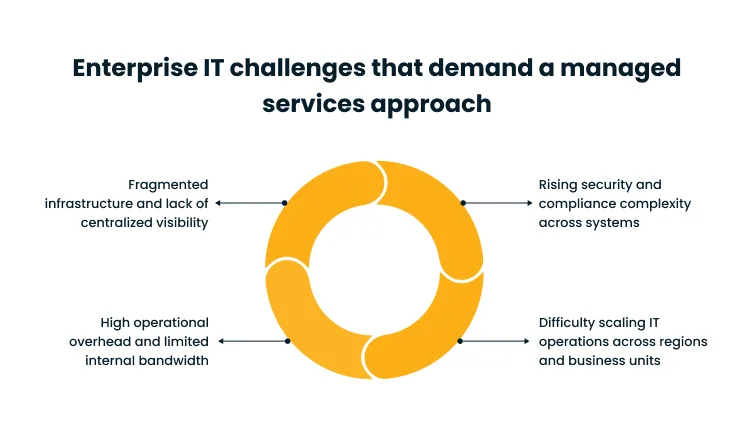
1. Fragmented infrastructure and lack of centralized visibility
One of the most persistent challenges in enterprise IT is fragmentation. Systems are distributed across public cloud, private cloud, on-premise infrastructure, and SaaS platforms. Over time, multiple tools and vendors create silos that limit unified oversight.
This fragmentation reduces system transparency. Issues are often identified late, and incident resolution becomes slower due to disconnected monitoring. Teams struggle to correlate events across environments, making diagnosis more complex.
As a result, operations become less efficient, and maintaining consistent performance across systems becomes difficult. These gaps grow more pronounced as environments scale.
2. Rising security and compliance complexity across systems
Security and compliance have become continuous operational responsibilities. Enterprises must navigate multiple regulatory frameworks while managing an increasing volume of threats.
Inconsistent monitoring across systems creates gaps in oversight. Patch cycles may be delayed, and security updates are not always applied uniformly. These inconsistencies introduce vulnerabilities that are difficult to track across distributed environments.
The impact extends beyond technical risk. Compliance gaps can lead to penalties, while unmanaged vulnerabilities increase exposure to security incidents. Addressing this requires governance-driven models that enforce alignment across systems and ensure continuous oversight.
According to IBM’s Cost of a data breach report 2025, the average cost of a data breach has reached $4.45 million globally, highlighting the financial and operational consequences of unmanaged security gaps.
3. High operational overhead and limited internal bandwidth
Enterprise IT teams often balance operational responsibilities with transformation initiatives. Tasks such as incident handling, vendor coordination, and system maintenance consume significant time and effort.
This limits the ability to focus on forward-looking improvements. Teams are frequently occupied with resolving issues rather than improving systems, which slows down innovation cycles.
The business impact is clear. Operational inefficiencies increase costs, while limited bandwidth reduces overall productivity. Without a streamlined operating model, organizations struggle to support both stability and growth.
4. Difficulty scaling IT operations across regions and business units
Scaling IT operations across regions and business units introduces additional challenges. Different teams often follow different processes and use different tools based on local requirements or historical decisions.
This lack of process alignment results in uneven service delivery. Performance varies across regions, and maintaining service expectations becomes increasingly difficult.
Over time, this slows down expansion and increases operational risk. Growth becomes harder to sustain when IT operations cannot scale in a consistent and predictable manner.
How enterprise managed IT services are delivered at scale
Enterprise managed IT services are delivered through a structured operating model that emphasizes governance, observability, and continuous improvement. This approach replaces fragmented execution with coordinated processes that enable reliable service delivery across complex environments.
1. Enterprise IT environment assessment and baseline creation
A mature managed services engagement begins with a comprehensive assessment. Infrastructure, applications, integrations, and dependencies are evaluated to understand how systems interact and where gaps exist.
This process generates key outputs:
- A current state blueprint of the environment
- Baseline metrics for uptime, responsiveness, and incident patterns
- A prioritized roadmap for remediation and optimization
These insights establish a clear foundation for execution. Decisions are based on actual system behavior, reducing the risk of misaligned changes.
Cygnet.One follows a similar assessment-led approach within its infrastructure and application managed services, emphasizing visibility, resilience, and continuous management as the foundation before broader optimization.
2. Governance models and SLA-driven service frameworks
Governance frameworks define how services are delivered and managed across the enterprise. This includes roles, responsibilities, escalation paths, and communication structures.
Service level agreements formalize expectations through defined uptime targets, response times, and reporting standards. These frameworks create clarity and ensure accountability across teams.
With governance in place, service delivery becomes consistent and measurable. This reduces ambiguity and enables better tracking of performance and service quality.
3. Continuous monitoring and proactive infrastructure management
Continuous monitoring is central to enterprise-managed IT services. Systems are observed in real time to detect anomalies, performance degradation, and potential failures before they impact business operations.
Automated alerts and maintenance workflows enable faster response and prevent issues from escalating. Key operational activities, such as proactive infrastructure management, contribute to maintaining system stability.
This approach shifts IT operations from reactive to proactive. Downtime is minimized, systems perform more consistently, and organizations gain better control over their infrastructure.
4. Data-driven optimization and performance improvement
Managed IT services extend beyond maintenance by focusing on continuous improvement. Operational data is analyzed to identify trends, inefficiencies, and areas for enhancement.
By evaluating system behavior and usage patterns, organizations can refine infrastructure and improve resource allocation. This ensures that environments evolve in line with changing business needs.
The result is sustained efficiency. Systems become more resilient, and performance improvements are maintained over time.
Business outcomes enterprises achieve with managed IT services
Enterprise managed IT services deliver measurable outcomes by improving system reliability, enabling scalability, strengthening governance, and optimizing operational efficiency.
By shifting from reactive support to proactive, structured management, organizations gain greater control over their IT environments while aligning technology performance with business objectives.
1. Improved uptime and system reliability across operations
When monitoring is centralized and maintenance is proactive, uptime improves. That is the most immediate operational gain. Reduced downtime means fewer business disruptions, more stable user experiences, and less internal firefighting.
Cygnet.One’s application managed services explicitly center on uninterrupted performance and reduced downtime, while its infrastructure services emphasize resilient, high-performing, future-ready operations.
The impact reaches beyond IT. Stable operations improve employee productivity, customer trust, and leadership confidence in technology delivery.
2. Scalable infrastructure aligned with business growth
Infrastructure must adapt to changing business demands, whether driven by increased usage, regional expansion, or new digital initiatives.
Managed IT services enable this adaptability by aligning infrastructure with operational needs. Systems can scale without introducing instability or requiring frequent redesign.
This supports growth while maintaining operational continuity.
3. Stronger compliance posture and risk reduction
A well-managed environment improves governance and reduces exposure to risk. Continuous oversight, standardized processes, and defined ownership support regulatory alignment.
This reduces the likelihood of compliance gaps and strengthens overall system security. Organizations gain better control over risk across distributed environments.
4. Optimized IT costs with predictable service models
Managed IT services improve cost predictability by introducing structured service models. Organizations gain clearer visibility into operational expenses and reduce unexpected costs caused by reactive issue handling.
This enables better financial planning and improves efficiency. Resource utilization becomes more effective, and operational performance remains consistent as environments scale.
Implementation approach for enterprise-managed IT services
A well-defined implementation approach focuses on adoption, alignment, and change management rather than just technical setup. A structured transition ensures that services are integrated smoothly while maintaining operational stability.
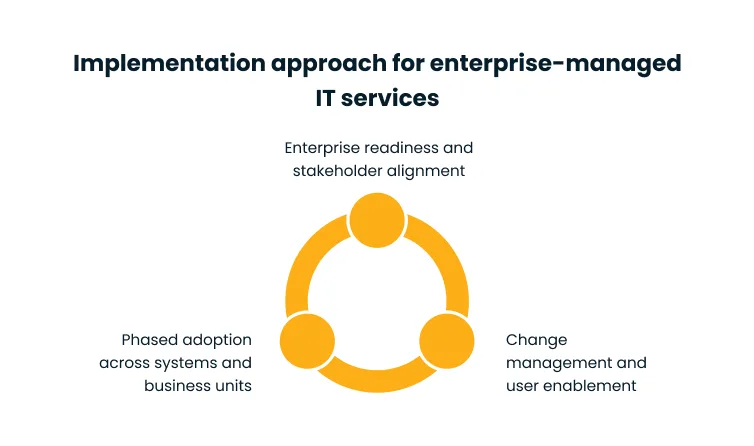
1. Enterprise readiness and stakeholder alignment
Implementation begins with assessing organizational readiness and aligning stakeholders. IT leadership, business teams, and operational owners must share a clear understanding of expected outcomes.
Defining success metrics early ensures accountability and direction. This alignment reduces resistance and improves the likelihood of successful adoption.
2. Phased adoption across systems and business units
A phased rollout is usually the safest enterprise path. Critical systems come first, then adjacent services, then broader regional or business unit coverage. This reduces disruption and gives teams time to refine governance and workflows before scaling.
A phased model also makes it easier to prove value. Organizations can compare incident trends, reporting quality, service responsiveness, and internal workload changes before expanding scope.
This kind of controlled transition aligns well with the structured adoption style of Cygnet.One emphasizes across infrastructure, application support, and change management-driven service delivery.
3. Change management and user enablement
The technical transition is only part of the job. Teams need to know how the new model works, what changes in escalation, how reporting will be handled, and who owns what moving forward.
Strong change management usually includes:
- Clear communication plans
- Updated process documentation
- Training for internal stakeholders
- Governance reviews during early rollout phases
This matters because enterprise-managed IT services are most effective when internal and external teams work as one operating system. The provider should not become a black box. It should become a structured extension of enterprise capability.
Conclusion
Enterprise IT environments require structured management, continuous monitoring, and scalable service delivery to maintain performance and support growth. Managed IT services provide a clear path to achieve this by improving visibility, strengthening governance, and enabling consistent operations across complex environments.
The next step is to evaluate current IT challenges, identify gaps in efficiency, and assess where proactive management can drive better outcomes. Selecting the right provider depends on their ability to deliver standardized processes, scalability, and long-term operational stability.
Providers such as Cygnet.One offer integrated managed IT services that combine infrastructure management, application support, cybersecurity, and governance.
For organizations considering this shift, schedule a demo with Cygnet.One to explore how these services can align with specific business needs and operational goals.
FAQs
Enterprise managed IT services refer to outsourcing IT operations, infrastructure, and support to a specialized provider that manages systems at scale. These services focus on continuous monitoring, governance, and performance optimization to support complex enterprise environments with high reliability, security, and compliance requirements.
Enterprise managed IT services integrate and manage systems across multiple vendors through centralized platforms. Providers standardize monitoring, streamline communication, and ensure compatibility between tools and technologies. This reduces complexity, improves coordination, and enables consistent performance across diverse IT ecosystems.
Enterprise managed IT services are tailored to specific business requirements, including infrastructure, compliance, and operational goals. Providers customize service scope, SLAs, and reporting frameworks to align with enterprise needs, ensuring flexibility while maintaining standardized processes for efficiency and scalability.
Enterprise managed IT services include structured disaster recovery strategies such as automated backups, failover systems, and regular testing. These ensure critical systems can recover quickly during disruptions, minimizing downtime and protecting business continuity across complex and distributed environments.
Managed IT services provide centralized dashboards and reporting tools that give real-time insights into system performance, incidents, and usage trends. This improves decision-making, helps identify inefficiencies, and allows IT leaders to maintain control over large and distributed environments.
Enterprise managed IT services support hybrid environments that include both legacy systems and modern platforms. Providers ensure compatibility, maintain performance, and enable gradual modernization without disrupting existing operations or requiring immediate system replacement.
Author


Abhishek Nandan
AVP, Marketing
Abhishek Nandan is the AVP of Services Marketing at Cygnet.One, where he drives global marketing strategy and execution. With nearly a decade of experience across growth hacking, digital, and performance marketing, he has built high-impact teams, delivered measurable pipeline growth, and strengthened partner ecosystems. Abhishek is known for his data-driven approach, deep expertise in marketing automation, and passion for mentoring the next generation of marketers.