


































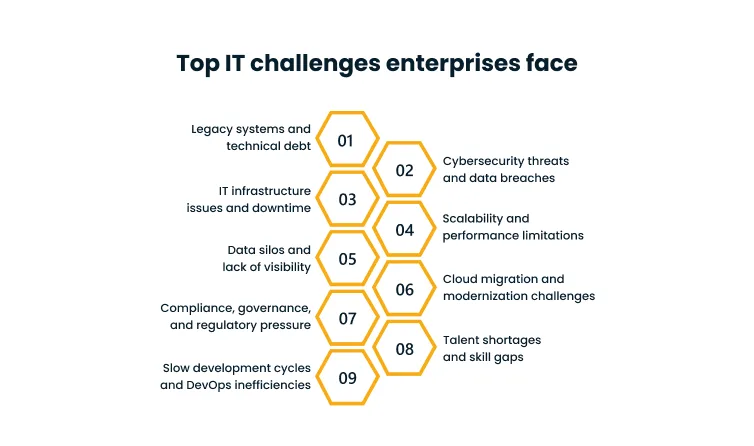
The major IT challenges enterprises face today include legacy systems carrying years of technical debt, escalating cybersecurity threats, infrastructure issues that drive costly downtime, scalability limits that constrain growth, fragmented data silos, complex cloud migration journeys, intensifying compliance requirements, persistent talent shortages, and slow development cycles that delay competitive response.
The most common challenges include:
- Legacy systems and technical debt
- Cybersecurity threats and data breaches
- IT infrastructure issues and downtime
- Scalability and performance limitations
- Data silos and lack of visibility
These are no longer isolated technical issues. They are interconnected business risks that compound over time and either accelerate or block every digital initiative the enterprise depends on for growth, resilience, and customer experience.
In this guide, we break down the nine most common IT challenges enterprises face, why each one happens, what it costs the business, and the practical steps that resolve them at scale.
Top IT Challenges Enterprises Face (and How to Solve Them)
Each one of the challenges below has root causes that touch architecture, operations, security, and organizational design, and most of them reinforce each other when ignored.
For each challenge, we describe the problem in practical terms, explain why it tends to emerge, call out the business impact, and lay out the solution pattern that consistently works.
1. Legacy systems and technical debt
Enterprises accumulate technical debt by deferring modernization in favor of feature delivery, by acquiring companies whose stacks were never integrated, and by extending the life of systems that “still work” past the point where they can keep pace with the rest of the business.
Innovation slows because every new capability has to work around an older system. Maintenance costs rise as fewer engineers are willing to specialize in the old stack. Cloud, AI, and modern data initiatives stall because the legacy platforms cannot integrate cleanly with them.
- Treat modernization as a structured program.
- Replatform or refactor applications based on the value they deliver and the cost of maintaining them as-is.
- Move from monolithic architectures toward microservices where the seams justify the work.
- Use cloud migration as the forcing function that resets infrastructure assumptions across the portfolio.
Cygnet.One’s AWS Modernization and Migration service helps enterprises re-architect legacy workloads onto cloud-native foundations using a structured assessment-to-deployment approach that prioritizes the applications where modernization unlocks the most business value.
2. Cybersecurity threats and data breaches
The threat surface has expanded faster than most security programs can adapt. For example, ransomware operators target enterprises systematically, phishing campaigns are increasingly tailored using AI, and insider threats remain difficult to detect because they look like normal user activity until they are not.
Cloud adoption, distributed workforces, third-party APIs, and SaaS sprawl have multiplied the attack surface. Identity-based attacks now cross trust boundaries that traditional perimeter-based controls were never designed to handle.
Direct financial loss, regulatory fines, lost customer trust, and operational disruption that can last weeks. Brand damage compounds the dollar cost in industries where security posture is a buying criterion.
- Move toward zero-trust architecture where every identity, device, and request is verified rather than assumed.
- Build continuous monitoring across endpoints, identity systems, and cloud workloads.
- Automate response for known patterns so human analysts focus on novel threats rather than triage.
- Adopt proactive threat detection that surfaces anomalies before they become incidents.
According to the 2025 IBM Cost of a Data Breach Report, the global average cost of a data breach reached USD 4.44 million in 2025, with organizations facing significant security skills shortages paying USD 5.74 million on average compared to USD 3.98 million for those with stronger security teams. Security maturity has become directly visible in the financials.
3. IT infrastructure issues and downtime
Performance failures, outages, and system crashes cost the business measurable hours of productive operation. For example, slowdowns during peak load, failed batch jobs that propagate into broken downstream systems, and unplanned maintenance windows that stretch beyond their estimates.
Outdated infrastructure operating beyond its design parameters, weak observability that only surfaces issues after they affect users, and capacity planning models that have not kept pace with actual demand growth.
IT downtime translates directly into revenue loss in customer-facing operations and into productivity loss across internal teams. Repeated outages erode trust in the IT function and make every future capacity request harder to justify.
- Move workloads onto cloud-based infrastructure that scales elastically and self-heals from common failure modes.
- Instrument every layer with observability tools that detect anomalies before they cascade.
- Adopt high-availability architecture patterns, including redundancy, failover, and multi-region deployment for critical services.
- Run proactive monitoring with alerting thresholds calibrated to business impact rather than raw technical metrics.
4. Scalability and performance limitations
Systems perform well at current load but struggle as transaction volumes, user counts, or data sizes grow. Performance bottlenecks emerge unpredictably, often during peak demand when impact is highest.
Architectures designed for fixed capacity rather than elastic scale. Monolithic codebases where one slow component throttles the entire system. Storage and database layers that were not designed for the access patterns the application now demands.
Customer-facing slowdowns drive churn. Internal performance issues cascade into delayed reports, missed SLAs, and operational backlog. The team spends growing effort on capacity firefighting rather than on building new capability.
- Move to an elastic cloud infrastructure that auto-scales with demand.
- Decompose monolithic applications into distributed systems where individual components scale independently.
- Adopt load balancing, caching layers, and asynchronous patterns that absorb traffic spikes without proportional infrastructure cost.
- Design for scale assumption from day one rather than retrofitting it later.
5. Data silos and lack of visibility
Operational data sits in dozens of disconnected systems across departments and acquired entities. A unified view of the customer, the financials, or the operating performance does not exist because no single platform holds it.
For example, departmental SaaS purchases made without an integration strategy, legacy systems that were never connected, and acquisition-related stacks that were left in place rather than consolidated all contribute to silos.
Reports drawn from different sources contradict each other. Decisions get delayed while teams reconcile numbers. Analytics and AI initiatives stall because the data they need cannot be joined cleanly.
- Build centralized data platforms (data lakes, lakehouses, or federated access layers) that consolidate operational data with consistent quality standards.
- Implement integration pipelines that move data reliably between source systems and the analytics layer.
- Pair the platform with BI tooling and governance so the consolidated view becomes the trusted source for business decisions.
Cygnet.One’s Data Engineering and Management service helps enterprises consolidate fragmented data environments into integrated platforms with the pipeline development, governance frameworks, and quality monitoring needed to make analytics and AI use cases viable downstream.
6. Cloud migration and modernization challenges
Cloud migrations that take longer than planned, cost more than budgeted, and deliver less value than the business case projected. Workloads that move to the cloud without being refactored end up running more expensively than they did on-premises.
Insufficient workload assessment before migration. Unclear sequencing across the application portfolio. Limited internal experience with cloud-native architecture patterns. Unpredictable cost behavior once workloads start running in elastic environments.
Migration timelines slip, budgets overrun, and the transformation outcomes the program was approved for arrive late or not at all. Skepticism about cloud value grows internally and slows the next round of investment.
Use a structured migration framework that assesses every workload against business value, technical readiness, and modernization opportunity before deciding rehost, replatform, refactor, or retire.
Migrate in phases tied to business outcomes rather than infrastructure milestones. Build cost optimization from day one with tagging, monitoring, and rightsizing as continuous practices rather than one-time exercises.
According to the 2024 Gartner Forecast on Worldwide Public Cloud End-User Spending, worldwide public cloud spending was projected to reach USD 723 billion in 2025, up 21.5% year over year. The investment is accelerating, but the success rate of individual migrations depends almost entirely on the structure of the program rather than the size of the budget.
Cygnet.One’s Cloud Migration and Modernization service applies the ORBIT migration framework alongside AWS MAP (Migration Acceleration Program) alignment to take enterprises through assessment, mobilization, and migration phases with predictable timelines and cost outcomes.
7. Compliance, governance, and regulatory pressure
Regulatory requirements are expanding across jurisdictions and intensifying in regulated industries like banking, insurance, and healthcare. Audit cycles are getting tighter, evidence requirements are more demanding, and the cost of non-compliance has moved into nine-figure territory for the largest enterprises.
New frameworks (DORA, EU AI Act, sector-specific privacy regulations) layer on top of existing ones (GDPR, HIPAA, SOC 2, PCI DSS). Cloud and hybrid environments make data residency and access control harder to enforce consistently.
Legal and regulatory exposure, audit findings that translate into remediation costs, and operational delays when compliance reviews block new initiatives.
- Establish governance frameworks that codify policies, ownership, and evidence collection across the technology estate.
- Automate compliance tracking and continuous control monitoring rather than relying on point-in-time audits.
- Build audit-ready systems where required evidence is generated as a byproduct of normal operation rather than reconstructed under deadline pressure.
8. Talent shortages and skill gaps
Cloud architects, security engineers, AI specialists, and senior DevOps practitioners are scarce. Even when enterprises hire, they struggle to retain talent in environments where the work feels operational rather than strategic.
Technology evolution is outpacing the supply of practitioners trained in the latest tools and patterns. Internal upskilling programs cannot keep up with the pace of change in cloud, AI, and security.
Strategic initiatives get delayed because the in-house team is fully consumed by run-the-business work. Dependency on external vendors grows, and roadmap predictability declines.
Combine targeted hiring with managed services for the operational work that does not need to be in-house. Invest in upskilling for the engineering capability that should remain internal. Use strategic outsourcing for specialized capabilities needed temporarily, like cloud migration or AI deployment.
According to the 2026 Gartner CFO Survey on AI and Digital Talent, acquiring and developing AI and digital talent is the top near-term challenge cited by CFOs. The shortage shows up in salary inflation, longer time-to-hire, and high attrition once specialists are onboarded.
Cygnet.One’s Managed IT Services practice extends enterprise teams with infrastructure management, cybersecurity, and application support coverage, freeing internal staff to focus on the higher-value work that justifies in-house investment.
9. Slow development cycles and DevOps inefficiencies
Software releases that take weeks to move from code complete to production. Manual processes are inserted between development and deployment that introduce delay and risk. Siloed teams that hand off work over walls instead of operating as integrated delivery units.
CI/CD pipelines that exist in name but not in practice. Manual approvals are layered on for compliance reasons that have outlived their justification. Cultural separation between development, operations, and security teams.
Slow time-to-market that erodes competitive position. Delayed bug fixes that compound user impact. Reduced ability to respond to market changes or customer feedback at the pace the business needs.
- Build automated CI/CD pipelines that take code from commit to production with deterministic gates.
- Adopt infrastructure-as-code so environments are reproducible and auditable.
- Embed security and compliance checks into the pipeline rather than treating them as separate gates.
- Drive a DevOps culture where development, operations, and security teams share ownership of delivery outcomes.
Why IT Challenges Are Increasing for Modern Enterprises
The IT environment most enterprises operate in today is structurally more complex than the one they were operating in five years ago. Several macro forces are driving that complexity, and they compound rather than offset each other.
- Rapid digital transformation: Every business function now depends on technology to deliver, measure, and optimize its work. The IT estate has expanded accordingly, with more systems, more integrations, and more failure modes than the prior decade ever produced.
- Explosion of data: The volume, velocity, and variety of data flowing through enterprise systems have outpaced the infrastructure built to handle it. Storage, processing, and governance models designed for terabyte-scale environments are creaking at petabyte scale.
- Multi-cloud complexity: Most enterprises now run on two or more cloud providers, plus on-premise infrastructure for workloads that have not migrated. Each environment has its own identity model, networking, cost structure, and operating tools.
- AI adoption pressure: Generative AI and predictive analytics have moved from optional to expected, but they place demands on data quality, compute capacity, and integration that legacy IT was not designed for.
- Rising compliance demands: New regulations are arriving faster than existing ones are sunsetting, and they apply across jurisdictions that enterprises may not have operated in before.
According to the 2026 Gartner Forecast on Worldwide IT Spending, worldwide IT spending is projected to reach USD 6.15 trillion in 2026, up 10.8% from 2025. The spending growth reflects how much more IT is being asked to deliver, and how much more complex the environment is becoming.
The shift this all adds up to is that IT now operates as the fabric of the business itself, far beyond its prior role as a support function. The cost of getting it wrong no longer stays absorbed quietly inside the IT budget. It shows up in revenue, in customer experience, and in competitive position.
Why Enterprises Must Address and Overcome IT Challenges
The IT challenges above are business risks that compound over time and surface as direct constraints on growth, efficiency, and competitiveness. Delayed innovation pushes time-to-market past competitor cycles.
Inefficiencies and downtime drive operational costs that erode margin. Lack of data visibility leads to decisions made on intuition, where evidence should be available. Cybersecurity and compliance exposure convert into legal liability and brand damage, and weak foundations cause cloud, AI, and modernization initiatives to fail to deliver the value that was projected when they were funded.
Modern enterprises cannot continue treating IT as a support function. IT has become a core driver of scalability, resilience, and digital transformation, and the organizations that recognize this shift sooner pull ahead of those still operating on the older model.
Solving these challenges requires more than isolated fixes. Enterprises need a unified strategy across cloud, data, AI, and infrastructure, continuous optimization rather than one-time transformation, and the ability to scale securely and efficiently as the business changes shape.
Partners like Cygnet.One helps enterprises move from fragmented IT environments toward integrated, future-ready systems.
Our AWS partnership supports cloud migration and modernization at enterprise scale. Our Modernization and Migration service provides structured transformation frameworks that move applications and infrastructure into cloud-native operating models with predictable outcomes.
Our Data Engineering and Management practice consolidates fragmented data environments into platforms that support analytics, AI, and integrated decision-making, while our Managed IT Services practice covers ongoing infrastructure, cybersecurity, and application operations so internal teams can focus on the strategic work that drives business outcomes.
Enterprises that proactively address IT challenges are better positioned to scale faster, innovate confidently, and stay competitive in a rapidly evolving digital landscape.
What Enterprises Should Do Next
The enterprises that get ahead of IT complexity are the ones that stop reacting to individual issues and start building the underlying capability that makes the next round of issues smaller.
Practically, that means investing in IT as a strategic capability with clear ownership, funded roadmaps, and measurable outcomes.
The key insights to carry forward are:
- IT challenges are interconnected. Solving one without addressing the others rarely produces lasting results.
- Legacy systems and data silos are root causes of most surface-level symptoms. Addressing them unlocks downstream improvement everywhere else.
- Cloud, AI, and automation are the core building blocks of the modern IT operating model. Investment in them is no longer optional.
- Proactive strategy outperforms reactive firefighting in every measurable dimension, from cost to delivery speed to risk exposure.
- Talent and skill gaps are best addressed through a mix of targeted hiring, focused upskilling, and managed services rather than any one of those alone.
- IT transformation is a growth enabler. The enterprises that treat it that way consistently outperform peers that treat IT as a cost center.
If your teams are working through any of the challenges above and want a partner to help build the strategy and execution path forward, book a demo to discuss how Cygnet.One can support your modernization and IT transformation roadmap.
FAQs
The most common IT challenges enterprises face today include legacy systems carrying technical debt, cybersecurity threats and data breaches, IT infrastructure issues that drive downtime, scalability and performance limitations, fragmented data silos, complex cloud migration journeys, expanding compliance and regulatory pressure, persistent talent shortages, and slow development cycles.
Enterprises struggle with legacy systems because mission-critical workloads are often built on monolithic architectures and outdated technology stacks that cannot easily integrate with cloud, AI, or modern data platforms. Modernization gets deferred in favor of new feature delivery, technical debt accumulates, and over time, the cost and risk of working around legacy platforms exceed the cost of replacing them.
IT infrastructure issues affect business performance directly through downtime, slow response times, and failed transactions that translate into lost revenue and damaged customer trust. They also affect performance indirectly by consuming IT capacity that should be going into new capabilities, and by undermining business confidence in the systems the enterprise depends on for daily operation.
The biggest challenges in cloud migration for enterprises are workload assessment and prioritization, migration sequencing across the application portfolio, cost predictability once workloads start running in elastic environments, and the internal skill gap around cloud-native architecture patterns. Migrations that succeed apply a structured framework to these issues from the beginning rather than working through them in flight.
Enterprises overcome IT challenges effectively by treating IT as a strategic capability with named ownership, funded roadmaps, and measurable outcomes rather than as a cost center delivering individual projects. The pattern that works combines cloud-native architecture, data consolidation, security automation, structured modernization, and a mix of targeted hiring and managed services to extend internal capacity.
Solving IT challenges is critical for digital transformation because cloud, AI, analytics, and customer-facing digital initiatives all depend on the underlying infrastructure, data, and security foundations being reliable. Weak foundations cause transformation programs to underdeliver against their business cases regardless of how well the front-end initiatives are designed or executed.
Author


Abhishek Nandan
AVP, Marketing
Abhishek Nandan is the AVP of Services Marketing at Cygnet.One, where he drives global marketing strategy and execution. With nearly a decade of experience across growth hacking, digital, and performance marketing, he has built high-impact teams, delivered measurable pipeline growth, and strengthened partner ecosystems. Abhishek is known for his data-driven approach, deep expertise in marketing automation, and passion for mentoring the next generation of marketers.