




































Cloud migration stalls when execution falls behind ambition, and for most enterprises, that gap comes down to structure, not intent.
AWS migration services provide that structure, guiding organizations through the full path from readiness assessment and strategy to execution, modernization, and post-migration optimization, with each phase designed to control risk and protect business continuity.
According to a 2022 Gartner Enterprise Cloud Spending Shift, more than half of enterprise IT spending in key market segments was on track to shift to the cloud by 2025, up from 41% in 2022, and the organizations capturing the most value from that shift are the ones with a structured migration approach behind them.
This guide covers what those services include, the business value they deliver, real-world use cases, and what to look for in a provider capable of executing at enterprise scale.
AWS Migration Services: What They Include and How They Work
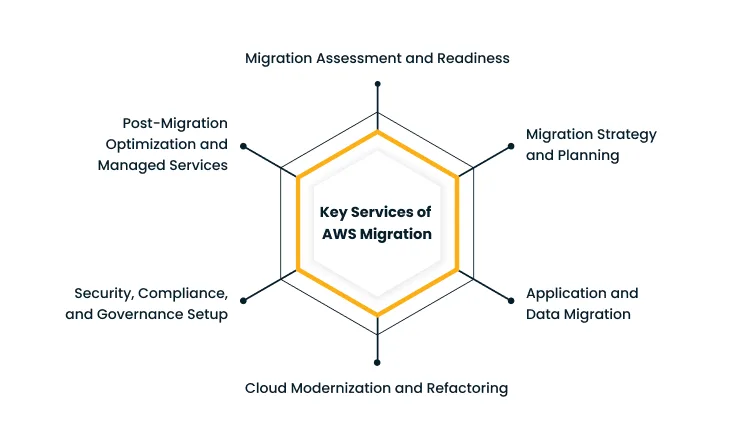
AWS migration services help organizations move applications, data, and infrastructure workloads from on-premises or legacy environments to AWS. These services cover the full migration lifecycle, spanning readiness assessment, migration strategy and planning, application and data migration, cloud modernization, security and governance configuration, and post-migration optimization.
Each phase is managed to minimize downtime, control costs, and ensure workloads perform at the level the business requires once they are live.
For enterprises managing hundreds of interdependent applications, this structured approach is what separates a migration that captures real business value from one that simply moves a cost problem from one environment to another.
The core components include:
- Infrastructure and workload assessment
- Migration strategy development and prioritization
- Application and database migration
- Cloud modernization and refactoring
- Security, compliance, and governance configuration
- Post-migration optimization and managed services
Each component plays a distinct role in ensuring workloads don’t just move to AWS; they perform there.
Key Services of AWS Migration
A successful AWS migration is a coordinated sequence of services, each addressing a distinct phase of the journey from legacy infrastructure to cloud-native operations.
Understanding what each service delivers helps you evaluate migration proposals with precision, set realistic expectations with stakeholders, and make informed decisions about which provider has the depth to execute.
1. Migration Assessment and Readiness
Before anything moves, you need to know exactly what you have. Assessment starts with application inventory and dependency mapping, identifying which workloads exist, how they interact, and the sequencing that minimizes operational disruption.
Cloud readiness scoring tells you which applications are suited for a direct migration versus those that need remediation first. Risk and cost estimation translates those findings into financial projections that stakeholders can act on. Skip this step, and execution runs on assumptions, which is the leading cause of overruns.
2. Migration Strategy and Planning
Not every workload should take the same path. AWS migrations typically apply three approaches across the portfolio:
- Lift (rehost): Move as-is. Fastest option, but doesn’t unlock cloud-native performance benefits.
- Replatform: Make targeted optimizations without rearchitecting. Common for databases and managed services.
- Refactor / Re-architect: Rebuild for cloud-native performance. Highest effort, strongest long-term return.
Good cloud migration planning maps each workload to the right approach, sequences migration waves, and aligns teams before execution begins.
3. Application and Data Migration
This is where planning meets execution, and quality here determines whether operations stay intact during the move. Secure data transfer keeps integrity intact and access controls in force throughout. Workload migration coordinates the movement of applications, compute, and storage while maintaining service availability.
For customer-facing systems, minimal downtime is non-negotiable. Incremental replication, cutover windows, and rollback protocols reduce exposure during the switchover period, especially critical for high-volume or compliance-heavy environments.
4. Cloud Modernization and Refactoring
Getting workloads onto AWS is the start, not the finish. Modernization is where infrastructure advantages translate into application-level gains. Re-architecting for cloud-native performance means breaking apart monolithic applications, removing legacy middleware dependencies, and redesigning workloads to scale horizontally instead of vertically.
Containerization accelerates this. A cloud-native architecture delivers consistent performance across environments, faster deployments, and more efficient resource use than monolithic setups. Organizations that modernize close to the migration window get significantly more from their AWS investment.
5. Security, Compliance, and Governance Setup
Migration doesn’t automatically fix security gaps. Without the right configuration from day one, access controls and compliance setups can introduce new vulnerabilities rather than resolve existing ones.
IAM defines who can do what across the AWS environment, enforcing least-privilege principles and tightening the attack surface.
Compliance alignment covers HIPAA for healthcare, SOC 2 for SaaS, GDPR for European-market organizations, and financial sector requirements. Setting this up during migration, rather than retrofitting it later, avoids remediation costs that are far higher after go-live.
6. Post-Migration Optimization and Managed Services
Migration done doesn’t mean work done, because cloud costs drift upward and performance degrades when teams make changes without visibility into their cumulative impact. Performance monitoring keeps application health, latency, and availability in check before small issues become bigger ones.
Cost optimization involves rightsizing compute resources, selecting the right AWS pricing models, and eliminating idle or over-provisioned workloads. Managed services extend this discipline across the full environment, sustaining the gains that justified the migration in the first place.
These services work together, and the business value they deliver becomes clearer when you see what a well-executed migration actually produces.
Benefits of AWS Migration Services
AWS migration delivers measurable business value, and the scale of that opportunity is significant. According to a 2022 McKinsey Cloud Value Study, companies that go beyond basic cloud adoption stand to capture $3 trillion in EBITDA value by 2030.
Realizing that value comes down to the right service architecture backing the move. Here’s what a well-executed migration delivers:
- Reduced infrastructure and maintenance costs: The pay-as-you-go model replaces fixed IT spend with variable costs that scale with actual usage, cutting on-premises overhead.
- Improved scalability and performance: Scale workloads up or down on demand, without over-provisioning for peak loads.
- Faster deployment and innovation cycles: Cloud-native tooling cuts time from development to production, enabling faster releases and quicker responses to market shifts.
- Enhanced security and compliance posture: AWS’s shared responsibility model and purpose-built compliance frameworks help organizations meet regulatory requirements more reliably than most on-premises setups.
- Better disaster recovery and resilience: Multi-region replication, automated backups, and failover capabilities deliver RTOs and RPOs that legacy infrastructure simply cannot match.
As costs fall and deployment speeds increase, the compounding effect on operational efficiency and innovation output is significant.
AWS Migration Services Use Cases Across Industries
AWS migration use cases vary by industry, but the underlying drivers are largely the same. Rising maintenance costs, architectural constraints, and the competitive pressure to build and deploy faster are what push organizations to move.
According to a 2024 Gartner Cloud Spending Forecast, worldwide public cloud spending is forecast to hit $723 billion in 2025, a clear signal of how broadly this shift is already underway.
Legacy System Modernization
Running business-critical applications on end-of-life infrastructure is a problem that only gets more expensive over time. As hardware ages, vendor support expires, and the skills to maintain legacy stacks become harder to source, maintenance costs climb with no ceiling in sight.
AWS migration replaces that constraint with a scalable cloud architecture built for continuous evolution, letting teams modernize at a pace the business can absorb rather than forcing a single high-risk replacement cycle.
Data Center Exit and Consolidation
Running multiple data centers means compounding overhead in real estate, power, cooling, and staffing that adds up fast. A managed migration to AWS creates a defined path to exit those facilities on a clear timeline.
The operational complexity doesn’t vanish, but it becomes cloud-managed rather than hardware-dependent. The cost profile shifts from capital-heavy to operationally optimized, and teams previously managing physical infrastructure can focus on higher-value work.
Cloud-Native Application Transformation
Legacy infrastructure creates deployment bottlenecks. Every release requires coordination across environments that weren’t built for continuous delivery, and that friction costs time and competitive ground.
Pairing an AWS move with containerization and DevOps tooling removes those constraints. Cloud modernization enables teams to ship faster and with greater confidence, and CI/CD pipelines on AWS can compress release cycles from weeks to days or hours. Teams that make this shift tend to hold that advantage.
Disaster Recovery and Business Continuity
On-premises disaster recovery typically means duplicate hardware at secondary sites, expensive to build, maintain, and test without disrupting production. AWS replaces that model with cloud-native replication and failover at a fraction of the equivalent on-premises cost.
Organizations achieve RTOs and RPOs that legacy infrastructure simply cannot match at comparable cost, and they can test recovery scenarios without taking production systems offline.
How to Get Started With AWS Migration Services
Successful migration doesn’t happen by accident. Organizations that approach it as a structured program, with defined phases, clear accountability, and the right partner behind execution, consistently achieve better outcomes, faster timelines, and more durable cost reductions than those that treat it as a one-time IT project. Here’s how to run it right.
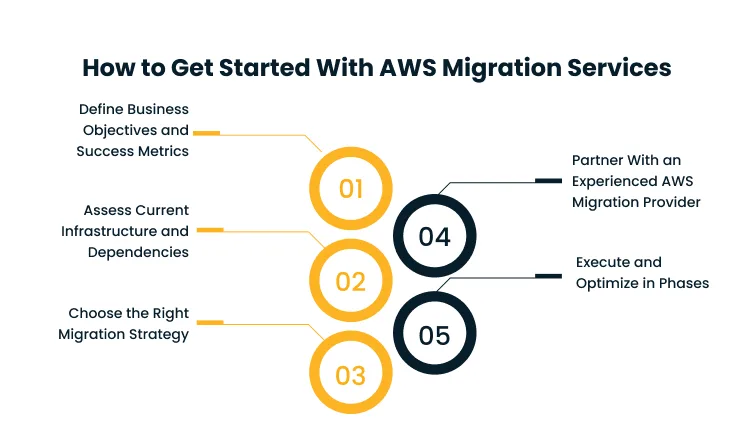
Step 1: Define Business Objectives and Success Metrics
Migration without a clear business case tends to lose momentum fast. Start by anchoring the program to specific outcomes, whether cost reduction targets, scalability goals tied to the product roadmap, or innovation timelines that legacy infrastructure is currently blocking.
Defining success metrics upfront, whether cost savings, deployment frequency, system availability, or compliance coverage, creates the accountability framework that keeps the program on track.
Step 2: Assess Current Infrastructure and Dependencies
A complete inventory of workloads, dependencies, and data flows is the foundation of any workable cloud migration planning. Assessment identifies which applications can move quickly, which need remediation first, and which dependencies create sequencing constraints.
Shortcutting this step is one of the most common causes of overruns. Undocumented dependencies that surface mid-execution force delays and improvisations that compound risk.
Step 3: Choose the Right Migration Strategy
Assessment output determines which workloads lift-and-shift, which replatform, and which justify full refactoring. That mapping sets the overall migration effort, timeline, and cost.
The best cloud migration strategies run multiple approaches in parallel, leading with simpler workloads in early waves to generate wins while complex modernization work runs alongside, building operational confidence before the hardest work begins.
Step 4: Partner With an Experienced AWS Migration Provider
Provider selection matters more than most organizations realize. A poorly executed migration, in downtime, data integrity issues, and rework, typically costs more than any savings from a cheaper provider.
Prioritize AWS Advanced Tier or Premier Tier partners with proven end-to-end delivery, a documented governance methodology, and demonstrated track records in your industry. How a provider handles the full lifecycle from assessment to optimization is the most reliable signal of what your migration will look like.
Step 5: Execute and Optimize in Phases
Migration waves let teams learn and adjust before tackling the most complex workloads. Each wave delivers tangible progress while building the operational knowledge needed for what comes next.
Start post-migration optimization as soon as the first workloads go live. Carrying avoidable overhead through the entire migration window adds up fast, and early optimization compounds into real savings by the time the full portfolio has moved.
What to Look for in an AWS Migration Service Provider
Choosing the right AWS migration partner directly impacts cost, speed, and long-term outcomes. The provider landscape covers a wide range of capability levels, so evaluating with precision protects the program from misaligned expectations and under-resourced execution.
- AWS certifications and partnership tier: Advanced Tier or Premier Tier status confirms alignment with AWS’s technical delivery standards.
- End-to-end delivery scope: Covers assessment through post-migration optimization, reducing multi-vendor coordination overhead.
- Security and governance methodology: Documented frameworks for IAM, compliance alignment, and data protection configured from day one.
- Migration accelerators and proprietary tooling: Structured frameworks speed assessment, discovery, and execution with fewer manual errors.
- Demonstrated industry experience: Case studies in your sector are the strongest signal a provider can handle your specific constraints.
- Post-migration managed services: Providers invested in ongoing management have more accountability for how the migration itself is executed.
The strongest partners treat migration as a business transformation, not an infrastructure project. Look for AWS modernization and migration capabilities backed by a proven delivery framework, full lifecycle ownership, and a verifiable enterprise track record.
Conclusion
AWS migration delivers real value, but that value is only as reliable as the execution behind it. Organizations that treat migration as a structured business program consistently achieve better outcomes, faster timelines, and more durable cost reductions.
If you work with Cygnet.One, you get a team that covers the full migration lifecycle, from infrastructure assessment through post-migration optimization, with 700+ AWS-certified professionals and proven delivery across 100+ enterprise migrations.
Cygnet’s ORBIT framework and CMMI Level 5 certification bring the process discipline that turns migration intent into measurable cloud outcomes.Book a demo with Cygnet.One today.
FAQs
AWS migration services are end-to-end programs that help organizations move applications, data, and infrastructure from on-premises or legacy environments to AWS. They cover assessment, strategy, execution, security and compliance configuration, and post-migration optimization to deliver scalability, cost efficiency, and long-term performance in the cloud
Timeline depends on portfolio size, workload complexity, and the migration strategy chosen. Lift-and-shift migrations for individual workloads can take weeks, while full enterprise data center exits with modernization work often span 12 to 24 months. A rigorous assessment phase produces a realistic timeline before execution begins.
Migration costs depend on workload complexity, strategy, and the provider’s engagement model. Assessment, tooling, execution resources, and post-migration optimization all factor into the total investment. Most organizations see a net cost reduction over a 2 to 3 year horizon as infrastructure and maintenance costs fall once workloads move to AWS.
Primary risks include data integrity issues during transfer, extended downtime for critical systems, compliance gaps from misconfigured security controls, and cost overruns from incomplete pre-migration assessment. Experienced providers address these through structured assessment, rollback protocols, phased migration execution, and governance frameworks configured before go-live.
Prioritize providers with AWS Advanced Tier or Premier Tier status, end-to-end delivery capabilities, documented security and governance methodologies, proprietary migration frameworks, and demonstrated experience in your industry. Post-migration managed services capability is a strong signal that the provider is invested in outcomes beyond project completion.
Yes. Most legacy applications can migrate to AWS, though the approach varies. Some move through lift-and-shift with minimal changes. Others require replatforming or refactoring to perform effectively in a cloud environment. A thorough assessment determines the right path for each workload, balancing migration speed, cost, and long-term performance objectives.
Author


Abhishek Nandan
AVP, Marketing
Abhishek Nandan is the AVP of Services Marketing at Cygnet.One, where he drives global marketing strategy and execution. With nearly a decade of experience across growth hacking, digital, and performance marketing, he has built high-impact teams, delivered measurable pipeline growth, and strengthened partner ecosystems. Abhishek is known for his data-driven approach, deep expertise in marketing automation, and passion for mentoring the next generation of marketers.