




































Migrating to the cloud is like shifting your entire physical workplace to a modern, scalable, and efficient space. From moving your data, apps, workloads, to your complete on-premises infrastructure, cloud gives you incredible benefits of lower cost, flexibility, and innovative tools (AI and Analytics) to grow your organization with pay for what you use options.
Yet, many cloud initiatives struggle not because the cloud platforms fail, but because the cloud migration strategy is unclear from the initial stage. Enterprises rush into,
- Lift-and-shift moves
- Underestimate dependencies or
- Apply a one-size-fits-all approach across workloads
The result is higher cloud spend, performance bottlenecks, compliance gaps, and limited business growth. This is where cloud migration strategies matter for modern enterprises.
In this blog, we break down the most effective cloud migration strategies used by modern enterprises today. We start with the 7Rs framework as the foundation, then move into workload-based strategy selection, cost and risk analysis, and hybrid cloud migration strategy considerations. Finally, we bring it together with real-world examples to help you choose the right approach for your enterprise.
Understanding the 7Rs of Cloud Migration
The 7Rs of cloud migration planning is a strategic framework that gives you the seven options in the right direction for moving to the cloud. It gives you the options to choose between decommissioning, moving as it is, or fully re-architecting for cloud native transformation. Let’s understand each one in detail.
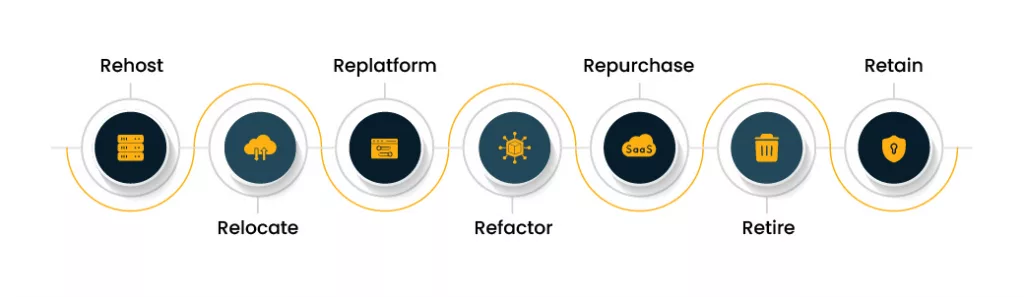
Rehost
Rehosting is the process of applying applications to the cloud with little or no modification. It is usually selected in order to speed up timelines or leave data centers fast.
This is the best strategy when there is low change frequency and most of the applications are stable. Nevertheless, being fast, it seldom brings cost optimization or performance gains unless it is further modernized.
Relocate
Relocation enables businesses to migrate workloads to cloud-based computing environments like VMware environments without modifying the application.
The option is especially applicable to organizations that manage big, virtualized estates. It helps in a hybrid cloud migration plan, as it will allow continuity but delay deeper architectural modifications.
Replatform
Replatforming involves making specific optimizations without changing the architecture. Some examples are the relocation of databases to manage services or reconfiguring middleware to be compatible with the cloud.
This is an approach used by enterprises to put on a middle ground of effort and advantage. It provides mediocre performance and cost improvements without the rigor of wholesale refactoring.
Refactor
Refactoring is the redesign of applications in a way that makes full use of cloud-native features that include microservices, containers, and managed services.
It is the most resource consuming cloud migration strategy but the most influential one. It is usually used in business-critical systems where there is no compromise in scaling, resilience, and speed of innovation.
Repurchase
Repurchasing involves using SaaS products to replace the old applications.
This framework makes things simple, minimizes the maintenance overhead, and fastens the time to value. It is usually used on the functions of a business such as CRM, HR, or finance systems.
Retire
Decommissioning applications refers to retirement of systems that are not valued by the business.
This is a step that is not taken seriously but very helpful in the control of costs. Elimination of idle applications limits migration coverage, cloud expenditure, and vulnerability risk.
Retain
Retention applies when the application is maintained at the premises or existing environment because of technical reasons, compliance, or business timing.
Retention does not imply the inability to migrate. It is a decision strategy in cloud migration best practice particularly in old systems, where a major redesign is needed or regulatory acceptance.
What is the Significance of the 7Rs for Your Organization?
The power of 7Rs is in elasticity. It helps businesses to implement various cloud migration policies in portfolios but not to compel them to make a similar decision. Such a method facilitates cost saving, reduction of risks, and realistic schedules and allows hybrid and stepwise migrations.
Choosing the Right Cloud Migration Strategy Based on Workloads
As an enterprise, you don’t have to move all applications to the cloud in the same manner. This is where choosing the right strategy helps you understand which workload needs urgent transition using a workload-based migration approach, how it behaves under load, and how much risk the enterprise can absorb during change.
This workload-first approach is a core principle of effective cloud migration planning. There are several factors that you need to consider. Let’s look at each one in detail.
Legacy and Core Systems of Record
These applications often run critical business processes but were not designed for cloud environments.
For stable systems with limited change requirements, rehost or relocate is usually the safest starting point. For systems that block scalability or innovation, replatforming can introduce incremental improvements without disrupting core logic. Full refactoring is typically deferred unless the system directly limits business growth.
Customer-Facing and Revenue-Critical Applications
Applications that impact customer experience, uptime, and revenue demand higher resilience and scalability.
These workloads benefit most from refactoring, where cloud-native design enables elastic scaling, fault tolerance, and faster release cycles. In some cases, repurchasing with a SaaS platform offers faster value and lower operational overhead.
Data-Intensive and Analytics Workloads
Analytics platforms, reporting systems, and data pipelines require high throughput and flexible compute scaling.
These workloads are strong candidates for replatforming or refactoring, especially when moving to managed databases, data warehouses, or analytics services. This approach supports performance optimization and predictable cost models.
Compliance-Driven and Regulated Workloads
Industries such as banking, healthcare, and government operate under strict regulatory controls.
For these systems, retain or relocate is often the initial choice, enabling a controlled hybrid cloud migration strategy. Over time, selective replatforming can be introduced once governance and compliance models mature.
Low-Value or Redundant Applications
Many enterprise portfolios contain applications that are rarely used or no longer aligned with business priorities.
These workloads should be evaluated for retirement early in the migration journey. Eliminating them reduces migration complexity, lowers cloud spend, and minimizes security risk.
Why You Should Choose Workload-Based Selection for Your Organization?
Applying cloud migration strategies at the workload level prevents over-engineering and under-delivering. It allows enterprises to invest in modernization effort where it creates measurable business impact, while maintaining stability where change introduces unnecessary risk.
Cost and Risk Analysis in Cloud Migration Planning
Cloud migration decisions that ignore cost and risk often fail after going live. While workloads may successfully move to the cloud, enterprises frequently encounter higher operating costs, performance issues, and new security gaps.
This is why cloud migration risk assessment must be embedded into cloud migration planning, not treated as a post-migration exercise.
Understanding the True Cost of Cloud Migration
Cloud costs extend beyond infrastructure usage. Enterprises must evaluate licensing changes, data transfer charges, operational tooling, and ongoing management overhead.
Rehosting may appear cost-effective initially, but without optimization, it can increase long-term spend. Replatforming and refactoring require higher upfront investment but often deliver better cost efficiency through managed services, auto-scaling, and reduced maintenance effort.
A realistic cost model compares short-term migration effort with long-term operational savings.
Risk Factors That Influence Migration Strategy
Every cloud migration strategy has varying risk profiles.
Rehosting and relocating have reduced technical risk but can still have the same current performance constraints. Refactoring is riskier to execute because of architectural change, the complexity of the tests, and dependency management. Repurchase changes jeopardize the selection of vendors, data migration, and integration preparedness.
Business enterprises need to evaluate risks in the areas of security, compliance, availability, and business continuity and then settle the approach to each workload.
Security and Compliance Considerations
The problem of insecurity is also likely to be elevated in the migration because of incorrect configuration, extended access, and exposure.
Identity, encryption, network isolation, and auditability controls are needed to provide clarity around workloads that process sensitive data. These are some of the aspects that often influence the decision to keep or redeploy applications in a hybrid cloud migration strategy.
Cloud Migration best practices are focused on ensuring alignment with the security at the initial stages so that the same will not negatively affect the business in the future.
Balancing Cost Optimization and Risk Control
Cloud migration strategies that provide the best balance between financial efficiency and operational stability are the most effective ones.
This implies giving its focus to high impact workloads towards modernization whereas implementing conservative approaches to systems with regulatory or operational limitations. Reductions in costs obtained via aggressive refactoring are no longer valuable when they add downtime or compliance breaches.
Real-World Cloud Migration Strategy Examples
Now, you know the strategy, but implementation can only be understood with real-life examples. Here are some prominent examples of cloud migration who used one of the 7Rs frameworks and improved performance and speed to grow their business.
1) Netflix
Netflix is known for its cloud migration and innovative architecture. It is one of the leading global entertainment service providers, which requires a scalable architecture for their streaming services.
Netflix began its cloud adventure in 2008, with more than 300 million subscribers not only in the US but around the globe and began moving its streaming platform out of physical datacenters and into AWS in the early part of 2016 to support its huge global scale/availability requirements.
Refactoring into microservices on AWS not only enabled Netflix to attain elasticity, greater resilience, and eventually serve hundreds of millions of streaming members in 190 countries but also created the opportunity to operate globally.
2) Spotify
Spotify migrated to cloud from their home-grown infrastructure when they have 75 million+ subscribers in 2016. By partnering with GCP, this leading audio streaming platform wants to migrate both its microservices and data platforms. This helped them reduce operational overhead, improved scalability, and reliability to enhance focus on core product innovation.
3) Airbnb
Airbnb is the most popular online traveler marketplace in the world with a user-base of more than 150 million people and a total of above 8 million active listings. The dominating marketplace turned to AWS as their own infrastructure experiences difficulties when their operations grow to global levels and heavy traffic peaks.
By carrying out a staged move that resulted in the migration of its main production database to Amazon RDS with approximately 15 minutes of downtime, by taking advantage of services like EC2, Auto Scaling, S3, CloudWatch, and mass data-transfer solutions to enhance availability, observability, and control of cost on its home-sharing, globally-available marketplace.
Conclusion
There is no single cloud migration strategy that works for every enterprise. The right approach depends on workload criticality, risk tolerance, compliance needs, and long-term business goals. Modern enterprises succeed when cloud migration strategies are created with clarity, considering all factors and choosing the right cloud partner.
Using the 7Rs framework, applying workload-based selection, and factoring cost and risk efficiently helps organizations to migrate without any disruption.
Whether the path involves rehosting, refactoring, or a hybrid cloud migration strategy, the objective remains the same. Build a cloud foundation that supports scale, resilience, and continuous innovation without compromising governance or cost discipline.
This is where Cygnet.One plays a critical role. As an experienced cloud migration and modernization partner, we help enterprises assess applications through the 7Rs framework, design hybrid-ready architectures, and execute migrations that balance speed, security, and long-term value. Our exceptional cloud transformation frameworks are carefully designed for CIOs and enterprise leaders to provide measurable outcomes. Let’s partner for long-term cloud success without hampering your complete business ecosystem.
Cloud migration is not a one-time event. With the right strategy and the right partner, it becomes a foundation for sustained modernization, operational resilience, and future-ready growth.
Author


Yogita Jain
Content Lead
Yogita Jain leads with storytelling and Insightful content that connects with the audiences. She’s the voice behind the brand’s digital presence, translating complex tech like cloud modernization and enterprise AI into narratives that spark interest and drive action. With a diverse of experience across IT and digital transformation, Yogita blends strategic thinking with editorial craft, shaping content that’s sharp, relevant, and grounded in real business outcomes. At Cygnet, she’s not just building content pipelines; she’s building conversations that matter to clients, partners, and decision-makers alike.