
































A vulnerability caught in code commit takes minutes to fix. The same vulnerability in production triggers a hotfix, pulls engineers off planned work, and starts an SLA clock that gets more expensive every hour it stays open.
Most DevOps teams already know this. But the pipeline keeps shipping fast while security review sits at the end of the cycle, running on a different timeline entirely. Nobody designed it that way. It’s just what happens when security was never part of the delivery workflow to begin with.
The gap isn’t tooling. It’s structural. The speed at which teams ship has outpaced the speed at which manual security can operate, and no scanner fixes that without changing where and how security runs in the pipeline.
This post covers what DevSecOps services actually include, how implementation works across assessment, pipeline integration, and governance, and what separates a provider doing real engineering work from one that bolts a scanner onto your pipeline and calls it done.
What Are DevSecOps Services?
DevSecOps services embed security practices, automated testing, and compliance controls directly into a DevOps pipeline. Instead of a manual security gate before deployment, security runs continuously across every stage of the software delivery lifecycle.
A typical engagement covers:
- Automated security testing at the build and commit stage
- Compliance controls enforced as machine-readable policy
- Runtime monitoring across live workloads
- Real-time findings delivered to developers during sprint work, not as batch reports before release
The result is security that runs in parallel with build, test, and deploy stages without blocking delivery velocity.
DevSecOps vs. DevOps: What Changes When Security Joins the Pipeline
DevOps automates software delivery through CI/CD pipelines, combining development and operations into a single workflow. Security traditionally sits outside this loop, handled by a separate team running reviews after code is already built and staged.
DevSecOps integrates security tooling directly into the CI/CD pipeline. SAST, DAST, and SCA scans run alongside build and test automation. Policy-as-code enforces compliance at every deployment. Developers get security findings at the same speed as unit test results, not in a separate review cycle weeks later.
The shift changes three things: when security runs (every commit, not end-of-cycle), who owns it (shared across dev, ops, and security, not siloed), and how it scales (automated policy enforcement, not manual review that bottlenecks at velocity).
| Aspect | Traditional DevOps | DevSecOps |
| Security timing | End-of-pipeline review or separate audit cycle | Continuous, automated at every pipeline stage |
| Security ownership | Dedicated security team, separate from development | Shared responsibility across development, operations, and security |
| Developer feedback | Batch vulnerability reports before release | Real-time, contextual findings per commit |
| Compliance | Periodic audits, manual evidence collection | Automated policy enforcement and continuous audit readiness |
| Cost of fixing vulnerabilities | High, found late in staging or production | Lower, found early at the build or commit stage |
What DevSecOps Services Include
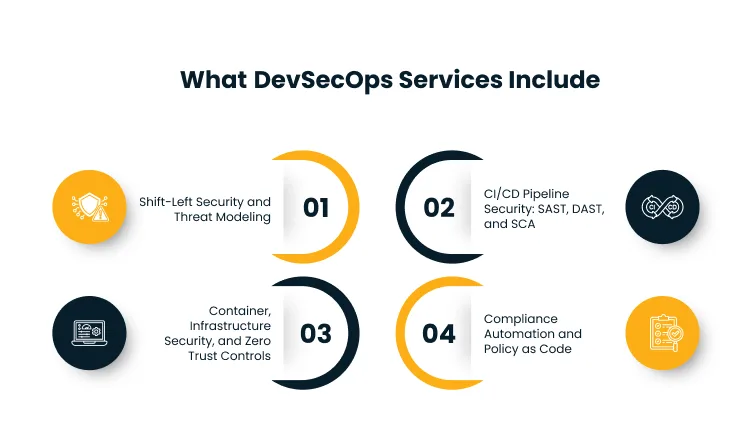
DevSecOps services cover four core capability areas: shift-left security and threat modeling, CI/CD pipeline security (SAST, DAST, SCA), container and infrastructure security with zero trust controls, and compliance automation through policy-as-code. Each layer targets a different stage of the delivery lifecycle, and they work as a connected system. A gap in any one layer weakens the others.
Shift-Left Security and Threat Modeling
Shift-left security moves security activities into the design and development stages, before code reaches the build pipeline. At this stage, a fix is a code change in a single file. In production, the same vulnerability requires a hotfix deployment, cross-team coordination, and potential regulatory disclosure.
Threat modeling applies structured frameworks like STRIDE and MITRE ATT&CK to map attack surfaces during the design phase. The output feeds directly into architecture guardrails and security requirements embedded in user stories and acceptance criteria, so developers work against specific security expectations per feature instead of consulting a separate document after the code is already written.
At the code level, pre-commit hooks and IDE-level security linting catch injection flaws, hardcoded secrets, and insecure dependencies before code reaches the repository. Security becomes part of how developers write code, not a review that happens after they’re done.
CI/CD Pipeline Security: SAST, DAST, and SCA
A mature DevSecOps pipeline uses three categories of automated security testing. Each catches vulnerability classes the others cannot reach, which is why all three run together rather than as interchangeable options.
Static Application Security Testing (SAST) analyzes source code and binaries without executing the application. Running at the build stage, tools like SonarQube, Checkmarx, and Semgrep detect SQL injection, cross-site scripting, insecure deserialization, and hardcoded credentials before code is deployed to any environment.
Dynamic Application Security Testing (DAST) tests the running application by simulating attacks against deployed endpoints in staging. Tools like OWASP ZAP and Burp Suite Enterprise catch runtime vulnerabilities that static analysis cannot reach: authentication flaws, session management issues, and exposed API endpoints.
Software Composition Analysis (SCA) scans open-source and third-party dependencies for known CVEs and license compliance risks. This matters because modern applications can consist of 80% or more open-source code by volume.
A disclosed CVE in a dependency is an exploitable vulnerability regardless of how clean the proprietary code is. Tools like Snyk and OWASP Dependency-Check run on every dependency install to catch these before deployment.
Beyond SAST, DAST, and SCA, two additional controls close common gaps. Automated quality gates block pipeline promotion when findings exceed defined severity thresholds, requiring teams to explicitly document accepted risk before pushing code forward. Secrets scanning tools like GitLeaks and TruffleHog catch API keys, tokens, and credentials before they reach version control, where they persist in commit history even after deletion.
Container, Infrastructure Security, and Zero Trust Controls
Code-level scanning covers the application layer. The infrastructure and runtime layer needs its own controls. Cloud native security practices for Kubernetes environments are a distinct implementation step, not something standard DevOps tooling produces by default. Container images, Kubernetes configurations, infrastructure-as-code, secrets, and service-to-service trust all require dedicated security treatment.
Container image scanning tools like Trivy and Aqua Security check every image for known CVEs before it reaches a registry or any environment. Images with critical vulnerabilities get blocked at the pipeline stage, before they run anywhere.
Kubernetes security hardening covers RBAC configuration, pod security admission controls, and network policies that restrict inter-service communication. Default Kubernetes configurations are frequently insecure and require a deliberate hardening pass. Runtime threat detection through Falco monitors container and workload behavior for anomalous activity in production.
Infrastructure as Code (IaC) security scanning validates Terraform, CloudFormation, and Helm charts before infrastructure is provisioned. Tools like Checkov and tfsec catch public storage buckets, overly permissive IAM roles, and open security groups at the code level. Embedding security by design in AWS modernization programs depends on this layer as a foundational control, particularly as infrastructure complexity scales.
Secrets management replaces hardcoded credentials and manual rotation with centralized vault-based injection at runtime through tools like HashiCorp Vault and AWS Secrets Manager. Secrets never touch environment files or code repositories.
Zero-trust pipeline controls remove implicit trust between services and pipeline stages. Every service-to-service call is authenticated using short-lived workload identities verified through OIDC, mTLS, or SPIFFE/SPIRE. In practice, this means every pipeline job runs with only the permissions it needs to complete its specific task, production is strictly segregated from dev and staging, and privileged operations require multi-party approval before execution.
Compliance Automation and Policy as Code
Manual compliance creates two compounding problems in continuous delivery environments. Evidence collection means pulling data from multiple systems before each audit, consuming engineering capacity for point-in-time records that go stale immediately. Manual policy enforcement depends on human review cycles that cannot keep pace with automated pipeline velocity.
Policy-as-code solves both. Compliance and security requirements are encoded as machine-readable rules using frameworks like OPA/Rego, HashiCorp Sentinel, and AWS Config Rules. These rules run on every build and deployment. Deployments that violate a defined policy are blocked automatically. No manual review, no exceptions without documented risk acceptance.
Every scan result, policy evaluation, approval decision, and deployment event is logged with timestamps, generating a continuous audit trail as a byproduct of normal pipeline operation. Framework coverage maps to the client’s regulatory environment: SOC 2, PCI DSS, HIPAA, ISO 27001, NIST CSF, and CIS Benchmarks are common implementations.
The result: audit readiness becomes a default state, not a multi-week preparation exercise.
| Capability Area | What It Covers | Representative Tools |
| Shift-Left Security and Threat Modeling | Design-time security, threat modeling, secure coding, pre-commit hooks | STRIDE, MITRE ATT&CK, IDE plugins, GitLeaks |
| CI/CD Pipeline Security | SAST, DAST, SCA, secrets scanning, automated quality gates | SonarQube, OWASP ZAP, Snyk, Dependabot |
| Container, Infrastructure Security, and Zero Trust | Image scanning, Kubernetes hardening, IaC security, secrets management, workload identity | Trivy, Checkov, HashiCorp Vault, Falco, SPIFFE/SPIRE |
| Compliance Automation and Policy as Code | Automated framework checks, policy enforcement, audit trail generation, and compliance dashboards | OPA/Rego, AWS Config Rules, HashiCorp Sentinel |
How a DevSecOps Implementation Works
A DevSecOps implementation runs across three phases: assessment and security baseline, pipeline integration and toolchain configuration, and continuous monitoring and governance. Each phase builds on the output of the previous one.
The sections below follow a running example: a financial services platform on Kubernetes with a Jenkins-based CI/CD pipeline, shipping weekly with no automated security testing, secrets in environment files, and six weeks of manual evidence collection before each compliance audit.
Phase 1: DevSecOps Assessment and Security Baseline
The assessment phase establishes what exists, what’s missing, and what needs to change before any tooling is introduced. Four areas are covered:
- Pipeline maturity review: how CI/CD is configured, what automated testing is in place, and how deployments are gated
- Security tooling inventory: what scanning tools exist and whether they’re integrated into the pipeline or running as separate processes
- Codebase security debt assessment: scanning existing repositories to quantify open vulnerabilities, outdated dependencies, and misconfigured infrastructure
- Compliance mapping: which regulatory frameworks apply, and which controls are manual versus automated
In the running example, the assessment finds Jenkins pipelines with unit tests but no security scanning, Kubernetes RBAC with overly broad service account permissions, secrets in .env files, and compliance evidence manually exported from seven systems before each audit cycle.
Output: a prioritized findings report, a DevSecOps implementation roadmap, toolchain recommendations aligned to the existing environment, and baseline security metrics.
Typical duration: 2 to 4 weeks.
Phase 2: Pipeline Integration and Toolchain Configuration
Phase 2 wires security into the existing CI/CD environment without replacing it. SAST and SCA integrate into the build stage with quality gates. DAST runs against staging before production promotion. Secrets migrate to a centralized vault with runtime injection. Kubernetes RBAC and network policies are hardened. IaC scanning covers Terraform and Helm configurations. Runtime monitoring deploys for live workloads.
In the running example, SonarQube is added as a Jenkins stage, Snyk runs on every dependency install, OWASP ZAP scans staging before production promotion, HashiCorp Vault replaces .env files, and Falco monitors the Kubernetes cluster.
Developer experience is a configuration variable, not an afterthought. Tooling is tuned to surface findings with a specific file, line number, and recommended fix. Raw vulnerability dumps produce alert fatigue and bypass behavior. Findings that give a developer a clear next action get resolved. Those that generate noise don’t.
Quality gates run in audit mode initially, reporting findings without blocking builds while the team clears existing security debt. Enforcement mode goes live once the backlog falls below the defined threshold. Typical duration: 4 to 8 weeks, depending on pipeline complexity and security debt volume.
Phase 3: Continuous Monitoring, Feedback, and Governance
Phase 3 is not a project phase. It’s the operating model the pipeline runs on after enforcement mode goes live.
Runtime monitoring through Falco or equivalent tooling alerts on anomalous container and workload behavior. Security events route to the appropriate response team with defined triage SLAs. Vulnerability SLAs classify findings by severity and define remediation windows, with the pipeline blocking promotion of builds that have unresolved critical findings beyond the SLA window.
Security metrics track mean time to remediation by severity, vulnerability trend by service, pipeline gate pass rates, and compliance posture by framework. These feed into monthly security reviews with defined ownership.
In the running example, the financial services team now generates automated SOC 2 evidence on every deployment. The six-week manual compliance process is replaced by a dashboard export. The findings backlog drops from 340 open issues at the Phase 1 baseline to 12 within 90 days of the enforcement mode going live.
Periodic architecture reviews and toolchain updates handle new CVE categories and compliance requirement changes. RBAC access reviews run on a defined cadence. Providers like Cygnet.One structure DevSecOps engagements across this three-phase lifecycle, covering assessment, pipeline integration, and continuous security governance as a managed service rather than a one-time implementation.
Benefits of DevSecOps Services for Enterprises
The value of DevSecOps services is most visible in what stops happening: production incidents from vulnerabilities that should have been caught at commit time, audit cycles that consume weeks of engineering effort, and security reviews that block every major release.
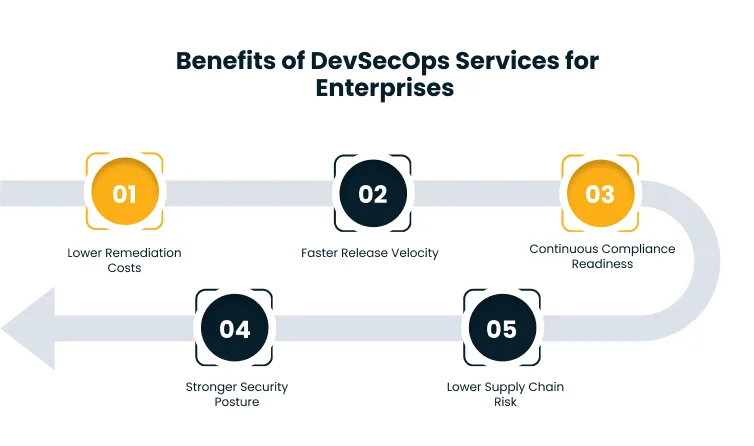
Lower cost of remediation. A vulnerability fixed at the build stage takes minutes and stays within the sprint. The same issue in production means a hotfix, diverted engineering time, potential regulatory disclosure, and compounding SLA consequences. According to the IBM Cost of a Data Breach Report, organizations with mature DevSecOps practices experience significantly lower breach costs and faster containment.
Faster release velocity. Automated security validation runs in parallel with build and test stages. Findings are resolved per sprint rather than accumulated into a pre-release backlog. Releases stop waiting for a manual security review to proceed.
Compliance is a continuous state. Policy-as-code and automated evidence generation keep the enterprise audit-ready on any given day. For organizations operating under PCI DSS, HIPAA, SOC 2, or ISO 27001, this eliminates the recurring audit-preparation sprint that previously consumed engineering and security team capacity.
Measurable security posture and MTTR. Real-time findings, severity-based SLAs, and pipeline metrics give teams the data to track remediation performance over time. Security posture becomes a quantifiable metric leadership can report on, not a qualitative judgment.
Reduced supply chain and dependency risk. Automated SCA and container image scanning monitor for newly disclosed CVEs across dependencies and base images. Alerts fire before exposed components reach production.
DevSecOps Use Cases Across Industries
The toolchain and implementation structure stay consistent across industries. What changes are in the compliance framework, the vulnerability classes prioritized, and the evidence requirements? Three applied contexts show how pipeline-embedded security produces different business outcomes under different regulatory pressures.
1. BFSI: Regulatory Compliance and Secure Release Pipelines
A financial services platform operating under PCI DSS and SOX requirements faces a compliance gate before every major deployment. Manual review cycles take 2 to 3 weeks, and a gap identified 48 hours before go-live forces a full rollback with downstream schedule consequences across multiple teams.
When security and compliance controls are automated into the pipeline, policy-as-code enforces separation-of-duties requirements at every deployment. Compliance evidence is generated as a deployment artifact, not assembled manually before each audit. The pre-release compliance gate is eliminated. Audit preparation drops from weeks to hours. Security findings are resolved within the sprint rather than accumulating into a backlog that determines whether the release window holds.
In a Cygnet.One case study, a leading asset management enterprise modernized its legacy backend into a cloud-native, microservices-based platform with DevSecOps automation embedded into CI/CD pipelines. The legacy architecture had backend APIs directly exposed to the internet and fragmented authentication mechanisms that made policy enforcement inconsistent.
After implementing Zero Trust controls with centralized identity management, secrets management, and continuous security scanning, the organization achieved 50-60% faster release cycles, reduced security exposure, and stronger compliance readiness without disrupting ongoing transaction flows.
2. Healthcare: HIPAA-Aligned Engineering and Audit Readiness
A healthcare SaaS company handling PHI across clinical applications and third-party EHR integrations runs quarterly manual security reviews. A misconfigured API endpoint in a recent release exposed patient data in a staging environment before internal testing caught it. The incident required a manual review of every deployment in the preceding quarter to determine scope.
HIPAA-aligned security controls embedded in the CI/CD pipeline validate encryption handling and PHI data exposure before each deployment. Automated audit trail generation captures every access event and deployment action in a format ready for HIPAA auditors.
The misconfiguration class is caught at build time before code reaches staging. HIPAA audit preparation drops from a four-week manual exercise to a two-day review. Compliance and engineering teams work from a single dashboard rather than reconciling separate reports across systems.
3. SaaS and ISVs: Security Without Slowing Delivery
A B2B SaaS company releasing weekly has no formal security practice embedded in its pipeline. Enterprise prospects require SOC 2 Type II reports as a procurement condition, and the security team cannot manually review every release at the current cadence without affecting delivery timelines.
Security scanning integrates into the existing pipeline without changing the release cadence. SOC 2 controls are encoded as automated pipeline policies, generating continuous evidence across the Trust Service Criteria from the first day of enforcement.
Findings surface per commit and are resolved within the sprint. Audit preparation uses automatically generated evidence rather than manual log collection. Security documentation for enterprise prospects is available on demand rather than being assembled the week before a questionnaire response is due.
When to Engage a DevSecOps Services Partner
The decision comes down to two questions: does your pipeline need structured external support, and does a specific provider have the depth to deliver it? Getting the first question right saves time in evaluation. Getting the second right protects against implementations that configure tooling without building the operating discipline to sustain it.
Signals Your Pipeline Needs Security Embedded
These operational patterns indicate that security has fallen behind delivery pace:
- Security reviews happen only at the end of the release cycle, bottlenecking deployments or forcing approvals under time pressure
- Production incidents trace back to vulnerabilities that sat in the codebase for weeks or months before being exploited
- Compliance audits require manual evidence collection rather than a straightforward records export
- Container and Kubernetes workloads run in production with no runtime monitoring or image scanning
- Secrets are managed manually or stored in environment files rather than through centralized secrets management
- Security findings accumulate in a backlog with no clear ownership or remediation SLA
- Enterprise prospects require SOC 2, ISO 27001, or security questionnaire responses that the team cannot support with automated evidence.
External support may not be needed if SAST, DAST, SCA, and container scanning already run with defined quality gates, findings stay consistently below threshold with enforced MTTR SLAs, or the team needs strategy guidance before implementation.
What to Look For in a DevSecOps Services Provider
Here are seven evaluation criteria to apply when assessing a DevSecOps provider, each addressing a distinct risk in the engagement.
Pipeline-first approach. The provider integrates security into your existing CI/CD environment rather than requiring a proprietary toolchain. Working with what’s already in place delivers faster time to value.
Full-stack coverage. SAST, DAST, SCA, container security, IaC security, secrets management, and compliance automation together. A partial implementation leaves gaps that undercut shift-left at the layers left unaddressed.
Compliance framework depth. Experience implementing controls for the specific frameworks your organization operates under. Generic security implementation without framework alignment creates a compliance gap, even when the tooling works.
Developer experience orientation. Tooling tuned for actionable, contextual output rather than high-volume alert noise. Findings that give developers a clear next action get resolved. Those that generate noise get bypassed.
Process maturity and engineering rigor. CMMI Level 5 process maturity, ISO certifications, and defined engagement frameworks signal predictable execution rather than improvised implementations that vary by team.
Post-implementation governance. Whether the engagement includes ongoing monitoring, toolchain maintenance, and compliance governance, or delivers a configured toolset and exits.
Regulated industry experience. BFSI, healthcare, and similar environments require compliance-aware pipeline design that a generalist provider may not be equipped to deliver.
Providers like Cygnet.One addresses these criteria through CMMI Level 5 process maturity, cross-industry delivery across BFSI, healthcare, manufacturing, and ISVs, and a DevSecOps capability spanning cybersecurity, digital engineering, and cloud engineering under a single engagement model.
Conclusion
DevSecOps services move security from a periodic gate to a continuous engineering practice embedded in every build, deployment, and runtime cycle. Findings surface during the sprint rather than blocking the release.
The right implementation depends on pipeline maturity, compliance environment, existing toolchain, and team capability. But the strongest outcomes come from treating DevSecOps as a lifecycle discipline, not a one-time project. The pipeline configuration is only as durable as the governance model that keeps it current.
With Cygnet.One, you get end-to-end DevSecOps implementation across SAST, DAST, container security, compliance automation, and zero trust pipeline controls, backed by CMMI Level 5 process maturity and cross-industry delivery in BFSI, healthcare, and SaaS environments. Book a consultation to scope what a DevSecOps engagement looks like for your pipeline.
FAQs
Costs range from $25,000 for a focused assessment to $150,000+ for full pipeline integration with compliance automation. Pricing depends on pipeline complexity, number of environments, compliance frameworks required, and whether the engagement includes ongoing governance or is a one-time implementation.
No. Properly implemented DevSecOps runs security scans in parallel with build and test stages, adding seconds to pipeline execution. Development slows only when security is bolted on as a manual gate. Automated, pipeline-embedded security removes bottlenecks rather than creating them.
Cybersecurity protects infrastructure, networks, and data from external threats. DevSecOps specifically embeds security testing and compliance controls into the software delivery pipeline. Cybersecurity operates across the organization. DevSecOps operates inside the CI/CD workflow where code is built, tested, and deployed.
Key metrics include mean time to remediation (MTTR) by severity, vulnerability trend by service, pipeline quality gate pass rates, percentage of findings resolved within a sprint, and compliance posture score by framework. These are tracked continuously through pipeline dashboards, not periodic reports.
No. DevSecOps services build the tooling, automation, and governance that the internal team operates on. The security team shifts from manual review to defining policies, managing exceptions, and improving security posture using real-time pipeline data rather than batch audit reports.
A DevSecOps maturity model measures how deeply security is integrated into the delivery pipeline across five levels: ad hoc, repeatable, defined, managed, and optimized. It assesses tooling coverage, automation depth, governance rigor, and developer adoption to identify gaps and prioritize improvements.
Author


Abhishek Nandan
AVP, Marketing
Abhishek Nandan is the AVP of Services Marketing at Cygnet.One, where he drives global marketing strategy and execution. With nearly a decade of experience across growth hacking, digital, and performance marketing, he has built high-impact teams, delivered measurable pipeline growth, and strengthened partner ecosystems. Abhishek is known for his data-driven approach, deep expertise in marketing automation, and passion for mentoring the next generation of marketers.