


































• Cygnet IRP
  • Glib.ai
  • IFSCA
Cygnet.One
  • About
  • Products
  • Solutions
  • Services
  • Partners
  • Resources
Generic selectors
Exact matches only
Search in title
Search in content
Post Type Selectors
Get Started
About
  • Overview

    A promise of limitless possibilities

  • We are Cygnet

    Together, we cultivate an environment of collaboration

  • Careers

    Join Our Dynamic Team: Careers at Cygnet

  • CSR

    Impacting Communities, Enriching Lives

  • In the News

    Catch up on the latest news and updates from Cygnet

  • Contact Us

    Connect with our teams across the globe

What’s new

chatgpt

Our Journey to CMMI Level 5 Appraisal for Development and Service Model

Full Story

chatgpt

ChatGPT: Raising the Standards of Conversational AI in Finance and Healthcare Space

Full Story

Products
  • Cygnet Tax
    • Cygnet Tax
    • e-Invoicing / Real time reportingIRP-integrated e-Invoicing with real-time validation
    • e-Way Bills / Road permitsGST-compliant centralized e-Way Bill platform for scalable operations
    • Direct Tax ComplianceAccurate direct tax compliance, filings, litigation, and assessments
    • Indirect Tax ComplianceEnterprise-grade platform for indirect tax compliance
      • Indirect Tax Compliance
      • GST Compliance India
      • VAT Compliance EU
      • VAT Compliance ME
    • Managed ServicesEnd-to-end indirect tax compliance support by experts
  • Global e-Invoicing
    • Global e-Invoicing
    • APAC
      • India
      • Malaysia
      • Singapore
      • Japan
    • Africa
      • Egypt
      • Kenya
      • Zambia
      • Nigeria
    • Europe
      • Spain
      • France
      • Germany
      • Poland
      • Belgium
    • Oceania
      • Australia
      • New Zealand
    • Middle East
      • UAE
      • Oman
      • Saudi Arabia
      • Bahrain
      • Qatar
      • Jordan
  • Cygnet Vendor Postbox
    • Cygnet Vendor PostboxDigitize purchase invoice validation & posting to ERPs & maximize ITC
  • Finance Transformation
    • Finance Transformation
    • Cygnet FinalyzeUnlock working capital with data-driven invoice-based credit decisions
    • Bank Statement AnalysisEvaluate company health by analyzing performance and financial risk
    • Financial Statement AnalysisAssess company performance and risk with financial statement analysis
    • GST Business Intelligence Report360-degree financial health insights using GST data analytics
    • GST Return Compliance ScoreGST-based compliance score to assess business risk and credibility
    • ITR AnalysisAssess creditworthiness and lending risk using ITR filing analysis
    • Invoice Verification for Trade FinanceVerify invoices to reduce fraud and improve credit decisions
    • Account Aggregator – Technology Service Provider (AA-TSP)Onboard to the Account Aggregator ecosystem with FIP & FIU modules
  • Cygnet BridgeFlow
    • Cygnet BridgeFlowAutomated digital onboarding with real-time validations and compliance
  • Cygnet Bills
    • Cygnet BillsGST-compliant centralized e-Way Bill platform for scalable operations
  • Cygnet IRP
    • Cygnet IRPIRP-integrated e-Invoicing with real-time validation
  • Cygnature
    • CygnatureSecure, compliant digital signing with audit-ready traceability

What’s new

e-Invoicing compliance Timeline

Know More →

UAE e-Invoicing: The Complete Guide to Compliance and Future Readiness

Read More →

Types of Vendor Verification and When to Use Them

Read More →

Safeguard Your Business with Vendor Validation before Onboarding

Read More →

Modernizing Dealer/Distributor & Customer Onboarding with BridgeFlow

Read More →

Accelerate Vendor Onboarding with BridgeFlow

Read More →

GST Filing 360°: GST, E-Invoicing, E-Way Bills & Annual Returns Made Simple

Read More →

Why Manual Tax Determination Fails for High-Volume, Multi-Country Transactions

Read More →

GST Filing 360°: GST, E-Invoicing, E-Way Bills & Annual Returns Made Simple

Read More →

Key Features of an Invoice Management System Every Business Should Know

Read More →

Automating the Shipping Bill & Bill of Entry Invoice Operations for a Leading Construction Company

Read More →

From Manual to Massive: How Enterprises Are Automating Invoice Signing at Scale

Know More →

Solutions
  • HireAI
  • AI-powered Voice Assistant
  • Generative AI Workshop
  • TestingWhiz
  • VIPRE

What’s new

AI powered Interviewer

AI-Powered Interviewing Helped an Education Group Reduce Hiring Time Significantly

Know More

Generative AI ebook

Navigating the Generative AI Landscape

Download eBook

Services
  • Data Analytics & AI
    • Data Analytics & AI
    • Data Engineering and ManagementData engineering and management for smart, scalable systems
    • Data Migration and ModernizationData migration and modernization for future-ready platforms
    • Insights Driven Business TransformationInsight-driven business transformation for faster decisions
    • Business Analytics and Embedded AIBusiness analytics and embedded AI for data-led growth
  • Digital Engineering
    • Digital Engineering
    • Technical Due DiligenceEnabling smarter decisions through future-ready digital ecosystems
    • Product EngineeringEngineering impactful digital products that elevate business growth
    • HyperautomationSmarter hyperautomation using low-code for agile business processes
    • Enterprise IntegrationIntegrating enterprise systems for seamless operations and growth
    • Application ModernizationModernizing IT ecosystems with scalable, AI-driven innovation
  • Quality Engineering
    • Quality Engineering
    • Test Consulting & Maturity AssessmentTest consulting and maturity assessments for reliable software QA
    • Business Assurance TestingBusiness assurance testing aligned with real business outcomes
    • Enterprise Application & Software TestingEnterprise application testing for continuity and scale
    • Data Transformation TestingData transformation testing for scalable, trusted data quality
  • Cloud Engineering
    • Cloud Engineering
    • Cloud Strategy and DesignCloud strategy and design services for secure, scalable growth
    • Cloud Migration & ModernizationORBIT: a proven framework for measurable cloud transformation
    • Cloud Native DevelopmentCloud-native development for resilient, scalable innovation
    • Cloud Operations and OptimizationCloud optimization and operations for enterprise resilience
    • Cloud for AI FirstAI-first cloud transformation for smarter, scalable enterprises
  • Managed IT Services
    • Managed IT Services
    • IT Strategy and ConsultingStrategic IT consulting to align technology with business goals
    • Application Managed Services24/7 managed application services for performance and security
    • Infrastructure Managed ServicesEnd-to-end infrastructure management for resilient IT operations
    • CybersecurityComprehensive cybersecurity solutions to protect business assets
    • Governance, Risk Management & ComplianceGRC solutions to manage risk, compliance, and governance
  • Cygnet TaxAssurance
    • Cygnet TaxAssurance
    • Tax DatalakeUnified tax data lake for intelligent, compliant decision-making
    • Tax InfraDigital tax infrastructure for efficient, compliant transformation
  • Amazon Web Services
    • Amazon Web Services
    • Migration and ModernizationMake Your Move to the Cloud With AWS Smarter & Faster
    • Generative AIRun your Gen AI workloads on AWS with full control

What’s new

Our Journey to CMMI Level 5 Appraisal for Development and Service Model

Read More →

Extend your team with vetted talent for cloud, data, and product work

Explore More →

Enterprise Application Testing Services: What to Expect

Read More →

Future-Proof Your Enterprise with AI-First Quality Engineering

Read More →

Cloud Modernization Enabled HDFC to Cut Storage Costs & Recovery Time

Know More →

Cloud-Native Scalability & Release Agility for a Leading AMC

Know More →

AI-Powered Voice Assistant for Smarter Search Experiences

Explore More →

Cygnet.One’s GenAI Ideation Workshop

Know More →

AWS workload optimization & cost management for sustainable growth

Know More →

Cloud Cost Optimization Strategies for 2026: Best Practices to Follow

Read More →

Cygnet.One’s GenAI Ideation Workshop

Explore More →

Practical Approaches to Migration with AWS: A Cygnet.One Guide

Know More →

Tax Governance Frameworks for Enterprises

Read More →

Cygnet Launches TaxAssurance: A Step Towards Certainty in Tax Management

Read More →

Partners
  • Products Partner Program
Resources
  • Blogs
  • Case Studies
  • eBooks
  • Events
  • Webinars

Blogs

A Step-by-Step Guide to E-Invoicing Implementation in the UAE

A Step-by-Step Guide to E-Invoicing Implementation in the UAE

View All

Case Studies

Cloud-Based CRM Modernization Helped a UK Based Organization Scale Faster and Reduce Deployment Complexity

Cloud-Based CRM Modernization Helped a UK Based Organization Scale Faster and Reduce Deployment Complexity

View All

eBooks

Build Smart Workflow with Intelligent Automation and Analytics

Build Smart Workflow with Intelligent Automation and Analytics

View All

Events

Global Fintech Fest (GFF) 2025

Global Fintech Fest (GFF) 2025

View All

Webinars

Rewiring Tax Infrastructure: Build Your Single Source of Truth

Rewiring Tax Infrastructure: Build Your Single Source of Truth

View All
Cygnet IRP
Glib.ai
IFSCA

What is Cloud Native Application Development?

  • By Yogita Jain
  • November 18, 2025
  • 5 minutes read
Share
Subscribe

Businesses today are expected to deliver digital services at a much faster pace. These include things like customer portals and payment systems. They also need to maintain reliability while being able to handle growth.

But older systems often get in the way. They cannot keep up with the speed or scale that modern services demand. That is why many teams are shifting their focus to cloud modernization and cloud native application development.

This approach gives businesses a way to build applications that work well in cloud environments from the start. However, it is not about taking old software and moving it to the cloud. Cloud native refers to building applications specifically for cloud environments. These applications are designed to be efficient and easy to update as business needs evolve.

To understand why this shift is happening, let’s look at what’s driving businesses toward this approach.

Why Are More Businesses Going Cloud Native?

People expect digital services to run without issues. They also notice when updates take too long. As a result, businesses now face pressure to keep things moving while staying in control of their costs and decisions.

Many organizations, including small businesses, are now using cloud native development services to make this possible.

Some examples include:

  • A retailer preparing for holiday traffic without downtime
  • A financial service company releasing weekly updates
  • A health provider offering seamless online booking

They all need systems that are built to adapt. That’s where cloud native application development helps.

What Does ‘Cloud Native’ Actually Mean?

Cloud native is a way of building apps that are meant to run in the cloud from day one. They’re set up to use everything the cloud offers, including:

  • How they’re launched
  • How they grow
  • How they’re looked after

This approach often relies on container technology and automated processes. It also supports modular structures that can grow or adjust as needed. These systems are built to manage changes and recover from failures with more control — a core capability of cloud engineering services.

An app built in this way can:

  • Start up faster
  • Use only the resources it needs
  • Handle sudden traffic spikes
  • Roll out new updates with low risk

These traits are hard to achieve with older, traditional methods.

How Is It Different from Traditional Software?

Older software is usually built as a big system. If something needs to change, it can affect the whole thing. Even a small update might mean shutting everything down or checking every part just to be safe. That process takes time and can cause problems.

Cloud-native software breaks this down into separate units that can run independently.

Here’s a quick table to show the difference:

FeatureTraditional SoftwareCloud Native Software
StructureOne large systemSmall, independent parts
DeploymentManual, slowAutomated, faster
ScalabilityRequires major effortBuilt-in scalability
UpdatesRisk of downtimeMinimal disruption
Cost EfficiencyOverprovisionedUse-what-you-need

This kind of modular design is made possible through cloud-native microservices and orchestration tools.

What Are the Key Parts That Make Cloud Native Work?

A cloud-native approach includes several technical pieces. These aren’t just buzzwords — they’re the backbone of how modern applications run well in the cloud.

Key Components:

  • Microservices

Each service or feature is separated into its own unit. For example, user login, payments, or search might each be their own service. This allows teams to update or scale one piece without affecting the rest.

  • Containers (e.g. Docker)

These packages up software, so it runs consistently in any environment. Whether it’s development, testing, or production — the container behaves the same.

  • Kubernetes

A system used to manage and run many containers at once. It automates deployment, scaling, and operations.

  • DevOps & Automation

Instead of manually releasing updates or fixing problems, many tasks are automated. This means faster changes and fewer human errors.

Together, these tools support cloud native architecture, enabling agility and faster delivery.

Why Should Business Owners Care About This?

This approach affects how a business delivers value to its customers. Here’s how:

Faster Time to Market

You can launch new features more quickly. If customers request something or you spot a new opportunity, your team can move fast.

Less Downtime

Apps built this way tend to run more smoothly. If one part stops working, the rest can still keep going. There is no need to shut everything down.

Better Use of Developer Time

Teams can focus on solving business problems, not fixing servers, or waiting on long deployments.

Scalability Without the Overhead

Your app can handle 10 users or 10,000 users. Plus, you do not need massive changes.

Using cloud native development services lets even smaller teams compete with much larger ones.

Is This Just for Big Tech Companies?

No, it is not just for companies like Amazon or Netflix. While they may have introduced the approach early on, cloud native application development is now practical for businesses of all sizes.

You do not need to build everything yourself. Platforms like Google Cloud and AWS already have tools set up. Even small teams can start using them without needing a big technical setup.

Many businesses are already working this way. A retail brand might use it to manage changing website traffic. A health provider might rely on it to keep online services running. Even finance and education teams are using it to release updates more consistently and reduce system issues.

The approach works because it fits real business needs — not just big tech goals.

What Can Cloud Native Look Like in Your Business?

The following are common scenarios that benefit from a cloud-native approach.

Examples:

  • A retail website often gets a rush of visitors during end-of-year sales. With cloud-native tools, the site can handle that traffic. The site does not slow down.
  • A healthcare provider offering 24/7 telehealth booking. If one service fails, the system can keep other parts running smoothly.
  • A finance platform that updates security protocols weekly. Cloud-native tools allow these updates without full system shutdowns.

These are real ways to use cloud native microservices and containers to meet customer demand and maintain trust.

How Can You Start with Cloud Native?

You do not need to move everything at once. In fact, starting small is often better.
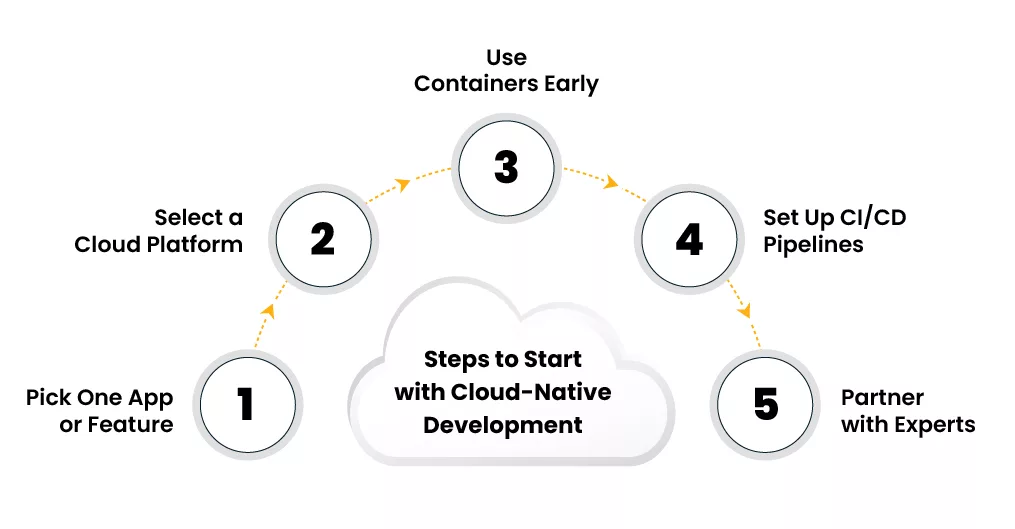
Here’s a simple path forward:

1. Pick One Application or Feature

Choose something like your online checkout, customer dashboard, or booking system.

2. Select a Cloud Platform

Use services like AWS, Azure, or Google Cloud. They all offer tools that support cloud native development services.

3. Use Containers from the Start

Even small apps run more smoothly when placed in containers. It makes future changes easier.

4. Set Up CI/CD Pipelines

Tools like CI/CD help teams make changes without slowing things down or causing issues.

5. Work With Experienced Developers or Partners

If your team has not worked with cloud native architecture before, you should get a cloud migration consultant to help you get started safely.

This step-by-step method helps reduce risk while giving you early wins.

What’s Coming Next in the Cloud Native World?

Serverless Platforms

Let you run code without managing any servers at all.

Edge Computing

Moves parts of your app closer to the user’s physical location for faster performance.

AI Integration

Today’s platforms come with built-in tools, so you do not need a full data team to build smart features into your app.

Is Now the Right Time to Go Cloud Native?

Yes. If your business is growing, or even if it just needs to keep up with customers better, this approach is worth exploring.

Cloud native application development gives you the tools to stay reliable and reduce technical bottlenecks.

The process might seem technical at first, but the benefits are very real — especially when you use cloud native development services designed for your size and industry. Get started today!

Author

Yogita Jain Linkedin
Yogita Jain
Content Lead

Yogita Jain leads with storytelling and Insightful content that connects with the audiences. She’s the voice behind the brand’s digital presence, translating complex tech like cloud modernization and enterprise AI into narratives that spark interest and drive action. With a diverse of experience across IT and digital transformation, Yogita blends strategic thinking with editorial craft, shaping content that’s sharp, relevant, and grounded in real business outcomes. At Cygnet, she’s not just building content pipelines; she’s building conversations that matter to clients, partners, and decision-makers alike.

Related Blog Posts

Cloud Reference Architectures: Why Most Enterprises Get Them Wrong 

CalendarFebruary 23, 2026

Re-Architecting for Failure: Designing Cloud Systems That Assume Things Will Break 

CalendarFebruary 23, 2026

Cloud Migration Costs: Understanding and Managing the Financials

CalendarOctober 15, 2025

Sign up to our Newsletter

    Latest Blog Posts

    Digital Banking & Road Ahead
    Digital Banking & Road Ahead

    CalendarMarch 03, 2026

    Claiming GST Input Tax Credit? Here’s a checklist for you!
    Claiming GST Input Tax Credit? Here’s a checklist for you!

    CalendarMarch 03, 2026

    GST Audit: Top 5 Steps To Get Ready!
    GST Audit: Top 5 Steps To Get Ready!

    CalendarMarch 03, 2026

    Let’s level up your Business Together!

    The more you engage, the better you will realize our role in the digital transformation journey of your business


      I agree to the Terms & Conditions and Privacy Policy and allow Cygnet.One (and its group entities) to contact me via Promotional SMS / Email / WhatsApp / Phone Call.*

      I agree to receive occasional product updates and promotional messages from Cygnet.One (and its group entities) on Promotional SMS / Email / WhatsApp / Phone Call.

      Cygnet.One Locations

      India India

      Cygnet Infotech Pvt. Ltd.
      2nd Floor, The Textile Association of India,
      Dinesh Hall, Ashram Rd,
      Navrangpura, Ahmedabad, Gujarat 380009

      Cygnet Infotech Pvt. Ltd.
      6th floor, A-wing Ackruti Trade Center,
      Road number 7, MIDC, Marol,
      Andheri East, Mumbai-400093, Maharashtra

      Cygnet Infotech Pvt. Ltd.
      WESTPORT, Urbanworks,
      5th floor, Pan Card Club rd.,
      Baner, Pune, Maharashtra 411045

      Cygnet Infotech Pvt. Ltd.
      10th floor, 73 East Avenue,
      Sarabhai campus, Vadodara, 391101

      Global

      CYGNET INFOTECH LLC
      125 Village Blvd, 3rd Floor,
      Suite 315, Princeton Forrestal Village,
      Princeton, New Jersey- 08540

      CYGNET DIGITAL IT SOLUTION LLC
      Office 707, Magnum Opus Tower,
      Al Thanyah First, Dubai, U.A.E,
      P.O. Box 125608

      CYGNET INFOTECH PRIVATE LIMITED
      Level 35 Tower One,
      Barangaroo, Sydney, NSW 2000

      CYGNET ONE SDN.BHD.
      Unit F31, Block F, Third Floor Cbd Perdana 3,
      Jalan Perdana, Cyber 12 63000 Cyberjaya Selangor, Malaysia

      CYGNET INFOTECH LIMITED
      C/O Sawhney Consulting, Harrow Business Centre,
      429-433 Pinner Road, Harrow, England, HA1 4HN

      CYGNET INFOTECH PTY LTD
      152, Willowbridge Centre,
      39 Cronje Drive, Tyger Valley,
      Cape Town 7530

      CYGNET INFOTECH BV
      Peutiesesteenweg 74, Machelen (Brab.), Belgium

      Cygnet One Pte. Ltd.
      160 Robinson Road,
      #26-03, SBF Centre,
      Singapore – 068914

      • Explore more about us

      • Download Corporate Deck
      • Terms of Use
      • Privacy Policy
      • Contact Us
      © Copyright – 2026 Cygnet.One
      We use cookies to ensure that we give you the best experience on our website. If you continue to use this site we will assume that you are happy with it.

      Cygnet.One AI Assistant

      ✕
      AI Assistant at your help. Cygnet AI Assistant