




































Modern enterprises are under constant pressure to release faster, scale applications on demand, improve resilience, and reduce the operational drag created by legacy systems. Moving workloads to the cloud can help, but migration alone rarely solves deeper problems such as monolithic architecture, manual deployments, fragile integrations, and limited visibility across systems.
That is where cloud native transformation becomes important. It helps enterprises modernize applications, platforms, delivery pipelines, and operating models so technology can support business growth with less friction. A well-planned cloud native transformation strategy brings together microservices, containers, Kubernetes, DevOps, CI/CD, observability, security, and governance in a structured way.
The execution gap remains the biggest enterprise hurdle. In the 2024 IBM Application Modernization research, 83% of IT executives reported that modernization was central to their organization’s strategy, while only 27% said their organizations had actually modernized the underlying workflows, applications, and systems.
This blog explains how enterprises can approach cloud native transformation as a phased modernization program rather than a one-time migration event. It covers what the strategy should include, how to prioritize applications, which architecture patterns matter, how to reduce risk, and how to measure transformation success.
What Cloud Native Transformation Means for Enterprises?
Cloud native transformation is the structured process of modernizing applications, infrastructure, delivery pipelines, and operating models so they fully use cloud capabilities such as elastic scaling, automated deployment, and distributed resilience.
It changes how applications are built, deployed, secured, and operated, rather than only changing where they run. Modern cloud native transformation combines microservices, containers, Kubernetes, serverless functions, DevOps automation, CI/CD pipelines, observability, security, and governance practices.
The goal is to create a foundation where new features can be released quickly, workloads scale automatically with demand, and operational risk decreases as the environment grows.
How Cloud Native Transformation Differs From Cloud Migration?
Cloud migration moves applications or workloads from one environment to another, usually from on-premises to a cloud provider. Cloud modernization improves existing applications so they perform better in cloud environments through replatforming, configuration tuning, or partial refactoring. Cloud native transformation goes further by changing the architecture, engineering practices, platform foundation, and operating model so applications can fully use cloud capabilities.
A lift-and-shift migration moves workloads to the cloud, but it does not automatically fix slow releases, monolithic dependencies, scaling limits, or high maintenance effort. Many enterprises still face the same application bottlenecks after migration because the underlying architecture and operating model remain unchanged.
Real transformation happens when applications become modular, automated, observable, scalable, and easier to change without creating operational risk. For enterprise teams evaluating cloud strategy, the practical implication is that cloud value depends less on where an application runs and more on how easily it can be changed, scaled, monitored, secured, and improved over time.
A Practical Roadmap For Cloud Native Transformation
Cloud native transformation works best when it happens through a phased roadmap rather than a single migration event. Enterprises that move in phases can validate architecture, automation, security, and operations on pilot workloads before scaling across the portfolio.
This approach helps leaders control modernization risk while proving value through measurable outcomes. A typical roadmap moves through six phases that build on each other.
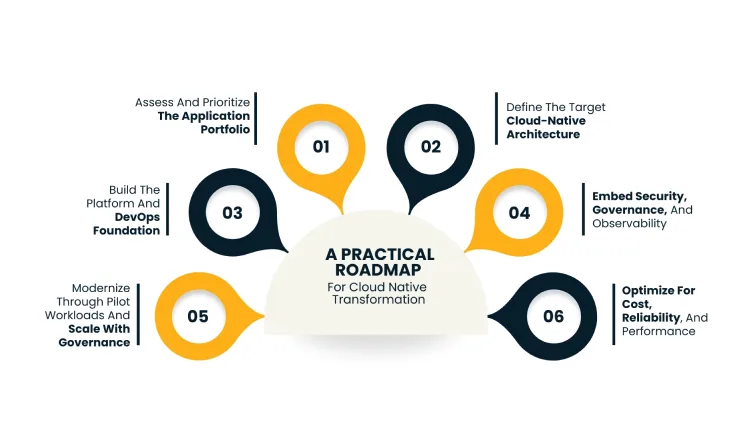
Assess And Prioritize The Application Portfolio
The roadmap begins with a structured review of each application’s architecture, dependencies, business value, performance, data sensitivity, compliance needs, and modernization complexity.
This produces a workload taxonomy that separates full modernization candidates from those needing only rehosting, replatforming, replacement, or retirement. Programs that start with workloads carrying clear business impact, manageable dependencies, measurable outcomes, and lower delivery risk tend to build momentum faster than those that attack the most complex systems first.
Define The Target Cloud-Native Architecture
The target architecture sets the future-state design for applications, services, APIs, data, infrastructure, security, and operations. A complete target architecture typically defines the following building blocks:
- Microservices boundaries aligned with business domains and team ownership
- Container and Kubernetes standards across development, staging, and production
- API gateways and event-driven integration patterns for system connectivity
- Serverless functions for variable-demand or event-triggered workloads
- Landing zones and reusable engineering templates for consistent deployment
Cygnet.One’s Cloud Native Development practice helps enterprises define these architecture standards before modernization scales, which prevents isolated technology choices that become difficult to operate at scale.
Build The Platform And DevOps Foundation
Once architecture is defined, the program builds the shared platform that supports every modernized workload. This includes reusable CI/CD pipelines, container registries, Kubernetes cluster standards, infrastructure automation, security policies, monitoring stacks, and deployment templates.
Cloud engineering services help enterprises build these platform, automation, and operations foundations before cloud-native modernization scales across teams. Platform engineering teams typically own this foundation, so application teams consume it rather than rebuild it for every workload.
The strength of this layer determines how quickly teams can move from pilot to production at scale, and how consistently new applications meet the program’s reliability and security baselines.
Embed Security, Governance, And Observability
Security, governance, and observability cannot be retrofitted after applications run in production. Vulnerability scanning, secrets management, policy enforcement, and compliance validation should be built into CI/CD pipelines and infrastructure-as-code workflows from the start.
Governance frameworks define tagging standards, access policies, and change management practices that scale with the environment. Observability gives teams the telemetry needed to detect issues quickly across microservices, containers, APIs, and cloud infrastructure, which becomes essential as the system grows.
Cloud-native observability becomes especially important after large-scale migrations, where distributed services need consistent telemetry, tracing, and operational visibility from the start.
Modernize Through Pilot Workloads And Scale With Governance
Pilot workloads validate the architecture, DevOps pipeline, security controls, and operating practices before the program scales. A successful pilot gives the enterprise a proven modernization pattern, complete with deployment templates, runbooks, and operating procedures that subsequent teams can reuse.
Scaling follows the pilots, using standardized patterns, reference architectures, policy guardrails, reusable components, and platform engineering practices that keep transformation consistent across business units. Without this consistency, scaling becomes a series of one-off projects rather than a repeatable program.
Optimize For Cost, Reliability, And Performance
Cloud native transformation continues after applications go live. Teams keep improving resource utilization, deployment speed, application reliability, security posture, and developer productivity through continuous tuning rather than one-time projects.
Continuous optimization separates programs that deliver lasting value from those that lose momentum after the initial modernization wave. The teams that build feedback loops between operations, engineering, and finance maintain the highest long-term return from cloud-native investments.
How To Decide Which Applications Should Become Cloud Native?
A strong cloud native migration strategy does not treat every application the same way. Some applications need only rehosting or replatforming, while others need refactoring or rearchitecture to support scale, agility, and resilience.
The decision rests on business value, technical complexity, change frequency, customer impact, integration needs, compliance requirements, and long-term product relevance. Four patterns drive most enterprise modernization decisions.
Rehost Or Replatform Stable Low-Risk Workloads
Applications with limited change needs, low business differentiation, or simple infrastructure constraints often do not need full refactoring. Rehosting (lift-and-shift) or replatforming (minor adjustments such as containerization without rearchitecture) can improve hosting flexibility, reduce on-premises overhead, and free up resources without adding unnecessary engineering effort.
This option works well for internal applications, low-traffic systems, or workloads close to end-of-life where modernization investment would not return value within their useful lifespan.
Refactor Business-Critical Applications That Need Scale
Applications that support customer experience, revenue operations, frequent releases, or high transaction volume often need refactoring. This involves changing significant portions of the codebase to use cloud-native patterns such as microservices, managed databases, async messaging, or container orchestration, without a full ground-up rewrite.
Understanding cloud native architecture helps teams choose the right refactoring patterns before they break legacy applications into modular, scalable services.
Refactoring improves scalability, maintainability, deployment speed, and resilience while preserving the existing application’s business logic and user experience. It is usually the highest-value option for applications that will continue to be central to business operations for several years.
Re-architect Systems Blocking Speed Or Innovation
Large monoliths, tightly coupled systems, and applications with heavy release bottlenecks often need deeper rearchitecture. This decomposes the system into microservices or modular services aligned with business domains, redesigns data models for distributed access, and introduces event-driven integration patterns.
Rearchitecting is where Kubernetes orchestration, API-led integration, and DevOps automation create long-term value. The investment is higher than refactoring, but for systems that block new product launches or constrain team velocity, the productivity gains justify the engineering effort.
Retire Or Replace Applications With Low Strategic Value
Some legacy applications add operational cost without supporting future business goals. Retiring them, consolidating them with adjacent systems, or replacing them with SaaS platforms can reduce complexity before the transformation program scales further.
This decision usually surfaces during portfolio assessment, when teams find applications that have been kept alive primarily through inertia. Removing them simplifies the modernization scope and frees capacity for higher-value work.
Which Cloud-Native Architecture Patterns Fit Enterprise Modernization?
Cloud-native architecture should not be applied as a generic technology checklist. Enterprises need to choose architecture patterns based on application behavior, team maturity, scalability needs, integration complexity, and business criticality. The patterns below reduce coupling, improve deployment independence, and make systems easier to scale and operate.
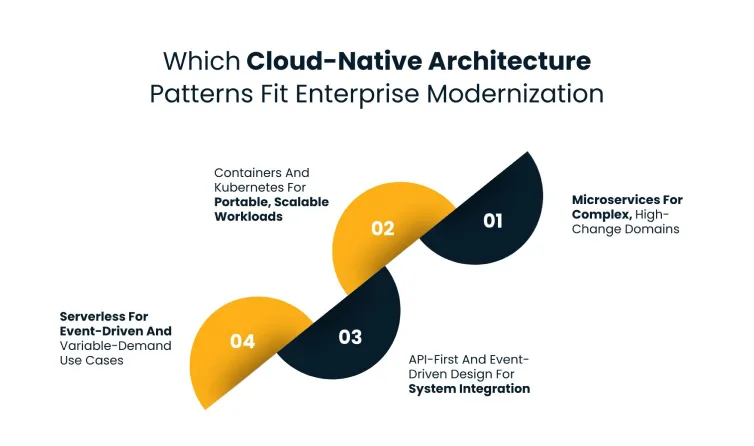
Microservices For Complex, High-Change Domains
Microservices work best when large applications need independent release cycles, domain-level ownership, and modular scaling. They make sense when the following conditions hold:
- The application spans multiple business domains that change at different rates
- Teams are sized and skilled to own the end-to-end service lifecycle
- Operational tooling exists for distributed systems (service mesh, observability, deployment automation)
- The complexity tradeoff is justified by team velocity gains
Microservices add operational overhead through distributed system complexity. Teams without the platform foundation or operating maturity often struggle to capture the velocity benefits.
Containers And Kubernetes For Portable, Scalable Workloads
Containers package applications consistently across environments, while Kubernetes orchestrates deployment, scaling, and workload management at scale. This pattern fits enterprises that need portability, resilience, and standardized runtime operations across multiple environments or providers.
Kubernetes adoption has reached mainstream status. The 2024 Gartner Cloud Survey on Kubernetes Adoption found that 54% of survey respondents had a full or partial Kubernetes implementation, with skills gaps and DevOps maturity flagged as the most common adoption constraints. Containers and Kubernetes work especially well in the following scenarios:
- Applications needing consistent deployment across development, staging, and production
- Workloads requiring elastic scaling to handle traffic spikes
- Multi-cloud and hybrid environments where runtime portability matters
- Systems where rolling updates and automated rollbacks reduce release risk
Serverless For Event-Driven And Variable-Demand Use Cases
Serverless functions work well for event-driven tasks, APIs, background jobs, and workloads with unpredictable demand. They remove the need for capacity planning and infrastructure management when the use case does not require constant runtime control. Common fit scenarios include the following:
- API endpoints with bursty or low average traffic
- Background processing of events from message queues or storage triggers
- Scheduled tasks and batch processing with variable durations
- Integration logic between SaaS systems and internal services
Serverless is less suitable for long-running processes, latency-critical workloads requiring warm-start guarantees, or applications with complex local state requirements.
API-First And Event-Driven Design For System Integration
API-first design treats every capability as a consumable service with a defined contract, while event-driven patterns decouple producers from consumers using message brokers or streaming platforms. These patterns help enterprises connect modernized systems with legacy platforms, data services, third-party tools, and customer-facing applications.
They reduce tight coupling between systems, which makes integration more flexible and lets teams change one side of the connection without breaking the other. For most enterprise modernization programs, API-first plus event-driven becomes the backbone of how new services connect to old ones during the transition.
How Enterprises Can Reduce Cloud Native Transformation Risk?
Cloud native transformation can fail when enterprises modernize too much, too quickly, choose tools before defining architecture, or ignore operating model changes. The risk is not only technical.
It also comes from unclear ownership, weak governance, limited skills, and poor cost control. A safer approach modernizes in phases, builds reusable platform standards, automates delivery, embeds security early, and measures progress continuously.
Map Legacy Dependencies Before Modernization
Legacy applications often depend on shared databases, hidden integrations, batch jobs, and tightly coupled workflows. Mapping these dependencies early helps teams avoid breaking critical business processes during modernization. A complete dependency map typically covers the following categories:
- Shared databases and stored procedures spanning multiple applications
- Synchronous integration points (REST APIs, SOAP services, RPC calls)
- Asynchronous integrations (message queues, file drops, scheduled batches)
- Authentication and identity dependencies (LDAP, federated SSO, certificates)
- Business workflows that cross application boundaries
Skipping this step is one of the most common failure modes. Teams discover hidden dependencies only after a modernization deployment breaks a downstream system that no one realized was connected.
Avoid Kubernetes Complexity Without Platform Standards
Kubernetes improves scalability and orchestration, but unmanaged adoption creates operational overhead. Enterprises that scale Kubernetes across teams without defining platform standards end up with fragmented clusters, inconsistent security postures, and rising support burdens. Standards to define before scaling include the following:
- Cluster topology, sizing, and multi-tenancy policies
- Deployment templates, Helm charts, and namespace conventions
- Access control and RBAC policies across teams and environments
- Monitoring, logging, and incident response standards
- Support ownership and escalation paths between the platform and application teams
Cygnet.One’s Cloud Strategy and Design practice helps enterprises establish these platform standards before Kubernetes adoption scales, which reduces the operational drag that typically appears as more teams are onboarded.
Build Security And Compliance Into Pipelines
Security should not be treated as a final review stage. Automated security activities should be built into CI/CD pipelines and infrastructure workflows so they run continuously rather than as gate-keeping events. Pipeline security typically includes the following activities:
- Static and dynamic application security testing (SAST, DAST)
- Container image scanning for known vulnerabilities
- Secrets management with rotation and access auditing
- Policy enforcement for infrastructure-as-code (Terraform, Pulumi, Bicep)
- Compliance checks against frameworks (SOC 2, HIPAA, PCI DSS, ISO 27001)
Control Cloud Cost Sprawl With FinOps Practices
Cloud-native environments can become expensive when teams overprovision resources or leave unused services running. FinOps practices help teams monitor usage, assign ownership, optimize workloads, and connect cloud spend to business value. Mature FinOps programs typically include the following:
- Cost allocation through consistent tagging across accounts and workloads
- Real-time budget alerts and anomaly detection
- Right-sizing recommendations for compute, storage, and database resources
- Reserved capacity and savings plan management across cloud providers
- Showback or chargeback reporting tied to product and business unit ownership
Prepare Teams For A New Operating Model
Cloud native adoption changes how development, operations, security, and infrastructure teams work together. The traditional separation between developers writing code and operations running it breaks down when applications are released continuously and managed as distributed systems.
Enterprises need shared ownership models where engineering teams take responsibility for their workloads in production, supported by platform engineering teams who provide the underlying capabilities. Clear accountability for reliability, security, and cost becomes a prerequisite for transformation success alongside the technical changes.
How Enterprises Should Measure Cloud Native Transformation Success?
Cloud native transformation should be measured by business and operational outcomes rather than migration completion. The goal is to improve how quickly teams deliver, how reliably applications run, how efficiently cloud resources are used, and how well technology supports business change.
A strong measurement model connects engineering metrics with enterprise value, so leaders can see whether the program is improving speed, resilience, customer experience, cost efficiency, and innovation capacity.
Delivery Speed
Delivery speed metrics show whether the program is shipping software faster while maintaining quality. Track the following indicators across releases and engineering teams:
- Deployment frequency across services and environments
- Lead time from code commit to production deployment
- Release cycle time from feature start to production
- Pipeline automation coverage across build, test, and deploy stages
- Change the failure rate per deployment
Faster delivery should come with better control. Programs that increase deployment frequency while the change failure rate also rises usually have a pipeline or testing gap rather than a true velocity improvement.
Reliability And Resilience
Reliability and resilience metrics indicate whether cloud-native systems recover faster and contain failures better than the legacy systems they replaced. Common indicators include the following:
- Uptime and service-level performance per workload
- Incident frequency across critical services
- Mean time to detect (MTTD) and mean time to recover (MTTR)
- Rollback rate and rollback success rate
- Blast radius of incidents across services and customer segments
Cloud Cost Efficiency
Cost efficiency metrics monitor whether the transformation creates sustainable cost outcomes or unmanaged spend. The 2024 McKinsey Report on IT Productivity documented that top-performing technology organizations aimed for developers to spend up to 70% of their time on inner-loop activities (writing and testing code) rather than infrastructure management
Productivity payoff from cloud-native platforms shows up in measurable terms. Track the following alongside utilization and budget data.
- Resource utilization across compute, storage, and network
- Idle capacity across non-production and overprovisioned workloads
- Cost per transaction or cost per active user
- Scaling efficiency (cost-to-revenue ratio under load)
- Budget variance across business units and product teams
Developer Productivity
Developer productivity metrics measure whether the platform reduces friction across the delivery process. A mature cloud-native foundation should make every engineering team faster, not just the pilot teams. Indicators to track include the following:
- Build and test pipeline duration
- Environment provisioning time for development and testing
- Developer self-service adoption across platform capabilities
- Onboarding time for new engineers to first production commit
- Manual handoffs are reduced across the deployment lifecycle
Business Impact
Business impact metrics translate engineering outcomes into language that executives, product leaders, and finance teams can use. These metrics make transformation meaningful beyond IT performance. Common indicators include the following:
- Time to launch new products and features
- Customer experience metrics (uptime perception, response time, defect rates)
- Downtime cost reduction across business-critical workflows
- Scalability headroom for demand spikes (peak load handling)
- Modernization debt reduction across the application portfolio
How Cygnet.One Supports Enterprise Cloud Native Transformation?
Most enterprise cloud-native programs stall between strategy decks and production-grade execution. Cygnet.One’s Cloud Engineering practice is built around closing that gap, applying the same phased approach the previous sections describe across real enterprise application estates.
The engagement typically starts with a structured assessment of the application portfolio, surfaces the modernization candidates that will return value fastest, and lays down a target architecture before any code is touched. From there, platform and DevOps foundations come in alongside the first pilot workloads, so the underlying environment is ready when scaling begins rather than playing catch-up later.
Security, governance, and FinOps are built into the same delivery model from the start, which is what keeps cloud-native operations sustainable once the program moves beyond the early teams and starts spanning multiple business units.
Conclusion
Cloud native transformation works as a phased modernization program that brings application architecture, DevOps, cloud platforms, security, governance, and operations together. Enterprises that approach it with a structured roadmap modernize the right workloads, reduce risk, improve release speed, build resilient systems, and create a foundation that supports future digital initiatives.
The teams that succeed treat cloud-native adoption as an ongoing discipline rather than a one-time migration project. As workloads, regulatory expectations, and business priorities continue to shift, the architecture and operating model need to keep pace.
Book a demo with Cygnet.One to explore how our Cloud Engineering practice can help your organization plan, execute, and scale a cloud native transformation aligned with your business goals, application portfolio, and operating maturity.
FAQs
Cloud migration moves workloads to the cloud, while cloud native transformation changes how applications are built, deployed, scaled, secured, and operated. Migration changes hosting; transformation changes architecture, engineering practices, and operating models so applications fully use cloud capabilities such as elastic scaling and automated deployment.
No. Some applications only need rehosting, replatforming, replacement, or retirement. Cloud-native modernization should be reserved for workloads where scalability, agility, resilience, or business value justify the engineering effort. Low-change or end-of-life applications usually do not return the investment within their remaining useful lifespan.
Kubernetes is not always required, but it is commonly used for managing containerized applications at scale. Enterprises should adopt it when they need workload orchestration, portability, resilience, and standardized deployment across environments. Simpler workloads can succeed with managed container services or serverless platforms without Kubernetes overhead.
Cloud native transformation typically runs as a multi-year program rather than a single project. Pilot workloads can show results within 3-6 months, but full-portfolio modernization for enterprise application estates usually spans 18-36 months, depending on portfolio complexity, team maturity, and governance readiness.
Enterprise teams need a mix of cloud architecture, microservices design, Kubernetes operations, DevOps automation, CI/CD pipeline engineering, security engineering, and platform engineering skills. Soft skills like cross-functional collaboration, ownership culture, and incident management also become critical as teams shift to running applications continuously in production.
Cloud native transformation provides the technology foundation on which digital transformation depends. Scalable, resilient, and faster-moving applications make it possible to launch new products, automate customer experiences, integrate AI capabilities, and respond to market changes without rebuilding the underlying systems each time.
Author


Abhishek Nandan
AVP, Marketing
Abhishek Nandan is the AVP of Services Marketing at Cygnet.One, where he drives global marketing strategy and execution. With nearly a decade of experience across growth hacking, digital, and performance marketing, he has built high-impact teams, delivered measurable pipeline growth, and strengthened partner ecosystems. Abhishek is known for his data-driven approach, deep expertise in marketing automation, and passion for mentoring the next generation of marketers.