




































Enterprises that migrate workloads to the cloud without a supporting engineering layer tend to encounter the same operational problems they were trying to escape. Fragmented infrastructure, rising costs, and governance gaps compound as usage grows, until the environment is too complex to manage efficiently and too expensive to ignore.
Most cloud adoption programs underestimate the gap between deploying to the cloud and operating in the cloud. Moving workloads is a logistics challenge. Building a cloud environment that is scalable, secure, automated, and cost-governed is an engineering challenge of a different order.
Global public cloud end-user spending reached $675.4 billion in 2024, a 20.4% increase over the prior year, according to the 2024 Gartner Forecast on Public Cloud End-User Spending. That scale reflects how deeply cloud infrastructure has embedded itself into enterprise operations globally.
This guide covers what cloud engineering services include, how engagements are structured, and what to evaluate when selecting a cloud engineering provider.
What Are Cloud Engineering Services?
Cloud engineering services are the set of technical practices through which organizations design, build, migrate, automate, secure, and operate cloud infrastructure and applications. They span cloud architecture, migration and modernization, cloud-native development, DevOps automation, security engineering, and cloud governance across platforms, including AWS, Azure, and Google Cloud.
Beyond moving workloads into a cloud environment, cloud engineering creates the architectural and operational framework that determines how those workloads perform, scale, and behave under production conditions.
Organizations use cloud engineering to build environments that are automated, resilient, cost-governed, and aligned with long-term business and operational requirements.
Why Cloud Engineering Services Matter For Cloud Adoption?
Enterprise cloud programs that prioritize migration speed over architecture and governance typically face compounding problems within the first year. Security gaps, cost overruns, and performance inconsistencies emerge at the same pace as workload growth.
Correcting them retroactively costs significantly more than addressing them in the initial program design. Only 42% of companies fully achieved their expected cloud outcomes, according to the 2023 Accenture Cloud Outcomes Perspective.
That gap consistently traces back to architectural shortfalls and governance gaps in early program design, and those problems compound as workloads scale across multi-cloud environments. Cloud engineering services address this gap across several critical dimensions:
- Build scalable cloud infrastructure aligned with long-term performance and growth requirements.
- Accelerate migration and application modernization at reduced operational and delivery risk.
- Improve resilience through automation, redundancy, and governance controls embedded at the infrastructure level.
- Strengthen cloud security posture through architecture-level identity, network, and policy controls.
- Enable DevOps workflows and infrastructure automation across software delivery pipelines.
- Optimize cloud performance and cost efficiency through continuous operational management.
- Support hybrid and multi-cloud environments with unified governance and operational visibility.
Enterprise teams that invest in cloud engineering early avoid the costly infrastructure corrections that accumulate when cloud adoption prioritizes speed over architectural quality.
Core Components Of Cloud Engineering Services
Cloud engineering is an integrated discipline that combines architecture, migration, development, automation, security, and operations. Each component addresses a different layer of the cloud environment, and the quality of each layer influences the reliability of the others.
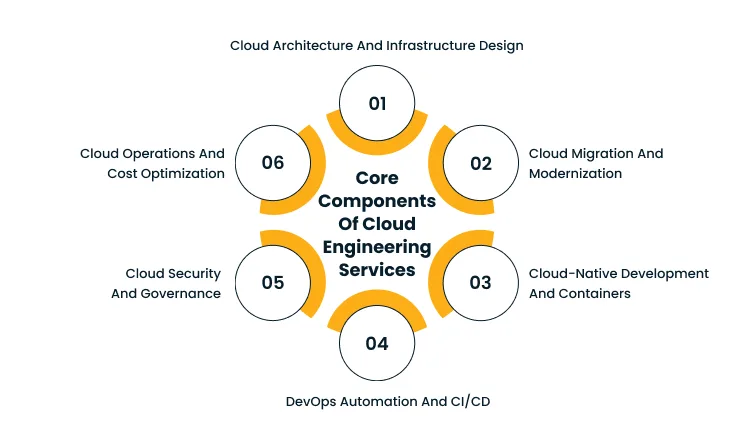
Cloud Architecture And Infrastructure Design
Cloud architects design the foundational infrastructure patterns that determine scalability, availability, and operational efficiency across cloud workloads. Architectural decisions made at the start of a program, covering multi-region availability, network topology, identity boundaries, and compute strategy, shape cost and complexity as workloads scale.
Infrastructure design that accounts for disaster recovery, failover, and workload isolation from the beginning avoids the expensive re-architecture work that surfaces under production pressure. Poorly designed foundations are difficult and costly to correct after workloads are running at enterprise scale.
Cloud Migration And Modernization
Migration engineering covers the technical planning and execution required to move workloads, applications, and databases from on-premises or legacy environments into cloud platforms. A structured migration program typically addresses the following phases:
- Workload dependency mapping to establish the migration sequence and identify integration risks.
- Migration pattern selection (rehost, re-platform, refactor, or rebuild) based on application complexity.
- Cutover planning with rollback procedures for production-critical systems.
- Post-migration validation against performance, integration, and security baselines.
A clear cloud migration roadmap helps enterprises sequence these phases properly before workloads move into production environments.
Modernization extends migration by addressing application architecture. Legacy monolithic applications are decomposed, re-platformed, or rebuilt using cloud-native patterns that improve scalability and reduce operational overhead. Cygnet.One’s Cloud Migration and Modernization practice supports both lift-and-shift programs and full application re-architecture engagements.
Cloud-Native Development And Containers
Cloud-native engineering builds applications using microservices, containers, Kubernetes orchestration, and serverless functions designed to scale dynamically within cloud platforms. These architectures distribute workloads across independently scalable services that respond to demand without manual intervention.
Understanding cloud native architecture helps teams see how microservices, containers, APIs, and orchestration patterns work together inside modern cloud engineering programs.
Container orchestration through Kubernetes enables automated scheduling, health monitoring, and self-healing across application workloads. Teams can deploy and scale services independently, improving both release velocity and infrastructure resilience for enterprise software delivery.
DevOps Automation And CI/CD
DevOps automation transforms cloud infrastructure management from manual provisioning into code-driven, repeatable delivery pipelines. Engineering teams implement automation frameworks that cover the full deployment lifecycle.
Core capabilities that cloud engineering teams typically deliver in DevOps engagements include the following:
- Infrastructure as Code using Terraform or cloud-native provisioning tools for consistent, repeatable deployments.
- CI/CD pipelines that automate build, test, and deployment workflows across development and production environments.
- Kubernetes-based container orchestration for scalable workload scheduling and management.
- Monitoring and observability integration for real-time infrastructure and application performance visibility.
Cloud Security And Governance
Security engineering in cloud environments requires controls embedded in the infrastructure architecture. Applying security as an overlay after deployment creates coverage gaps that expand as environments grow across accounts and regions.
Governance frameworks define how cloud resources are provisioned, tagged, monitored, and managed across teams. Organizations that establish governance early maintain better cost visibility, compliance posture, and operational accountability as environments scale.
Cloud Operations And Cost Optimization
Cloud operations teams manage the ongoing health, performance, and cost efficiency of environments after deployment. This covers workload monitoring, rightsizing, capacity planning, incident response, and infrastructure optimization.
Strong cloud infrastructure management gives enterprises the operational structure needed to keep cloud environments reliable, cost-efficient, and scalable after deployment.
Continuous cost management prevents the spending drift that accumulates when cloud environments scale without governance. Cygnet.One’s Cloud Operations and Optimization practice provides ongoing operational management across AWS, Azure, and GCP environments.
Where Cloud Engineering Projects Usually Struggle?
Cloud engineering programs stall when technical execution outpaces governance, automation, and organizational readiness. The challenges that surface mid-program are almost always rooted in gaps from the early phases.
Only 10% of companies have fully captured the cloud’s potential value, according to the 2023 McKinsey Report on Cloud Value. The same research found that 50% are starting to capture value, and 40% have seen no material return. That shortfall consistently traces back to gaps in engineering governance, automation, and operational discipline.
Common challenges that affect enterprise cloud engineering outcomes include the following:
- Legacy application complexity that creates migration dependencies and extended modernization timelines.
- Limited visibility across accounts, regions, and platforms running separate cost and governance controls.
- Security and compliance requirements that vary across workloads complicate consistent policy enforcement.
- Manual infrastructure provisioning creates configuration drift, deployment delays, and reproducibility gaps.
- Cloud cost management without centralized governance and continuous optimization practices.
- Gaps in cloud engineering skills within internal teams that delay adoption and increase delivery risk.
- Governance inconsistency across environments as teams grow and workloads scale independently.
These challenges compound each other. Poor tagging breaks cost attribution, weak governance enables unauthorized provisioning, and skills gaps delay the automation work that would address both. Organizations that build governance, automation, and skills planning into early program phases avoid the recovery cycles that consume time and budget in later stages.
How Cloud Engineering Services Are Typically Delivered?
Cloud engineering engagements typically follow a phased delivery model that reduces risk and builds operational maturity progressively. Phased delivery allows architecture decisions to be validated at a smaller scale before being applied across the full enterprise environment.
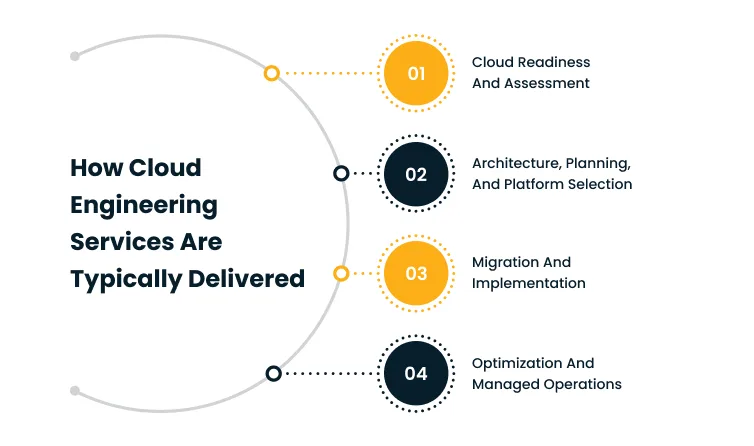
Cloud Readiness And Assessment
The engagement begins with a structured evaluation of existing infrastructure, applications, security posture, and organizational readiness. A cloud readiness assessment typically covers the following areas:
- Existing infrastructure topology and workload performance baselines.
- Application dependency mapping and migration complexity scoring per workload.
- Security posture, compliance requirements, and current identity architecture.
- Cloud skills inventory and organizational readiness for operational change.
This phase surfaces the risks, constraints, and technical debt that would otherwise emerge under production pressure. A thorough assessment significantly reduces the cost and complexity of the phases that follow.
Architecture, Planning, And Platform Selection
Based on assessment findings, cloud architects design the target infrastructure model and select platforms based on performance requirements, governance constraints, compliance standards, and workload characteristics.
Platform selection evaluates AWS, Azure, GCP, or hybrid configurations against scalability requirements, existing licensing, regional availability, security certifications, and integration needs with enterprise systems.
Migration And Implementation
The implementation phase executes the migration plan across workloads, configures automation pipelines, deploys security controls, and validates cloud performance before production rollout. Infrastructure as Code ensures consistent, repeatable resource provisioning across environments.
Each workload follows a structured process that includes pre-migration validation, cutover execution, and post-migration testing. This process reduces the risk of production failures and ensures performance is validated before business traffic is routed.
Optimization And Managed Operations
After initial deployment, ongoing operations management covers performance monitoring, cost governance, security compliance, and infrastructure optimization. Cloud environments require continuous operational attention because workload demands and security requirements evolve constantly.
Managed operations engagements provide enterprises with cloud engineering expertise aligned to their environment, without requiring internal teams to build that capability from scratch.
Best Practices For Successful Cloud Engineering Adoption
Cloud engineering outcomes depend on more than platform selection and migration execution. Enterprises that achieve durable cloud maturity establish governance, automation, and standardization frameworks before scaling workloads across their environments.
Build Cloud Governance Early
Governance frameworks define how cloud resources are created, tagged, monitored, and managed. Core governance components established in early program phases include the following:
- Resource tagging standards for cost attribution, workload tracking, and environment classification.
- Access control policies and identity governance are applied consistently across accounts and teams.
- Budget alert thresholds and spend governance workflows are aligned to team and project boundaries.
- Compliance policy baselines are enforced at resource provisioning across all accounts.
When governance is added after workloads are running, it requires retroactive remediation across resources deployed without controls. Governance components implemented in early program phases cost significantly less than applying them at scale to an uncontrolled environment.
Automate Infrastructure Management
Infrastructure as Code removes the manual configuration that creates drift, inconsistency, and delayed deployments. When infrastructure is defined in code, it can be versioned, reviewed, tested, and deployed consistently across development, staging, and production environments.
CI/CD pipeline automation extends this principle to software delivery. Automated build, test, and deployment workflows reduce release cycle times, improve reliability, and give teams a consistent operational baseline across environments.
Standardize Security Across Environments
Cloud security applied at the perimeter level breaks down as environments expand across accounts, regions, and teams. Controls embedded at the architecture layer (IAM policies, network segmentation, encryption standards, and logging frameworks) provide coverage that scales with the environment.
Consistent security baselines across workloads reduce the risk of configuration gaps that surface during audits or incident response, when the cost of remediation is highest.
Optimize Cloud Costs Continuously
Cloud cost management works best as an ongoing operational discipline. Rightsizing, reserved instance planning, automated governance policies, and usage monitoring deliver compounding efficiency over time that periodic reviews cannot achieve.
Giving engineering teams visibility into cost data at the point of infrastructure decisions reduces the delay between spending accumulation and remediation. Organizations that embed continuous cost governance into their cloud operations maintain better alignment between investment and business value.
What To Evaluate In A Cloud Engineering Services Provider?
The quality of a cloud engineering partner determines the long-term operational health of the cloud environment. Evaluation should center on technical depth, operational maturity, and enterprise delivery experience. Partnership certifications provide useful context but rarely capture the delivery capability that organizations need at scale.
Cloud Platform Expertise
Strong providers demonstrate architectural depth across AWS, Azure, and GCP rather than surface familiarity. Platform expertise includes hands-on experience with advanced services, migration patterns, governance frameworks, and security configurations that differ materially across each cloud environment.
Certifications provide a baseline signal. Case studies and reference engagements in comparable enterprise contexts give more reliable evidence of actual delivery capability.
Automation And DevOps Capability
Providers that cannot demonstrate mature Infrastructure as Code, CI/CD, and Kubernetes capabilities will deliver environments that require extensive manual management at scale. Evaluate whether the provider’s automation frameworks are standardized across engagements or rebuilt from scratch for each project.
Consistent automation tooling across engagements indicates operational maturity. Custom-built automation for every project suggests a delivery model that does not scale reliably across enterprise workloads.
Security And Governance Maturity
Cloud security is not a feature added at the end of an engagement. Evaluate whether the provider’s delivery methodology embeds security controls into the architecture from the start. A mature security delivery framework addresses the following areas:
- IAM governance policies are enforced at account provisioning and applied consistently across workloads.
- Network segmentation and firewall rule management across multi-account and multi-region environments.
- Encryption standards and key management practices across data at rest and in transit.
- Continuous compliance monitoring with automated policy enforcement and drift detection.
Providers with mature governance frameworks demonstrate how policies are applied consistently across accounts and workloads without requiring manual intervention at the resource level.
Scalability And Operational Support
Cloud engineering does not end at deployment. Evaluate whether the provider offers long-term managed operations, optimization, and scaling support aligned with enterprise workload requirements.
Providers that deliver implementation only transfer operational responsibility to internal teams that may lack the engineering depth to maintain and evolve the environment over time.
Industry And Enterprise Experience
Enterprise cloud programs often involve compliance requirements, security frameworks, and operational constraints specific to regulated industries. Providers with relevant sector experience address these requirements in the initial architecture rather than during later compliance review.
Domain-specific cloud engineering experience reduces the risk of architectural decisions that pass technical review but fail industry-specific compliance requirements at scale.
How Cygnet.One Supports Enterprise Cloud Engineering?
Cygnet.One helps enterprises design, build, migrate, and operate cloud environments across AWS, Azure, and GCP. Through Cloud Engineering services, organizations receive cloud architecture design, migration and modernization, DevOps automation, cloud-native development, security governance, and managed cloud operations in a unified delivery engagement.
Cygnet.One’s Cloud Strategy and Design practice helps enterprises define the architecture frameworks, platform selection criteria, and governance models that determine long-term cloud operational maturity. For organizations expanding across multi-cloud environments, this foundational work prevents the governance gaps and cost inefficiencies that accumulate when cloud programs scale faster than their operating models.
Conclusion
Cloud engineering is the discipline that turns cloud adoption into lasting operational capability. Enterprises that build governance, automation, and security into their cloud programs from the start operate more efficiently, scale more reliably, and resolve infrastructure challenges faster.
The shift that matters most is treating cloud engineering as an ongoing operational function rather than a migration project with a fixed end date. Cloud environments change continuously, and the engineering practices that sustain them work best when embedded as disciplines from the start of the program.
As enterprise workloads grow more complex across multi-cloud environments, cloud engineering capability becomes a direct factor in how quickly organizations can deliver software, adapt to market changes, and maintain operational reliability. Book a demo with Cygnet.One to explore how our Cloud Engineering practice can help your organization design, build, and operate cloud infrastructure aligned with your architecture, governance, and long-term scalability requirements.
FAQs
Cloud engineering services are professional services that help organizations design, migrate, automate, secure, and operate cloud environments. They typically cover cloud architecture, infrastructure design, DevOps automation, cloud-native development, governance, and ongoing optimization across platforms such as AWS, Azure, and Google Cloud.
A cloud engineering company helps businesses build and manage cloud environments that are scalable, secure, automated, and cost-efficient. Its work can include architecture design, workload migration, application modernization, CI/CD implementation, security governance, cloud operations, and performance optimization.
Cloud engineering services are important because they help organizations avoid poorly designed, expensive, or difficult-to-manage cloud environments. They bring architecture discipline, automation, governance, security controls, and operational maturity into cloud adoption, so businesses can scale cloud usage without creating long-term technical debt.
Cloud migration focuses on moving workloads from legacy or on-premises environments to the cloud. Cloud engineering is broader because it includes architecture design, automation, security, governance, cloud-native development, cost optimization, and ongoing operations that support long-term cloud performance and scalability.
Cloud engineering services usually support AWS, Microsoft Azure, Google Cloud, hybrid cloud, and multi-cloud environments. The right platform depends on workload requirements, compliance needs, performance goals, existing technology investments, and how the organization plans to scale cloud operations.
Cloud engineering services support DevOps by implementing CI/CD pipelines, Infrastructure as Code, deployment automation, container orchestration, monitoring, and release governance. These capabilities help teams deploy faster, reduce manual errors, improve infrastructure consistency, and operate cloud applications more reliably.
Author


Abhishek Nandan
AVP, Marketing
Abhishek Nandan is the AVP of Services Marketing at Cygnet.One, where he drives global marketing strategy and execution. With nearly a decade of experience across growth hacking, digital, and performance marketing, he has built high-impact teams, delivered measurable pipeline growth, and strengthened partner ecosystems. Abhishek is known for his data-driven approach, deep expertise in marketing automation, and passion for mentoring the next generation of marketers.