


































• Cygnet IRP
  • Glib.ai
  • IFSCA
Cygnet.One
  • About
  • Products
  • Solutions
  • Services
  • Partners
  • Resources
Generic selectors
Exact matches only
Search in title
Search in content
Post Type Selectors
Get Started
About
  • Overview

    A promise of limitless possibilities

  • We are Cygnet

    Together, we cultivate an environment of collaboration

  • Careers

    Join Our Dynamic Team: Careers at Cygnet

  • CSR

    Impacting Communities, Enriching Lives

  • In the News

    Catch up on the latest news and updates from Cygnet

  • Contact Us

    Connect with our teams across the globe

What’s new

chatgpt

Our Journey to CMMI Level 5 Appraisal for Development and Service Model

Full Story

chatgpt

ChatGPT: Raising the Standards of Conversational AI in Finance and Healthcare Space

Full Story

Products
  • Cygnet Tax
    • Cygnet Tax
    • e-Invoicing / Real time reportingIRP-integrated e-Invoicing with real-time validation
    • e-Way Bills / Road permitsGST-compliant centralized e-Way Bill platform for scalable operations
    • Direct Tax ComplianceAccurate direct tax compliance, filings, litigation, and assessments
    • Indirect Tax ComplianceEnterprise-grade platform for indirect tax compliance
      • Indirect Tax Compliance
      • GST Compliance India
      • VAT Compliance EU
      • VAT Compliance ME
    • Managed ServicesEnd-to-end indirect tax compliance support by experts
  • Global e-Invoicing
    • Global e-Invoicing
    • APAC
      • India
      • Malaysia
      • Singapore
      • Japan
    • Africa
      • Egypt
      • Kenya
      • Zambia
      • Nigeria
    • Europe
      • Spain
      • France
      • Germany
      • Poland
      • Belgium
    • Oceania
      • Australia
      • New Zealand
    • Middle East
      • UAE
      • Oman
      • Saudi Arabia
      • Bahrain
      • Qatar
      • Jordan
  • Cygnet Vendor Postbox
    • Cygnet Vendor PostboxDigitize purchase invoice validation & posting to ERPs & maximize ITC
  • Finance Transformation
    • Finance Transformation
    • Cygnet FinalyzeUnlock working capital with data-driven invoice-based credit decisions
    • Bank Statement AnalysisEvaluate company health by analyzing performance and financial risk
    • Financial Statement AnalysisAssess company performance and risk with financial statement analysis
    • GST Business Intelligence Report360-degree financial health insights using GST data analytics
    • GST Return Compliance ScoreGST-based compliance score to assess business risk and credibility
    • ITR AnalysisAssess creditworthiness and lending risk using ITR filing analysis
    • Invoice Verification for Trade FinanceVerify invoices to reduce fraud and improve credit decisions
    • Account Aggregator – Technology Service Provider (AA-TSP)Onboard to the Account Aggregator ecosystem with FIP & FIU modules
  • Cygnet BridgeFlow
    • Cygnet BridgeFlowAutomated digital onboarding with real-time validations and compliance
  • Cygnet Bills
    • Cygnet BillsGST-compliant centralized e-Way Bill platform for scalable operations
  • Cygnet IRP
    • Cygnet IRPIRP-integrated e-Invoicing with real-time validation
  • Cygnature
    • CygnatureSecure, compliant digital signing with audit-ready traceability

What’s new

e-Invoicing compliance Timeline

Know More →

UAE e-Invoicing: The Complete Guide to Compliance and Future Readiness

Read More →

Types of Vendor Verification and When to Use Them

Read More →

Safeguard Your Business with Vendor Validation before Onboarding

Read More →

Modernizing Dealer/Distributor & Customer Onboarding with BridgeFlow

Read More →

Accelerate Vendor Onboarding with BridgeFlow

Read More →

GST Filing 360°: GST, E-Invoicing, E-Way Bills & Annual Returns Made Simple

Read More →

Why Manual Tax Determination Fails for High-Volume, Multi-Country Transactions

Read More →

GST Filing 360°: GST, E-Invoicing, E-Way Bills & Annual Returns Made Simple

Read More →

Key Features of an Invoice Management System Every Business Should Know

Read More →

Automating the Shipping Bill & Bill of Entry Invoice Operations for a Leading Construction Company

Read More →

From Manual to Massive: How Enterprises Are Automating Invoice Signing at Scale

Know More →

Solutions
  • HireAI
  • Agent as a Service
  • AI-powered Voice Assistant
  • Generative AI Workshop
  • TestingWhiz
  • VIPRE

What’s new

AI powered Interviewer

AI-Powered Interviewing Helped an Education Group Reduce Hiring Time Significantly

Know More

Generative AI ebook

Navigating the Generative AI Landscape

Download eBook

Services
  • Data Analytics & AI
    • Data Analytics & AI
    • Data Engineering and ManagementData engineering and management for smart, scalable systems
    • Data Migration and ModernizationData migration and modernization for future-ready platforms
    • Insights Driven Business TransformationInsight-driven business transformation for faster decisions
    • Business Analytics and Embedded AIBusiness analytics and embedded AI for data-led growth
  • Digital Engineering
    • Digital Engineering
    • Technical Due DiligenceEnabling smarter decisions through future-ready digital ecosystems
    • Product EngineeringEngineering impactful digital products that elevate business growth
    • HyperautomationSmarter hyperautomation using low-code for agile business processes
    • Enterprise IntegrationIntegrating enterprise systems for seamless operations and growth
    • Application ModernizationModernizing IT ecosystems with scalable, AI-driven innovation
  • Quality Engineering
    • Quality Engineering
    • Test Consulting & Maturity AssessmentTest consulting and maturity assessments for reliable software QA
    • Business Assurance TestingBusiness assurance testing aligned with real business outcomes
    • Enterprise Application & Software TestingEnterprise application testing for continuity and scale
    • Data Transformation TestingData transformation testing for scalable, trusted data quality
  • Cloud Engineering
    • Cloud Engineering
    • Cloud Strategy and DesignCloud strategy and design services for secure, scalable growth
    • Cloud Migration & ModernizationORBIT: a proven framework for measurable cloud transformation
    • Cloud Native DevelopmentCloud-native development for resilient, scalable innovation
    • Cloud Operations and OptimizationCloud optimization and operations for enterprise resilience
    • Cloud for AI FirstAI-first cloud transformation for smarter, scalable enterprises
  • Managed IT Services
    • Managed IT Services
    • IT Strategy and ConsultingStrategic IT consulting to align technology with business goals
    • Application Managed Services24/7 managed application services for performance and security
    • Infrastructure Managed ServicesEnd-to-end infrastructure management for resilient IT operations
    • CybersecurityComprehensive cybersecurity solutions to protect business assets
    • Governance, Risk Management & ComplianceGRC solutions to manage risk, compliance, and governance
  • Cygnet TaxAssurance
    • Cygnet TaxAssurance
    • Tax DatalakeUnified tax data lake for intelligent, compliant decision-making
    • Tax InfraDigital tax infrastructure for efficient, compliant transformation
  • Amazon Web Services
    • Amazon Web Services
    • Migration and ModernizationMake Your Move to the Cloud With AWS Smarter & Faster
    • Generative AIRun your Gen AI workloads on AWS with full control

What’s new

AI-Powered Voice Assistant for Smarter Search Experiences

Explore More →

Cygnet.One’s GenAI Ideation Workshop

Know More →

Our Journey to CMMI Level 5 Appraisal for Development and Service Model

Read More →

Extend your team with vetted talent for cloud, data, and product work

Explore More →

Enterprise Application Testing Services: What to Expect

Read More →

Future-Proof Your Enterprise with AI-First Quality Engineering

Read More →

Cloud Modernization Enabled HDFC to Cut Storage Costs & Recovery Time

Know More →

Cloud-Native Scalability & Release Agility for a Leading AMC

Know More →

AWS workload optimization & cost management for sustainable growth

Know More →

Cloud Cost Optimization Strategies for 2026: Best Practices to Follow

Read More →

Cygnet.One’s GenAI Ideation Workshop

Explore More →

Practical Approaches to Migration with AWS: A Cygnet.One Guide

Know More →

Tax Governance Frameworks for Enterprises

Read More →

Cygnet Launches TaxAssurance: A Step Towards Certainty in Tax Management

Read More →

Partners
  • Products Partner Program
Resources
  • Blogs
  • Case Studies
  • eBooks
  • Events
  • Webinars

Blogs

A Step-by-Step Guide to E-Invoicing Implementation in the UAE

A Step-by-Step Guide to E-Invoicing Implementation in the UAE

View All

Case Studies

Cloud-Based CRM Modernization Helped a UK Based Organization Scale Faster and Reduce Deployment Complexity

Cloud-Based CRM Modernization Helped a UK Based Organization Scale Faster and Reduce Deployment Complexity

View All

eBooks

Build Smart Workflow with Intelligent Automation and Analytics

Build Smart Workflow with Intelligent Automation and Analytics

View All

Events

11th CIO Conclave & Awards

11th CIO Conclave & Awards

View All

Webinars

Beyond Chat: How Voice-Assisted AI is Redefining Digital Engagement

Beyond Chat: How Voice-Assisted AI is Redefining Digital Engagement

View All
Cygnet IRP
Glib.ai
IFSCA

Cloud infrastructure Management: Why It Matters for Enterprises

  • By Abhishek Nandan
  • December 22, 2025
  • 5 minutes read
Share
Subscribe

Enterprises rely on cloud environments to run critical applications, store business data, support automation, and manage customer activity across regions. These environments expand as teams deploy new services and add capacity to meet business needs, and this creates operational complexity. The growing complexity increases the need for structured oversight, so systems remain reliable and predictable. This is where cloud infrastructure management becomes essential. It helps teams establish control over compute usage, storage behavior, network activity, access rules, and operational signals that guide long-term stability.

A modern cloud environment functions across multiple layers, and each layer carries its own responsibilities. Applications operate inside distributed services, and data moves through storage and retrieval systems. Network paths connect these services across different regions. Each layer requires coordinated attention, so the entire environment stays stable during daily activity.

As workloads grow and shift, enterprises depend on monitoring systems, scaling frameworks, and compliance routines to maintain consistent behavior. These responsibilities shape the foundation of daily cloud operations and help teams manage environments with confidence.

What is cloud infrastructure management?

Cloud infrastructure includes all the components that support applications inside the cloud. These components include:

  • Compute instances
  • Storage layers
  • Network paths
  • Service endpoints
  • Automation frameworks

Managing these components requires a structured process that determines how resources are created, maintained, and monitored — a foundation strongly supported through our cloud engineering services, which help enterprises design secure and scalable environments. This structure forms the base of what is cloud infrastructure management, and it supports steady performance across all environments.

A cloud setup contains many elements that interact continuously. Each application depends on resources that need careful attention, and this creates several responsibilities for teams. Some of the key areas include:

Workload tracking: Teams observe how activity changes during the day, so they know when resources need adjustment.

Storage behavior: Growth patterns show how data is being used and where capacity needs to increase.

Service communication: Interactions between services reveal how different layers depend on one another.

Operational monitoring: Tools capture logs, events, and performance signals that help teams understand real traffic behavior.

Scaling routines: Capacity increases or decreases in response to activity, which keeps applications responsive.

Compliance checks: Access rules and configuration standards to keep environments safe and predictable.

These responsibilities require clear processes, so teams can remain consistent in how they manage the environment. Enterprises rely on this consistency to avoid unexpected behavior and maintain dependable systems. This is why cloud infrastructure management remains a central discipline for organizations that operate in the cloud.

What does cloud infrastructure management include in modern enterprises?

Cloud environments require steady oversight across several operational areas, and each area contributes to overall stability. These areas work together to provide visibility, control, and predictable system behavior as workloads change — especially when supported through cloud operations and optimization services that streamline compute governance, storage lifecycle rules, and network routing decisions.

Compute responsibilities

Compute instances handle the execution of services and jobs. Teams select instance types that match the workload and determine how many instances should run at any given time. Autoscaling rules respond to traffic patterns and adjust the number of active instances. These responsibilities help maintain responsiveness and ensure performance aligns with user activity.

Storage responsibilities

Storage systems hold files, datasets, backups, and operational outputs. Teams manage access patterns so different applications can retrieve data safely. Retention policies define how long data remains stored. Performance levels vary across storage tiers, and teams select these tiers according to how the data is used. These decisions shape the speed and reliability of data access.

Network responsibilities

Network paths allow services to communicate. Routing rules determine how requests move across regions. Teams monitor latency and connectivity to ensure applications respond consistently. When these paths operate smoothly, system behavior remains stable.

Service oversight

Services inside the cloud environment require identity rules and access boundaries. Teams maintain version details to avoid confusion during updates or incident handling. Clear ownership structures prevent overlaps and help teams respond quickly when issues arise.

Monitoring as a continuous requirement

Monitoring supports all other responsibilities. Logs, metrics, and events show how resources behave under real workloads. Teams use these signals to detect changes in performance and identify areas that need attention. Alerting routines notify teams when behavior moves outside expected ranges. These signals help maintain predictable operations and stronger system visibility.

Organizations that use cloud infrastructure management services receive structured workflows for provisioning, monitoring, governance, scaling, and compliance management across cloud environments. These services help teams form structured processes that support stable environments. Many enterprises also depend on routines for audits and policy checks, and these routines create a predictable operational rhythm that strengthens long-term management.

How do enterprises monitor cloud infrastructure effectively?

Monitoring helps teams understand how cloud environments behave throughout the day. These environments produce continuous operational data that reflects system health, and observability platforms collect this data so teams can make informed decisions.

Effective monitoring captures activity across multiple layers. Several cloud observability and monitoring practices discussed here help teams maintain secure and predictable cloud-native environments.

 Metrics show resource usage patterns such as CPU load or memory activity. Logs collect system messages that reveal internal behavior. Traces show how requests move across services. Alerts notify teams when values move outside healthy ranges. Together, these elements help teams respond to busy periods and maintain control during unexpected changes.

Monitoring also guides scaling decisions. When traffic increases, metrics reveal the need for additional capacity. When activity decreases, teams understand when it is safe to scale down resources. Monitoring also supports compliance routines because it captures events, configuration changes, and policy actions.

Here is a table that shows how monitoring contributes to operational stability:

AreaWhat Is MonitoredWhy It Matters
ComputeCPU, memory, loadStable performance
StorageCapacity, IOPSReliable data access
NetworkLatency, routesPredictable traffic flow
ServicesErrors, requestsClear operational patterns
SecurityAccess activityCompliance readiness

Teams practicing cloud infrastructure management depend on monitoring every day. It forms a connection between engineering activity and business expectations by showing how the environment responds to real workloads.

What enterprise benefits come from effective cloud infrastructure management?

Enterprises gain several advantages when cloud operations follow consistent management practices. These advantages shape how teams maintain systems, plan workloads, and strengthen internal processes.
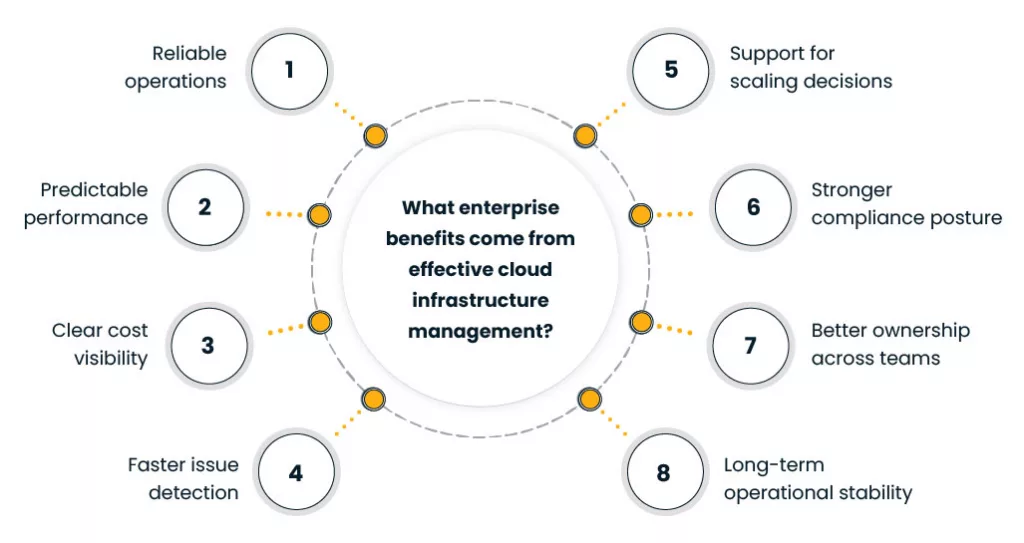
Reliable operations

A consistent management structure keeps systems steady even during high-traffic periods, especially when supported through cloud-native development services, which integrate security, scalability, and operational consistency from the start. Teams understand how resources behave, and this helps them prevent issues before they reach users.

Predictable performance

Monitoring, planning, and access controls help applications maintain predictable behavior. These routines reveal performance shifts early and allow teams to adjust configurations in a structured way.

Clear cost visibility

Enterprises gain clearer insight into resource usage when provisioning and tracking follow defined standards. This visibility supports financial planning and provides a better understanding of monthly trends.

Faster issue detection

Operational signals help teams identify unusual activity early. Logs and traces reveal the parts of the system involved, and this shortens investigation time, so teams maintain steady daily operations.

Support for scaling decisions

Systems that rely on structured management practices can scale more predictably. As workloads grow, teams understand when additional capacity is needed and how to apply it without disruption.

Stronger compliance posture

Defined identity rules and configuration standards support compliance requirements, further reinforced by cloud security best practices that reduce risk across distributed services. Teams maintain audit-ready environments because process consistency keeps systems aligned with regulatory expectations.

Better ownership across teams

Ownership models help teams understand which resources fall under their responsibility. This improves coordination and supports broader management of cloud infrastructure and services.

Long-term operational stability

Environments built on consistent routines adapt more smoothly as workloads change. This stability supports product development and internal growth across teams.

Key Takeaways!

Enterprises depend on cloud platforms to run applications, manage data, and support daily operations. These responsibilities require structured processes across compute, storage, network behavior, and monitoring. A consistent approach to cloud infrastructure management helps teams maintain reliable systems, respond to traffic changes, and prepare for compliance requirements. These practices support long-term stability and provide clarity across the entire cloud environment.

FAQs

Yes. Dedicated roles help maintain ownership and reduce operational confusion.

Yes. Monitoring signals reveal unusual patterns before they affect users.

Yes. Regular checks help maintain safe access and consistent configuration.

Yes. Workloads often require different capacity plans based on activity.

Yes. Stability depends on transparent processes, ownership, and consistent monitoring.

Author

Abhishek Nandan Linkedin
Abhishek Nandan
AVP, Marketing

Abhishek Nandan is the AVP of Services Marketing at Cygnet.One, where he drives global marketing strategy and execution. With nearly a decade of experience across growth hacking, digital, and performance marketing, he has built high-impact teams, delivered measurable pipeline growth, and strengthened partner ecosystems. Abhishek is known for his data-driven approach, deep expertise in marketing automation, and passion for mentoring the next generation of marketers.

Related Blog Posts

The Ultimate Guide to Cloud Transformation: Strategy, Implementation, and Optimization

CalendarFebruary 20, 2025

Building A Hybrid Cloud Strategy For Modern Enterprises

CalendarJune 30, 2025

Creating a Cloud Strategy Roadmap for Business Success 

CalendarJuly 16, 2025

Sign up to our Newsletter

    Latest Blog Posts

    The Role of Metadata Management in Scaling Enterprise Data Platforms 
    The Role of Metadata Management in Scaling Enterprise Data Platforms 

    CalendarApril 03, 2026

    How Enterprises Can Reduce Dashboard Sprawl in Business Intelligence Platforms? 
    How Enterprises Can Reduce Dashboard Sprawl in Business Intelligence Platforms? 

    CalendarApril 03, 2026

    Designing Enterprise Data Contracts to Improve Data Reliability Across Teams 
    Designing Enterprise Data Contracts to Improve Data Reliability Across Teams 

    CalendarMarch 31, 2026

    Let’s level up your Business Together!

    The more you engage, the better you will realize our role in the digital transformation journey of your business


      I agree to the Terms & Conditions and Privacy Policy and allow Cygnet.One (and its group entities) to contact me via Promotional SMS / Email / WhatsApp / Phone Call.*

      I agree to receive occasional product updates and promotional messages from Cygnet.One (and its group entities) on Promotional SMS / Email / WhatsApp / Phone Call.

      I agree to receive promotional SMS messages from Cygnet.One (and its group entities). Up to 4 messages per month. Message & data rates may apply. Reply STOP to opt out. Consent is not a condition of purchase.

      Cygnet.One Locations

      India India

      Cygnet Infotech Pvt. Ltd.
      2nd Floor, The Textile Association of India,
      Dinesh Hall, Ashram Rd,
      Navrangpura, Ahmedabad, Gujarat 380009

      Cygnet Infotech Pvt. Ltd.
      6th floor, A-wing Ackruti Trade Center,
      Road number 7, MIDC, Marol,
      Andheri East, Mumbai-400093, Maharashtra

      Cygnet Infotech Pvt. Ltd.
      WESTPORT, Urbanworks,
      5th floor, Pan Card Club rd.,
      Baner, Pune, Maharashtra 411045

      Cygnet Infotech Pvt. Ltd.
      10th floor, 73 East Avenue,
      Sarabhai campus, Vadodara, 391101

      Global

      CYGNET INFOTECH LLC
      125 Village Blvd, 3rd Floor,
      Suite 315, Princeton Forrestal Village,
      Princeton, New Jersey- 08540

      CYGNET DIGITAL IT SOLUTION LLC
      Office 707, Magnum Opus Tower,
      Al Thanyah First, Dubai, U.A.E,
      P.O. Box 125608

      CYGNET INFOTECH PRIVATE LIMITED
      Level 35 Tower One,
      Barangaroo, Sydney, NSW 2000

      CYGNET ONE SDN.BHD.
      Unit F31, Block F, Third Floor Cbd Perdana 3,
      Jalan Perdana, Cyber 12 63000 Cyberjaya Selangor, Malaysia

      CYGNET INFOTECH LIMITED
      C/O Sawhney Consulting, Harrow Business Centre,
      429-433 Pinner Road, Harrow, England, HA1 4HN

      CYGNET INFOTECH PTY LTD
      152, Willowbridge Centre,
      39 Cronje Drive, Tyger Valley,
      Cape Town 7530

      CYGNET INFOTECH BV
      Peutiesesteenweg 74, Machelen (Brab.), Belgium

      Cygnet One Pte. Ltd.
      160 Robinson Road,
      #26-03, SBF Centre,
      Singapore – 068914

      • Explore more about us

      • Download Corporate Deck
      • Terms of Use
      • Privacy Policy
      • Contact Us
      © Copyright – 2026 Cygnet.One
      We use cookies to ensure that we give you the best experience on our website. If you continue to use this site we will assume that you are happy with it.

      Cygnet.One AI Assistant

      ✕
      AI Assistant at your help. Cygnet AI Assistant