



































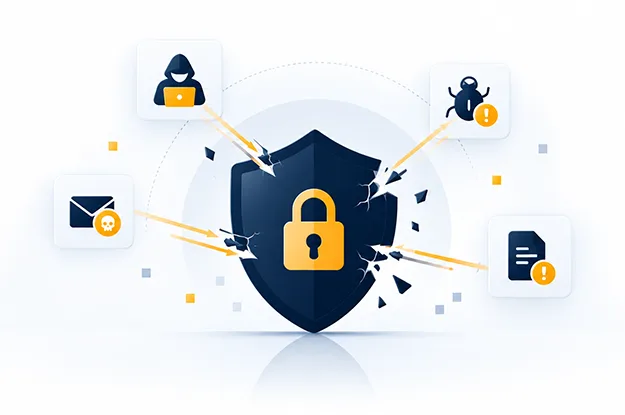
A security tool can report a clean device while an attacker is already using it.
That is the central endpoint problem in 2026. Many intrusions no longer begin with a suspicious executable that antivirus can quarantine. They begin with a valid account, an unpatched application, a remote administration utility, a signed script, or a user approving the wrong request.
- CrowdStrike reported that 82% of detections observed in 2025 were malware-free.
- Verizon’s 2026 DBIR found that vulnerability exploitation caused 31% of breaches, overtaking stolen credentials as the leading entry point for the first time in the report’s history.
Traditional antivirus still has a job. It can catch known malicious files and remove common malware. The error is treating that job as complete endpoint protection.
Endpoint security solutions now have to identify how a process started, which identity launched it, what it contacted, what changed afterward, and whether the activity fits a broader attack sequence, supported by Cybersecurity solutions for business that strengthen detection and response.
This shift calls for a different security question. Instead of asking, “Is this file malicious?” teams must ask, “Is this chain of activity legitimate?”
How Endpoint Threats Changed
The endpoint was once an office desktop on a company network. It now includes laptops, virtual desktops, cloud workloads, mobile devices, contractor systems, developer machines, servers, and operational technology interfaces.
Attackers have adjusted faster than many security programs, which is why endpoint security solutions must assess activity across a complete attack path.
A modern intrusion may use five ordinary actions that look harmless when viewed separately:
- A user signs in with valid credentials.
- A legitimate system tool starts a script.
- The script queries local privileges.
- A remote management application opens a connection.
- Data leaves through an approved cloud service.
No single step has to contain malware. The malicious intent appears in the sequence.
This is why modern endpoint protection depends on behavioral context. It connects identities, processes, files, network activity, memory activity, and security controls, then retains enough history to reconstruct events before an alert.
The pace has changed as well. CrowdStrike reported an average eCrime breakout time of 29 minutes in 2025, referring to the period between initial access and movement to another system. A security team that reviews endpoint alerts once each morning is working on a schedule the attacker has already defeated.
The Endpoint Is Now Part of an Attack Path
For modern endpoint protection, the endpoint can no longer be managed as an isolated device, which is why enterprises also need strong cloud security architecture across identity, endpoints, SaaS, and workloads. It is one step in a route that may cross identity systems, email, SaaS applications, cloud infrastructure, and internal servers.
This is where many endpoint programs become misleading. Their dashboards show device coverage, agent health, and blocked files. Those metrics say little about whether defenders can follow an attacker across systems. Coverage without connected evidence creates false confidence.
Why Traditional Antivirus Misses Modern Attacks
Signature-based antivirus compares files against known malicious patterns. Heuristic engines flag suspicious file characteristics. Both remain useful against common malware and known payloads.
Their limitation is structural. They work best when an attack introduces something recognizably malicious. Many current attacks avoid that condition.
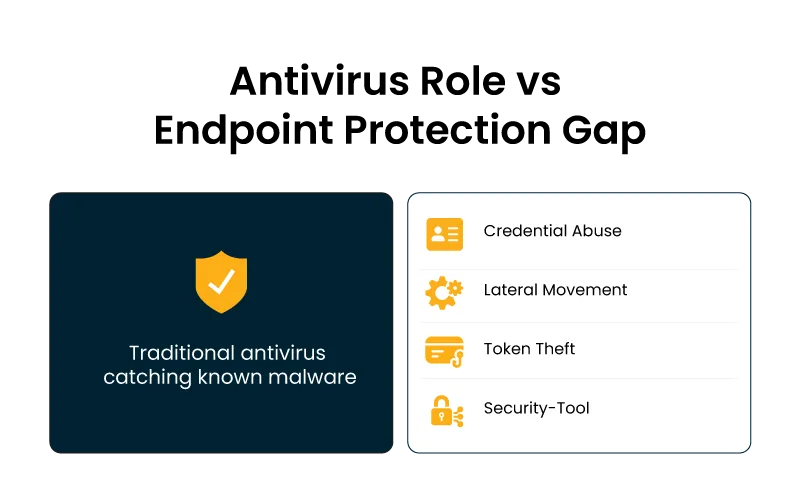
Attackers may use:
- PowerShell, Windows Management Instrumentation, or command-line tools already present on the device
- Stolen session tokens or authenticated remote access
- Signed applications that have legitimate administrative uses
- Credential dumping from memory
- Malicious browser extensions or OAuth permissions
- Vulnerable public-facing software that provides direct access
- Security-tool tampering before ransomware deployment
CISA has documented ransomware operators using open-source administration tools, remote access software, credential extraction utilities, and attempts to terminate antivirus or EDR processes. These tools have legitimate uses. Risk comes from how, when, and by whom they are used.
| Antivirus question | Security question required in 2026 |
| Is the file known to be malicious? | Is the activity consistent with the user and device? |
| Does the file match a signature? | What process, identity, or remote session created it? |
| Can the file be quarantined? | Has the attacker gained persistence or moved elsewhere? |
| Was malware blocked? | Was the entire attack path contained? |
| Is the agent installed? | Is telemetry complete, monitored, and actionable? |
Adding another scanning engine rarely fixes this gap. Endpoint security solutions need prevention, visibility, investigation, and containment working together.
Antivirus also struggles with time. It acts when a file opens or runs, while an investigation needs history. Without retained telemetry, analysts may see the final ransomware process and miss the earlier credential theft.
What Modern Endpoint Security Architecture Includes
A sound architecture for endpoint security solutions assumes that some prevention controls will fail. This is a practical engineering position.
Modern endpoint protection should contain several connected layers:
1. Prevention Based on Behavior
The platform should block known malware, suspicious scripts, exploit techniques, malicious memory activity, credential theft, and unauthorized changes to security settings. Prevention rules should be tested against business applications before broad enforcement.
2. Continuous Endpoint Telemetry
Process creation, parent-child relationships, logons, file activity, network connections, registry changes, device control events, and security configuration changes should be recorded. Telemetry must remain searchable long enough to support investigation.
3. Identity and Device Context
An alert carries more value when the system knows if the user is privileged, the device is managed, the sign-in location is unusual, and the account has recently changed authentication methods.
4. Attack Surface Reduction
Application control, browser controls, macro restrictions, device policies, privilege management, and exploit protection reduce the number of actions available to an intruder. This is where advanced endpoint security becomes practical. It narrows attacker options before detection is required.
5. Automated Containment
Security teams need the ability to isolate a device, stop a process, quarantine a file, disable a compromised account, block a hash or domain, and collect evidence, where managed IT services help maintain response workflows and endpoint support discipline. Automation should follow clear approval rules, especially on production servers.
6. Central Investigation
Endpoint events should connect with identity, email, cloud, network, and vulnerability data. The objective is a single incident timeline, rather than six alerts in separate consoles.
Modern endpoint protection is only as good as its daily operation. CISA described an incident in which EDR alerts were not continuously reviewed, some public-facing systems lacked endpoint coverage, and malicious activity remained undetected for three weeks. The lesson is direct: buying detection technology does not create detection capability.
Where EDR Fits and Where It Does Not
EDR records endpoint behavior, detects suspicious activity, supports investigation, and gives responders tools to contain threats. The term endpoint detection response is often used as shorthand for this wider capability.
A useful EDR platform should answer four questions quickly:
- What happened first?
- Which user, process, or device was involved?
- What else did the attacker touch?
- Which action will contain the incident without causing unnecessary disruption?
This makes EDR central to modern endpoint protection against malware-free activity and legitimate-tool abuse. It can identify unusual process chains, privilege escalation, credential access, lateral movement, and security-control tampering.
EDR remains one part of the security program.
CISA has also warned against relying too heavily on host-based EDR without sufficient network protections, secure configuration, staff capability, and leadership attention to known attack paths. An endpoint agent cannot patch an exposed application by itself. It cannot correct weak identity policies, replace tested incident plans, or compensate for alerts nobody reviews.
The best endpoint security solutions connect EDR with:
- Vulnerability and patch management
- Identity protection and privileged access controls
- Email and browser security
- Network visibility
- Central logging and security analytics
- Tested incident response playbooks
- Threat intelligence and proactive hunting
This is also where the phrase endpoint detection response needs care. Detection without a defined response process produces a queue. Response without sufficient evidence produces risky containment decisions. Both sides need ownership, service levels, and trained people.
How to Evaluate Endpoint Protection in 2026
Comparisons of endpoint security solutions often focus on detection scores and feature lists, but enterprises should also know how to choose the right VAPT provider to validate endpoint and infrastructure exposure. Buyers should go further. The better test is whether the operating team can use the platform under pressure.
Ask these questions:
Can the platform detect legitimate-tool abuse?
A tool designed mainly around malicious files will miss too much current activity.
Can analysts reconstruct the full timeline?
The system should preserve searchable evidence and show process ancestry, user context, remote connections, and affected assets.
Can it contain an incident safely?
Isolation and remediation actions need safeguards for critical devices and servers.
Does it expose coverage gaps?
Teams should see unmanaged devices, unhealthy agents, missing telemetry, stale policies, and unsupported operating systems.
Can it connect endpoint and identity evidence?
A valid login followed by unusual device behavior should become one investigation, rather than unrelated alerts.
Who monitors it, and when?
Continuous tooling with business-hours review leaves a predictable gap.
How is success measured?
Blocked malware counts are weak evidence. Better measures include time to validate, time to contain, repeat incidents, coverage quality, and the percentage of alerts with enough context for a decision.
A credible advanced endpoint security program also reviews exclusions because modern endpoint protection can be weakened by poorly governed exceptions. Attackers know that security tools often exclude folders, processes, service accounts, and business applications to prevent disruption. Each exception should have an owner, a reason, an expiry date, and a compensating control.
The Better Endpoint Security Question
Traditional antivirus remains useful as one control inside a larger system.
The case for modern endpoint protection rests on a basic fact: current attacks often look like normal work until their actions are connected. A valid account, a signed tool, and an approved cloud service can become an intrusion path without triggering a classic malware alert.
That changes how leaders should judge endpoint security solutions. Product count is irrelevant. What matters is enough prevention, telemetry, context, and response capacity to recognize malicious behavior early and contain it before one device becomes an enterprise incident.
In 2026, the strongest endpoint program is the one that can explain activity, prove what happened, and act with control. Antivirus can still block a bad file. Security teams now need to stop the attacker operating through the device.
Author


Yogita Jain
Content Lead
Yogita Jain leads with storytelling and Insightful content that connects with the audiences. She’s the voice behind the brand’s digital presence, translating complex tech like cloud modernization and enterprise AI into narratives that spark interest and drive action. With a diverse of experience across IT and digital transformation, Yogita blends strategic thinking with editorial craft, shaping content that’s sharp, relevant, and grounded in real business outcomes. At Cygnet, she’s not just building content pipelines; she’s building conversations that matter to clients, partners, and decision-makers alike.