



































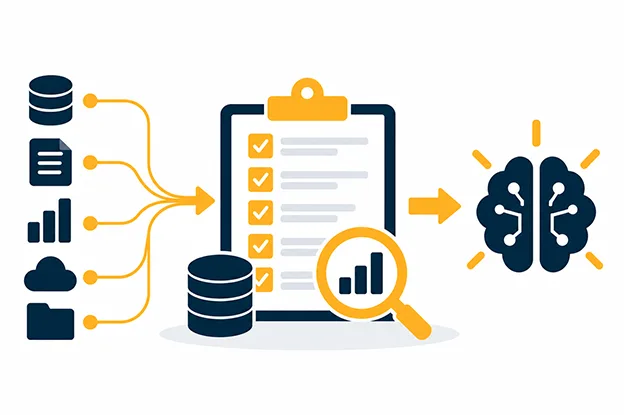
An AI project starts spending credibility before it starts spending compute.
The first serious decisions are made while teams are still discussing datasets: which records represent the business problem, which fields can be trusted, what can legally be used, which history is missing, and whether anyone can explain how a value reached the training table. A model can be technically impressive and still inherit a weak business definition from the data beneath it.
That gap is visible in current enterprise research. In IBM Institute for Business Value research published in 2025, only 26% of surveyed data leaders said they were confident their data could support new AI-enabled revenue streams. The study also identified accessibility, completeness, integrity, accuracy, and consistency as continuing barriers.
A data readiness assessment should therefore ask a narrower question than “Is our data good?”, where data analytics services help evaluate data quality, usability, governance, and business fit before AI development. It should ask whether the available data is fit for this AI use case, under the conditions in which the model will be trained, tested, approved, and used.
That distinction changes the work. AI data readiness is use-case specific. A customer history table may be adequate for monthly reporting and still be poor training material for next-best-action prediction. A service log may be complete enough for audit and still lack the event timing needed for failure prediction.
The assessment belongs before serious model development because it tells the team whether the problem is ready for modeling, needs data remediation, or should be reframed.
What Does AI Data Readiness Actually Mean?
A dataset is ready when its strengths, limitations, rights, meaning, and history are understood well enough to support a defined model objective, making data governance essential before AI moves into experimentation.
This is broader than data cleansing. It includes the relationship between the data and the decision the model is expected to support. NIST’s AI Risk Management Framework treats AI risk through governance, mapping, measurement, and management, while its measurement guidance calls for documented test sets, metrics, deployment context, privacy risk, and validation.
For an enterprise, AI data readiness can be tested through seven questions:
- Do we have enough relevant history for the business event?
- Can we trace important fields to their source and processing logic?
- Do owners know what each high-impact field means?
- Are usage rights, privacy restrictions, retention rules, and access controls clear?
- Can we identify missing groups, periods, channels, or operating conditions?
- Is the data available when the real-world prediction must be made?
- Can the same dataset be reproduced later for audit or retraining?
This is the core of data readiness for machine learning as well. Readiness is tied to the intended prediction, observation window, target, and environment in which the output will be consumed.
Why Completeness Is More Than a Missing-Value Check
Many assessments begin with null percentages. Useful, but shallow.
A better AI data quality checklist asks what is absent and why. A field may be blank because a customer withheld information, an older system never captured it, a business unit follows a different process, or a pipeline failed. Those causes create different model risks.
| Completeness question | What to inspect | Why it matters |
| Population coverage | Regions, products, customer groups, channels | Reveals who or what the model has seen |
| Time coverage | Seasonal periods, policy changes, unusual periods | Tests whether history represents current conditions |
| Event coverage | Positive, negative, rare, borderline outcomes | Shows whether the target is learnable |
| Feature availability | Training-time versus prediction-time fields | Exposes leakage and production gaps |
The last row is frequently missed. If a field exists only after an event occurs, it can make training results look unusually strong while being useless in production. A data readiness assessment should record when each important feature becomes available, not simply whether it exists.
Can You Trace a Training Field Back to Its Business Source?
Lineage becomes practical when the model team can answer: “Where did this value come from?”, which is why metadata management matters for AI models, feature traceability, and auditability.
Google Cloud’s ML guidance recommends tracking source code, pipelines, datasets, artifacts, configurations, statistics, anomalies, and model outputs so teams can reproduce and investigate results. AWS guidance similarly emphasizes version control, traceability, reproducibility, and changes across data, models, code, and infrastructure.
For metadata and lineage for AI, a diagram alone is insufficient. The record should connect a model feature to its source system, extraction rule, business definition, processing step, owner, update frequency, and known exceptions.
That creates a useful test for AI data readiness: if a high-impact model input produces an unexpected value, can the team identify where it changed without reconstructing the pipeline from memory?
This matters most for fields renamed, joined across systems, calculated through business rules, or repurposed over time. They can look clean at the model layer while carrying hidden semantic drift.
How Should Enterprises Assess Data Governance and Privacy for AI?
Availability is a technical condition. Permission is a governance condition.
The assessment should separate “we can access this data” from “this data is approved for this AI purpose.” Microsoft’s current Purview guidance for enterprise AI applications covers classification, sensitivity labels, access controls, auditability, data loss controls, and restricting outputs to information a user is authorized to receive. NIST’s Generative AI Profile also identifies privacy risks related to unauthorized use, disclosure, and de-anonymization of sensitive information.
Good data governance for AI models should make five decisions explicit: who owns the dataset, who approves AI use, which purposes are allowed, which restrictions apply, and what evidence must be retained.
A practical review can classify each source as approved, conditionally approved, or blocked. Conditional approval may require masking identifiers, excluding restricted attributes, changing retention, or limiting access.
This is where enterprise AI readiness becomes an operating issue. Legal, privacy, security, data owners, and business owners may each hold part of the answer.
Metadata Should Explain Business Meaning
A catalog entry that says customer_status = current status of customer adds little value.
Useful metadata explains how the field behaves in the business. When is status assigned? Which system is authoritative? Can it change retroactively? Are inactive customers retained? Did the definition change after a policy update? What does a blank value mean?
That context is part of metadata and lineage for AI because models learn from operational definitions, including the inconsistencies inside them.
The same test applies to labels. If an attrition model uses “churn” as its target, the assessment should document exactly when a customer is considered churned, whether different exit types are combined, how reactivations are handled, and whether the definition changed during the training period.
This is why AI data readiness requires domain review. Data engineers can verify pipelines. Data scientists can profile distributions. Business owners have to verify meaning.
Access Readiness Is About Timing and Reproducibility
A dataset can be approved, accurate, and documented yet still fail operationally.
Model development often begins with a convenient extract. Production may depend on a source that arrives late, updates unpredictably, or requires manual intervention. Readiness therefore needs an access test based on the real prediction window.
For each source, record:
- How the model receives it
- How frequently it refreshes
- How late it can arrive before the prediction loses value
- What happens when the source is unavailable
- Whether historical versions can be reconstructed
If the training set cannot be reproduced as it existed at a given date, later investigation becomes guesswork.
The second AI data quality checklist should include freshness, schema stability, duplicate behavior, source outages, late-arriving records, and historical reproducibility alongside accuracy and completeness.
Test Business Context Before Testing Algorithms
One of the most expensive readiness mistakes is solving a data problem that belongs to the business definition.
Suppose a manufacturer wants to predict late orders. Before model work begins, the team needs to agree on what “late” means. Promised date or requested date? Customer-confirmed date or internal commit date? Are customer-requested changes excluded? How are partial shipments treated?
Until those questions are resolved, more data engineering will not produce a stable target.
A data readiness assessment should include a “decision contract” before a model contract. It records the business action, prediction point, target definition, acceptable delay, users of the output, and consequences of error.
This improves data readiness for machine learning because it connects data requirements to a real decision. It can also expose use cases where a deterministic business rule is sufficient.
A Data Readiness Assessment Framework Before Model Development
The assessment should end with evidence, owners, and a decision. Avoid compressing readiness into one percentage because a strong average can hide a blocking privacy or lineage issue.
| Readiness gate | Evidence required | Typical blocker |
| Business fit | Decision contract, target, success criteria | Ambiguous outcome |
| Data coverage | Population, time, event, feature review | Missing operating conditions |
| Quality | Profiling results and issue thresholds | Systematic errors |
| Traceability | Source-to-feature lineage, version history | Unknown processing logic |
| Governance | Owner approval, purpose rights, privacy controls | Unclear permission |
| Operational access | Refresh, latency, failure path, reproducibility | Data unavailable when needed |
Use three outcomes: proceed, remediate, or reframe.
“Proceed” means evidence is strong enough to begin model development with known limitations. “Remediate” means specific data work must be completed first. “Reframe” means the target, population, source, or business action is too uncertain to justify model work.
This gives data governance for AI models a direct connection to engineering decisions. It also gives sponsors a clearer view of why a project is waiting and what would remove the blocker.
For enterprise AI readiness, the framework can be reused across use cases while keeping thresholds decision-specific. Fraud detection, demand forecasting, document retrieval, and service triage should not inherit identical standards for timeliness, acceptable error, retention, or human review.
What Evidence Should Exist Before Serious Model Development?
A mature assessment leaves behind a small evidence pack rather than a presentation full of readiness language.
It should contain the decision contract, source inventory, field definitions, quality findings, lineage evidence, rights and privacy decisions, access conditions, known exclusions, and named owners. It should also state what the dataset cannot support.
Limitations are part of readiness. If two years of history exclude a new product line, say so. If a customer segment has sparse outcomes, record it. If labels were created under an old policy, document the break.
This is the point of AI data readiness. The goal is to make model risk visible before the model makes it harder to separate data problems from algorithm problems.
A data readiness assessment also creates a clean handoff into experimentation. The model team knows which dataset version is approved, which caveats must be tested, which features need caution, and who can resolve questions about meaning.
When Is Enterprise Data Ready for AI?
Data is ready for AI when the organization can defend its use, meaning, timing, coverage, and history for a specific model objective.
That standard is more demanding than a clean table and more useful. It prevents teams from treating access as approval, completeness as representativeness, metadata as business context, or a successful experiment as proof that the underlying data is fit for production.
The strongest data readiness assessment ends with a decision that an accountable owner can explain. The strongest AI data readiness evidence shows what is known, what remains uncertain, and what must be fixed before modeling begins.
The final question is practical: if the model produces a surprising result six months from now, can the team trace the data, explain its meaning, confirm it was permitted for use, reproduce the training view, and identify the owner responsible for the disputed field?
If the answer is unclear, model building has started before the data work is finished.
Author


Yogita Jain
Content Lead
Yogita Jain leads with storytelling and Insightful content that connects with the audiences. She’s the voice behind the brand’s digital presence, translating complex tech like cloud modernization and enterprise AI into narratives that spark interest and drive action. With a diverse of experience across IT and digital transformation, Yogita blends strategic thinking with editorial craft, shaping content that’s sharp, relevant, and grounded in real business outcomes. At Cygnet, she’s not just building content pipelines; she’s building conversations that matter to clients, partners, and decision-makers alike.