




































IDC estimates that unstructured data makes up 80% of all enterprise data generated today, and that volume is growing at 55% annually.
Despite that scale, most migration frameworks were built for structured data. Unstructured data migration does not fit those frameworks. So, enterprises that apply structured migration logic to unstructured data discover that gap only after data has already moved incorrectly in data migration projects.
This blog covers what makes these data types genuinely difficult to migrate and the strategies that actually work at enterprise scale.
What Is the Difference Between Unstructured and Semi-Structured Data in a Migration Context?
Unstructured Data
Unstructured data has no predefined schema and no fixed format. Emails, PDFs, images, video files, audio recordings, and log files all fall into this category. None of them can be stored in a relational table without undergoing a significant transformation first. Volume is large, format is inconsistent, and metadata is often incomplete or missing entirely.
Semi-Structured Data
Semi-structured data has some organizational properties but no rigid schema. JSON files, XML documents, YAML configurations, and CSV files with inconsistent column counts are the most common examples. Semi-structured data migration is particularly complex within modern data management environments. A JSON file from one source system may carry 12 fields. The same entity exported from a different source may carry 27 with different field names for the same values.
| Data Type | Structure | Migration Complexity |
| Structured | Fixed schema, defined columns | Lower — standard ETL applies |
| Semi-structured | Flexible, self-describing | Medium-High — schema variance per record |
| Unstructured | No schema | Highest — requires classification before migration |
Understanding what these data types are is the starting point. Understanding why they break standard migration frameworks is where most enterprises run into trouble.
Why Do Standard Migration Approaches Fail With Unstructured and Semi-Structured Data?
ETL Pipelines Are Built for Rows and Columns
Standard Extract, Transform, Load pipelines expect a defined schema at the extraction stage in traditional data engineering workflows. Unstructured data has no schema to extract against the pipeline and has no field definitions to map. Applying ETL logic to a folder of 40,000 PDF documents or a data lake containing mixed JSON and XML produces immediate failures at the extraction layer.
Validation Logic Does Not Transfer
Structured data validation checks field types, null rates, and referential integrity. Unstructured data migration has no equivalent. A migrated PDF is either present or it is not, but its content accuracy cannot be validated the same way a database record can. Semi-structured data validation requires schema inference, meaning the pipeline must determine what fields exist before it can validate them at all.
Volume and Variety Combine at Scale
Enterprise data migration challenges with unstructured data are not purely technical and require strong data quality management. A single enterprise data lake can contain petabytes of mixed-format files accumulated over decades with no consistent naming convention, metadata standard, or access control structure applied across them. The variety problem and the volume problem hit simultaneously, and standard migration tooling is not built to handle both at once.
These are the known difficulties. The challenges enterprises consistently overlook go deeper. They are the ones that cause the most damage after migration completes.
What Are the Specific Challenges in Migrating Unstructured Data That Enterprises Miss?
Most migration teams plan for the data movement itself. They do not plan for what happens when the data arrives without context, with broken permissions, in formats the target cannot read, or duplicated across thousands of files that nobody cataloged. These are the challenges in migrating unstructured data that surface after go-live, when fixing them is significantly more expensive than preventing them.
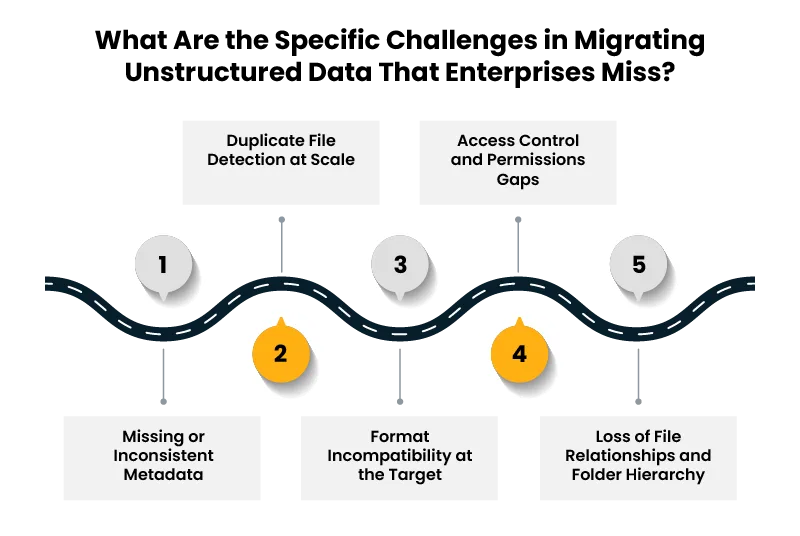
1. Missing or Inconsistent Metadata
Unstructured files depend on metadata for discoverability and governance. File type, creation date, owner, access permissions, retention policy; all of it needs to travel with the file to the target system.
When metadata is missing or inconsistent across source files, the migrated data arrives at the target with no way to classify, search, or govern it. A document without metadata is functionally invisible in a target system that depends on metadata for retrieval. Finance documents land in the same undifferentiated pool as HR records and marketing assets. Separating them after migration requires manual effort at a scale most teams did not budget for.
Pre-migration metadata audits are the fix. Every file gets assessed for metadata completeness before it moves. Files that cannot be enriched automatically get flagged for manual review. Files that cannot be enriched at all get held back from migration until they can.
2. Duplicate File Detection at Scale
Enterprises accumulate duplicate files over the years. The same document saved under different names, stored in different folders, owned by different departments, sometimes existing in four or five copies simultaneously across the organization.
Standard deduplication logic that works on database records does not apply to binary files. Comparing file names catches almost nothing. Comparing file sizes catches slightly more. Content-based hashing is the only method that reliably detects duplicates in unstructured file sets. It generates a unique value from file content, so identical files produce the same hash even if their names or locations differ.
Running content-based deduplication before migration reduces target storage requirements. More importantly, it eliminates redundant files that would otherwise consume metadata tagging, governance review, and access control configuration time at the target.
3. Format Incompatibility at the Target
Migrating JSON XML data to cloud platforms is not a simple copy operation. A JSON file that is valid in the source system may use a schema version that the target platform does not support. XML documents with custom DTD references break when the target cannot resolve those references. Older PDF versions using deprecated encoding standards render incorrectly in modern document management systems.
Semi-structured data migration must include format compatibility testing against the target environment before bulk migration begins. A representative sample, covering every file format present in the source, gets processed through the target system first. Format failures surface at the sample scale, where fixing them is contained. They do not surface at the petabyte scale, where fixing them requires re-migrating millions of files.
4. Access Control and Permissions Gaps
File-level permissions in the source system do not automatically transfer to the target. A document restricted to the finance department in the source system may become accessible to all authenticated users in the target if permissions are not explicitly remapped during migration.
Enterprise data migration challenges around access control are compliance risks with direct regulatory consequences. GDPR requires that personal data access restrictions remain intact after any system change. HIPAA requires the same for protected health information. Neither regulation provides an exception for migration events.
Permissions mapping must be completed before files move; source permission structures documented, target permission equivalents defined, and automated checks confirming that every migrated file landed with the correct access controls applied.
5. Loss of File Relationships and Folder Hierarchy
Unstructured data in enterprise environments is rarely stored in isolation. Documents reference other documents. Folders carry organizational meaning; a folder structure built over ten years reflects how a business unit actually operates.
When migration flattens that hierarchy, moving files without preserving folder structure, parent-child relationships, or cross-document references, the target system receives the data but loses the context that made it usable. Users cannot find the files they need. Workflows that depended on folder-based routing break. Document management systems that rely on folder metadata for classification cannot function correctly.
Preserving folder hierarchy during unstructured data migration requires explicit mapping of source folder structure to target folder structure before migration begins, and validation confirming that every file landed in the correct location after migration completes.
What Document Data Migration Strategies Actually Work at Enterprise Scale?
Pre-Migration Data Classification
Before any unstructured file moves, every file gets classified by:
Type
Sensitivity level
Business domain
Retention requirement
Classification determines which migration method applies, which validation checks run, and which access controls transfer. Tools like Apache Atlas and AWS Macie automate classification at scale. Manually classifying petabytes of unstructured data is not operationally feasible.
Incremental Migration for Large File Sets
Moving petabytes of unstructured data in a single batch creates network saturation and processing bottlenecks. Incremental migration moves defined subsets with validation completed on each subset before the next begins.
Unstructured data migration executed incrementally contains failures within each subset. A failure in the finance document subset does not affect the HR document subset running in the next window. The blast radius stays small, and the fix stays targeted.
Metadata Enrichment Before Migration
Missing metadata gets added before files move. Automated metadata extraction tools read file content and generate tags like:
Document type
Language
Creation date
Detected entities
Files that cannot be enriched automatically get flagged for manual review. Files that cannot be enriched at all get held back.
Format-Specific Pipeline Architecture
One pipeline per data format — JSON, XML, PDF, image, video — each with format-specific extraction, validation, and loading logic. Document data migration strategies that rely on a single generic pipeline for all formats produce inconsistent results. A pipeline built for JSON does not handle XML namespace conflicts. A pipeline built for structured documents does not handle binary image files. Format specificity is not optional at enterprise scale.
These strategies require tooling and execution experience that most internal teams are building for the first time on the migration itself. Organizations that want a structured approach, from pre-migration classification through post-migration validation, can evaluate Cygnet.One’s data migration and modernization services as a starting point.
What Should Enterprises Do Differently When Migrating Unstructured and Semi-Structured Data?
Most enterprises treat unstructured migration as a larger version of structured migration. It is not. It requires a different planning approach, different tooling, and different validation logic at every stage.
Three things that need to change before migration starts:
Classification is a migration phase — not a prerequisite. It has its own timeline, tooling requirements, and completion criteria before the next phase begins
Governance is defined before data moves — access controls, retention policies, and metadata standards for the target environment are finalized before the first file migrates. Retrofitting governance onto a migrated data lake costs significantly more than building it in during migration
Validation covers different dimensions — file presence, metadata completeness, format compatibility, folder hierarchy integrity, and access control accuracy each requires its own checklist and sign-off
Unstructured data migration that skips any of these three produces a target environment where data arrives but cannot be governed, found, or trusted.
The Gap Most Enterprises Close Too Late
Unstructured data migration breaks standard migration frameworks because those frameworks were built for structured data. The challenges are entirely preventable when the migration plan accounts for them before data moves.
The strategies exist. Pre-migration classification, content-based deduplication, format-specific pipelines, incremental execution, and governance-first planning are all documented and proven. Enterprise data migration challenges with unstructured data are not technology problems. They are planning, and execution problems — and planning is entirely within a team’s control before the project starts.
Author


Yogita Jain
Content Lead
Yogita Jain leads with storytelling and Insightful content that connects with the audiences. She’s the voice behind the brand’s digital presence, translating complex tech like cloud modernization and enterprise AI into narratives that spark interest and drive action. With a diverse of experience across IT and digital transformation, Yogita blends strategic thinking with editorial craft, shaping content that’s sharp, relevant, and grounded in real business outcomes. At Cygnet, she’s not just building content pipelines; she’s building conversations that matter to clients, partners, and decision-makers alike.