
































Economic conditions across the United States continue to place pressure on operational margins. In this, businesses in New Jersey are feeling that pressure particularly strongly.
Rising labor costs is putting pressure on operational budgets across many enterprises. This pressure forces organizations to examine their operational efficiency. As per the U.S. Bureau of Labor Statistics, U.S. business costs related to compensation increased by 4.3% in 2023, reflecting sustained cost pressure across industries.
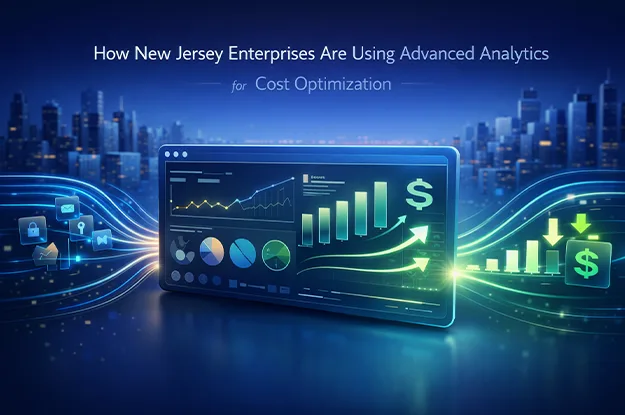
Enterprises are therefore turning to data-driven methods supported by data analytics services New Jersey to reveal where inefficiencies originate. One approach gaining traction is advanced analytics New Jersey. It allows organizations to understand operational patterns and find hidden cost drivers across departments.
This shift reflects a great transformation in how companies manage expenses. Instead of reacting to rising bills, enterprises are increasingly analyzing operational behavior using business analytics services before costs escalate. As a result, analytics-driven cost management is becoming a strategic capability.
Understanding how this transformation unfolds requires knowing the economic pressures shaping enterprise decisions today.
What economic pressures are New Jersey enterprises facing today?
New Jersey enterprises operate in a business environment where multiple cost drivers are evolving simultaneously. Moreover, infrastructure expenses remain high because the state supports dense commercial activity and complex logistics networks. Workforce costs also continue to increase as industries compete for skilled labor.
Several economic factors contribute to rising operational pressure:
- Workforce and compensation growth across key industries
- Transportation and logistics costs linked to regional distribution hubs
- Energy price fluctuations affecting production and facilities
- Supply chain volatility impacting inventory and procurement
These pressures interact across operations. This makes cost management more complicated than simple budget adjustments. Organizations therefore require deeper insight into how costs behave across facilities and supply chains.
When companies attempt to respond using traditional cost-cutting techniques, however, the results often remain temporary.
Why do traditional cost-cutting strategies fail to deliver long-term savings?
Traditional cost control methods usually rely on budget reductions or spending restrictions. Finance departments examine historical expenses and set limits on operational spending. While this approach may reduce costs temporarily, it rarely addresses the operational conditions that generated those expenses.
Budget-based cost reduction typically suffers from three structural limitations.
| Traditional Cost Control | Limitation |
| Departmental budget cuts | Reduces activity without addressing root causes |
| Expense monitoring | Detects issues after spending occurs |
| Periodic financial reviews | Provides delayed operational insight |
Because these methods focus on financial outcomes rather than operational behavior, inefficiencies often return once business activity resumes. Production schedules increase, transportation demand rises, and infrastructure resources scale again.
Organizations eventually realize that meaningful cost improvement requires visibility into operational processes themselves. This realization has led many enterprises to adopt advanced analytics New Jersey to examine cost drivers in real time rather than retrospectively.
Once companies begin examining operational data closely using ai analytics, they gain a clearer picture of where inefficiencies originate.
How does advanced analytics help enterprises understand where costs actually originate?
Advanced analytics enables organizations to analyze operational data across departments, systems, and workflows. Instead of reviewing expense summaries at the end of a quarter, analytics platforms examine data continuously and identify patterns in how resources are consumed.
When companies adopt advanced analytics New Jersey, they gain the ability to correlate operational activity with financial outcomes. Production output can be connected to energy consumption. Transportation routes can be evaluated against fuel expenditure. Workforce scheduling can be aligned with service demand.
The difference between traditional reporting and analytics-driven insight becomes clearer when comparing the two approaches.
| Traditional Financial Analysis | Analytics-Driven Cost Insight |
| Historical expense review | Identification of cost drivers |
| Manual reporting cycles | Automated data analysis |
| Limited operational context | Integrated operational visibility |
| Reactive decision-making | Predictive cost forecasting |
Through this deeper visibility, organizations begin to recognize inefficiencies that previously remained hidden. Analytics reveals patterns in equipment downtime, transportation routes, and workforce utilization that affect overall operational costs.
Once these insights become available, enterprises can apply analytics to specific industry operations where cost structures are most complex.
How are New Jersey manufacturers using advanced analytics to control production costs?
Manufacturing companies in New Jersey operate in a competitive environment where efficiency determines profitability. Hence, production facilities must manage:
- Equipment utilization
- Material consumption
- Workforce productivity
- Supply chain reliability
Manufacturers have begun using enterprise analytics New Jersey to improve visibility into production operations. For this, sensors embedded in equipment collect operational data continuously, while analytics systems evaluate performance patterns.
Several manufacturing applications demonstrate the value of analytics-driven cost management. For example,
- Predictive maintenance detects equipment issues before breakdowns occur.
- Production analysis identifies bottlenecks across assembly lines.
- Material monitoring reduces waste and improves inventory planning.
- Energy analytics optimizes facility operations during peak demand.
These insights allow manufacturers to redesign production processes with greater precision. Instead of responding to breakdowns or inefficiencies after they occur, analytics reveal performance trends early enough for corrective action.
Manufacturing operations are not the only area where analytics is influencing cost management. Logistics companies across New Jersey are also applying similar techniques to improve efficiency.
How are logistics and distribution companies in New Jersey using analytics for cost reduction?
New Jersey serves as a major logistics gateway for the northeastern United States, which makes transportation efficiency critical for regional enterprises. Distribution networks must coordinate shipping schedules and inventory management across multiple facilities.
Logistics organizations increasingly rely on analytics for cost reduction to optimize these complex operations. Transportation data, warehouse activity records, and shipment tracking information provide valuable insight into operational performance.
Analytics platforms evaluate these datasets to identify opportunities such as:
- Route optimization that reduces fuel consumption and delivery time
- Inventory forecasting that prevents overstocking or stock shortages
- Warehouse layout optimization that improves picking and packing efficiency
- Shipment consolidation strategies that reduce transportation expenses
These improvements accumulate across logistics networks and contribute to significant operational savings. However, these analytics capabilities depend heavily on the quality and structure of enterprise data environments.
This requirement leads organizations to evaluate the infrastructure needed to support advanced analytics effectively.
What data infrastructure does enterprises need to support advanced analytics?
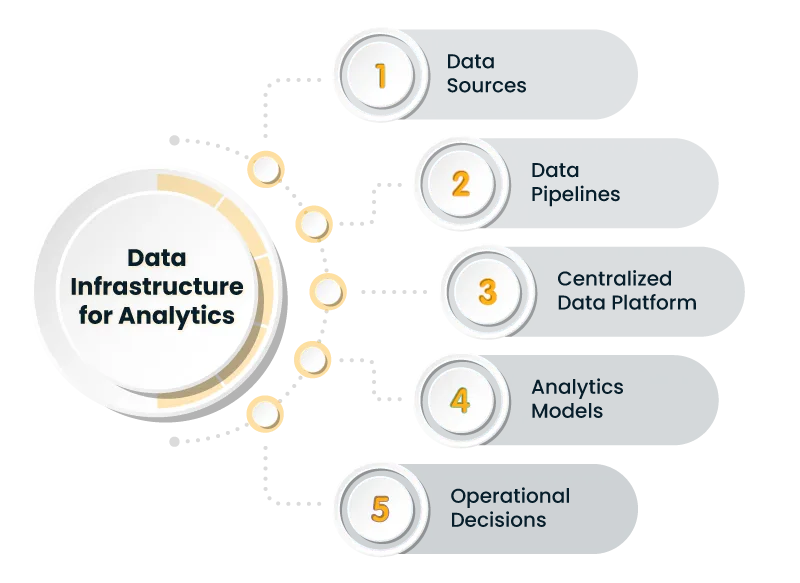
Analytics initiatives depend on reliable data systems capable of processing and analyzing large volumes of operational information. Enterprises therefore invest in data infrastructure that integrates multiple sources into a unified environment.
A strong analytics foundation typically includes several components.
- Centralized data platforms that consolidate operational information from multiple systems
- Real-time data pipelines that capture events as they occur
- Governance frameworks that ensure data accuracy and security
- Scalable computing environments capable of processing complex analytical models
These systems enable organizations to perform operational cost analytics across departments rather than analyzing isolated datasets. Production data, logistics activity, and financial records can be evaluated together to identify relationships between operational actions and financial outcomes.
Once infrastructure supports these capabilities, analytics begins to influence broader enterprise decision-making processes.
How does cost optimization analytics change enterprise decision-making?
When organizations implement cost optimization analytics, operational decisions become increasingly data driven. Leaders gain the ability to forecast cost implications before operational changes occur.
Analytics platforms powered by AI predictive Analytics allow executives to evaluate potential scenarios such as production expansion, transportation schedule adjustments, or workforce allocation changes. Hence, decisions are supported by predictive analysis.
The transformation becomes visible when comparing decision-making approaches.
| Traditional Management | Analytics-Driven Management |
| Reactive cost control | Predictive operational planning |
| Departmental decision-making | Cross-functional data visibility |
| Periodic reporting cycles | Continuous operational insight |
Through these capabilities, enterprises develop a proactive approach to cost management. Operational teams identify inefficiencies early and address them before they escalate into major financial issues.
When analytics becomes embedded within enterprise operations, the benefits extend well beyond cost control.
What business outcomes are New Jersey enterprises achieving with advanced analytics?
Organizations that implement advanced analytics New Jersey are observing measurable improvements across operational performance and financial stability. Analytics enables enterprises to operate with greater awareness of how resources are used and where improvements are possible.
Several outcomes are becoming increasingly common among enterprises that adopt analytics-driven operations.
- Reduced operational waste through data-informed process improvements
- Faster decision-making because leaders access real-time operational insight
- Improved resource allocation across departments and facilities
- More stable financial performance due to predictable cost behavior
These improvements demonstrate how analytics transforms cost management from a reactive exercise into a strategic capability. Enterprises that rely on advanced data insights are better equipped to respond to economic pressure while maintaining operational efficiency.
As the complexity of enterprise operations continues to increase, analytics will play an increasingly important role in helping organizations navigate cost challenges effectively.
FAQs
What is advanced analytics in enterprise cost management?
Advanced analytics uses data modeling and predictive algorithms to identify cost drivers and operational inefficiencies within enterprise systems.
How does analytics help reduce operational costs?
Analytics identifies patterns in operational data that reveal where resources are overused, underutilized, or inefficiently allocated.
Which industries in New Jersey benefit most from advanced analytics?
Manufacturing, logistics, healthcare, and financial services often benefit significantly because their operations involve complex cost structures.
What infrastructure is required to implement advanced analytics?
Organizations typically need centralized data platforms, real-time data pipelines, governance frameworks, and scalable computing environments.
How quickly can enterprises see results from analytics initiatives?
Many organizations begin identifying operational improvements within the first analytics implementation cycle, although long-term benefits grow as data systems mature.
Author


Yogita Jain
Content Lead
Yogita Jain leads with storytelling and Insightful content that connects with the audiences. She’s the voice behind the brand’s digital presence, translating complex tech like cloud modernization and enterprise AI into narratives that spark interest and drive action. With a diverse of experience across IT and digital transformation, Yogita blends strategic thinking with editorial craft, shaping content that’s sharp, relevant, and grounded in real business outcomes. At Cygnet, she’s not just building content pipelines; she’s building conversations that matter to clients, partners, and decision-makers alike.