

































• Cygnet IRP
  • Glib.ai
  • IFSCA
Cygnet.One
  • About
  • Products
  • Solutions
  • Services
  • Partners
  • Resources
Generic selectors
Exact matches only
Search in title
Search in content
Post Type Selectors
Get Started
About
  • Overview

    A promise of limitless possibilities

  • We are Cygnet

    Together, we cultivate an environment of collaboration

  • Careers

    Join Our Dynamic Team: Careers at Cygnet

  • CSR

    Impacting Communities, Enriching Lives

  • In the News

    Catch up on the latest news and updates from Cygnet

  • Contact Us

    Connect with our teams across the globe

What’s new

chatgpt

Our Journey to CMMI Level 5 Appraisal for Development and Service Model

Full Story

chatgpt

ChatGPT: Raising the Standards of Conversational AI in Finance and Healthcare Space

Full Story

Products
  • Cygnet Tax
    • Cygnet Tax
    • e-Invoicing / Real time reportingIRP-integrated e-Invoicing with real-time validation
    • e-Way Bills / Road permitsGST-compliant centralized e-Way Bill platform for scalable operations
    • Direct Tax ComplianceAccurate direct tax compliance, filings, litigation, and assessments
    • Indirect Tax ComplianceEnterprise-grade platform for indirect tax compliance
      • Indirect Tax Compliance
      • GST Compliance India
      • VAT Compliance EU
      • VAT Compliance ME
    • Managed ServicesEnd-to-end indirect tax compliance support by experts
  • Global e-Invoicing
    • Global e-Invoicing
    • APAC
      • India
      • Malaysia
      • Singapore
      • Japan
    • Africa
      • Egypt
      • Kenya
      • Zambia
      • Nigeria
    • Europe
      • Spain
      • France
      • Germany
      • Poland
      • Belgium
    • Oceania
      • Australia
      • New Zealand
    • Middle East
      • UAE
      • Oman
      • Saudi Arabia
      • Bahrain
      • Qatar
      • Jordan
  • Cygnet Vendor Postbox
    • Cygnet Vendor PostboxDigitize purchase invoice validation & posting to ERPs & maximize ITC
  • Finance Transformation
    • Finance Transformation
    • Cygnet FinalyzeUnlock working capital with data-driven invoice-based credit decisions
    • Bank Statement AnalysisEvaluate company health by analyzing performance and financial risk
    • Financial Statement AnalysisAssess company performance and risk with financial statement analysis
    • GST Business Intelligence Report360-degree financial health insights using GST data analytics
    • GST Return Compliance ScoreGST-based compliance score to assess business risk and credibility
    • ITR AnalysisAssess creditworthiness and lending risk using ITR filing analysis
    • Invoice Verification for Trade FinanceVerify invoices to reduce fraud and improve credit decisions
    • Account Aggregator – Technology Service Provider (AA-TSP)Onboard to the Account Aggregator ecosystem with FIP & FIU modules
  • Cygnet BridgeFlow
    • Cygnet BridgeFlowAutomated digital onboarding with real-time validations and compliance
  • Cygnet Bills
    • Cygnet BillsGST-compliant centralized e-Way Bill platform for scalable operations
  • Cygnet IRP
    • Cygnet IRPIRP-integrated e-Invoicing with real-time validation
  • Cygnature
    • CygnatureSecure, compliant digital signing with audit-ready traceability

What’s new

e-Invoicing compliance Timeline

Know More →

UAE e-Invoicing: The Complete Guide to Compliance and Future Readiness

Read More →

Types of Vendor Verification and When to Use Them

Read More →

Safeguard Your Business with Vendor Validation before Onboarding

Read More →

Modernizing Dealer/Distributor & Customer Onboarding with BridgeFlow

Read More →

Accelerate Vendor Onboarding with BridgeFlow

Read More →

GST Filing 360°: GST, E-Invoicing, E-Way Bills & Annual Returns Made Simple

Read More →

Why Manual Tax Determination Fails for High-Volume, Multi-Country Transactions

Read More →

GST Filing 360°: GST, E-Invoicing, E-Way Bills & Annual Returns Made Simple

Read More →

Key Features of an Invoice Management System Every Business Should Know

Read More →

Automating the Shipping Bill & Bill of Entry Invoice Operations for a Leading Construction Company

Read More →

From Manual to Massive: How Enterprises Are Automating Invoice Signing at Scale

Know More →

Solutions
  • HireAI
  • Agent as a Service
  • AI-powered Voice Assistant
  • Generative AI Workshop
  • TestingWhiz
  • VIPRE

What’s new

AI powered Interviewer

AI-Powered Interviewing Helped an Education Group Reduce Hiring Time Significantly

Know More

Generative AI ebook

Navigating the Generative AI Landscape

Download eBook

Services
  • Data Analytics & AI
    • Data Analytics & AI
    • Data Engineering and ManagementData engineering and management for smart, scalable systems
    • Data Migration and ModernizationData migration and modernization for future-ready platforms
    • Insights Driven Business TransformationInsight-driven business transformation for faster decisions
    • Business Analytics and Embedded AIBusiness analytics and embedded AI for data-led growth
  • Digital Engineering
    • Digital Engineering
    • Technical Due DiligenceEnabling smarter decisions through future-ready digital ecosystems
    • Product EngineeringEngineering impactful digital products that elevate business growth
    • HyperautomationSmarter hyperautomation using low-code for agile business processes
    • Enterprise IntegrationIntegrating enterprise systems for seamless operations and growth
    • Application ModernizationModernizing IT ecosystems with scalable, AI-driven innovation
  • Quality Engineering
    • Quality Engineering
    • Test Consulting & Maturity AssessmentTest consulting and maturity assessments for reliable software QA
    • Business Assurance TestingBusiness assurance testing aligned with real business outcomes
    • Enterprise Application & Software TestingEnterprise application testing for continuity and scale
    • Data Transformation TestingData transformation testing for scalable, trusted data quality
  • Cloud Engineering
    • Cloud Engineering
    • Cloud Strategy and DesignCloud strategy and design services for secure, scalable growth
    • Cloud Migration & ModernizationORBIT: a proven framework for measurable cloud transformation
    • Cloud Native DevelopmentCloud-native development for resilient, scalable innovation
    • Cloud Operations and OptimizationCloud optimization and operations for enterprise resilience
    • Cloud for AI FirstAI-first cloud transformation for smarter, scalable enterprises
  • Managed IT Services
    • Managed IT Services
    • IT Strategy and ConsultingStrategic IT consulting to align technology with business goals
    • Application Managed Services24/7 managed application services for performance and security
    • Infrastructure Managed ServicesEnd-to-end infrastructure management for resilient IT operations
    • CybersecurityComprehensive cybersecurity solutions to protect business assets
    • Governance, Risk Management & ComplianceGRC solutions to manage risk, compliance, and governance
  • Cygnet TaxAssurance
    • Cygnet TaxAssurance
    • Tax DatalakeUnified tax data lake for intelligent, compliant decision-making
    • Tax InfraDigital tax infrastructure for efficient, compliant transformation
  • Amazon Web Services
    • Amazon Web Services
    • Migration and ModernizationMake Your Move to the Cloud With AWS Smarter & Faster
    • Generative AIRun your Gen AI workloads on AWS with full control

What’s new

AI-Powered Voice Assistant for Smarter Search Experiences

Explore More →

Cygnet.One’s GenAI Ideation Workshop

Know More →

Our Journey to CMMI Level 5 Appraisal for Development and Service Model

Read More →

Extend your team with vetted talent for cloud, data, and product work

Explore More →

Enterprise Application Testing Services: What to Expect

Read More →

Future-Proof Your Enterprise with AI-First Quality Engineering

Read More →

Cloud Modernization Enabled HDFC to Cut Storage Costs & Recovery Time

Know More →

Cloud-Native Scalability & Release Agility for a Leading AMC

Know More →

AWS workload optimization & cost management for sustainable growth

Know More →

Cloud Cost Optimization Strategies for 2026: Best Practices to Follow

Read More →

Cygnet.One’s GenAI Ideation Workshop

Explore More →

Practical Approaches to Migration with AWS: A Cygnet.One Guide

Know More →

Tax Governance Frameworks for Enterprises

Read More →

Cygnet Launches TaxAssurance: A Step Towards Certainty in Tax Management

Read More →

Partners
  • Cygnet Elevate Global Partner Program
  • Products Partner Program

Partner Program

Cygnet Elevate Global Partner Program

Cygnet Elevate Global Partner Program

Strategic Services Partner Program

A partner program built for services businesses to collaborate, expand offerings, and drive shared growth with Cygnet. Tap into shared expertise, go-to-market support, and long-term value creation.

Know more→

Products Partner Program

Products Partner Program

Co-create value through our global SaaS products.

Partner with Cygnet.One, a global leader in AI-powered compliance, tax, e-Invoicing, and automation solutions. Deliver seamless digital experiences, enable client success, and scale across markets with a future-ready platform.

Know more→

Resources
  • Blogs
  • Case Studies
  • eBooks
  • Events
  • Webinars

Blogs

A Step-by-Step Guide to E-Invoicing Implementation in the UAE

A Step-by-Step Guide to E-Invoicing Implementation in the UAE

View All

Case Studies

Cloud-Based CRM Modernization Helped a UK Based Organization Scale Faster and Reduce Deployment Complexity

Cloud-Based CRM Modernization Helped a UK Based Organization Scale Faster and Reduce Deployment Complexity

View All

eBooks

Build Smart Workflow with Intelligent Automation and Analytics

Build Smart Workflow with Intelligent Automation and Analytics

View All

Events

11th CIO Conclave & Awards

11th CIO Conclave & Awards

View All

Webinars

Beyond Chat: How Voice-Assisted AI is Redefining Digital Engagement

Beyond Chat: How Voice-Assisted AI is Redefining Digital Engagement

View All
Cygnet IRP
Glib.ai
IFSCA

Operational Analytics vs Strategic Analytics: Why Enterprises Need Both 

  • By Yogita Jain
  • April 20, 2026
  • 6 minutes read
Share
Subscribe

Approximately 402.74 million terabytes of data are created each day. This number is predicted to shoot up to around 221 zettabytes annually by 2026. This scale of data is changing how enterprises approach decision-making across every level of the organization. 

Some of this data is used to respond to immediate situations, while some of it supports long-term planning. This is where operational analytics and strategic analytics begin to take shape. 

Operational analytics focuses on what is happening right now. It helps teams act quickly by using current data. At the same time, strategic analytics examine patterns over time and support broader-level planning. 

As data continues to grow, relying on only one type of analytics creates gaps, especially in modern data analytics services environments. When both approaches are used together, organizations can connect daily actions with long-term directions more effectively. 

What is Operational Analytics 

Operational analytics is the practice of analyzing data to support decisions that must be made now or in the very near term. It focuses on current system performance and real-time or near-real-time data feeds. 

The questions it answers are specific and time sensitive. For example: 

Is this transaction processed within acceptable latency thresholds? 

Which support tickets have breached their SLA response window? 

A delayed response to any of these incurs a direct, measurable operational cost. Hence, data freshness and system reliability matter more here. 

Real time operational reporting is the primary output format in this layer, often powered by real-time pipelines. It typically surfaces through: 

Live production dashboards 

Threshold-based alerting pipelines 

Operational scorecards refreshing at short intervals 

The data sources feeding these outputs are transactional systems and application logs. 

What is Strategic Analytics 

Strategic analytics focuses on analyzing historical and aggregated data to understand patterns over time. It helps organizations forecast outcomes and guide decisions that shape long-term direction. 

The questions it addresses require a different kind of data infrastructure entirely. Common examples include: 

Which customer segments have shown declining lifetime value over the past three quarters? 

What does churn look like across product lines when segmented by acquisition channel? 

Where is margin compression occurring, and what is the primary driver? 

These questions require clean, well-modeled historical data. The answers inform strategic priorities. 

The infrastructure that supports this layer relies on curated data warehouses or lakehouse environments, supported by data engineering services. They are designed using dimensional models to handle complex analytical queries efficiently. 

Strategic analytics is also where data science and advanced modeling work tend to sit, including AI analytics. Forecasting models and market mix models all operate in this layer, and the expected output is reliable insights. 

Key Differences Between Operational and Strategic Analytics 

The core distinction is the time horizon. Operational analytics is built around decisions that must be made within the current operating period. Strategic analytics is built around decisions that will shape future operating periods. 

Dimension Operational Analytics Strategic Analytics 
Time Horizon Minutes to hours Months to years 
Data Sources Transactional systems, event streams, logs Data warehouses, lakehouses, aggregated models 
Data Freshness Real-time or near-real-time Daily, weekly, or monthly refresh 
Primary Users Operations teams, engineers, support staff Executives, product leaders, data scientists 
Output Type Alerts, live dashboards, operational reports Forecasts, trend analyses, strategic reports 
Decision Type Tactical, immediate, corrective Directional, long-term, investment-focused 
Query Complexity Low to moderate, high frequency High complexity, lower frequency 

Organizations that try to serve both needs from a single analytics layer run into trouble. Why? Because the infrastructure trade-offs pull in opposite directions. Conflating them produces a platform that serves neither well. 

How Enterprises Can Leverage Both Analytics Types 

Running operational analytics and strategic analytics as separate, parallel programs is the right structural approach. The strategies below reflect how mature data organizations design for both. 

1. Separate the Data Layers 

Operational and strategic workloads should run on architecturally distinct infrastructure. Real time operational reporting belongs on low-latency systems —  

Streaming pipelines 

OLTP-adjacent query engines 

Purpose-built operational stores 

Strategic workloads belong to warehouse or lakehouse layers optimized for complex analytical queries. Sharing infrastructure between the two creates resource contention and forces architectural compromises that degrade performance for both. 

2. Define Clear Ownership Across Both Layers 

Ownership determines accountability, and without clear boundaries, requests get routed to the wrong team. A practical split that works at enterprise scale: 

Operational layer: owned by engineering and operations teams closest to the monitored systems 

Strategic layer: owned by data and analytics teams managing the modeled data environment 

This boundary prevents operational data requests from incurring 24-hour latency when routed to the strategic team and prevents strategic requirements from being pushed onto operational infrastructure, where aggregations may be incorrect. 

3. Build Analytics Decision Frameworks That Span Both Types 

One of the most common gaps in enterprise analytics programs is the absence of a governance layer that connects operational signals to strategic decisions. Analytics decision frameworks formalize that connection by defining: 

Which operational metrics feed into periodic strategic reviews 

How anomalies surfaced in operational reporting are escalated into strategic analysis 

Which business questions belong to each analytics layer 

Without that structure, operational analytics and strategic analytics operate in organizational silos even when the underlying data is technically integrated. 

4. Align Refresh Cadences to Decision Cycles 

Applying uniform data freshness standards across all analytics outputs is a common implementation mistake. The right cadence depends on who is consuming the data and what decision they are making: 

Production system dashboards: sub-minute refresh 

Operational SLA reports: hourly or daily 

Executive strategy reports: weekly or monthly 

Matching the refresh cadence to the decision cycle reduces unnecessary infrastructure load and keeps each stakeholder group focused on data relevant to their planning horizon. 

5. Use Strategic Insights to Calibrate Operational Thresholds 

Strategic analysis should feed back into how operational thresholds are configured. If strategic analytics identifies that a specific customer segment carries significantly higher churn sensitivity, that finding should inform how service-level alerts for that segment are set in the operational layer. This feedback loop is where the two analytics types generate compounding value rather than operating independent programs. 
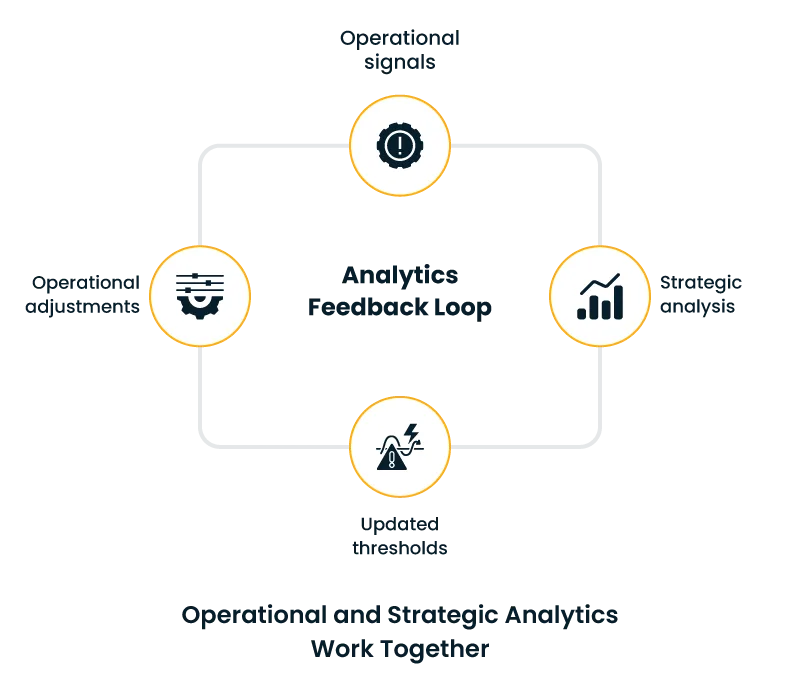
Circular workflow diagram with four icons around a central alert—gear for operations, chart for analytics, warning for risk, and a central notification.

Build an Analytics Program That Covers the Full Decision Spectrum 

Enterprises that run operational analytics and strategic analytics as a single undifferentiated function tend to find that neither performs as well as it should. Operational teams wait too long for the data they need in minutes. Strategy teams work with data that was never designed for longitudinal analysis. 

A well-structured analytics program does the following:  

Defines the boundary between these two types clearly 

Invests in the right infrastructure for each 

Uses analytics decision frameworks to keep them connected at the governance level 

If your organization is managing large-scale data operations, analytics investments may not always lead to consistent decision quality. This often points to gaps in how data is structured. The way operational and strategic data is separated and governed is worth examining closely. 

FAQs 

What is the difference between operational and strategic analytics? 

Operational analytics supports decisions made within the current operating window, using data from transactional systems. Strategic analytics supports decisions about organizational direction by using historical and aggregated data, modelled for pattern recognition and forecasting. The difference reflects two distinct categories of business questions with different urgencies, data requirements, and stakeholder groups. 

Can the same data platform support both operational and strategic analytics? 

A single platform can house both, but the workloads should run on separate layers within it. Mixing operational and strategic query patterns on shared infrastructure leads to resource contention and latency issues. Modern lakehouse architectures with distinct serving layers for real-time and analytical workloads can support both types effectively when the separation is designed from the start. 

What does real-time operational reporting typically include? 

Real-time operational reporting covers the outputs that operations and engineering teams monitor continuously. Common examples include: 

•        Live production system health dashboards 

•        Threshold-based alerts for latency, error rates, or capacity breaches 

•        SLA compliance tracking at the ticket or transaction level 

•        Inventory and capacity scorecards refreshing at short intervals 

The defining characteristic is that these reports drive an immediate response, not a periodic planning review. 

How do analytics decision frameworks help enterprises? 

Analytics decision frameworks provide the governance structure that connects analytics outputs to the decisions they are meant to inform. They define which metrics belong to which decision layer, how operational signals escalate into strategic reviews, and what data standards apply to each output type. Without that structure, analytics programs tend to produce reports that are technically accurate but organizationally disconnected from the decisions that matter. 

How should enterprises prioritize investment between operational and strategic analytics? 

The right balance depends on the organization’s current state. Enterprises with significant operational complexity or customer-facing SLA commitments typically need stronger investment in the operational layer first. Organizations where competitive differentiation depends on forecasting or long-term trend analysis need stronger investment in the strategic analytics layer. Most mature enterprises need both running reliably, which is why the architectural separation between the two is worth getting right early. 

Author

Yogita Jain Linkedin
Yogita Jain
Content Lead

Yogita Jain leads with storytelling and Insightful content that connects with the audiences. She’s the voice behind the brand’s digital presence, translating complex tech like cloud modernization and enterprise AI into narratives that spark interest and drive action. With a diverse of experience across IT and digital transformation, Yogita blends strategic thinking with editorial craft, shaping content that’s sharp, relevant, and grounded in real business outcomes. At Cygnet, she’s not just building content pipelines; she’s building conversations that matter to clients, partners, and decision-makers alike.

Related Blog Posts

What Is Data Management? Fundamentals, Benefits, and Challenges

CalendarMay 29, 2025

The Future of AI-Driven Data Visualization in Business

CalendarMay 22, 2025

Why Is Data Product Thinking Transforming Enterprise Analytics Teams? 

CalendarApril 14, 2026

Sign up to our Newsletter

    Latest Blog Posts

    Semantic Data Layers: The Missing Link Between Data Warehouses and Business Users 
    Semantic Data Layers: The Missing Link Between Data Warehouses and Business Users 

    CalendarApril 20, 2026

    Data Observability: Why Modern Data Teams Need Visibility into Pipeline Health 
    Data Observability: Why Modern Data Teams Need Visibility into Pipeline Health 

    CalendarApril 20, 2026

    How New Jersey Enterprises Are Using Advanced Analytics for Cost Optimization?
    How New Jersey Enterprises Are Using Advanced Analytics for Cost Optimization?

    CalendarApril 20, 2026

    Let’s level up your Business Together!

    The more you engage, the better you will realize our role in the digital transformation journey of your business


      I agree to the Terms & Conditions and Privacy Policy and allow Cygnet.One (and its group entities) to contact me via Promotional SMS / Email / WhatsApp / Phone Call.*

      I agree to receive occasional product updates and promotional messages from Cygnet.One (and its group entities) on Promotional SMS / Email / WhatsApp / Phone Call.

      I agree to receive service-related messages from Cygnet.One, including account updates, notifications, and support-related communications via SMS, email, or phone call.

      I agree to receive promotional SMS messages from Cygnet.One. Message and data rates may apply. Reply STOP to opt out.

      Cygnet.One Locations

      India India

      Cygnet Infotech Pvt. Ltd.
      2nd Floor, The Textile Association of India,
      Dinesh Hall, Ashram Rd,
      Navrangpura, Ahmedabad, Gujarat 380009

      Cygnet Infotech Pvt. Ltd.
      6th floor, A-wing Ackruti Trade Center,
      Road number 7, MIDC, Marol,
      Andheri East, Mumbai-400093, Maharashtra

      Cygnet Infotech Pvt. Ltd.
      WESTPORT, Urbanworks,
      5th floor, Pan Card Club rd.,
      Baner, Pune, Maharashtra 411045

      Cygnet Infotech Pvt. Ltd.
      10th floor, 73 East Avenue,
      Sarabhai campus, Vadodara, 391101

      Global

      CYGNET INFOTECH LLC
      125 Village Blvd, 3rd Floor,
      Suite 315, Princeton Forrestal Village,
      Princeton, New Jersey- 08540

      CYGNET DIGITAL IT SOLUTION LLC
      Office 707, Magnum Opus Tower,
      Al Thanyah First, Dubai, U.A.E,
      P.O. Box 125608

      CYGNET INFOTECH PRIVATE LIMITED
      Level 35 Tower One,
      Barangaroo, Sydney, NSW 2000

      CYGNET ONE SDN.BHD.
      Unit F31, Block F, Third Floor Cbd Perdana 3,
      Jalan Perdana, Cyber 12 63000 Cyberjaya Selangor, Malaysia

      CYGNET INFOTECH LIMITED
      C/O Sawhney Consulting, Harrow Business Centre,
      429-433 Pinner Road, Harrow, England, HA1 4HN

      CYGNET INFOTECH PTY LTD
      152, Willowbridge Centre,
      39 Cronje Drive, Tyger Valley,
      Cape Town 7530

      CYGNET INFOTECH BV
      Peutiesesteenweg 74, Machelen (Brab.), Belgium

      Cygnet One Pte. Ltd.
      160 Robinson Road,
      #26-03, SBF Centre,
      Singapore – 068914

      • Explore more about us

      • Download Corporate Deck
      • Terms of Use
      • Privacy Policy
      • Contact Us
      © Copyright – 2026 Cygnet.One
      We use cookies to ensure that we give you the best experience on our website. If you continue to use this site we will assume that you are happy with it.

      Cygnet.One AI Assistant

      ✕
      AI Assistant at your help. Cygnet AI Assistant