




































Schema changes mid-migration is not edge cases. They are one of the most consistent reasons for schema evolution data migration projects to stall or require expensive rework.
As this happens, the source system keeps changing while data is actively moving. This means pipelines built for one schema version break when that version shifts in modern data engineering environments.
This blog covers why that happens and the strategies that actually keep continuous migrations running when schemas change underneath them.
What Is Schema Evolution in the Context of Data Migration?
Schema evolution is the process by which a database schema changes over time within data management practices. In this, new application requirements are supported as:
- Fields get added
- Data types get altered
- Columns get removed
- Tables get restructured
In a one-time migration, schema changes are planned in advance, and the pipeline is built around a fixed schema state. In continuous data migration, there is no fixed state. The source schema keeps evolving while data is actively moving to the target. The pipeline has to keep up with every change without breaking, dropping records, or loading incorrect values.
The challenge here is that pipelines are rarely built to handle those changes gracefully.
Why Does Schema Evolution Happen During Active Migration Projects?
Long-running migrations create a window during which the source system continues operating normally. Application teams keep shipping. That means schema changes keep happening — independent of the migration timeline.
Four specific triggers drive schema changes during active migrations:
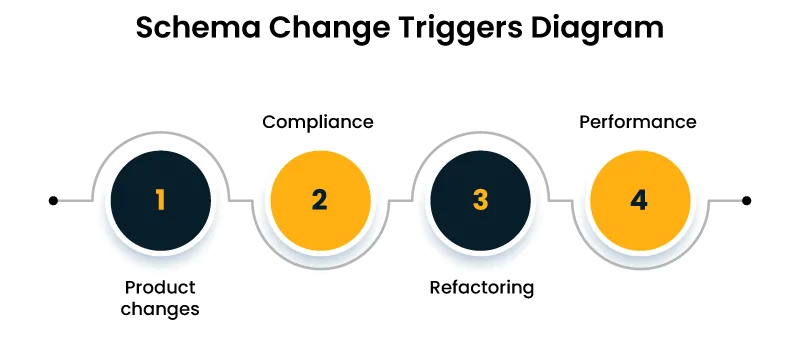
- Product development: New features require new fields, new tables, or restructured relationships in the source database
- Compliance changes: Regulatory updates force data type changes — a field storing a national ID number may need to expand from VARCHAR(10) to VARCHAR(20) to accommodate new formats
- Legacy refactoring: Technical debt cleanup renames columns, splits tables, or removes deprecated fields that pipelines depend on
- Performance optimization: Index restructuring and table partitioning changes alter how data is stored and accessed at the schema level
The longer a migration runs, the higher the probability that at least one of these triggers produces a breaking schema change. A migration spanning six months will almost certainly encounter several.
What Makes Schema Evolution Particularly Difficult in Continuous Migration Projects?
Pipelines Break on Undeclared Changes
A pipeline extracting a field called “customer_tier” breaks the moment that field is renamed “account_tier” in the source. The pipeline receives no notification. It either fails outright or silently loads null values into the target, which looks like valid empty data until someone runs a report and the numbers do not add up.
Continuous data migration pipelines process data in real time or near-real time, requiring strong data quality management. A schema change in the source propagates as an error across every downstream system almost immediately. There is no buffer to catch it before it causes damage.
Target Systems Fall Out of Sync
When a new field is added to the source and the target schema has not been updated, that field’s data goes missing from every record processed after the change. When a field is removed from the source, the target retains a column receiving no input, creating silent nulls that are indistinguishable from intentionally empty values.
Schema evolution data migration events that go undetected create source-to-target divergence that compounds with every batch processed after the change.
Versioning Becomes Unmanageable Without a System
Without data schema versioning, there is no reliable record of what the schema looked like when each data batch was processed. Debugging a discrepancy six weeks after a schema change, with no version history, means reconstructing the schema state from memory, application logs, and developer recollection. That process is slow, unreliable, and expensive.
What Are the Most Effective Schema Evolution Strategies in Data Engineering?
This is where preparation separates migrations that stay on track from those that require expensive recovery work.
These five schema evolution strategies in data engineering hold up at enterprise scale when supported by data engineering services.
1. Schema Registry Implementation
A schema registry is a centralized repository that stores and versions every schema definition a pipeline uses. Tools like Apache Confluent Schema Registry and AWS Glue Schema Registry validate incoming data against a registered schema before the pipeline processes it.
When a schema change is detected, the registry flags it. The pipeline does not process data blindly against a schema it was not built for.
What a schema registry prevents:
- Silent null loading from renamed or removed fields
- Type mismatch errors that corrupt numeric or datetime values
- Undetected field additions that go missing from the target
Migrations that skip schema registry implementation rely on manual detection without data migration services. At the speed and volume of enterprise pipelines, manual detection is always too slow.
2. Backward and Forward Compatibility Rules
Backward compatibility data pipelines are designed to process data produced by a newer schema version without breaking existing consumers. Not every schema change requires a compatibility rule, but knowing which changes are safe and which are breaking determines how the pipeline responds.
| Change Type | Backward Compatible | Pipeline Action Required |
| New optional field added | Yes | None — existing pipelines ignore it |
| Field widened (VARCHAR 50 → 100) | Yes | None |
| Required field removed | No | Pipeline pause, contract review |
| Field renamed | No | Mapping update before resuming |
| Data type changed to incompatible format | No | Full pipeline update required |
Defining these rules before migration begins is what keeps response time short when a change does happen.
3. Schema Versioning With Explicit Version Control
Every schema change gets a version number. Every data batch gets tagged with the schema version it was produced under. Data schema versioning allows pipelines to process historical batches correctly even after the current schema has moved forward.
Schema version control techniques follow the same logic as software version control:
- No schema change is deployed without a version increment
- Every version increment includes a documented changelog
- The changelog records what changed, when, who approved it, and what pipeline response was required
A dedicated schema version repository gives the migration team a single source of truth for every schema state the pipeline has ever operated under.
4. Additive-Only Schema Change Policy During Migration Windows
This policy restricts what kinds of schema changes are permitted while a migration is actively running. New fields can be added. Existing fields cannot be removed, renamed, or have their data types changed to incompatible formats during active migration windows.
Destructive changes – removals, renames, breaking type changes – are queued and applied only during defined maintenance windows when the pipeline can be safely paused, updated, and restarted.
Two things this policy does not do:
- It does not eliminate schema evolution
- It does not require application teams to stop shipping
It controls when and how breaking changes reach the pipeline. That is enough to prevent the majority of mid-migration failures caused by schema changes.
5. Contract Testing Between Producers and Consumers
A schema contract defines exactly what a producer system outputs and what a consumer pipeline expects to receive within data analytics consulting services. When the producer changes its output, the contract test fails before the change reaches production.
Contract testing moves schema change detection from the pipeline layer to the development layer. A breaking change is caught when a developer runs tests, not when a live pipeline drops records at 2 AM.
Tools like Pact and Spring Cloud Contract support producer-consumer contract testing for data pipelines. At enterprise scale, contract testing is the most cost-effective way to prevent breaking schema changes from reaching a live continuous data migration pipeline.
How Do You Handle Schema Changes During Migration Without Breaking Pipelines?
How to handle schema changes during migration reliably requires two things running in parallel: automated detection and a defined classification response.
Detection runs at the extraction layer. Schema diff tools compare the current source schema against the last registered version before every pipeline run. When a difference is found, an automated alert notifies the migration team before the pipeline processes the next batch.
Classification determines the response:
| Change Type | Description | Pipeline Behavior | Action Required |
| Additive Change | New optional field added | Pipeline continues | Target schema updated in the next maintenance window |
| Non-breaking Type Change | Field widened with no risk of data loss | Pipeline continues without modification | No immediate action required |
| Breaking Change | Field removed, renamed, or changed to an incompatible type | Pipeline pauses | Contract reviewed and target schema updated before resuming |
Every classification decision gets logged — timestamp, change description, responsible team member, and resolution action. Backward compatibility data pipelines depend on this log to process historical data correctly after the current schema has moved forward.
What Best Practices Keep Continuous Migrations Schema-Resilient Over Time?
Three practices separate migrations that handle schema evolution systematically from those that respond to it reactively.
Build schema awareness into the pipeline architecture from day one
Pipelines that are not schema-aware require manual intervention every time the source schema changes. Schema-aware pipelines read the version tag on each incoming batch and apply the correct transformation rules automatically. Retrofitting this capability into an existing pipeline costs significantly more time than building it in from the start.
Separate schema version history from application code history
A schema change that breaks a pipeline is much faster to diagnose when schema history is isolated in its own repository. Data schema versioning in a dedicated repository gives the migration team a clean audit trail without having to sort through application commits to find the relevant change.
Run schema compatibility tests before every source system deployment
Every application release that touches the source database should trigger an automated compatibility test against the migration pipeline before it reaches production. This test catches breaking schema changes at the development stage before they affect a single live record.
Why Do Enterprise Teams Struggle to Manage Schema Evolution on Their Own?
Most internal teams hit the same walls:
- Application and migration teams operate on different release cadences — schema changes land without warning
- Internal pipelines are built to move data, not to handle schema evolution across a multi-month project
- Retrofitting schema registries and versioning into an existing pipeline introduces its own failure risk
- Schema-aware pipeline design is a skill most internal teams encounter for the first time on the migration itself
The response is almost always reactive. By the time the team responds, the pipeline has already failed.
Cygnet.One’s services build schema resilience into the migration architecture from day one with registry configuration, compatibility rules, and automated monitoring included.
The Real Cost of Treating Schema Evolution as an Afterthought
Schema evolution data migration is not a problem that resolves itself. Every undetected schema change that reaches a live pipeline produces records that are missing fields, carrying wrong values, or breaking referential integrity downstream.
What determines whether a continuous migration handles schema evolution reliably is whether the strategies are built into the pipeline architecture before the first schema change happens.
Author


Yogita Jain
Content Lead
Yogita Jain leads with storytelling and Insightful content that connects with the audiences. She’s the voice behind the brand’s digital presence, translating complex tech like cloud modernization and enterprise AI into narratives that spark interest and drive action. With a diverse of experience across IT and digital transformation, Yogita blends strategic thinking with editorial craft, shaping content that’s sharp, relevant, and grounded in real business outcomes. At Cygnet, she’s not just building content pipelines; she’s building conversations that matter to clients, partners, and decision-makers alike.