

































A surprising amount of enterprise IT waste never appears in a failed project review. It hides in inactive SaaS seats, forgotten laptops sitting in storage rooms, duplicated endpoint contracts, and infrastructure renewals nobody questioned because “the business still needs it.” Most finance leaders notice the damage too late, usually during budget resets or vendor audits. By then, the spending pattern has already been baked into operations.
That is why IT asset lifecycle management has shifted from an operational process into a board-level financial discipline. The conversation is no longer about keeping an inventory spreadsheet updated; it is about how managed IT services improve visibility, ownership, and lifecycle control. It is about controlling recurring spend before it compounds across procurement, support, licensing, security, and disposal.
The pressure is real. Flexera’s 2025 State of ITAM Report found that only 43% of organizations reported complete visibility across their technology stack, a drop from the previous year. At the same time, enterprises are facing higher software subscription costs, AI-driven infrastructure purchases, and tighter scrutiny from CFOs.
An effective IT asset management strategy now sits at the center of operational discipline. The companies controlling technology spend in 2026 are not necessarily buying less technology. They are managing timing, usage, ownership, and retirement with more precision.
Why Asset Lifecycle Discussions Usually Start Too Late
Most enterprises still treat asset ownership as a procurement event. Buy a laptop. Assign the software. Renew the contract. Move on. That mindset creates blind spots.
The actual financial impact begins after deployment. Support costs rise unevenly. Devices stay active long after productive life ends. Teams continue paying for licenses tied to former employees. Security tools overlap because no one mapped functional duplication during procurement.
This is where IT asset lifecycle management changes the equation. Instead of treating hardware and software as static purchases, it treats them as operational assets with measurable financial behavior from acquisition to retirement.
The strongest IT asset management strategy does something many organizations avoid: it forces finance, security, procurement, and IT operations into the same conversation before spending decisions happen.
The Cost Drivers Most IT Teams Underestimate
There is a tendency to focus only on procurement pricing. That is incomplete. Hardware and software costs expand through maintenance, downtime, license misuse, poor refresh timing, and fragmented ownership.
Here are the cost drivers that quietly drain budgets inside large enterprises:
| Cost Driver | What Usually Happens | Financial Effect |
| Overlapping SaaS platforms | Multiple teams buy similar tools | Duplicate subscription spend |
| Delayed hardware retirement | Aging devices remain active | Higher support and failure costs |
| Inactive user licenses | Licenses stay assigned after role changes | Recurring waste every quarter |
| Poor vendor renewal reviews | Contracts auto-renew without usage analysis | Long-term overspending |
| Untracked shadow IT | Departments purchase tools outside governance | Compliance and audit risk |
| Reactive endpoint replacement | Devices fail before refresh planning | Emergency procurement costs |
This is exactly how optimizing IT cost assets becomes more than a finance phrase. It becomes an operational discipline.
A mature IT asset management strategy tracks utilization patterns instead of relying on assumptions, using stronger business intelligence for renewal and usage decisions. That distinction matters. Assumptions create renewal waste. Usage data creates negotiation power.
Asset Lifecycle Stages That Actually Influence Financial Control
Most frameworks describe procurement, deployment, maintenance, and retirement. Useful, but incomplete.
The real issue inside enterprise IT asset lifecycle programs is decision timing. The timing of replacement, license reduction, and support termination.
An enterprise running effective IT asset lifecycle management reviews assets through six financial checkpoints:
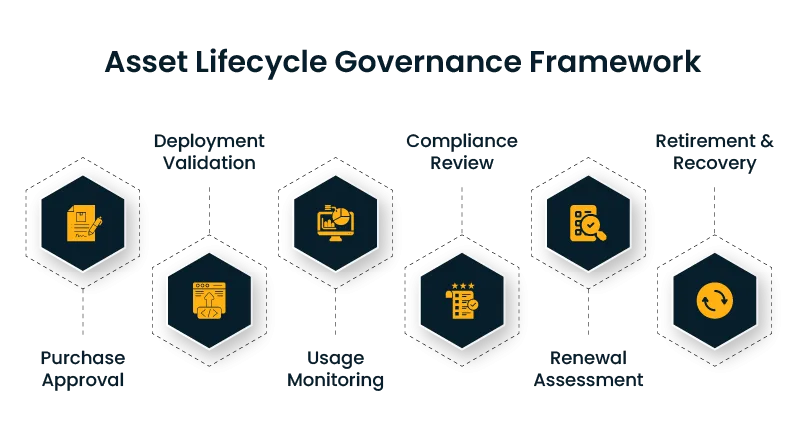
- Business justification before purchase
- Usage validation after deployment
- Quarterly utilization analysis
- Security and compliance review
- Renewal risk assessment
- Disposal and recovery tracking
Another issue many companies ignore is managing hardware and software lifecycles together instead of managing them separately. Hardware refresh decisions directly affect software supportability, endpoint security posture, and help desk costs. Treating them as isolated categories creates fragmented spending patterns.
The companies reducing operational waste fastest in 2026 are managing hardware and software lifecycles as one connected process rather than separate administrative functions.
Why Visibility Still Fails in Mature Enterprises
Most enterprises already own monitoring platforms, CMDB systems, procurement tools, and discovery agents, but weak cloud infrastructure management still creates visibility gaps. Yet visibility gaps remain everywhere.
Why? Because data ownership is fragmented. Procurement tracks purchasing. Security tracks endpoints. Finance tracks invoices. IT tracks deployment. Nobody owns the full operational picture. That is why IT asset tracking tools fail when they are deployed as inventory systems instead of decision systems.
A modern IT asset management strategy connects three layers of information:
- Financial usage data
- Technical utilization data
- Contract and renewal data
Without those three layers connected, organizations cannot identify underused assets before renewal cycles begin.
Effective IT asset lifecycle management depends less on data volume and more on action triggers. The strongest IT asset tracking tools are tied directly to procurement workflows, identity systems, and service management platforms through Enterprise AI solutions. Otherwise, asset visibility becomes outdated almost immediately.
Cost Optimization Is Now an Operational Discipline
The phrase ‘IT cost optimization assets’ often gets reduced to budget cutting. That approach usually backfires because teams start delaying upgrades and reducing support coverage.
Real optimization is different. It focuses on lifecycle timing, asset utilization, and contract positioning. A mature IT asset lifecycle management program reduces waste in four practical ways:
1. Rightsizing Software Commitments
Many enterprises still buy licenses based on projected growth instead of verified usage. That creates recurring excess spend. Quarterly usage audits create cleaner renewal discussions with vendors.
2. Extending Useful Hardware Life Carefully
Not every device requires replacement at the same interval. Some systems remain operationally stable longer than expected. Others become security liabilities earlier than planned. Refresh decisions should follow usage risk, not fixed calendar assumptions.
3. Standardizing Procurement Categories
Too many enterprises support five tools where two would cover operational needs. Standardization lowers training, support, and integration overhead.
4. Recovering Value During Retirement
Retired assets still carry recoverable value through resale, component reuse, or secure redeployment. Disposal without recovery planning wastes budget twice.
This is where IT cost optimization assets become tightly connected to governance rather than isolated cost-cutting exercises.
Renewal Planning Is the Part Most Enterprises Still Get Wrong
Renewals create some of the largest avoidable expenses inside enterprise IT. The problem is timing. Most renewal reviews happen too close to contract expiration. That leaves no room for utilization analysis, negotiation preparation, or workload migration.
An effective IT asset management strategy begins renewal planning at least six months before contract deadlines. That process should answer five questions:
| Renewal Question | Why It Matters |
| Are teams actively utilizing the platform? | Identifies inactive spend |
| Does another approved platform already provide similar capability? | Prevents duplication |
| Has vendor pricing changed materially? | Protects budget planning |
| Is support quality still acceptable? | Measures operational value |
| Does the asset still align with business priorities? | Prevents legacy carryover |
This is another area where enterprise reviews of IT asset lifecycle stages matter. Renewal planning should never happen independently from utilization analysis.
The strongest procurement leaders now treat renewals as strategic checkpoints rather than administrative tasks.
Governance Decides Whether ITAM Creates Savings or Noise
Many enterprises launch ambitious ITAM programs that collapse into reporting exercises within a year. The issue is rarely tooling. It is governance ownership.
Effective IT asset lifecycle management requires clear operational accountability across procurement, finance, cybersecurity, legal, and infrastructure teams.
That governance model should define:
- Who approves asset purchases
- Who validates utilization
- Who reviews renewals
- Who tracks retirement and disposal
- Who handles audit readiness
Without accountability, the entire process drifts into spreadsheet management.
An effective IT asset management strategy also needs executive visibility. When ITAM operates only inside infrastructure teams, cost decisions remain disconnected from business planning.
Some financial services companies created a simple rule that changed their spending behavior completely: no software renewal moved forward without utilization evidence attached to the request. Within one year, they removed multiple overlapping tools that nobody previously questioned because contracts renewed automatically.
That example matters because reducing IT asset costs for enterprise programs is rarely dependent upon one dramatic initiative. Most savings come from operational discipline applied consistently across small decisions.
The same applies to evaluating enterprise assets around hardware retirement, software usage, and vendor consolidation. Consistency matters more than complexity.
Closing Thoughts
Enterprise IT environments became harder to manage the moment technology spending shifted from periodic purchases to recurring operational commitments.
That changed the economics completely.
Today, IT asset lifecycle management is no longer about tracking equipment. It is about controlling financial exposure across software subscriptions, infrastructure refreshes, support contracts, endpoint security, and vendor renewals.
The companies building stronger operational control in 2026 are not chasing more dashboards. They are building decision systems tied directly to accountability, timing, and measurable usage.
That is the real purpose of an effective IT asset management strategy. Not inventory. Control. And when done properly, IT cost optimization stops being a quarterly budgeting exercise and starts becoming part of everyday operational decision-making.
Strong governance keeps cost optimization efforts tied to measurable business outcomes instead of temporary budget reductions. Mature procurement teams now connect these initiatives directly to renewal timing, utilization analysis, and vendor accountability. When executives review recurring technology spend carefully, asset optimization becomes an integrated core of financial planning rather than an emergency response.
Author


Yogita Jain
Content Lead
Yogita Jain leads with storytelling and Insightful content that connects with the audiences. She’s the voice behind the brand’s digital presence, translating complex tech like cloud modernization and enterprise AI into narratives that spark interest and drive action. With a diverse of experience across IT and digital transformation, Yogita blends strategic thinking with editorial craft, shaping content that’s sharp, relevant, and grounded in real business outcomes. At Cygnet, she’s not just building content pipelines; she’s building conversations that matter to clients, partners, and decision-makers alike.