

































One weak vendor handoff can make a mature IT function look careless. The incident may begin with a missed patch, an unclear escalation path, a delayed access removal, or a cloud provider ticket sitting between two partners. When the issue reaches leadership, the technical fault is usually only part of the story. The deeper failure is unclear ownership. It is usually a missing operating model.
This is why IT vendor management has moved beyond procurement and renewal tracking. Enterprises now run core operations through software providers, cloud platforms, managed service providers, cybersecurity partners, SaaS vendors, network carriers, implementation firms, and niche support teams.
- The 2025 Verizon Data Breach Investigations Report found that third-party involvement in breaches doubled from 15% to 30%.
- IBM’s 2025 Cost of a Data Breach Report also placed third-party vendor and supply chain compromise among the costliest breach sources, with an average cost of USD 4.91 million.
Strong technology vendor governance gives the enterprise a way to control that risk without turning partner management into paperwork. The goal is simple: know who owns what, how work moves, where risk sits, and how performance will be judged when several partners touch the same outcome.
Vendor Management Challenges Enterprises Face
Most vendor issues do not start with a bad supplier. They start with a loose design. A vendor is hired to fix tickets. Another manages endpoints. A cloud partner owns infrastructure. A security provider monitors alerts. A SaaS vendor owns the product. This is where IT vendor management becomes difficult. The enterprise may have strong individual contracts yet still lack one operating view across partners, making enterprise managed IT services important for service coordination and accountability. When an incident crosses tools, platforms, and teams, people begin searching for the owner instead of solving the issue.
This is also where how to manage multiple IT vendors becomes a leadership question. The answer is not more meetings. It is a cleaner accountability system.
Accountability Gaps Across Tools, Partners, and Platforms
A good vendor accountability model removes this gap by assigning ownership at three levels: service outcome, technical domain, and task execution.
| Accountability layer | What it controls | Typical owner |
| Service outcome | Availability, user impact, recovery priority | Enterprise IT |
| Technical domain | Cloud, endpoint, network, security, application | Named vendor or internal team |
| Task execution | Ticket action, patch, change, access update | Assigned resolver |
| Risk acceptance | Delay, exception, control gap | Business and IT leadership |
This structure strengthens technology vendor governance and keeps managed service integration honest because it prevents a familiar excuse: “That part sits with another provider.” A vendor can own a component. The enterprise must own the service chain.
SLA Governance Across Vendors
A vendor SLA can look healthy while the business service fails. One provider responds within 30 minutes. Another waits for logs. A third says the request lacks the right severity. This is why SLA governance across vendors must measure service movement, not only vendor response. Response time matters, but resolution quality, handoff delay, repeat incidents, and exception age often tell the real story.
A practical SLA model should separate four measures:
- Response: How quickly the vendor acknowledges the issue.
- Restoration: How quickly the affected service returns.
- Handoff: How much time is lost between teams.
- Prevention: Whether the root cause comes back.
This is where service integration and management becomes necessary. It creates one service view across vendors, so reporting reflects user experience, not supplier silos.
Escalation Paths Should Be Designed Before Incidents
Escalation cannot depend on who knows whom. Personal channels help during pressure, but they are not governance. They fail when account managers change, engineers rotate, or the issue happens outside normal hours.
Effective technology vendor governance defines escalation by severity, service, risk, and time. It also names who can make decisions when evidence is incomplete.
This is a core part of IT vendor risk management. Risk does not appear only during onboarding. It appears when the enterprise cannot force timely action during disruption.
Reporting That Shows Risk, Not Just Activity
Many vendor reports are clean and useless. They show ticket counts, average response times, SLA percentage, and monthly activity. Better reporting connects vendor performance to service risk. It should show where issues repeat, where handoffs stall, where access exceptions remain open, and where one vendor’s delay affects another vendor’s delivery.
| Report view | Weak version | Better version |
| Ticket volume | 1,240 tickets closed | Top recurring failure types by business service |
| SLA | 98% met | Breaches by service impact and handoff delay |
| Risk | Open vendor risks | Risks with owner, age, decision needed |
| Access | Users provisioned | Privileged access exceptions and removal delays |
This is where managed service integration becomes useful for leadership. It creates a shared operating view across providers, instead of forcing each vendor to defend its own dashboard.
For regulated or high-dependence environments, third party IT risk reporting should also include subcontractors, offshore support access, data handling, incident notification terms, and evidence retention.
Ownership Must Be Written Into the Operating Model
Contracts matter, but operating models decide how work actually moves. If ownership lives only in legal language, support teams will interpret it differently during incidents.
A working ownership model should define the business service owner, vendor service owner, internal technical owner, security owner, escalation approver, change approver, and risk acceptance owner.
This keeps IT vendor management grounded in daily operations. It also reduces the common gap between procurement success and service delivery reality.
For example, a cloud infrastructure partner may manage servers, but the enterprise may retain responsibility for identity policy. A SaaS provider may secure the application layer, while internal IT owns user lifecycle controls. A managed service provider may operate the queue, while the enterprise owns priority rules.
Vendor Scorecards That Change Behavior
Effective scorecards combine performance, risk, relationship quality, and improvement actions. They should also include internal dependencies.
| Scorecard area | What to measure |
| Service performance | SLA trend, repeat incidents, backlog age |
| Risk posture | Open risks, audit findings, control exceptions |
| Collaboration | Handoff quality, evidence quality, escalation behavior |
| Commercial health | Scope creep, change volume, renewal risk |
This is where managed service integration should connect vendor performance to business service health. A provider that closes tickets quickly but leaves recurring issues unresolved should not receive a strong score.
Scorecards also help with technology vendor governance and managed service integration because they show where one partner’s behavior affects another partner’s performance.
Governance Framework for Multiple Technology Partners
A practical framework for technology vendor governance and managed service integration should be light enough to run and strict enough to matter. A better framework has five working layers.
1. Vendor segmentation
Classify vendors by business dependency, data access, operational role, and replacement difficulty. A payroll platform, endpoint security provider, identity vendor, and cloud support partner do not carry the same risk as a design tool. This makes third party IT risk visible before renewal time.
2. Shared service map
Map each business service to the vendors, tools, data flows, access paths, and internal owners behind it. This improves how to manage multiple IT vendors because teams can see the delivery chain before something breaks.
3. Integrated control calendar
Track audits, access reviews, contract renewals, DR tests, penetration tests, policy reviews, and certificate renewals in one calendar. This prevents control work from becoming vendor-by-vendor chaos.
4. Decision rights
Define who can approve exceptions, emergency changes, risk acceptance, and vendor escalation. Without decision rights, managed service integration becomes coordination without authority.
5. Quarterly service review
Use quarterly reviews to discuss incidents, risk, cost pressure, upcoming changes, and unresolved ownership gaps. Do not let the review become a vendor presentation. Use it to review open issues, assign owners, and close decisions.
This framework improves IT vendor risk management because it treats risk as an operating condition, not a procurement checkpoint.
Service Integration Without More Noise
Many enterprises hear service integration and management and think of another management layer. That concern is fair. A poorly designed model can add meetings, dashboards, and process drag.
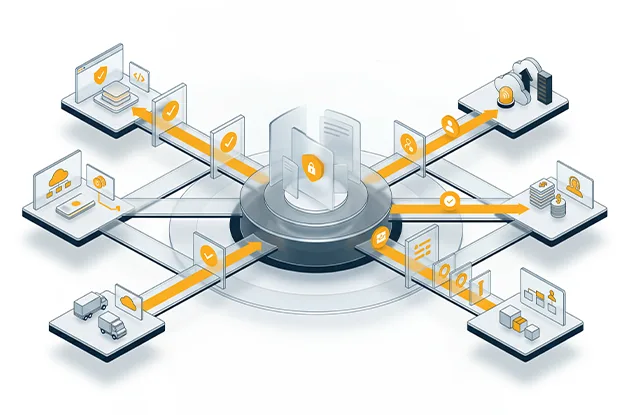
The useful version is simpler. It creates one front door for service performance, one view of risk, one escalation model, and one set of rules for vendor handoffs. It does not replace specialist vendors. It makes them work as part of one delivery system.
This matters most when enterprises depend on multiple managed providers. Managed service integration gives internal IT a way to retain control without rebuilding every capability in-house, which is why leaders often compare managed IT vs in-house IT before changing operating models.
That last point is where many enterprises lose control. The gap between vendors is where delays, duplicated work, security exceptions, and user frustration build quietly.
Conclusion: Control Comes From Operating Discipline
Enterprises do not reduce vendor risk by adding more suppliers, more dashboards, or longer contracts. They reduce it by making ownership visible and enforceable.
IT vendor management must be visible in operating routines, not buried in contract files.
Strong IT vendor management starts with a clear map of who supports each business service. It matures through scorecards, escalation rules, evidence standards, access reviews, and decision rights.
The practical test is simple. When a serious incident crosses three vendors, can the enterprise identify the owner, gather evidence, escalate quickly, protect access, and avoid unnecessary IT downtime?
If the answer is no, the enterprise has a governance gap. Strong technology vendor governance closes that gap by naming owners before pressure arrives.
A clean vendor accountability model gives every partner a defined role. Mature service integration keeps handoffs visible. Mature IT vendor management turns a crowded vendor ecosystem into a controlled service network, where partners remain useful because accountability is built into the work.
Author


Yogita Jain
Content Lead
Yogita Jain leads with storytelling and Insightful content that connects with the audiences. She’s the voice behind the brand’s digital presence, translating complex tech like cloud modernization and enterprise AI into narratives that spark interest and drive action. With a diverse of experience across IT and digital transformation, Yogita blends strategic thinking with editorial craft, shaping content that’s sharp, relevant, and grounded in real business outcomes. At Cygnet, she’s not just building content pipelines; she’s building conversations that matter to clients, partners, and decision-makers alike.