

































Enterprise IT environments have become operationally louder over the last few years. More telemetry. More dashboards. More alerts. More tooling layered across cloud workloads, APIs, endpoints, SaaS platforms, and distributed infrastructure.
Yet many outages still arrive as surprises — not because organizations lack monitoring, but because most support environments are still designed to react after disruption becomes visible. The real problem usually begins earlier — inside small behavioral shifts that look harmless in isolation but dangerous in combination across modern cloud infrastructure management environments.
A queue retry pattern changes slightly. Authentication latency rises in one region. A dependency starts timing out intermittently under a specific workload condition. Individually, none of these signals seem urgent. Together, they often mark the beginning of an incident.
At 2 AM, a payment service slowed down inside a retail environment that had already passed every dashboard check. CPU looked normal. Memory stayed within expected threshold. No outage alert fired. Yet transactions were backing up across regions because a queueing service had started retrying requests at abnormal intervals after a silent API timing drift.
The issue did not begin at 2 AM. That was simply the moment customers noticed it.
This is why proactive IT support is becoming a strategic conversation instead of a service desk upgrade, especially within modern managed IT services. Enterprises are recognizing that waiting for incidents to become visible is expensive.
New Relic’s 2025 observability research estimated the median cost of a high-impact outage at nearly $2 million per hour globally.
The discussion in 2026 is no longer about faster response alone. It is about reducing the number of incidents that require response in the first place. That is where IT incident prevention has shifted from theory into operational necessity.
Why Reactive Support Models Break in Modern Infrastructure
Reactive support was built for a different technology environment. A decade ago, infrastructure was comparatively stable. Fewer APIs. Fewer distributed dependencies. Smaller cloud footprints. Monitoring systems mainly tracked hardware failures, service crashes, and storage exhaustion.
That logic struggles inside modern enterprise systems. Today, a small authentication delay inside one SaaS dependency can trigger retries across dozens of services. A container orchestration change can create latency drift elsewhere. Teams end up diagnosing symptoms instead of causes.
This is where the discussion around proactive vs reactive IT support becomes operationally important. Reactive environments depend heavily on user-reported issues. Proactive environments depend on behavioral signals.
| Reactive Support Model | Proactive Support Model |
| Waits for alerts or tickets | Detects behavioral drift early |
| Focused on recovery | Focused on disruption avoidance |
| Tracks infrastructure health | Tracks service behavior patterns |
| Human-heavy diagnosis | Data-assisted analysis |
| Periodic reviews | Continuous operational analysis |
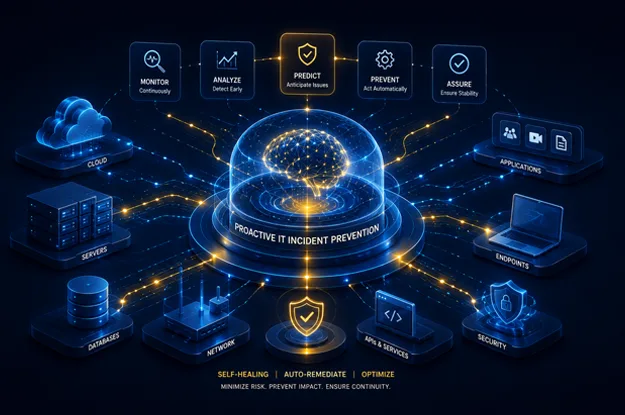
The strongest IT teams are now redirecting investment away from pure incident-response staffing and toward AI-powered analytics systems designed for IT incident prevention before customer impact appears. That shift is driving a new operational mindset around predictive IT operations.
Monitoring Changed. Most Support Teams Did Not
Traditional monitoring platforms were designed to answer a simple question: “Is the system available?”
Modern operations teams need answers to much harder questions:
- Why did latency rise only in one region?
- Which dependency caused retry storms across services?
- Why do failures appear after weekly reporting jobs?
- Which workload pattern usually appears before saturation?
This is where observability platforms started replacing passive monitoring frameworks. Metrics alone no longer provide enough operational context.
Enterprises now process massive telemetry streams simultaneously — logs, traces, infrastructure metrics, API timing data, user analytics, network paths, synthetic transactions, and queue behavior. The challenge is no longer collecting data. It is interpreting it correctly through data analytics consulting services.
That is why predictive IT operations has become central to enterprise support strategy. Instead of detecting failures after thresholds are breached, predictive systems identify patterns that resemble previous incidents.
| A reactive alert | A predictive model alert |
| CPU crossed 90% | This workload pattern usually precedes degradation within 25 minutes |
The difference changes response windows significantly.
Many enterprise teams now depend on predictive IT monitoring tools that combine anomaly detection, telemetry correlation, and historical incident analysis instead of relying only on static thresholds.
Interestingly, mature operations teams are reducing alert noise while improving detection accuracy. Most older alerts never mattered operationally.
Why Predictive Models Are Becoming Operational Infrastructure
Prediction in enterprise IT is rarely futuristic. It is pattern recognition backed by operational history.
A mature predictive engine might detect:
- Unusual database lock timing
- Authentication retries gradually increasing
- DNS lookup delays across regions
- Abnormal queue persistence
- Network latency correlation between unrelated services
Individually, these conditions may not justify escalation. Together, they often represent the opening stage of instability. This is where IT incident prevention becomes practical instead of theoretical. Strong predictive environments usually rely on three operational layers:
1. Historical Incident Correlation
Past incidents become training material. Systems learn recurring behavioral patterns instead of treating every anomaly equally.
2. Service Dependency Mapping
Modern outages spread through dependencies. Predictive systems track relationships between applications, APIs, cloud workloads, and third-party services.
3. Behavioral Baselines
Static thresholds fail because infrastructure behavior changes constantly. Predictive systems compare workloads against historical operating norms instead of fixed limits.
This approach explains why predictive IT operations is steadily replacing traditional NOC models across large enterprises. The goal is no longer visibility alone. The goal is earlier operational certainty.
Automation Is Becoming the First Line of Defense
One of the biggest misconceptions in enterprise IT is that automation exists mainly for efficiency. Increasingly, automation is becoming an incident reduction mechanism.
The strongest automation programs focus on removing recurring operational mistakes before they become outages.
Examples include:
- Restarting degraded services automatically
- Rotating certificates before expiration
- Isolating suspicious traffic patterns
- Expanding compute resources during abnormal load conditions
- Reverting failed deployments automatically
- Correcting configuration drift
This is where IT automation for incident prevention becomes operationally valuable. It reduces the gap between anomaly detection and corrective action.
Human teams matter deeply, and automation helps reduce response delays and operational inconsistency during high-pressure situations. Mature enterprises place automation inside strict guardrails. Nobody wants remediation systems shutting down production environments incorrectly.
| Automation Area | Operational Purpose |
| Certificate lifecycle management | Avoid expiration failures |
| Auto-remediation scripts | Correct recurring faults |
| Intelligent patch scheduling | Reduce vulnerability exposure |
| Dependency validation | Detect integration instability |
| Infrastructure policy enforcement | Prevent configuration drift |
This operational maturity is pushing proactive IT support far beyond traditional help desk models.
The Business Case Is Bigger Than Downtime Reduction
Technical teams discuss outages operationally. Executives discuss them financially.
They care about:
- Revenue interruption
- Customer retention risk
- SLA penalties
- Brand damage
- Regulatory exposure
- Productivity loss
That gap matters because many enterprises still underfund prevention while overspending on recovery.
Customers also notice instability immediately now. A slow checkout flow gets screenshotted within minutes. Banking users post outage reports publicly before escalation finishes. SaaS buyers interpret recurring instability as operational weakness.
That environment makes IT incident prevention strategically important far beyond IT departments.
The operational benefits of predictive IT operations now include:
- Reduced emergency escalations
- Lower alert fatigue
- Faster root-cause identification
- Better infrastructure planning
- Fewer customer-visible disruptions
- Improved compliance readiness
There is another advantage enterprises rarely discuss publicly: engineering retention.
Burned-out operations teams rarely stay inside permanently reactive environments.
Where Enterprises Are Seeing Results First
The strongest adoption patterns are appearing in industries where downtime creates immediate business consequences.
Financial Services
Banks are using predictive IT monitoring tools to detect transaction instability, API latency, and queue abnormalities before customer impact spreads.
Manufacturing
Production environments increasingly depend on proactive IT support because ERP interruptions now affect logistics, inventory movement, and supplier coordination simultaneously.
Healthcare
Healthcare providers are using IT automation for incident prevention to reduce downtime across patient systems, diagnostics, and scheduling platforms.
SaaS Platforms
Software companies are heavily investing in predictive IT operations because subscription businesses are highly sensitive to trust erosion caused by recurring instability.
This is where proactive vs reactive IT support becomes operationally obvious. Reactive teams spend most of their time recovering from incidents. Proactive teams spend more time reducing recurrence probability. That difference compounds over time.
Prevention Requires Operational Discipline
Successful prevention strategies depend on more than tooling alone. Operational alignment, governance, and process discipline play an equally important role. The strongest IT incident prevention strategies usually share several operational characteristics:
- Incident reviews focus on systemic correction instead of blame
- Dependency visibility remains continuous
- Telemetry stays centralized
- Automation policies are tested aggressively
- Alert thresholds are revised frequently
- Technical debt is treated as operational risk
Many organizations fail because they buy tooling before improving operational processes. Technology helps. Discipline matters more.
This is also why proactive IT support cannot exist as an isolated service desk initiative. It requires coordination across infrastructure teams, engineering groups, security operations, cloud administrators, and leadership.
The organizations doing this well increasingly treat operational stability as part of product quality.
Final Perspective!
Enterprise support models are changing because infrastructure risk changed first.
Modern outages rarely begin with catastrophic failure. They begin with weak signals buried inside telemetry streams that most teams still struggle to interpret correctly.
That reality is pushing enterprises toward proactive IT support built around behavioral analysis, automation, dependency awareness, and predictive decision-making.
The companies gaining operational stability are not waiting for users to report problems anymore. They are building systems designed for IT incident prevention before disruption spreads across customers, employees, or business operations.
This is why predictive IT operations has become more than an operational trend. It is becoming the foundation for how modern IT environments remain stable under growing complexity.
The future of enterprise support belongs to teams that can identify instability early, respond quietly, and prevent incidents from becoming business headlines.
Author


Yogita Jain
Content Lead
Yogita Jain leads with storytelling and Insightful content that connects with the audiences. She’s the voice behind the brand’s digital presence, translating complex tech like cloud modernization and enterprise AI into narratives that spark interest and drive action. With a diverse of experience across IT and digital transformation, Yogita blends strategic thinking with editorial craft, shaping content that’s sharp, relevant, and grounded in real business outcomes. At Cygnet, she’s not just building content pipelines; she’s building conversations that matter to clients, partners, and decision-makers alike.