

































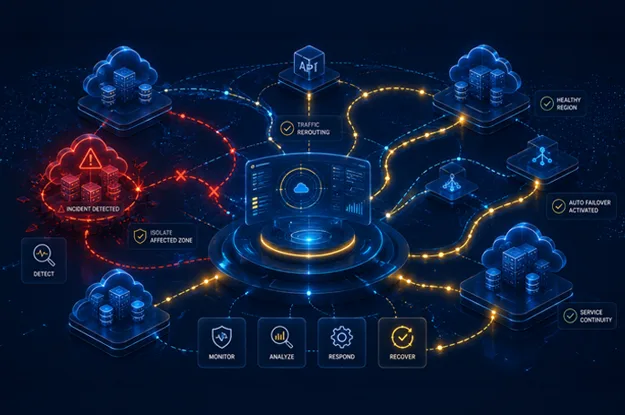
Every enterprise has a documented cloud incident management process. Fewer have one that holds up at 2 AM — when three services are simultaneously degraded, the initial alert missed the actual failing system, and four engineers in a war room cannot agree on what broke first.
The gap is what this post is about.
Distributed systems fail in ways that are rarely clean and almost never predictable, which makes cloud-native security critical. A configuration change pushed six hours ago. A third-party dependency quietly throttling requests. A memory leak so gradual that no single alert threshold caught it. By the time something is visibly broken, the actual cause is often two or three layers upstream.
SRE incident management has matured significantly as a discipline — but maturity on paper and maturity under pressure are different things. This is a practitioner’s view of how enterprise teams actually move through the incident lifecycle: what good detection looks like, where incident response cloud processes tend to break down, and what separates organizations that learn from failures from those that just survive them.
The Incident Lifecycle: What It Actually Looks Like in Production
Most incident lifecycle diagrams look clean on slides. Reality is messier. A single cloud incident management situation in a distributed environment can trigger alerts across six different services simultaneously, create three separate war rooms, and produce four conflicting hypotheses before anyone agrees on a severity level.
The canonical lifecycle still holds as a framework:
| Phase | What It Involves | Common Failure Points |
| Detection | Monitoring alerts, synthetic checks, customer reports | Alert fatigue, delayed thresholds, missing telemetry |
| Triage | Severity classification, impact scoping, team assembly | Misclassification, unclear ownership, slow escalation |
| Response | Mitigation, communication, war room coordination | Context switching, tool sprawl, poor runbook hygiene |
| Root Cause Analysis | Reviews, Five Whys, causal investigation | Blame culture, shallow analysis, incomplete data |
| Prevention | Action items, architectural changes, monitoring gaps | Items never actioned, no ownership, repeat incidents |
The gap between “having this process” and “executing it under pressure” is where enterprises lose the most time, especially when cloud infrastructure management is not mature. Effective incident response cloud coordination means reducing coordination overhead — assembling the team, finding context, switching tools — which typically consumes more time than the actual repair work. Automating responder assembly can meaningfully reduce coordination delays during the early stages of an incident.
Detection: The Window Nobody Wants to Miss
Detection speed is where cloud incident management often lives or dies, and cloud engineering services help strengthen observability and response workflows. The faster you know something is wrong, the smaller the blast radius.
Most enterprises rely on four detection sources, in roughly this order of reliability:
- Synthetic monitoring — Proactive transaction simulation that catches degradation before users feel it. Organizations using synthetic transaction monitoring typically detect issues much earlier than teams relying primarily on manual validation or customer reports.
- Infrastructure telemetry — CPU, memory, error rates, and latency signals from the four golden signals framework (latency, traffic, errors, saturation).
- Log-based alerting — Slower but richer. Useful for catching patterns that metrics miss.
- Customer reports — The most expensive detection path. If customers are your monitoring system, the incident is already mature.
Alert fatigue is real. Some modern observability platforms can correlate anomalies and initiate predefined remediation workflows before incidents escalate further.
The threshold question matters: what qualifies as an incident worth declaring? Most mature incident response cloud frameworks use a severity matrix that combines user impact, revenue exposure, and time-sensitivity. The speed and precision of your incident response cloud process in this early window determines how much ground you lose in the next hour.
Response: Structure Under Pressure
Once an incident is declared, incident response cloud processes run on two parallel tracks — technical mitigation and stakeholder communication. Both need to move at the same time.
Mature cloud incident management frameworks at enterprise level typically assign explicit roles:
- Incident Commander — Owns the war room. Does not troubleshoot. Coordinates.
- Technical Lead — Owns the diagnosis and mitigation path.
- Comms Lead — Updates the status page, drafts internal notifications, manages executive communication.
- Scribe — Documents the timeline in real time. Not optional.
The scribe role is underrated. Teams that document decisions in real time spend significantly less effort reconstructing timelines during postmortem reviews.
The shift toward ChatOps for incident response cloud coordination reduces context-switching and lets new responders orient without a verbal briefing. When incident coordination is centralized through a shared collaboration channel — commands, updates, runbook links — the cognitive load drops noticeably.
Cloud outage management strategies that treat communication as an afterthought consistently underperform. The moment customers know more about the incident than internal stakeholders, trust erodes faster than any SLA credit can repair.
Root Cause Analysis: The Work That Actually Prevents the Next Incident
Here is something most incident management guides do not say plainly: most RCAs for cloud incidents are incomplete.
Not because the team is incompetent. Because distributed systems produce distributed causality. A single observable failure — an API returning 500 errors — may have four contributing factors across two codebases, a third-party dependency, and a configuration change that shipped six hours earlier.
Root cause analysis cloud incidents require a deliberate methodology. Two techniques dominate in SRE practice:
Five Whys — Toyota’s deceptively simple method. Ask “why” recursively until you reach a broken process, not a broken person. The foundational rule: a person is never the root cause. What organizational or system failure allowed the human error to happen?
Fishbone (Ishikawa) Diagrams — Better suited to incidents with multiple contributing streams. Visualizes causal branches, which matters when a single incident has four simultaneous contributing factors.
A useful distinction: a symptom is what you observe (the API is returning errors). A trigger is the event that activated the failure (a deployment introduced a bug). A root cause is the underlying condition that allowed it — insufficient test coverage for that code path, for instance. Most teams confuse trigger identification with root cause analysis. Fixing the trigger prevents today’s incident. Fixing the root cause prevents an entire class.
Blameless postmortems are the cultural mechanism that makes honest RCA possible. Sanitized postmortems produce sanitized action items that do not prevent recurrence.
Root cause analysis cloud incidents should never produce action items that go unowned. The postmortem with no assigned DRI (Directly Responsible Individual) is documentation theater, not learning.
Prevention: The Loop That Most Teams Never Close
Cloud outage management strategies that stop at the postmortem stage are solving half the problem. The other half is closing the prevention loop.
What that looks like in practice:
- Error budget tracking — If you have defined SLOs, burn rate alerts tell you when you are consuming reliability capital faster than your error budget allows.
- Chaos engineering deliberately introduces controlled failures in non-production environments to expose single points of failure before they surface at 2 AM in production, strengthening cloud disaster recovery readiness.
- Post-incident architecture review — Not every incident warrants a code change. Some warrant a question: should this component be designed differently?
- Runbook hygiene — Runbooks that are out of date are actively harmful. An engineer following a stale runbook during a high-pressure incident can make things worse.
Organizations adopting automated incident response orchestration frequently report measurable reductions in MTTR. Those implementing synthetic transaction monitoring typically detect issues much earlier than teams relying primarily on manual checks.
Prevention is a feedback loop, not a checklist. The metric that matters is repeat incident rate — how often is the same class of failure recurring? If the answer is “frequently,” the RCA process is producing the wrong outputs. This is where cloud incident management matures from reactive firefighting into an engineering discipline with measurable outcomes.
SRE Incident Management: Where Engineering Meets Reliability as a Product
SRE incident management treats reliability as a feature, not a constraint. This is the philosophical shift that separates high-performing engineering organizations from those permanently in firefighting mode.
Error Budgets and SLOs — Service Level Objectives define the acceptable reliability threshold. Error budgets quantify how much unreliability the product can absorb before development velocity must slow to address reliability debt. This converts an abstract quality conversation into a concrete engineering decision.
On-Call Rotation with Sustainable Toil Limits — Google’s SRE model recommends that operational work (toil) should not exceed 50% of an SRE team’s time. Teams that breach this threshold see burnout and degraded incident response cloud quality. Sustainable on-call rotations are a design problem, not a staffing problem.
Automated Remediation with Human-in-the-Loop Guardrails — The SRE incident management best practices consensus here is to require human approval for critical actions like restarting a production database — treating automation as augmentation, not a replacement for SRE incident management judgment.
AI-assisted triage is increasingly part of the incident response framework cloud teams rely on, especially with aws cloud consulting services. AI-powered platforms can analyze telemetry in real-time to suggest root causes, surface context from similar past incidents, and recommend specific remediation steps.
Incident response framework cloud maturity sits on a simple axis: how much of the incident lifecycle is reactive versus proactive? Immature organizations react. Mature ones anticipate failure modes, build for graceful degradation, and treat every incident as a signal — not noise.
The SRE Incident Management Best Practices That Actually Move Metrics
| Practice | What It Addresses | Measurable Outcome |
| Defined severity matrix | Inconsistent triage decisions | Faster escalation, clearer ownership |
| Blameless postmortem culture | Incomplete RCA due to blame avoidance | Higher action item quality and completion |
| Synthetic monitoring | Detection gaps, customer-reported incidents | Faster MTTD (Mean Time to Detect) |
| Automated responder assembly | Coordination tax at incident start | 10–15 min reduction per incident |
| Error budget tracking | Reactive reliability management | Fewer SLO violations, predictable reliability |
| Chaos engineering | Unknown single points of failure | Reduced blast radius, faster recovery |
| Runbook hygiene reviews | Stale documentation during high-pressure response | Reduced responder error during incidents |
Closing Thoughts: Incidents Are System Signals, Not Engineering Failures
The framing matters. Organizations that treat every cloud incident as an engineering failure spend enormous energy on blame allocation and very little on system improvement. Organizations that treat incidents as system signals — information the architecture is trying to tell you — consistently build more reliable products over time.
Cloud incident management at the enterprise level sits at the intersection of engineering, culture, and product strategy. The technical mechanics — detection tooling, runbooks, observability platforms — are table stakes. What differentiates engineering organizations is whether the cloud incident management process is making them faster and more reliable over time or just producing paperwork.
Incident response cloud maturity is not a certification. It is a measured improvement in MTTD, MTTR, and repeat incident rate over successive quarters. If those numbers are not moving, the process needs re-examination — regardless of how detailed the postmortems look.
SRE incident management done well is operationally invisible. The incidents that never happen, the failures caught before customers feel them, the cascades that stop at the first service boundary — these show up in SLO attainment, customer trust, and engineering teams that can sleep through the night.
Author


Yogita Jain
Content Lead
Yogita Jain leads with storytelling and Insightful content that connects with the audiences. She’s the voice behind the brand’s digital presence, translating complex tech like cloud modernization and enterprise AI into narratives that spark interest and drive action. With a diverse of experience across IT and digital transformation, Yogita blends strategic thinking with editorial craft, shaping content that’s sharp, relevant, and grounded in real business outcomes. At Cygnet, she’s not just building content pipelines; she’s building conversations that matter to clients, partners, and decision-makers alike.