


































Compliance finding rarely begins with a dramatic failure. It starts with ordinary IT work that cannot be defended later: a privileged account left open, a patch exception with no owner, a backup alert closed without restore proof, or an incident record written after everyone has forgotten the sequence.
That is the hard part of regulated technology operations. The control has to live inside the ticket, the change record, the access log, the patch report, the alert trail, and the incident timeline. The first proof of managed IT compliance should appear in routine operational records, not in a folder created before an audit. If evidence appears only before an audit, the operating model is already weak.
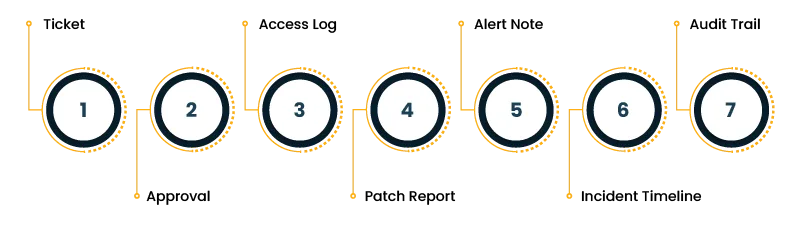
This is where managed IT compliance moves beyond support with extra paperwork, especially when enterprises understand how managed IT services work in enterprise environments. It helps regulated leaders see which controls are working, which ones are failing, and where risk is being accepted. It turns compliance activity into daily operating discipline.
Why Compliance Heavy IT Needs Daily Control
Access reviews become spreadsheet exercises. Patch reports show percentages without critical asset context. Monitoring tools produce alerts, yet the follow up record is thin. Documentation describes the intended process, while technicians follow what actually works.
Strong IT compliance operations remove that gap by making the next action clear. A mature operating model also shows control status before audit pressure begins. They make evidence a byproduct of work. A request should show approval. A change should show testing and rollback. A patch exception should show risk, owner, and expiry date. An incident should show timeline, impact, containment, recovery, and action items.
For regulated industry IT services, this is the minimum useful standard. Strong regulated industry IT services also keep evidence close to the activity that created it. This model must go further. A compliance-aware operating model proves that closed tickets followed the right control path. Regulated industry IT services must make that proof easy to find. The same operating model should also show who reviewed the issue, what risk remained, and who accepted it.
The Daily Control Model for Compliance Heavy IT
Controls become easier to manage when they are translated into daily operating behavior. This is where managed IT compliance needs structure, not slogans. It should be visible in the work queue, with owners, dates, decisions, and proof attached to the work itself.
| Control area | Daily operating behavior | Evidence created |
| Access | Request, approval, provisioning, review, removal | Ticket trail, approver, access log |
| Patching | Asset scope, risk rating, deployment, exception handling | Patch report, failure list, exception approval |
| Monitoring | Alert triage, escalation, closure, tuning | Alert notes, owner, response record |
| Documentation | Runbook updates after real work | Version history, owner, review date |
| Incidents | Timeline, containment, recovery, action items | Incident record, root cause, closure proof |
| Vendors | Review of service quality, access, and exceptions | SLA notes, issue register, risk record |
The value of this model is practical. It helps teams prove that controls were followed without rebuilding the story from scattered tickets, emails, and screenshots.
Access Reviews Without the Spreadsheet Theater
Effective access control monitoring should answer practical questions. Strong access control monitoring also needs review evidence. Who approved access? Was the account used? Does the role still match the user’s job? Are privileged rights justified? Was temporary access removed? Are service accounts owned and reviewed?
Temporary access becomes permanent. Shared admin accounts survive because teams fear breaking old jobs. Dormant users remain active because offboarding signals do not reach every system. Contractors keep remote access after the engagement ends.
They should flag unusual rights, inactive accounts, risky combinations, and access with no recent business reasons.
Patching Is More Than a Monthly Percentage
Too often, patch compliance is reported as a single number. Ninety five percent patched sounds good until the missing five percent includes the internet facing system, the old VPN appliance, or the production database that supports a regulated workflow.
Failed deployments need follow up. Unsupported platforms need compensating controls. Deferred patches need named approval.
A useful patch record should show:
- Asset and owner
- Vulnerability or update reference
- Deployment status
- Failed systems
- Business reason for deferral
- Control used during deferral
- Target closure date
The provider should separate cosmetic reporting from real risk. Patch compliance should include servers, endpoints, firmware, network devices, remote access tools, security platforms, and backup infrastructure. A vulnerable firewall does not become less relevant because it is missing from the server patch dashboard.
Monitoring, Incident Records, and Audit Trails
An alert without triage notes is weak evidence. Audit ready IT operations depend on readable records. A high-risk login alert should show investigation and outcome. A malware event should show containment steps. A failed backup should show owner, fix, and proof of the next successful run. A privileged access anomaly should show who reviewed it and what changed.
| Weak record | Better record |
| “Issue fixed.” | “Backup failed on finance file server at 02:14. Storage threshold cleared at 08:31. Manual backup completed at 09:05. Next scheduled job passed.” |
| “Access updated.” | “Temporary database admin access approved for restore work. Removed after validation. Logs attached.” |
| “Patch delayed.” | “MES server patch deferred due to vendor compatibility. Network restriction applied. Vendor test scheduled. Expiry date assigned.” |
It needs enough detail for an auditor, risk owner, or new engineer to understand what happened.
Documentation That Matches Real Work
A network diagram that misses recent changes creates false confidence. A recovery procedure that depends on one engineer is a business risk.
Managed IT services for regulated industries should include documentation upkeep in routine delivery. After a material change, the runbook changes. After an incident, the known error record changes. After an access review, ownership data changes. After a restore test, recovery notes change.
IT controls for healthcare finance manufacturing require different language, yet the pattern is similar. Healthcare teams need proof around protected data, access, downtime, and backup recovery. Finance teams need stronger change records, segregation of duties, transaction system controls, and vendor oversight. Manufacturing teams need plant network segmentation, remote vendor access records, maintenance windows, and production impact notes.
How Managed IT Connects Compliance to Risk Reduction
Regulated organizations need cleaner control execution, with fewer undocumented exceptions and fewer decisions trapped inside individual teams. Managed IT compliance reduces risk when it standardizes repeatable work, exposes exceptions, and gives leadership a decision view.
Access, patching, backup, monitoring, incident response, and documentation need named owners. Legacy systems exist. Vendor limits exist. Downtime windows are real. The issue is an exception with no owner, no compensating control, and no end date.
Leaders do not need raw ticket exports. They need to know which controls are healthy, which exceptions are aging, and where money or authority is needed.
| Weak metric | Better question |
| Patch percentage | Which critical assets remain exposed, and who owns closure? |
| Ticket volume | Which control failures repeat? |
| Alert count | Which alerts led to real incidents or tuning changes? |
| Access review completion | Which risky rights stayed approved and why? |
| Backup success rate | Which restores were tested and proved usable? |
This is the point of audit ready IT operations. It gives leaders a useful view before an auditor, customer, insurer, or regulator asks harder questions.
What to Expect From a Compliance Aware IT Partner
A provider offering managed IT services for regulated industries should be able to show how service delivery maps to controls, which is critical when choosing a managed IT services provider. A claim like “we follow best practices” does not prove much.
Ask for operating proof:
- Ticket based evidence for access, changes, and exceptions
- Privileged access review and removal records
- Patch reports with failed assets and owners
- Backup success plus restore validation
- Incident timelines with decisions and action items
- Audit trail retention for sensitive systems
- Vendor access logging
- Exception registers with expiry dates
- Service reviews tied to control health
This is where regulated industry IT services should feel different from basic outsourcing. Regulated industry IT services must defend the control trail, instead of only the ticket queue. The provider should know how to support compliance controls in IT operations without turning every request into a committee meeting. Compliance controls in IT operations should reduce uncertainty, not create extra noise.
A simple test works well. Pick one sensitive system and trace the last 90 days. Who gained access? Who approved it? Which changes happened? Were patches applied? Were alerts reviewed? Were backups tested? Were exceptions closed? If the evidence is scattered, the control design needs work.
Building Audit Readiness Into Normal Operations
Compliance heavy industries do not need a heroic audit season. They need normal operations that leave a clean trail.
Access is reviewed while people join, move, and leave. Patching is tracked with risk context. Monitoring creates response evidence. Documentation changes when systems change. Incidents leave a timeline that another person can read. Exceptions have owners and end dates.
IT controls for healthcare, finance, and manufacturing will vary by regulation, customer pressure, and operating risk. The foundation remains consistent: know the assets, control the access, patch known weaknesses, monitor activity, document decisions, test recovery, and retain proof.
If your IT provider cannot prove yesterday’s control activity without asking your internal team to rebuild the story, the service model is incomplete — a key factor in managed IT vs in-house IT decisions. Strong IT compliance operations make the organization easier to review, harder to surprise, and better prepared for the next audit request, incident review, or customer assurance call.
Author


Yogita Jain
Content Lead
Yogita Jain leads with storytelling and Insightful content that connects with the audiences. She’s the voice behind the brand’s digital presence, translating complex tech like cloud modernization and enterprise AI into narratives that spark interest and drive action. With a diverse of experience across IT and digital transformation, Yogita blends strategic thinking with editorial craft, shaping content that’s sharp, relevant, and grounded in real business outcomes. At Cygnet, she’s not just building content pipelines; she’s building conversations that matter to clients, partners, and decision-makers alike.