


































Hiring a senior cloud architect now takes three to six months on average, and keeping one costs more than most IT budgets planned for five years ago.
The work those specialists do still has to happen every day, which is why the question of whether to build IT capability internally or outsource it to a managed services provider has stopped being an occasional strategic review and has become a live operating decision.
Neither model is categorically better. The right answer depends on the workload, the skill mix already available internally, the pace of change the business expects from IT, and how much control the enterprise needs to retain over decisions that matter most.
What changes the answer more than anything else is whether the comparison stays at headline cost or goes deep enough to surface the trade-offs that actually shape uptime, modernization speed, and TCO over a three-year horizon.
Managed IT vs In-House IT: What’s the Difference?
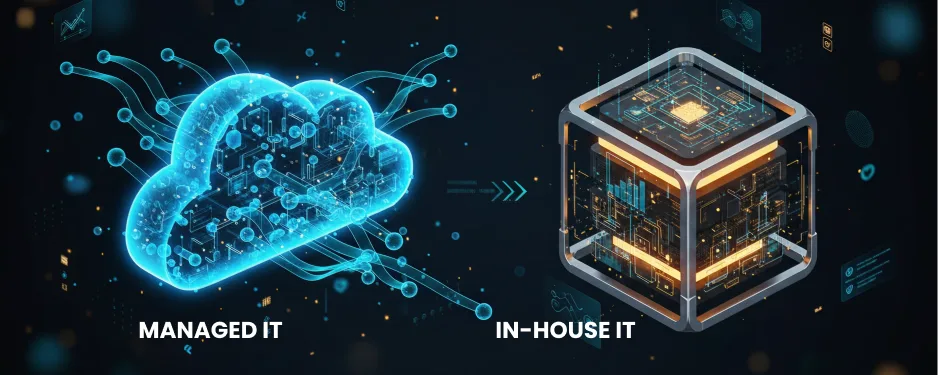
Managed IT means handing over some or all of your IT operations to an external specialist provider that delivers services against defined outcomes and SLAs. The provider owns the staffing, the tooling, the monitoring, and the day-to-day delivery, while the enterprise retains oversight, strategic direction, and accountability for business outcomes.
The engagement model is typically subscription-based, with service levels tied to availability, performance, and response time.
In-house IT sits at the opposite end of the spectrum. Internal employees run everything from infrastructure operations and application support to security, networking, and user services. The enterprise owns hiring, tooling, processes, and outcomes entirely.
Costs show up as fully loaded salaries, recruiting, training, retention, and infrastructure spend, with tighter alignment to internal priorities but heavier overhead to carry.
At a high level, the two models differ across four structural dimensions, summarized below.
| Dimension | Managed IT | In-house IT |
| Structure | Outsourced, service-based delivery by a specialist provider | Internal team under direct enterprise leadership |
| Cost Model | Subscription or service-based, predictable, and scalable | Fixed salary, benefits, training, and infrastructure overhead |
| Ownership | Shared through defined SLAs and governance | Full internal ownership of people, tools, and outcomes |
| Scalability | Elastic capacity that scales with demand | Constrained by hiring cycles and internal bandwidth |
Managed IT vs In-House IT: Key Differences Across Critical Factors
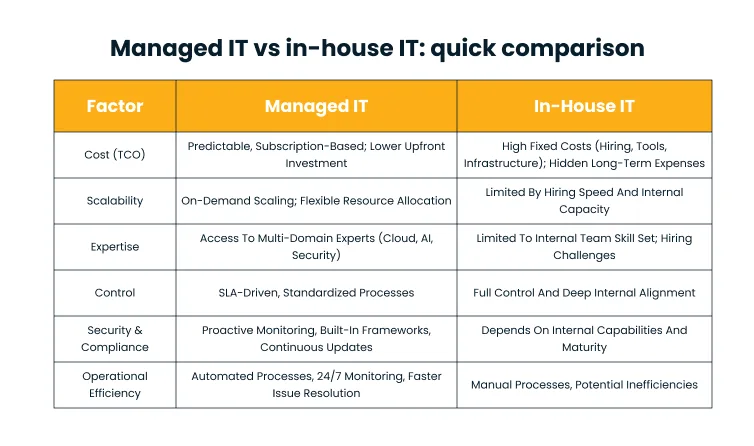
Each one of the key differences below has a clear answer for managed IT, a clear answer for in-house IT, and a practical takeaway for how to read the difference in your context.
1. Cost and Total Cost of Ownership (TCO)
Managed IT pricing typically arrives as a predictable monthly or annual fee that bundles staffing, tooling, monitoring, and support, which makes planning and budgeting straightforward.
Providers write off their infrastructure, licenses, and specialist talent across many clients, so the blended rate enterprises pay is often lower than the fully loaded cost of building the same capability internally.
In-house IT looks cheaper at first if you only count salaries, but the true total cost of ownership includes recruiting and onboarding, training and certification, retention, tool licenses, monitoring platforms, on-call coverage, backfill for vacancies, and the opportunity cost of senior engineers spending time on run-the-business work.
Those layers add up to 30% to 50% on top of base compensation in many organizations. Over a three- to five-year window, the TCO gap between a subscription-based managed model and a fully owned internal function is usually wider than the operating budget suggests.
Managed IT delivers stronger cost predictability and often lower TCO once all hidden costs are counted, while in-house IT only wins on cost in environments where workloads are stable enough to justify a fixed team and the specialist skills needed are available at a reasonable blended rate.
2. Scalability and Flexibility
Modern enterprises rarely operate at a flat baseline. Demand surges during product launches, seasonal peaks, migrations, and AI or analytics initiatives, and it subsides after them.
Managed IT absorbs that variability well because providers already carry the bench depth, tooling, and 24/7 coverage to flex capacity up or down without a hiring cycle in between.
Project-based scaling for modernization programs, time-bound migrations, or AI rollouts is especially clean under a managed model because the capacity shows up when it is needed and retracts when it is not.
In-house IT scales in longer cycles. Hiring, onboarding, and ramping a specialist engineer typically takes three to six months, which means internal teams either carry slack capacity for peak demand (expensive) or lag behind demand when it arrives (risky).
Cloud-driven flexibility in the infrastructure layer helps, and most enterprises now use it, though it does not solve the human capacity problem on its own.
3. Expertise and Skill Availability
The skills required to run a modern IT environment have broadened faster than most internal hiring pipelines can keep up with. Cloud, security, data engineering, AI, DevOps, and compliance specializations now sit on nearly every roadmap, and the practitioners who have deep expertise in more than one of those domains are scarce.
Managed IT providers solve this by concentrating specialist capability at scale. A single provider brings exposure to dozens of environments across cloud, security, observability, networking, and application platforms, which compounds into deeper expertise than most individual enterprises can build or retain internally.
Access to multi-domain skills is a central part of what enterprises are buying when they move to a managed model.
Internal teams carry the advantage of deep institutional knowledge, strong context on business priorities, and direct alignment with product and functional stakeholders.
Where they struggle is on emerging technology, especially in cloud-native architecture, AI and ML, modern security practices, and the specific tooling ecosystems that change quickly year over year.
According to Gartner’s 2026 CFO survey on AI and digital talent, acquiring and developing AI and digital talent is the top near-term challenge cited by CFOs. The skill gap is visible in salary inflation, longer time-to-hire, and higher attrition once specialists are onboarded.
4. Control and Customization
Control is the dimension where in-house IT has the clearest structural advantage. Internal teams can prioritize on the fly, take deep business-specific approaches to problems, integrate tightly with internal workflows, and respond to change without negotiating against a contract.
For environments with unusual customization needs or strong integration with proprietary systems, direct control of this kind is genuinely valuable.
Managed IT trades some of that flexibility for structure. SLAs define what will be delivered, governance processes manage change, and provider playbooks often standardize delivery across clients.
The structure is a strength for operational consistency and risk management, though it can feel slower for highly bespoke requirements. Mature managed engagements account for this by building a dedicated governance layer on top of standard service catalogs, which lets enterprises retain strategic direction while benefiting from the provider’s operational scale.
5. Security and Compliance
Security is no longer an area where most enterprises can rely on a lean internal team. The threat surface has expanded across cloud, endpoints, identities, third-party APIs, and SaaS sprawl, and the pace of regulatory change has accelerated in parallel.
Managed IT providers typically bring 24/7 security operations coverage, dedicated threat intelligence, and pre-built compliance frameworks that align to standards such as ISO 27001, SOC 2, GDPR, and industry-specific regulations.
Continuous monitoring, automated response for known patterns, and specialist expertise across identity, cloud, and endpoint security add up to a security posture that is difficult to replicate internally without significant investment.
In-house security teams are often stretched thin. The practitioners who can run modern security operations are among the most expensive and hardest to retain in the entire IT workforce, and internal teams frequently struggle to maintain 24/7 coverage through shift rotations.
According to the 2025 IBM Cost of a Data Breach Report, the global average cost of a data breach reached USD 4.44 million in 2025, with organizations facing security skills shortages paying USD 5.74 million on average compared to USD 3.98 million for those with stronger security teams. The cost of under-resourced security shows up directly in breach outcomes.
6. Operational Efficiency and Performance
Operational efficiency is where the compounding effects of the earlier dimensions show up. Managed IT providers operate at scale across many environments, which gives them the incentive and the volume to invest in automation, observability, and continuous improvement that most internal teams cannot justify on their own.
Automated monitoring, standardized runbooks, AI-assisted triage, and faster mean-time-to-resolution are the operational outputs of that investment.
Internal IT teams can deliver strong operational performance too, particularly in stable environments with well-understood workloads, though they tend to carry more manual process overhead and firefighting time.
Capacity is finite, and when incidents or urgent projects consume the team, routine optimization and automation work get pushed out.
Managed IT vs In-House IT: Pros and Cons
The pros and cons below summarize the trade-offs in a form that is easier to act on when scoping or reviewing an IT operating model.
Managed IT Services
Managed IT brings predictability, scale, and access to specialist capability that is hard to build internally.
Pros:
- Costs are predictable and scale with consumption rather than headcount
- Capacity can flex up or down without hiring cycles
- Enterprises get access to multi-domain expertise across cloud, security, infrastructure, and applications.
The model also removes a meaningful amount of the operational burden from internal teams, which lets leadership spend more time on strategic initiatives rather than day-to-day delivery.
Cons:
Managed engagements come with less direct control over individual decisions than an in-house team offers
- Dependency on the provider grows as the scope expands
- Onboarding requires upfront investment to transfer knowledge, align on SLAs, and establish governance.
These trade-offs are manageable with a well-structured engagement, though they should factor into the decision rather than be assumed away.
In-House IT Teams
In-house IT teams deliver full control, strong internal alignment, and immediate availability for the work that matters most to the business.
Pros:
- The team understands the products, the customers, and the priorities at a level that external providers take time to match, and decisions can be made quickly without navigating a contract.
Cons:
- Staffing a complete internal function at enterprise scale is expensive once recruiting, training, retention, tools, and infrastructure are all counted.
- Scalability is constrained by hiring cycles, which makes it hard to respond quickly to new initiatives.
- Skill gaps show up in emerging areas such as cloud-native architecture, AI, and security, where specialist demand outstrips supply, and internal innovation cycles often move more slowly than managed providers operating at scale across many environments.
When Should Enterprises Choose Managed IT vs In-House IT?
Most mature enterprises end up with a hybrid model, where some capability is held internally, and the rest is delivered through managed services. The decision factors below help isolate which side of the split a given workload or capability belongs on.
When managed IT is the stronger choice:
- Rapid scaling requirements: When the enterprise needs to scale capacity up for a modernization, migration, or AI initiative and then retract after, a managed provider flexes faster than any internal hiring cycle allows.
- Lack of internal expertise: When the workload requires specialist skills that are scarce, expensive, or difficult to retain internally, including cloud architecture, security operations, and AI engineering, a managed partner brings depth without the hiring burden.
- Cost optimization goals: When the executive mandate is to reduce and predict IT spend, the subscription model and scale economics of managed IT typically deliver a lower TCO than fully internal ownership.
- Modernization initiatives: When the organization is consolidating legacy systems, migrating to the cloud, or building a data and AI platform, a managed partner brings frameworks and delivery experience that compress the timeline.
When in-house IT is the stronger choice:
- Highly sensitive environments: When data residency, regulatory constraints, or proprietary IP tightly restrict external access, internal delivery is often the safer path.
- Need for full control: When the business strategy depends on deeply customized systems that change frequently and require tight business alignment, internal teams deliver that flexibility better than SLA-driven providers.
- Stable, predictable workloads: When the operating profile is steady, the required skill mix is available internally, and the work does not need to scale dynamically, an internal team is often the most efficient answer.
A practical decision framework is to categorize workloads along two axes. The first axis is strategic importance to the business, where differentiating work sits at one end, and commoditized work sits at the other.
The second axis is variability of demand, where steady workloads sit at one end, and bursty workloads sit at the other. Differentiating work with steady demand usually belongs internally. Commoditized work with bursty demand belongs in managed services. The in-between cases are where hybrid engagements earn their value.
Why Enterprises Are Shifting Toward Managed IT Services
The broader trend across enterprise IT is a clear move from ownership toward outcomes. Several forces are driving it, and they compound on each other rather than offset.
- IT complexity has expanded beyond what most internal teams can cover comprehensively. Cloud, data, AI, security, compliance, and application modernization each require dedicated specialization, and running all of them in-house is increasingly impractical at scale.
- The talent shortage in specialist roles has moved from a cyclical issue to a structural one. Hiring competition, salary inflation, and retention costs make it harder for enterprises to build and hold the depth they need internally.
- Cloud and AI adoption have reframed what IT is expected to deliver. The conversation has shifted from uptime and ticketing toward enabling business outcomes through scalable platforms and AI-ready infrastructure.
According to Gartner’s 2024 forecast on worldwide public cloud end-user spending, public cloud spending was projected to reach USD 723 billion in 2025, up 21.5% year over year.
Also, according to Gartner’s 2026 forecast on worldwide IT spending, global IT spending is projected to reach USD 6.15 trillion in 2026, up 10.8% from 2025. A growing share of that investment is flowing through managed and outcome-based engagements rather than fully internal delivery.
Cygnet.One sits in this shift as a managed IT and transformation partner covering the full operational footprint an enterprise needs to run a modern IT environment.
- Our Managed IT Services practice provides end-to-end operations coverage across infrastructure, applications, networks, and user services.
- Our IT Strategy and Consulting practice helps enterprises design target operating models and roadmaps before the delivery work starts.
- Our Application Managed Services practice keeps critical business applications performing at uptime targets, and our Infrastructure Management practice optimizes the underlying compute, storage, and network layers every workload depends on.
On the security and governance side, our Cybersecurity practice delivers continuous monitoring, threat detection, and incident response, and our Governance, Risk Management, and Compliance practice embeds compliance frameworks into the operating model so audit readiness becomes a byproduct of normal operation rather than a project.
For enterprises standardizing on the cloud, our AWS partnership supports migration, modernization, and ongoing workload optimization at scale.
The differentiation is that Cygnet.One operates across cloud, data, AI, and infrastructure as an integrated portfolio rather than as disconnected service lines, which matters when the modernization agenda crosses more than one domain.
As a concrete example, our AWS Workload Optimization for Sustainable Growth engagement delivered 72% AWS cost savings for the client through FinOps governance, continuous monitoring, and workload modernization.
The program combined right-sizing, reserved capacity planning, architectural refactoring, and ongoing cost observability into a single managed engagement rather than fragmenting the work across tools or teams.
Key Takeaways for Choosing the Right IT Model
Most of the complexity in the managed IT versus in-house IT decision comes from treating it as a single binary choice when it is actually a set of decisions across workloads, capabilities, and time horizons. The principles that hold up consistently across the engagements we see are:
- Managed IT leads on scalability, specialist expertise, and cost predictability in environments where demand varies or skill requirements span multiple domains.
- In-house IT leads on control, customization, and direct business alignment for workloads that are strategic, stable, and tightly integrated with internal processes.
- Hybrid models are the norm at enterprise scale, with internal teams holding strategic and customized capability and managed partners delivering operations, specialist coverage, and surge capacity.
- The decision should be driven by business goals and workload characteristics, not by a default preference for internal or external delivery.
- Total cost of ownership beats headline cost as a decision criterion. Factor in hiring, retention, tooling, training, and opportunity cost before comparing against a managed price tag.
- Governance and SLAs determine whether managed engagements succeed, so invest in the operating model at the start of the engagement rather than after the first SLA miss.
The next step for enterprises working through this decision is to map their IT operating model against the dimensions above, identify where in-house capability is delivering the most strategic value, and where managed services can compress cost, accelerate modernization, or fill specialist gaps that are hard to staff internally.
If your team is working through this decision and would benefit from a structured view of the trade-offs against your specific environment, book a demo to discuss how Cygnet.One can support your managed IT and transformation roadmap.
FAQs
Managed IT is an outsourced service model where a specialist provider delivers IT operations against defined SLAs, typically charged on a subscription or service basis. In-house IT is a fully internal model where the enterprise hires, trains, and retains its own IT staff, owns all tooling and infrastructure, and runs operations directly.
Managed IT is often cheaper than in-house IT on a total cost of ownership basis, though the headline rate is not always lower than internal salaries alone. The cost advantage comes from bundling staffing, tooling, monitoring, and infrastructure into a single subscription fee, amortizing specialist capability across many clients, and avoiding recruiting, retention, and training costs that add 30% to 50% on top of internal base compensation. In-house IT can be cheaper for stable workloads where the required skill mix is already available internally at a reasonable rate.
The primary benefits of IT outsourcing for enterprises are predictable cost, elastic scalability, access to multi-domain specialist expertise, stronger 24/7 operational coverage, faster modernization cycles, and a reduction in operational burden on internal leadership.
A company should consider switching to managed IT services:
1. When demand for IT capacity is outpacing internal hiring
2. When specialist skills such as cloud, security, AI, and data engineering are expensive or slow to recruit
3. When a modernization or migration initiative needs concentrated expertise for a defined period, or
4. When the executive mandate is to reduce and predict IT operating costs.
Most mature enterprises use both managed IT and in-house IT in a hybrid model. Internal teams typically hold strategic, differentiated, and tightly business-aligned capabilities, while managed partners cover operations, specialist domains, and surge capacity for time-bound initiatives. The hybrid model works best when governance, SLAs, and the hand-off between internal and provider responsibilities are clearly defined from the start.
Managed IT providers ensure security and compliance through continuous monitoring, dedicated 24/7 security operations coverage, automated threat detection and response, and compliance frameworks aligned to standards such as ISO 27001, SOC 2, GDPR, and industry-specific regulations.
Author


Abhishek Nandan
AVP, Marketing
Abhishek Nandan is the AVP of Services Marketing at Cygnet.One, where he drives global marketing strategy and execution. With nearly a decade of experience across growth hacking, digital, and performance marketing, he has built high-impact teams, delivered measurable pipeline growth, and strengthened partner ecosystems. Abhishek is known for his data-driven approach, deep expertise in marketing automation, and passion for mentoring the next generation of marketers.