



































IT teams rarely break under one big demand. They get stretched by the steady addition of applications, endpoints, cloud environments, alerts, audits, and small business requests that never come with extra capacity.
More apps, endpoints, cloud accounts, alerts, and audit pressure. The work grows, but the headcount plan stays flat. That tension is where scaling IT operations becomes a board-level issue, not a service desk issue.
The usual answer is “hire more people.” It rarely survives budget review. Gartner’s 2025 IT spending forecast showed continued growth in enterprise technology budgets, and Flexera’s 2025 cloud research found cloud cost management near the top of enterprise challenges. Spending is rising, yet capacity still feels thin.
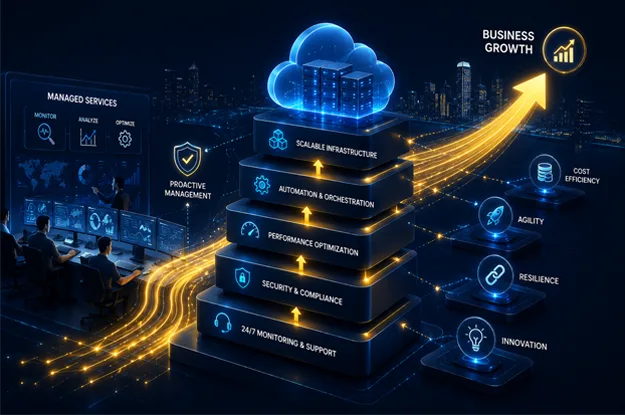
This is why managed IT services need a serious conversation around scalability, accountability, and operational control: an operating model for more controlled throughput from the same internal team.
The practical question is specific: how to scale IT without hiring more staff while reducing risk, backlog, and operational drag. The answer sits in automation, service design, and accountability.
Why IT Work Keeps Outgrowing the Team
The backlog rarely comes from one dramatic failure. It builds layer by layer as digital transformation expands applications, endpoints, cloud accounts, and audit demands.
Cloud migration adds monitoring work. A security program adds patch evidence, asset checks, and policy reviews. A product team adds environments, access requests, and release support. A compliance deadline adds reporting cycles. Each request looks reasonable. Together, they flatten the team.
This is where scaling IT operations breaks down. Leaders stretch engineers across incident response, maintenance, vendor tickets, architecture reviews, and escalations. Senior talent becomes the default route for everything. Soon, the best people are fixing routine noise instead of designing better systems.
As that pattern repeats, improvement work gets pushed aside and the environment becomes harder to support.
The goal is IT operations efficiency: fewer manual touches, fewer avoidable incidents, tighter ownership, and clearer service boundaries.
The Capacity Leak Most Leaders Miss
Before bringing in a provider, measure where time actually goes. Most teams guess. The data usually says something else.
| Capacity leak | What it looks like | What to measure |
| Repeat incidents | Same alerts, same fixes, same owners | Top recurring tickets by month |
| Manual provisioning | Access, VM, backup, and patch tasks done by hand | Request cycle time |
| Tool sprawl | Multiple dashboards with no clear source of truth | Alert duplication rate |
| Cloud waste | Idle resources and poor tagging | Monthly waste trend |
| Escalation overload | Senior engineers pulled into low-value work | Escalations by category |
The first proof of managed IT scalability is whether a provider can expose this waste, remove it, and report improvement without hiding behind ticket volume. That is the difference between support volume and IT operations efficiency.
Automation Comes Before Outsourcing
A weak outsourcing model moves manual work from one payroll to another. That may reduce visible strain, but it does not create capacity.
A strong IT automation and outsourcing strategy starts with standardization. The provider documents repeat work, converts it into runbooks, then automates the safe parts. Human review stays where judgment matters: change approval, incident command, architecture impact, security exceptions, and business decisions.
This is where scaling IT operations becomes practical. You do not need every task automated. You need the right tasks automated first.
Good early candidates include:
- Patch deployment checks and exception reporting
- Backup validation and failure routing
- User access request workflows
- Cloud cost anomaly alerts
- Endpoint compliance checks
- Standard incident triage scripts
Automation should reduce ticket creation, not just ticket handling. If the same ticket arrives weekly, faster closure is not enough. The provider must remove the trigger or change the workflow. That is where IT operations efficiency becomes measurable.
What Managed Services Should Own
Managed services work best with clear boundaries. Internal teams should keep business context, architecture ownership, vendor strategy, and product alignment. The provider should own operational consistency, repeatable execution, monitoring discipline, and reporting hygiene.
This split protects internal engineers from routine load without cutting them off from strategy.
| Internal IT keeps | Managed services own |
| Architecture direction | Monitoring and alert response |
| Business prioritization | Patch and backup operations |
| Security policy decisions | Evidence collection and reporting |
| Product team alignment | Standard request fulfillment |
| Vendor selection | Tool administration and runbooks |
For scaling IT infrastructure teams, this model works because it does not pretend external support can replace internal context. It gives internal context more room to matter.
That is the core of managed IT scalability: add operating capacity without diluting ownership.
Cost vs Efficiency: The ROI Test
A cheap contract becomes expensive if it adds coordination work. The right question is not “What is the monthly fee?” The better question is “Which internal hours will come back, and what will those hours be used for?”
This is where managed IT services ROI enterprise discussions should become concrete.
Look beyond invoice comparison. Build the case around:
- Reduced mean time to acknowledge and resolve incidents
- Fewer after-hours escalations for internal teams
- Lower cloud waste through active hygiene
- Faster audit evidence collection
- Higher patch compliance
- Shorter request fulfillment cycles
- More engineering time spent on revenue, resilience, or customer experience
A practical ROI model should include avoided hiring, reduced overtime, lower incident cost, and project acceleration. It should include management overhead. If your team spends ten hours a week chasing the provider for updates, the model is broken.
Strong IT operations efficiency shows up as reclaimed attention. Leaders feel it when architects stop clearing queues and start improving systems.
For leaders asking how to scale IT without hiring more staff, the answer is rarely one action. It is a disciplined IT automation and outsourcing strategy supported by clear ownership, measurable outcomes, and provider accountability. This is where managed IT scalability becomes more than a service promise. It becomes a practical route to better IT operations efficiency and a clearer managed IT services ROI enterprise case.
Case Scenarios: Where the Model Works
Scenario 1: Mid-sized SaaS firm with alert fatigue
A SaaS company has cloud alerts firing all night. Internal engineers rotate through support, then lose the next morning to recovery. A managed services partner takes first-line monitoring, tunes alert thresholds, documents incident paths, and automates low-risk remediation.
Result: engineers still own architecture and root-cause reviews, but they are no longer the first stop for every noisy alert. That is scaling IT operations without turning engineers into shift workers.
Scenario 2: Enterprise with audit-heavy infrastructure
A regulated business needs patch evidence, backup proof, endpoint reports, and access logs. The internal team can do the work, but it steals time from modernization.
A managed provider standardizes evidence collection and schedules compliance reporting. Internal security keeps policy ownership. The provider handles routine proof.
This is managed IT scalability with governance intact, and it improves IT operations efficiency without forcing the team into permanent audit mode.
Scenario 3: Company growing through acquisition
Acquisitions often leave IT with mixed tools, duplicate systems, unknown assets, and different support practices. Hiring before the environment is understood can make the mess bigger.
A provider maps assets, normalizes monitoring, creates baseline runbooks, and handles the first wave of support integration. Internal IT decides which platforms remain.
For scaling IT infrastructure teams, this creates breathing room before permanent organization design decisions.
Conclusion: More People Is Not the Only Answer
Hiring alone will not fix an operating model that leaks time.
Scaling IT operations needs cleaner workflows, sharper automation, better service boundaries, and stronger reporting. Managed services can help, but only when they are measured by outcomes, not activity.
The companies that get managed IT scalability right do not hand off responsibility. They treat scaling IT operations as an operating design problem, not a staffing reflex. They design a model where internal teams keep the decisions that require context, while a managed partner handles the repeatable work with consistency.
That is the practical path to IT operations efficiency through managed IT scalability: less firefighting, more control, and a team that can support growth without becoming the bottleneck.
Author


Yogita Jain
Content Lead
Yogita Jain leads with storytelling and Insightful content that connects with the audiences. She’s the voice behind the brand’s digital presence, translating complex tech like cloud modernization and enterprise AI into narratives that spark interest and drive action. With a diverse of experience across IT and digital transformation, Yogita blends strategic thinking with editorial craft, shaping content that’s sharp, relevant, and grounded in real business outcomes. At Cygnet, she’s not just building content pipelines; she’s building conversations that matter to clients, partners, and decision-makers alike.